
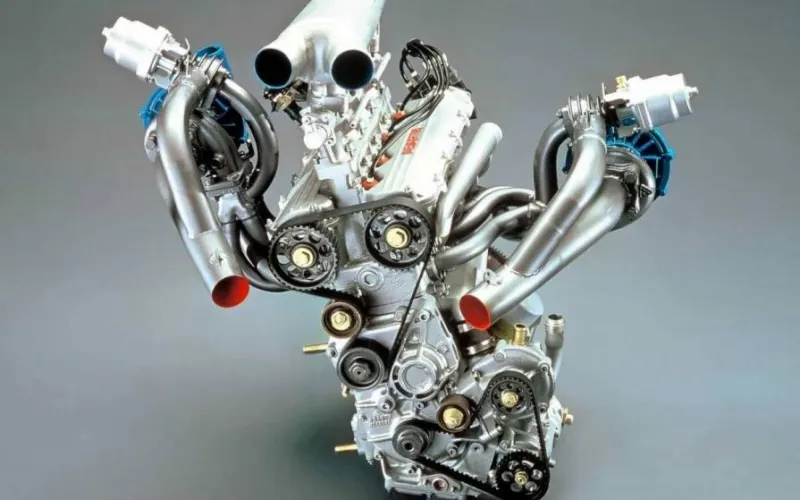
Triflux: the Lancia engine with the strangest cylinder head ever bolted to a block
Quick test. If I asked you to name the first car ever to use a properly sequential twin-turbocharger system — the kind where a small turbo spools up at low revs and a bigger one kicks in higher up — what would you say?
The petrolhead default answer is the 1991 Mazda RX-7 FD, with its 13B-REW rotary running twin sequential turbos. The Toyota tuners will say the 1993 Supra Mk IV, with the legendary 2JZ-GTE. The German loyalists will mention the BMW 335i with the N54 from 2006. And a handful of properly informed ones will dig up the 1986 Porsche 959, which used an early version of the idea on its flat-six.
All of those answers are good. They’re not the right one.
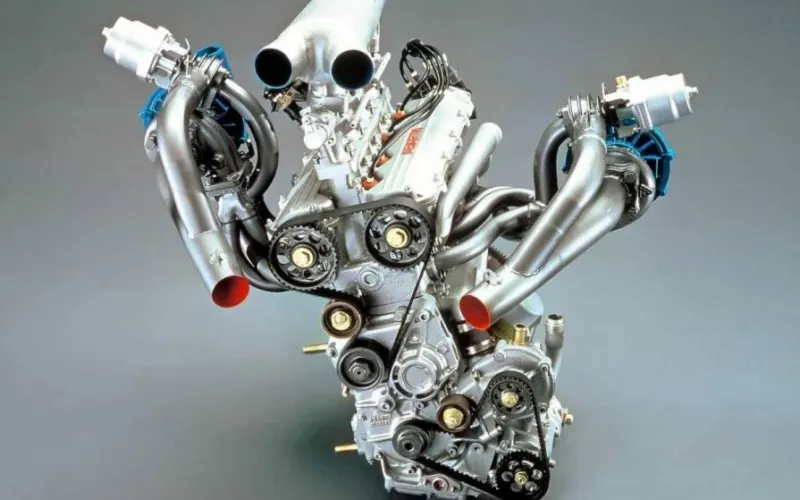
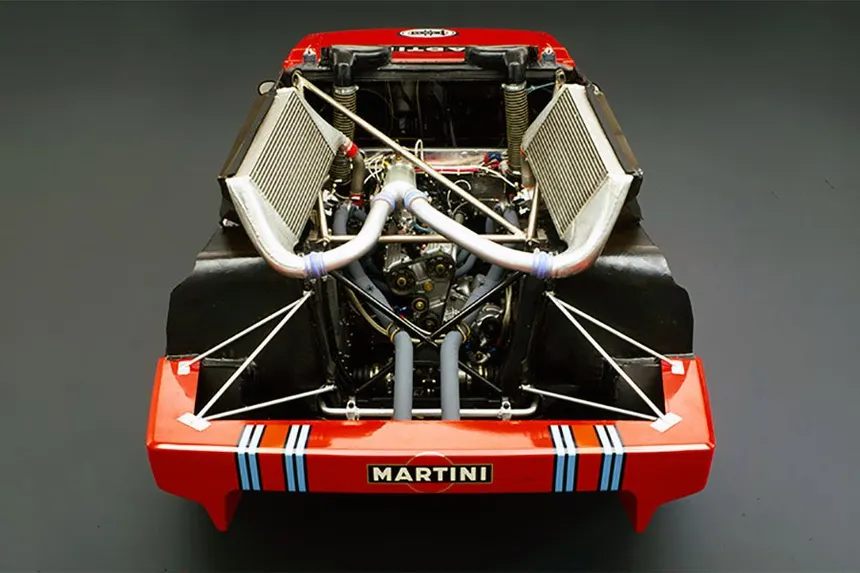
In 1986, inside an Abarth workshop in Turin, a man called Claudio Lombardi was running a 1,759cc inline-four on the dyno. It had two sequential turbochargers. And a cylinder head with the valves arranged in a pattern nobody had used before and nobody has used since. The engine was called Triflux. It was destined for the Lancia ECV, the rally car that never raced. And while the car ended up in a corner of a Turin warehouse when FISA killed off Group S, the engine — the engine itself — remains one of the most radical pieces of internal combustion architecture ever drawn on paper.
This is the story of the Triflux. The story of the engine with the strangest cylinder head in motorsport history. And the story of the engineer who built something so far ahead of its time that the rest of the industry was still catching up two decades later.
The problem Lombardi was trying to fix
To understand why Lombardi designed the Triflux, you have to understand what he was already living with.
What he was living with was the engine inside the Lancia Delta S4. A 1,759cc inline-four — Abarth’s Tipo 233 block — with one of the strangest forced-induction setups ever bolted to a road car. It carried a Roots-type supercharger AND a turbocharger. Two completely different boost systems on the same engine. The supercharger pushed air at low revs and progressively disengaged. The turbocharger took over higher up the rev range. On paper, it looked like full-spectrum boost coverage. In practice, it was complicated, heavy, and dragged chronic transition issues from one system to the other.
Here’s the bit almost nobody tells you. Lombardi never wanted that engine in the S4. He’d had something else in mind from the start.
Stellantis Heritage’s own documentation makes it clear: from the original design phase in 1982, Lombardi had been pushing for a twin-turbo arrangement. Not supercharger plus turbo. Two turbos. But conservative product decisions forced him to equip the S4 with the same volumetric supercharger already proven on the Lancia Rally 037, with a turbocharger added on top to plug the power gap against the competition. The S4 that won Argentina in 1986 was running the safe version of the engine Lombardi had wanted to build for years.
When the ECV programme finally arrived in 1985, Lombardi could at last build the engine he’d had drawn up since 1982. He called it Triflux.
The idea: crossing the valves
The first thing you have to grasp, and the bit that separates the Triflux from every other twin-turbo engine in history, is the cylinder head.
A normal four-valve-per-cylinder head, of the kind that’s been industry standard since Cosworth’s DFV, has two intake valves on one side of the combustion chamber and two exhaust valves on the other. Twelve o’clock and six o’clock, if you’re looking down at the cylinder from above. That’s how cylinder heads are built. It’s the first thing any apprentice mechanic learns when he picks one up off a workbench.
Lombardi looked at that and said no.
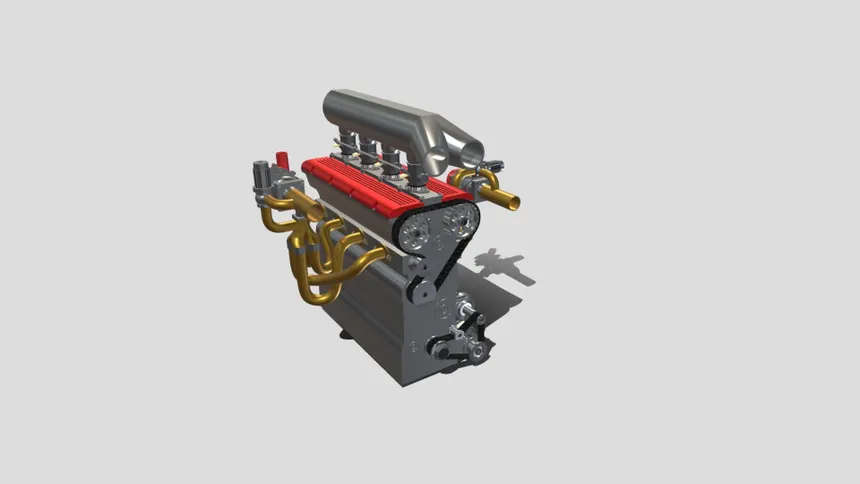
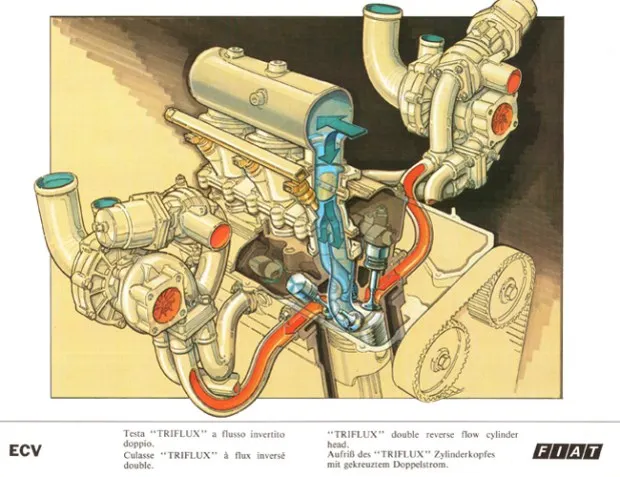
The Triflux head arranged the four valves of each cylinder in an X pattern. On each side of the cylinder, you had one intake valve and one exhaust valve, alternated. There was no “hot side” and “cold side” to the head anymore. Every side of every cylinder was half intake, half exhaust, mixed in.
Why on earth would you do something that mad? For one very specific mechanical reason. If every cylinder exhausts gas out to both sides of the head, you get TWO COMPLETELY SEPARATE EXHAUST MANIFOLDS, one running down each flank of the engine, that can feed TWO COMPLETELY SEPARATE TURBOCHARGERS without sharing exhaust pulses. And at the same time, the intake comes into the centre of the head through one shared manifold.
Hence the name. Three gas paths: two exhaust (one per flank of the head) and one intake (running into the middle). Tri flux. Three flows.
Fiat patented the architecture. Filed under the name FID — Flusso Incrociato Doppio, “double crossed flow”. That patent has belonged to Fiat since the mid-1980s. And nobody in the global industry has used it since.
The sequential system: the part that broke new ground
If the idea stopped there — a four-cylinder with twin turbos and a crossflow head feeding them independently — it would already be unusual enough. But what Lombardi did with the way those turbos worked together is what makes the Triflux historically important.
The two turbos didn’t run identically at all engine speeds. They ran sequentially.
According to the technical breakdown published by Motor1, at low revs the exhaust from all four cylinders was directed to ONE of the two turbines only. A single small, low-inertia turbine. That turbine spooled up almost as soon as the engine left idle and started pushing boost into the central intake manifold. The other turbo sat idle. Waiting.
From around 5,000 rpm upwards, a bypass valve opened and the exhaust split into both manifolds. Both turbines came online in parallel. System output doubled. And at the top end of the rev band, where a Group B car of the era lived, both turbos screamed in unison towards 600 horsepower at 8,000 rpm.
That’s physics applied to rallying. In 1986.
And here’s where you need to stop and let the date sink in. Because that system — small turbo spooled early at low revs, larger turbo joining at higher revs, both running in parallel at the top end — is exactly what Mazda launched in 1991 with the RX-7 FD’s 13B-REW. Five years later. It’s exactly what Toyota launched in 1993 with the Supra Mk IV’s 2JZ-GTE. Seven years later. It’s basically what BMW launched in 2006 with the N54 in the 335i. Twenty years later.
Lombardi was there in 1986. With the most sophisticated version of the idea: not just sequential twin-turbo, but with a crossflow cylinder head allowing both turbos to be fed by genuinely independent exhaust manifolds with no shared pulses. A cleaner architecture than anything that made it to production for decades afterwards.
And nobody saw it. Because it never started a rally.
What happens inside the head
This part lands better if you’ve ever pulled a cylinder head off a block. But I’ll walk it through so anybody can follow.
In a conventional four-valve head with all the intake valves on one side and all the exhaust valves on the other, you get a phenomenon known as asymmetric thermal loading. The exhaust side of the head sits at significantly higher temperature than the intake side. The aluminium alloy expands at different rates on each face. Head gaskets work hard. Stresses build up. On a highly stressed competition engine, that limits service life and forces you to thicker, heavier heads with more material to manage the heat.
With the Triflux architecture, every side of the head is half-intake, half-exhaust. Heat distributes more evenly. The head sits at a more uniform temperature. It tolerates higher revs with less mass.
There’s a second advantage. With exhaust valves split across both sides of the head, you get more physical room for exhaust ports and tracts. Better-flowing exhaust paths, less back-pressure, more efficient turbine feed.
And a third one that any workshop mechanic appreciates immediately. When one turbo is shut off at low revs, all the exhaust gas goes through two of the four exhaust paths in each cylinder — the ones feeding the active turbine. Which means cylinders aren’t pumping gas against a stationary turbine on the other side, because there’s nothing to push against. Zero useless backpressure. Zero residual losses.
This is an engine designed by somebody who has pulled apart a lot of cylinder heads. Not someone who lived only in front of a CAD screen.
The engine in numbers: Tipo 233 ATR 18S
Dry numbers for the technically minded.
Official designation: Abarth Tipo 233 ATR 18S motor.
Configuration: inline four-cylinder, twin overhead camshafts, four valves per cylinder in the Triflux crossflow layout.
Displacement: 1,759cc. Almost identical to the S4 engine — the block was effectively the same. The differences were entirely in the head, the induction system, and the boost arrangement.
Materials: aluminium alloy throughout, both block and head. Dry sump lubrication with external oil pump, in line with proper competition practice of the period.
Forced induction: two sequential turbochargers, fed by two independent lateral exhaust manifolds thanks to the crossflow head.
Fuel injection: electronic, with a Weber-Marelli IAW system. Specific mapping details were never fully published — Lombardi took much of that data with him when he moved to Ferrari.
Power output: 600 horsepower documented on the dyno at 8,000 rpm. Some sources mention a theoretical potential of up to 800 horsepower with continued development, but the figure that appears in Stellantis Heritage’s official documentation, and in the FID patent registry, is 600. Six hundred horsepower out of a 1.8-litre four-cylinder in 1986.
Group S regulations would have artificially limited output to 300 horsepower to control speeds. Lombardi built double that. Just to make the point.
The engineer: who Claudio Lombardi actually was
This part matters.
Claudio Lombardi was Abarth’s technical director through the 1980s. Abarth at that time was Fiat Auto’s competition department, responsible for Lancia’s rally programme and earlier motorsport efforts. Three of the cars that defined modern rally went through Lombardi’s desk: the Lancia Rally 037, the Lancia Delta S4 and the Lancia ECV.
The 037 engine — a four-cylinder with a Roots-type supercharger — was his. The S4 engine — same four-cylinder with the volumetric supercharger plus an added turbocharger — was his. The Triflux for the ECV — the clean, undiluted version of the engine he’d wanted to build all along — was his.
After Group S was cancelled and the ECV ended up in storage, Lombardi moved within the Fiat group. He went to Ferrari. And in Maranello, he led the development of Ferrari’s Formula 1 engines for several years through the early 1990s. Meaning: the ideas he’d tested on the Triflux — sequential turbocharging, advanced electronic management, unconventional cylinder head architectures — travelled with him from Turin to Maranello.
He’s one of the engineers who connects three motorsport worlds: the Group B and Group S rally era, the modern competition engine era, and 1990s Formula 1. The Lombardi line runs from a Roots-type supercharger on a 037 in 1983, to a crossflow Triflux head in 1986, to the V12 engines of Ferrari F1 cars in the early 90s. The Triflux cylinder head, in particular, stays as the most radical piece of casting in that whole journey.
Why nobody has built it since
Fair question. If the system worked — and it did — and if the thermal and flow advantages were real, why hasn’t the industry come back to the Triflux head?
Three reasons that make sense.
One is the patent. Fiat owns FID. The industry that came after tends to route around competitor patents rather than license them. The sequential twin-turbo systems that did make it to production — Mazda’s, Toyota’s, BMW’s — all used conventional cylinder heads with cleverly arranged separate exhaust manifolds and bypass valves. More complex, sure, but legally separate from the Fiat patent. Functionally similar; technically distinct.
Two is manufacturing complexity. A Triflux head is harder to machine than a conventional one. The asymmetric camshaft layout — each camshaft has to operate two different valve types in each cylinder — requires new geometries. In 1986, that was already difficult. At mass-production scale, with thousands of heads coming off the line every month, it was economically prohibitive given the machining technology of the era. Today, with modern five-axis CNC, it would be much easier. But by the time the manufacturing got cheap, the patent was already old and the industry was already moving towards different solutions.
Three, the most prosaic. Car manufacturers very rarely go back to ideas that didn’t get commercially developed. If the Triflux had won a rally world championship in the ECV — if FISA hadn’t killed Group S — there would probably be Triflux-style road engines today. The way Porsche’s race-bred turbos found their way to the 911 lineup, or the way Ferrari’s F1 V10 found its way into the Enzo road car. But the Triflux never had its marketing victory. There was never a Toivonen winning San Remo with one of these motors under the cowl. And without that on-stage glory, the technical idea stays in the archive. Nobody opens the drawer.
What might have been: Lombardi’s plans for the Triflux 2.0
One final piece almost nobody mentions.
Before the programme was cancelled along with Group S, Lombardi had ideas in the pipeline for a second-generation Triflux. The surviving documentation — some of it published by Dyler, based on information from Volta and Lombardi himself — points to two specifically.
First, variable-geometry turbochargers. The VGTs that today appear on modern diesels and a few extreme petrol engines like the Porsche 911 GT2 RS. Lombardi planned to fit them to the Triflux towards the late 1980s. Two full decades before they hit serial production on petrol cars.
Second, dual-stage activation via electromagnetic valves. The switching of the sequential flow — which turbo runs when, in what proportion — controlled by an electronic valve managed by the ECU. Today any modern turbocharged engine with an electronic wastegate does exactly this. In 1988, Lombardi already had the architecture mapped.
If the Triflux had ever had a Triflux 2.0, it would have been the most advanced internal combustion engine on the planet for at least a decade.
It didn’t get one. And the 1986 engine, frozen in time, is still there. Sitting inside the dry-sump Tipo 233 ATR 18S block that once ran on a Turin dyno, that ran again at San Marino in 2010 with Miki Biasion at the wheel, and that will probably never roar through a forest stage again.
There are mechanical objects that don’t age. A Triflux cylinder head is one of them. Lift the rocker cover, look at the X-pattern valve layout, and you immediately understand that you’re looking at something that shouldn’t exist yet. Not in 1986. Not with the manufacturing technology of that decade. But it does exist. It’s been built. It works. And it remains one of the most ingenious mechanical solutions ever bolted to a block.
Lombardi took the broader thinking with him to Ferrari and integrated evolved versions of it where he could. The crossflow head itself, though, stayed with those few Triflux engines built for the ECV. Five heads, according to Volta’s records. Five Triflux cylinder heads in the world. The two Volta owns. The ones inside the Heritage HUB. The ones lost along the way.
Five heads. One idea. Zero successors.
That’s the story of the strangest engine in rally. The one that could have brought turbocharged downsizing twenty years before the word existed. The one that an Italian engineer put in a drawer and nobody took out. The one that, every time someone fires it up at a demonstration, barks with a sharp metallic timbre unlike any other engine of its era. Or, frankly, any other engine since.
Check you’re still alive.