
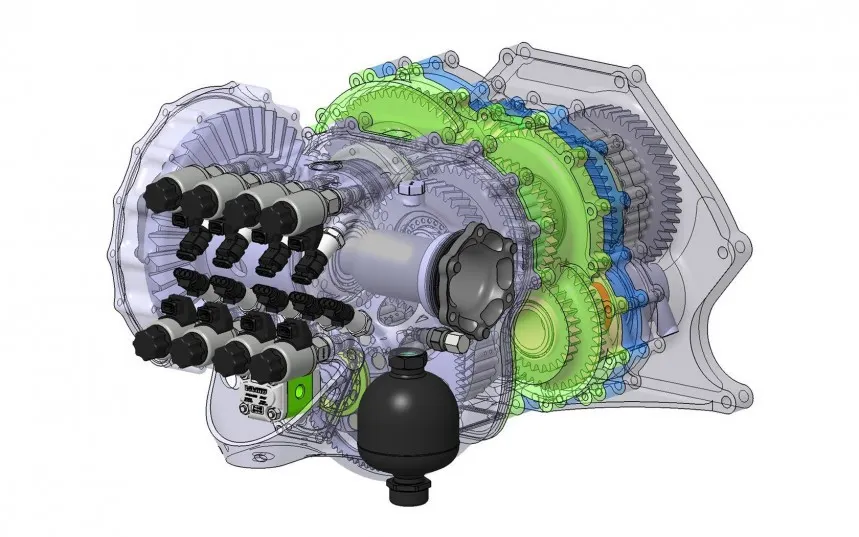
Light Speed Transmission (LST): the gearbox that doesn’t shift, it teleports
Ask any engineer at Porsche, Ferrari or McLaren what the fastest-shifting gearbox is, and for twenty years the answer was settled: the dual-clutch. The DSG, the PDK, the lot. While you’re in third, the box already has fourth loaded up on the second clutch, ready to swap in milliseconds. Brilliant engineering. Genuinely. And every one of them was locked inside the same cage without noticing the bars.
Because the dual-clutch has a dirty secret nobody puts on the brochure. It only moves one gear at a time.
Koenigsegg asked a different question. Not “how do I shift faster?” but “why do I have to shift one gear at a time at all?” And when you start from a different question, you end up somewhere nobody else is standing. You end up with a gearbox that doesn’t shift gears. It jumps between them.
The compromise nobody wanted to stare at
To see why this matters, you have to understand what a dual-clutch transmission actually does, because it’s the villain of this story.
A DCT is really two gearboxes crammed into one housing. One handles the odd gears, the other the evens, each with its own clutch. In third, the electronics predict your next gear will be fourth, based on speed, revs, throttle and brake position, drive mode and a handful of other variables, and pre-load it on the spare clutch. When the moment comes, one clutch releases as the other engages. Near-instant, because the gear was already waiting.
But the operative word is predict. The system bets, with ever more sophisticated algorithms, that your next gear is the adjacent one, going up. As long as it gets the bet right, you fly. The trouble starts when the prediction is wrong. You’re in fifth, the box has pre-loaded sixth assuming you’ll climb, and then you stamp on it to overtake and ask for fourth. Wrong gear loaded. It has to dump it, find fourth, pre-load it, then engage. That blistering shift suddenly drags. You feel the hesitation, the dip in thrust.
And even when the prediction lands in the right direction, there’s a hard floor it can’t get under: a DCT only works one gear at a time. Sixth to fourth can’t go direct. It has to pass through fifth. Two steps. Because each internal box only holds one pre-loaded gear, and the only one ready is the neighbour.
In a normal car, none of this matters. In a car aiming past 300 mph, it’s everything. Every millisecond counts, every interruption in thrust is speed you don’t claw back. Koenigsegg looked at that compromise and decided it wasn’t good enough.
Why they didn’t just buy a gearbox
Here’s the fact that explains the whole project, and Christian von Koenigsegg said it plainly.
The Jesko’s V8 puts out up to around 1,100 lb-ft of torque. When Koenigsegg went shopping for a gearbox that could survive that twist, there wasn’t one. According to the comparison Christian von Koenigsegg himself made when launching the LST in 2019, the dual-clutch units of the Ferraris and McLarens of the day topped out at roughly half that, around 660 lb-ft, and the reference figure he was working with for that category was about 275 lb. Exact weights vary by model and aren’t always published; most of these DCTs are built by Italy’s Graziano. What matters in von Koenigsegg’s calculation is the extrapolation: a hypothetical DCT capable of swallowing the Jesko’s 1,100 lb-ft, on his numbers, would have weighed around 440 lb. An absurd lump hanging off the back of a car obsessed with shedding weight.
It wasn’t a matter of taste. The market simply had nothing that worked. It’s the same reason the Regera, a few years earlier, deleted the gearbox entirely and drove the wheels with electric motors instead: above a certain torque figure, a conventional transmission is either impossible or a grand piano bolted to the diff.
For the Jesko, Koenigsegg wanted a pure combustion car with real gears and a direct mechanical connection. So they did the thing Koenigsegg does when the thing they need doesn’t exist: built it from scratch. The Light Speed Transmission, the LST, is the second gearbox Koenigsegg has designed and built one hundred percent in-house, after the Regera’s Direct Drive system. But it’s the first one with proper gears, in the traditional sense of the word.
Seven clutches and not a single synchro
This is where it gets properly clever.
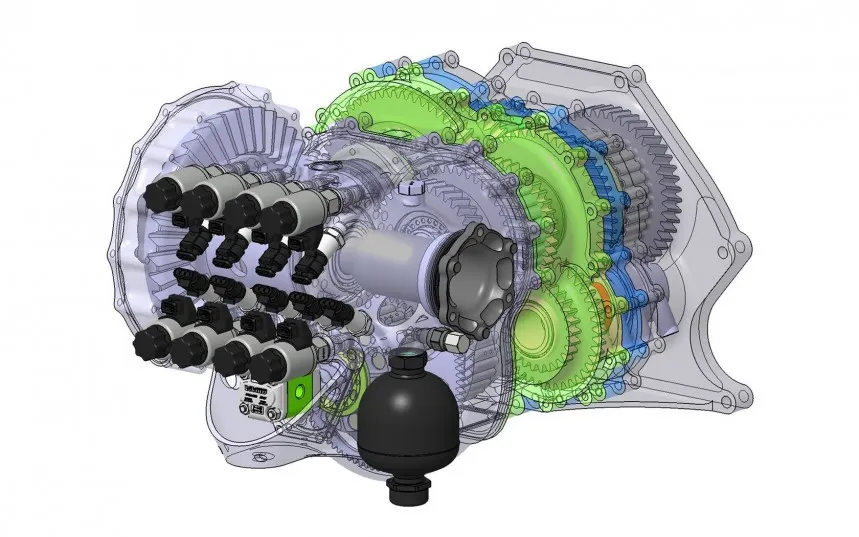
A normal manual uses synchronisers, the collars and forks that match shaft speeds so a gear slots home cleanly. A dual-clutch uses two clutches and selector mechanisms. The LST uses none of that. No synchros. No selector forks. No collars.
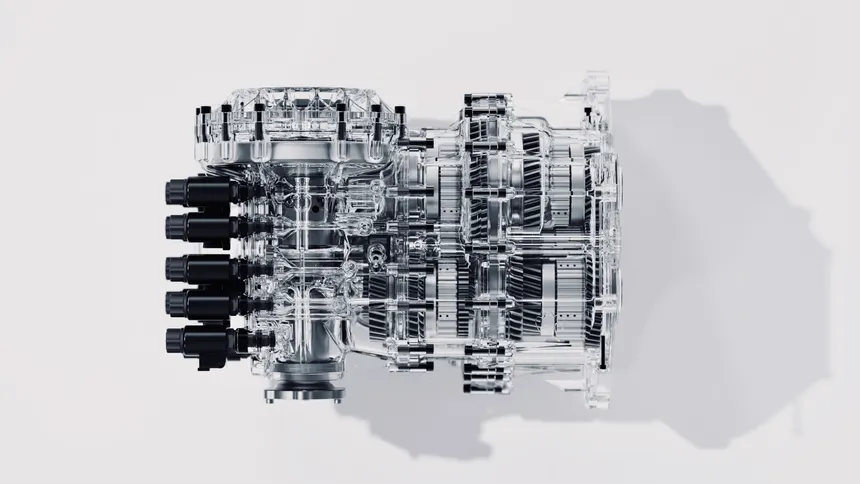
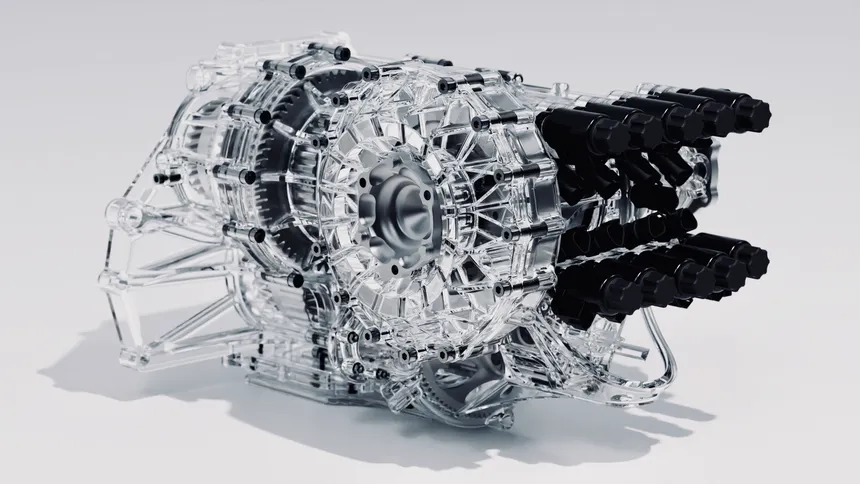
What it has is seven wet, multi-plate clutches. Seven. Each with its own pressure sensor and its own hydraulic actuator. And instead of the two shafts of a DCT, the LST runs three. Across those three shafts, with six of those seven clutches, the box assembles the nine forward gears. The seventh? It does something elegant: reverse. Rather than adding a dedicated reverse gear with its own reversal mechanism, that seventh clutch couples the input shaft directly to the output shaft, bypassing the gear set entirely and flipping the direction of rotation relative to the forward gears. One extra clutch instead of a whole reverse gear train.
And the operative word in all this architecture is “wet”. The seven clutches live submerged in oil, and that oil does two jobs at once. It’s the medium that carries the hydraulic pressure opening and closing each clutch, the actuation fluid. It’s also the coolant that hauls away the heat seven clutches generate working at this power level and at this rate of opening and closing. The box has its own oil pumps and integrated cooling circuit, all included inside that 90 kg figure. Without that system, the clutches wouldn’t last one serious lap. With it, they’re the part that defines the gearbox.
The idea is elegant to the point of being hard to digest. There’s no mechanism in the LST that physically moves parts to “select” a gear. Gear selection happens purely by opening and closing clutches. Nothing slides into place. There are clutches closing and clutches opening, and the specific combination of which ones are shut at any moment is what defines the gear you’re in.
And the whole box completes a shift, by the published figures, in twenty to thirty milliseconds. Twenty to thirty thousandths of a second. For scale, a blink takes more than a hundred. Which is why Koenigsegg says, half-joking, that the LST technically doesn’t shift. It just clutches between gears. There’s no shift in the old sense. There’s a set of clutches opening and closing faster than your foot or your ears can follow.
The jump: ninth to second, skipping the middle
This is the part that truly sets it apart, and it’s clearest in the example Jason Fenske walked through on Engineering Explained, because he took it down to the individual clutch.
Say you’re in ninth. In the LST, ninth means two specific clutch packs are closed, call them three and six, and everything else is open. Now you want second, instantly, for a savage stop into a corner. Second needs two different packs closed, one and five. So what does the box do? It opens three and six, and closes one and five, almost simultaneously. And you’re in second. No passing through eighth, seventh, sixth, fifth, fourth or third. Direct. Nine to two like pressing a button and appearing where you wanted to be.
A dual-clutch couldn’t dream of it. It would crawl down gear by gear, bleeding time and thrust at each rung. The LST does it in one move because it isn’t shackled to the logic that the next gear is the adjacent one. Any gear is one set of clutches away from any other.
The brain calling the shots is UPOD, Ultimate Power On Demand. It reads speed, revs, what your foot is asking, and instantly works out which gear delivers maximum acceleration at that exact moment. Not the next one. The optimal one. And it engages it.
How you actually drive it
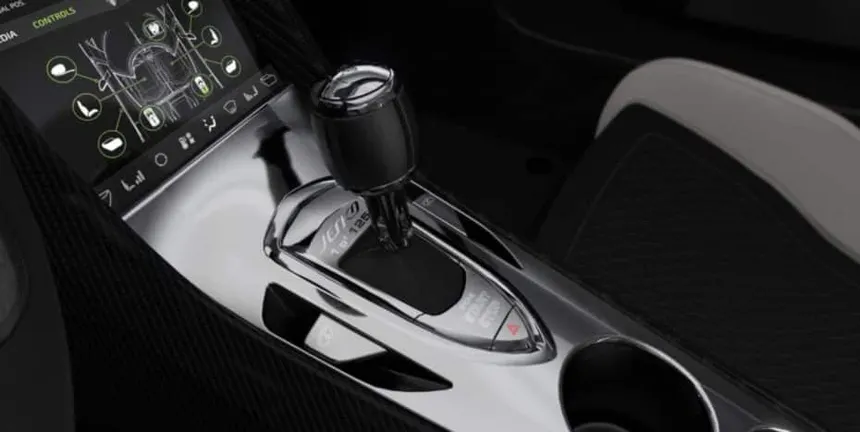
The lovely thing is that all this witchcraft doesn’t force you to relearn driving. Koenigsegg solved it with a watchmaker’s touch: the paddles and the lever have a dual-notch action.
Pull the paddle to the first notch and the box behaves like any other, up or down one gear. Normal, predictable, just faster. Press harder to the second notch and you wake UPOD. Now you’re not asking for “the next one.” You’re asking for “the best one,” and the system leaps straight to the optimal gear for maximum acceleration, whatever it happens to be.
And because Koenigsegg knows its customers, there’s also a short-throw physical stick-shift available, with the same dual-notch logic, for anyone who misses the organic feel of working a lever and being part of the car. First notch, one gear. Second notch, full UPOD. The most advanced gearbox on earth, with the option to drive it like the oldest one.
The side effect they didn’t go looking for
There’s a detail that wasn’t in the brief and it’s one of my favourites. By deleting the traditional flywheel, that heavy disc usually bolted to the crank to smooth delivery, the LST uses the rotating mass of the gearbox itself instead. The result: the Jesko’s engine revs faster than any production engine in history, by Koenigsegg’s own claim. So fast that at idle it sounds like a Formula 1 car.
And all of it, the nine gears, the seven clutches, the integrated differential, the fluids, the whole thing, weighs 90 kg. Ninety. Against the 125 of a top-tier dual-clutch, or the near-200 a box capable of the Jesko’s torque would have weighed. And it’s less than half the length of the seven-speed Koenigsegg used before. Lighter, smaller, faster-shifting and tougher, all at once. Not a better compromise. The compromise skipped entirely.
The question everyone asks next
There’s an obvious worry, and it’s the first thing anyone with grease under their nails thinks: seven small wet clutches doing the work that synchros and dog rings do in a normal box, handling both gear selection and 1,100 lb-ft of torque, opening and closing thousands of times a drive. How long does that last? A dual-clutch at least splits the duty; the LST asks these clutch packs to be selector and torque-carrier at the same time.
Koenigsegg’s answer is the wet, multi-plate design itself. Running the clutches in oil isn’t a detail, it’s the whole survival strategy: the fluid carries heat away and the multi-plate stack spreads the load across many surfaces rather than cooking one. Each pack has its own pressure sensor and actuator, so the system knows exactly how hard each clutch is being worked and can manage it rather than guess. It’s the same principle that lets a wet dual-clutch outlast a dry one, taken to seven clutches instead of two. The company hasn’t published a teardown of how every internal detail is arranged, and there’s a theoretical edge case where a requested gear would need a clutch that’s already busy, but Koenigsegg has clearly engineered the gear layout to make that a rare event. When a firm builds the whole thing in-house, it tends to have already solved the problem it isn’t talking about.
What this gearbox teaches
The LST isn’t just an engineering flex. It’s a lesson in how ceilings actually get broken.
The whole industry was optimising the same question: shift faster. And within that question, the dual-clutch was the undisputed champion, the ceiling. But you don’t break a ceiling by optimising. You break it by changing the question. Koenigsegg didn’t build a better dual-clutch. They stopped believing you had to move one gear at a time. And the moment they let that belief go, the entire dual-clutch world, twenty years of refinement and a list of legendary badges behind it, looked old overnight.
It’s true this lives in its own universe. Open clutches at these power levels are so thirsty for energy they make no sense in an ordinary car; you’ll never find an LST in a hatchback. But that’s not the point. The point is that someone looked at a problem everyone considered solved, asked the question nobody was asking, and built the answer in their own workshop because the world wasn’t selling it.
Next time you hear a car has “the fastest shift on the market,” remember that in a corner of Sweden there’s a gearbox that doesn’t shift at all. It jumps. And the gap between shifting and jumping is exactly the gap between improving an idea and having a new one.
Check you’re still alive.