
BMW M3 E92 V8: America Bought It, Munich Kept the Best Ones
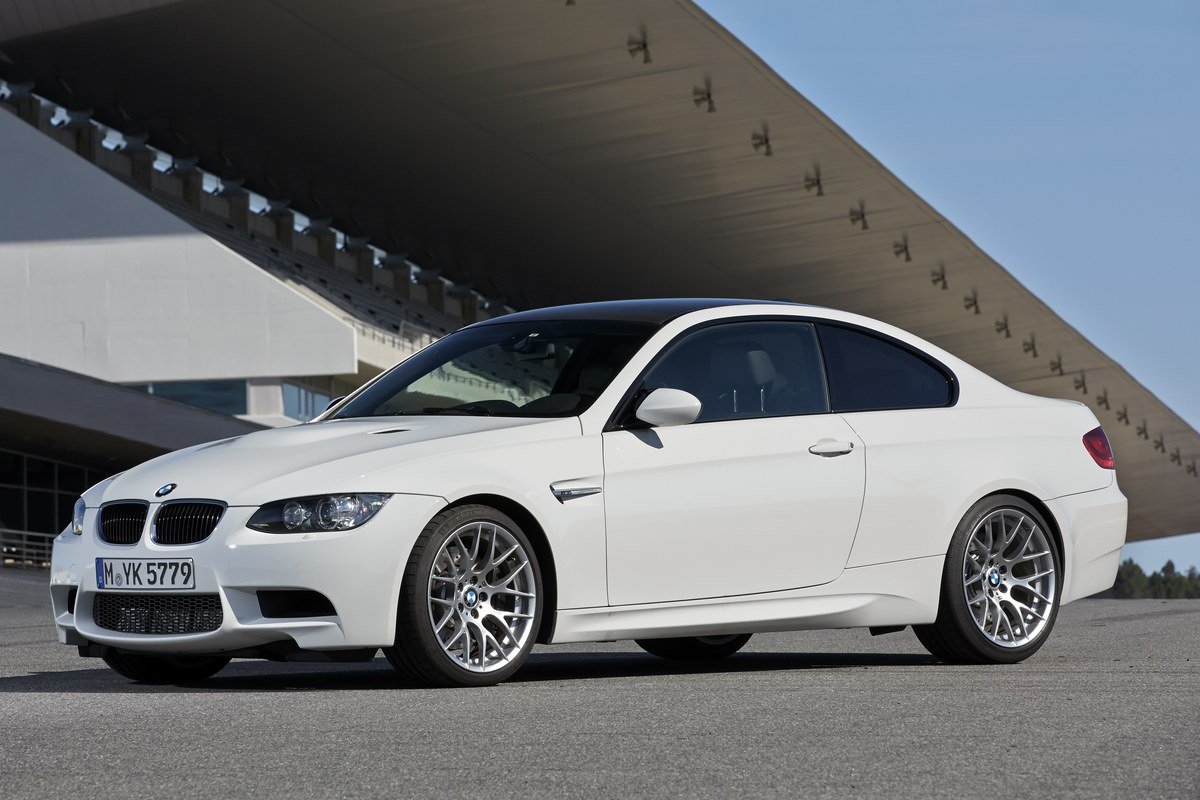
North America took more V8 M3s than anywhere else on earth, and BMW still wouldn’t sell it the good stuff. That’s the story of the E9x M3 told from this side of the Atlantic. You got the coupe, the sedan and the convertible. You got the 8,400-rpm V8. You didn’t get the GTS, you didn’t get the CRT, and the most famous V8 M3 of all, the one a whole generation drove in Need for Speed: Most Wanted, was never for sale to anyone.
Then there’s the consolation prize: 200 orange coupes named after a track in Connecticut. We’ll get there.
The numbers say it was an American car
BMW built the fourth-generation M3 at its Regensburg plant in Germany, alongside the regular 3 Series, from 2007 to 2013. The production breakdown compiled by the BMW M Registry makes one thing obvious. Of the 40,092 coupes built, GTS included, 15,799 were North American spec, more than the 14,775 left-hand-drive European cars. Of the 9,606 regular sedans (9,674 once you add the CRT), 5,867 went to North America, close to two in every three. And of the 16,219 convertibles, 8,590 were built for the US and Canada, more than half the entire run.
BMW itself listed the USA, Great Britain and Germany as the car’s most important markets when it announced the end of coupe production in July 2013. That same release spoke of “more than 40,000” coupes, “almost 10,000” sedans and “just under 16,000” convertibles. The registry’s 16,219 convertibles beat BMW’s own figure, which makes sense: the drop-top stayed in production until September. The registry figures put the US and Canada first by a distance in two of the three body styles. The sedan, which BMW brought back after skipping it on the E46, sold mostly here.
What you got: a V10 with two cylinders missing
The S65 is not a production-car engine with M badges on top. It comes straight from the S85, the 5.0-liter V10 of the E60 M5. BMW’s engineers had designed that engine around a 500 cc cylinder. Ten of them made the M5’s V10. Eight made the M3’s 3,999 cc V8. Bore and stroke are shared at 92 by 75.2 mm, and so is the 12.0:1 compression ratio.
BMW of North America rated it at 414 hp at 8,300 rpm and 295 lb-ft at 3,900 rpm, with the limiter at 8,400. The whole engine weighed 445 lb, 33 lb less than the straight-six S54 it replaced in the E46, despite carrying two extra cylinders. BMW M likes to explain the speed of the thing in one line: at 8,300 rpm, each piston travels 20 meters every second.
The hardware is why it cost what it cost. The block was cast at BMW’s light-alloy foundry in Landshut, the same place that cast the blocks for the BMW Sauber Formula 1 engine. The crankcase is an aluminum-silicon alloy bedplate design where the silicon crystals themselves form the cylinder walls, so the pistons run without liners. The crank is a one-piece forging of about 44 lb. Every cylinder gets its own throttle butterfly, eight in all, moved by two actuators, one per bank. Keep those two actuators in mind. The spark plugs double as sensors, detecting knock and misfire through ion-current technology. Oil is handled by two volume-controlled pumps and a split wet sump. And BMW fitted Brake Energy Regeneration, an alternator that only charges on overrun and under braking, to a car whose V8 was built to rev past eight grand.

The engine won its 3.0-to-4.0-liter class in the International Engine of the Year awards five years running, from 2008 to 2012. Wiesmann liked it enough to buy it for the GT MF4-S, at the same 420 PS.
The competition, by the sticker
The M3 went V8 because the straight-six wasn’t going to win the horsepower war of 2007. When Car and Driver lined up the 2008 class, the base prices it published read like this: BMW M3 sedan $53,800, Mercedes-Benz C63 AMG $53,800, Lexus IS F $56,000 and Audi RS 4 $66,910. Same magazine, same test, the M3 was the only one making its peak power north of 8,000 rpm. It was also the smallest engine and by far the weakest on torque. The C63 had a 6.2-liter V8 with 443 lb-ft. The M3 had 295.
That gap is the whole personality of the car. Everybody else made torque. BMW made revs and asked you to work for them. Eight years later Alfa Romeo built an entire car, the Giulia Quadrifoglio, with the M3 as its declared target.
The new M double-clutch transmission arrived for the 2008 model year. BMW announced it in January 2008 as the world’s first seven-speed dual-clutch built for a high-revving engine, rated to handle 9,000 rpm and developed with Getrag. It brought 11 shift programs and launch control. Purists heard the clutch pedal’s death rattle. They weren’t wrong, as the GTS would prove.
What breaks, and the one time BMW put it in writing
Nobody who owns an S65 escapes the rod bearing conversation. Premature wear is well documented by shops and specialists, but there is no agreement on why. One camp blames tight factory clearances combined with the 10W-60 oil BMW specified and an engine that lives past 8,000 rpm. The other camp says oil viscosity has nothing to do with it and points to localized oil starvation or tolerance stack-up at assembly. In practice, an S65 with a sketchy service history is a gamble, and preventive bearing replacement has become close to standard practice among owners.
The throttle actuators are the other classic. When one fails, the car drops into limp mode. BMW of North America eventually acknowledged it on paper. Its service bulletin SI B01 03 16, dated March 2016, extended the limited warranty on that actuator, which BMW’s paperwork calls the idle control device, to 10 years or 120,000 miles for model year 2013 M3 coupes and convertibles with the S65. A narrow fix for one model year, but a factory admission all the same.
The GTS: a car BMW never planned to sell you
When BMW M announced the M3 GTS in November 2009, the press release carried a note for the American market: the model was not planned for North America. It never came.
Here’s what you missed. The stroke grew from 75.2 to 82 mm, taking the V8 to 4,361 cc, 444 hp at 8,300 rpm and 440 Nm, about 324 lb-ft, at 3,750 rpm. Titanium rear silencers and model-specific catalysts. Dual-clutch only, with no manual on the order form. A DIN curb weight of 1,530 kg, roughly 3,373 lb, including the rear roll bar and the DCT, against 1,600 kg for a DCT M3. The diet came from deleting the rear seats, polycarbonate rear and rear side windows, lighter console and door panels and trimmed sound deadening. Air conditioning and a stereo were options.
Underneath it ran adjustable coilovers with independently adjustable damping, adjustable camber and ride height, and sat 16 mm lower in front and 12 mm lower at the rear. Fixed calipers with six pistons up front and four at the back clamped discs 18 mm larger in front and 30 mm larger in the rear than the standard car’s. The rear wing was based on the part from the BMW 320si WTCC touring car. Inside: bucket seats, a roll bar behind the B-pillars, mounts for six-point harnesses, a fire extinguisher and ordinary belts for the street. One color only, Fire Orange.

The bodies left Regensburg unfinished and were assembled at BMW M’s Garching facility near Munich, in the same workshop that built the M3 GT4 race cars. The German price in May 2010 was €136,850 including VAT, double the €68,350 of a regular M3 coupe.
BMW’s own count is where it gets murky. At launch the company talked about a maximum of 150. Specialists and auction houses settle on 138 built, and the registry identifies the same 138: 113 left-hand drive and 25 right-hand drive. When BMW wrote the E92’s obituary in July 2013, it said 135 had been delivered to customers. Built and delivered aren’t the same number, and the three-car gap could be press, factory or pre-production cars. BMW has never broken it down.
The GTS also came with a promise: to clearly beat the E46 M3 CSL’s lap of the Nürburgring Nordschleife. In German magazine sport auto’s Supertest, the GTS ran 7:48. The same magazine had timed the CSL at 7:50 in 2003. Different tires, weather and era, so the gap says nothing about the GTS being a letdown. It does say that “clearly” turned into two seconds. A few years later, a stock F82 M4 with a back seat and climate control ran 7:52 in the same test.
The CRT: the sedan that tested the i3’s carbon
BMW unveiled the M3 CRT, for Carbon Racing Technology, in June 2011 on the eve of the Nürburgring 24 Hours. It was an E90 sedan with the GTS’s 4.4-liter, 444-hp engine, 0-62 mph in 4.4 seconds and 3.5 kg per horsepower, painted Frozen Polar Silver with Melbourne Red accents. BMW of North America stated plainly that, due to the very limited worldwide volume, the CRT would not be homologated for sale in the USA. The UK didn’t get it either. Singapore got three.
The interesting part sits in the hood and the front seats. Both debuted the carbon-fiber-reinforced plastic production process BMW was preparing for the i3 and i8. The hood weighed a quarter of an equivalent steel part. The seats were two CFRP layers wrapped around a honeycomb of recycled paper. A gasoline M3 sedan was the test bed for BMW’s electric cars. BMW announced 67 units. The registry identifies 68, 63 left-hand drive and 5 right-hand drive.

The consolation prize from Connecticut
BMW of North America announced the 2013 M3 Coupe Lime Rock Park Edition in July 2012: 200 cars, all in Fire Orange, the GTS color that Americans had never been able to order on an M3. Competition Package, a numbered console plaque, a unique decal on the left rear quarter window and a certificate of authenticity. Pricing started at $70,995 including destination. Dealers were told no store would get more than one, and buyers couldn’t request a specific VIN or build number.
Track owner Skip Barber called it “a classic car for a classic track,” and BMW works driver Bill Auberlen was the first to evaluate the prototype on the 1.5-mile circuit. It’s a lovely car. It’s also a reminder of what wasn’t allowed through customs.
The V8 M3 nobody can buy
Before the E92 ever existed, there was a road-going V8 M3, and it was built because of an American race series. BMW Motorsport created the E46 M3 GTR to race in the 2001 American Le Mans Series, and the rules required road cars. The Strassenversion used a slightly detuned version of the 4.0-liter P60 V8, rated by BMW at 380 hp at 7,000 rpm, with a six-speed manual, a racing twin-disc clutch and a variable locking M differential.
For years the accepted number was ten road cars. BMW’s own account, published by BMW of North America in 2015, is smaller: six were completed before the program was terminated, three engineering development cars were later recycled, and the three production-level survivors live in the BMW Group Classic collection. The GTR dominated its one season and a rule change pushed it out of the series at the end of 2001. In 2025, Thomas Plucinsky, head of BMW Group Classic USA, said only three of the race cars remained, and BMW Group Classic USA is the outfit that rescued the last one still running.
So when BMW’s 2007 engine dossier called the S65 the first eight-cylinder engine for the M3, it skipped a car born for American racing. The car dossier was more careful, calling the E92 the first series-production M3 with eight cylinders. That part is true.
The racing story kept going with the E92. Rahal Letterman Racing ran the M3 GT2 in the ALMS from 2009, and in 2010 BMW took the GT manufacturers’ and teams’ titles. That same year the GT2 won the Nürburgring 24 Hours outright, and Jeff Koons turned one into the 17th BMW Art Car, unveiled at the Centre Pompidou and raced at Le Mans wearing No. 79, the number of Andy Warhol’s M1 in 1979. It retired early. By BMW’s count, the M3 GT2 won five ALMS titles.
After the V8
The replacement arrived for 2015. The F80 M3 and F82 M4 swapped the V8 for the S55, a twin-turbo 3.0-liter inline-six with 425 hp, only 11 more than the S65, but 406 lb-ft from 1,850 rpm. On paper it won everything. No M3 has had a V8 since.
The NEC verdict
The S65 has a bearing weakness nobody has fully explained, throttle actuators BMW of North America ended up covering for one model year, and less torque than a C63. The GTS cost twice as much as an M3, promised to clearly beat the CSL and beat it by two seconds, and BMW’s production numbers don’t fully match the registries. All of that is true, and none of it matters.
This is the best M3 ever built, because it’s the last one BMW designed around an engine. A naturally aspirated M5 V10 cut down to eight cylinders, with a throttle per cylinder and an 8,400-rpm limiter, isn’t coming back from Munich, and BMW knows it better than anyone. America bought more of them than anybody and still never got the two best versions. If you own a Lime Rock or a clean manual coupe, you’re holding the last M3 BMW built without checking the emissions spreadsheet first. Do you really think they’ll do it again?
Check you’re still alive.
Photos: BMW Group (BMW press), BMW Group (BMW press), BMW Group (BMW press), BMW Group (BMW press).