
Velocity stacks: the physics of the bellmouth, from Chrysler’s ram tubes to the Ferrari 360
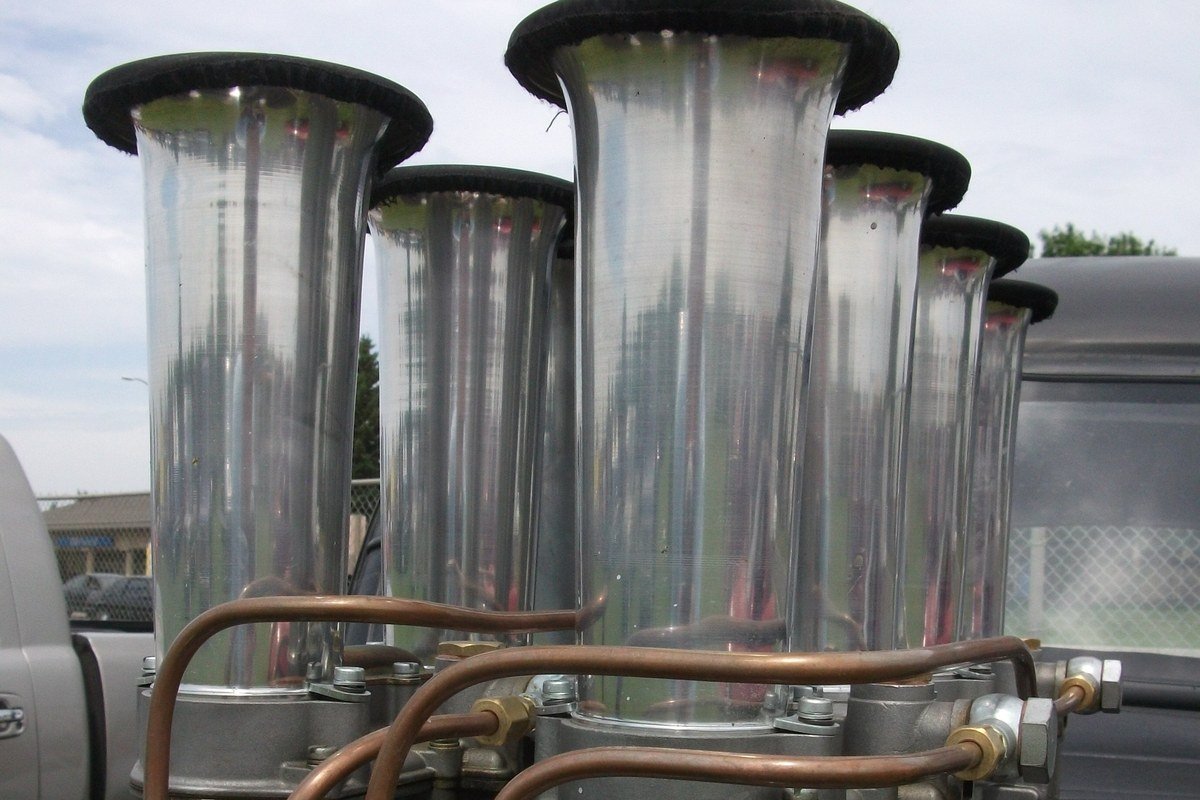
Those shiny trumpets sticking out of an engine with individual throttle bodies are the most misunderstood parts in the whole hot rod catalog. Half the guys who bolt them on think they’re jewelry, and half the guys who rip them off to fit a filter think they’re jewelry too. Both are wrong. A velocity stack does two separate jobs, both rooted in hard physics, and between them they decide where in the rev range your engine pulls and where it goes flat.
Back in the first chapter of this series we showed how a naturally aspirated engine rides the pressure waves in its own intake to cram a little more air into the cylinder than atmospheric pressure alone would give it. After the air filter bonus, this second bonus goes after the piece we skipped: the flared mouth at the very end of the intake tract, where the air first gets grabbed.
Here’s the short version before the long one. Job one is about the shape of the mouth and how cleanly air gets in, which is a question of entry losses. Job two is about the length of the tube and the timing of pressure waves bouncing inside it, and the shape of the mouth plays a part there too. People blur the two together all the time, and that’s exactly why so much nonsense gets written about stacks.
A sharp edge chokes the pipe you paid for
Take a straight tube cut off square and try to pull air through it fast. Air coming from the sides has to whip around that square lip to get in, and at speed it simply can’t make the turn. It peels off the wall and tumbles into eddies right at the entrance. Those eddies take up real estate. The flow squeezes into a narrower jet than the tube itself, a choke point engineers call the vena contracta, and suddenly your two-inch pipe is breathing like a smaller one. You paid for the diameter and the sharp edge stole part of it.
Flare that mouth into a smooth bell and the air never meets a corner. It follows the curve, stays attached to the wall and fills the tube. The yardstick here is the discharge coefficient, which compares the air that actually gets through with what the same hole would pass in a perfect world.
The best numbers on this come from Gordon Blair, the Queen’s University Belfast professor who spent decades modeling race engines, and W. Melvin Cahoon, a senior engineer at Volvo Penta of the Americas. In a study on bellmouth design for Race Engine Technology magazine they ran the cases through computational fluid dynamics at the kind of small pressure drop a real intake sees. The square-cut pipe came out at a discharge coefficient of 0.567. Put a simple radius on the lip and it jumped to 0.719. Their best bell, an elliptical profile, reached 0.743. In mass flow, the sharp pipe passed about 30 grams per second and the elliptical bell about 36, so roughly 20 percent more air through the same hole.
Now look at where the gain lives. The big step is from no bell to any decent bell. Going from a plain radius to the perfect ellipse bought only about 3.5 percent more discharge coefficient. Blair and Cahoon even wrote down a recipe: entry diameter around 2.13 times the pipe diameter, and a bell about as long as the pipe is wide. That’s why on every serious engine with a trumpet per cylinder, from vintage Weber setups to modern superbikes, the mouth always wears a bell. Nobody who races leaves a bare tube hanging in the breeze.
Where the gain runs out
Let’s keep this in proportion, because this is the point where forum threads go off the rails. That 20 percent is measured at the mouth, on its own. Your cylinder doesn’t care about the mouth on its own. It cares about the whole path, and on most engines at most rpm the tightest spot isn’t the trumpet. It’s way downstream at the intake valve, where all that air has to squeeze through the ring-shaped gap between valve and seat while the valve is only partly open.
Against that bottleneck, a better bell is a real gain and a modest one. If somebody tells you a set of pretty stacks transformed his engine all by themselves, he’s either changed something else too or he’s selling something. Stacks add. They don’t perform miracles.
Length is the part that moves the torque curve
The second job is the sneaky one, and it’s where the real tuning happens. A stack is also a pipe, and every pipe has a length. That length decides at what rpm the engine gets a free extra push of air.
Most explanations get this backwards, so here it is step by step. When the intake valve opens and the piston starts down, it pulls on the column of air in the runner. That sends a low-pressure pulse racing up the runner toward the open end. When that pulse hits the open mouth, it does something that sounds wrong: it reflects with its sign flipped. A suction wave going out comes back as a pressure wave. It’s an echo that returns inside out.
If the runner is the right length, that returning pressure wave arrives at the valve while it’s still open, near the end of the intake event, and shoves an extra slug of air into the cylinder just before the door shuts. No supercharger, no turbo, just the engine’s own breathing pulse bounced back at it on cue.
Because the wave travels at the speed of sound, the timing depends on how far it has to go. There’s an old rule of thumb tuners use as a starting point: rpm multiplied by runner length in inches equals 84,000. Run it and the trade-off is plain. Tune for 4,500 rpm and you need about 18.7 inches of runner. Tune for 9,000 and you’re down to about 9.3 inches. Long runners pay off in the low and middle revs, where you actually drive. Short runners pay off up top, where race engines live.
Treat that 84,000 as a starting point, not scripture. It assumes a particular wave mode and particular conditions; the speed of sound shifts with air temperature, and the effective length depends on the bell shape too. And since the length counts from the valve to the mouth, the stack is the part of the runner a tuner can actually change on the bench to slide the sweet spot around.
Detroit already did the math in 1960
If you want proof that this isn’t speed-shop folklore, look at what Chrysler bolted on in 1960. The 300F letter car, the Dodge D500 and the Plymouth Sonoramic Commando all offered ram induction: two long aluminum manifolds crossing over the V8, one per bank, each fed by a Carter AFB four-barrel, with runners around 30 inches long. Plug 30 inches into that same formula and you land around 2,800 rpm, which is exactly where a big-block luxury bruiser needs to pull when it’s passing a truck on a two-lane highway. Chrysler claimed up to 10 percent more torque from the plumbing alone.

That setup is also the cleanest illustration of the catch. A runner of fixed length can help in more than one band, but it can’t give you the fattest low end and the strongest top end at the same time. Tune it one way and the other end goes hungry. With a fixed pipe, you pick. It’s the same no-free-lunch rule that has run through this entire series.
Ferrari stopped picking
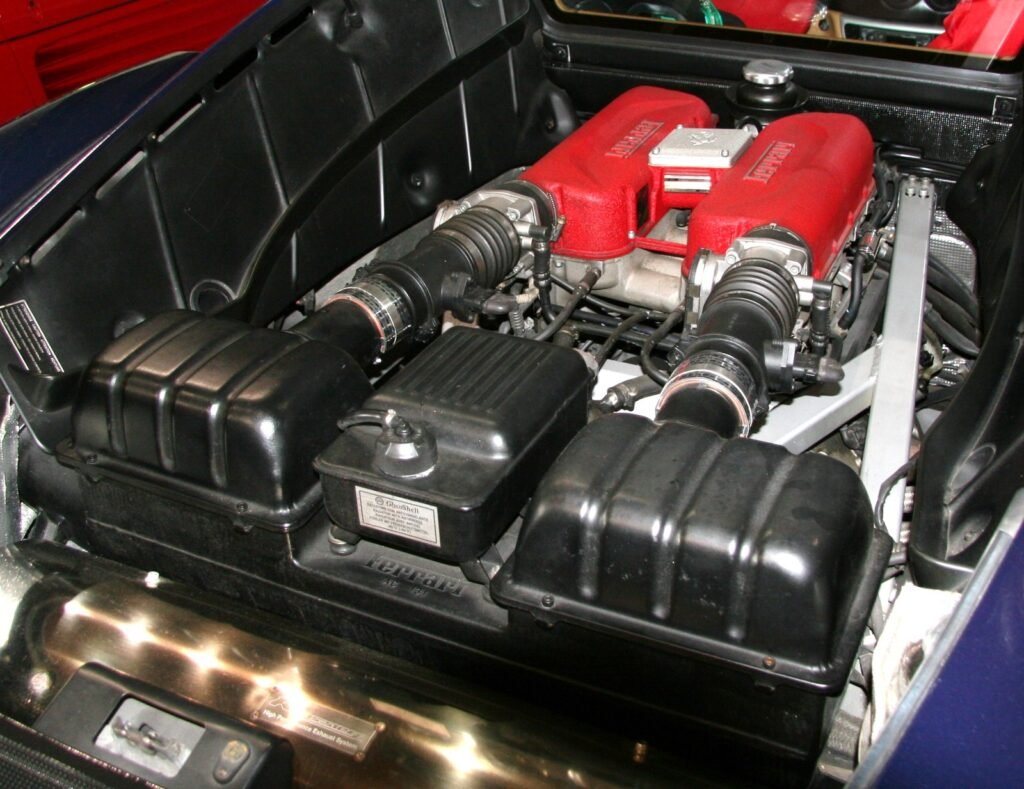
So what if the runner could change its effective length on the fly? Long at low rpm for torque, short at high rpm for power. That’s what a variable-length intake manifold does, and one of the cleverest examples sits on top of the Ferrari 360 Modena from the late nineties. To be clear, the trumpets themselves don’t telescope. The manifold opens and closes internal passages so the air takes a longer or shorter route.
At low revs and light throttle, the 360’s air is forced through long, narrow paths that favor torque. According to a technical description of the system, once the engine passes about 5,500 rpm with more than 45 percent throttle, butterfly valves worked by a pneumatic actuator swing open and give the air a much wider route that is less than half as long. The engine effectively gets short runners for the top end. That matters on a 3.6-liter V8 that makes its peak power at 8,500 rpm, because the gap between in-town torque and full-song power on that engine is huge. Lots of mainstream makers use the same idea with different hardware. It’s the smartest way out of the pick-one-rpm trap. The 360’s successor, the Ferrari F430, arrived in 2004 with an all-new 4.3-liter V8.
Barcelona’s four-cam V8 and the record it stole
Here’s a chapter of this story most American enthusiasts have never heard. In the early fifties, in a Spain still flat broke from its civil war, the state truck maker ENASA built a sports car in its Barcelona works: the Pegaso Z-102, made between 1951 and 1958, roughly 84 of them in all. The engine was an all-alloy V8 with double overhead cams on each bank, done in house under Wifredo Ricart, an engineer who had spent years designing racing cars at Alfa Romeo. The 2.8-liter version breathed through four Weber 36 DCF twin-choke carburetors, each crowned with its own intake mouths. It looked like a race engine because it was built like one, swallowing through many mouths instead of one shared throat.

And it went. On September 25, 1953, on the straight public road at Jabbeke in Belgium, Pegaso test driver Celso Fernández averaged 243.079 km/h, about 151 mph, through the flying kilometer and took four official Belgian auto club records. The car that did it was the backup. The special built for the job, the twin-supercharged 2.5-liter Bisiluro, had blown its engine, so the team rolled out the supercharged 2.8-liter Touring barchetta that had been to Le Mans. With that, the Pegaso became the fastest production car in the world and knocked off the Jaguar XK120, which had run about 132 mph on the same stretch in 1949.
Jaguar didn’t take it lying down. In October 1953 test driver Norman Dewis went back to Jabbeke with a heavily modified XK120 and ran about 172 mph. That tells you how much it stung to lose the title to a car from Spain. To keep it straight: the Pegaso record was set by a supercharged car, so it measures the whole package, not anything specific about trumpets.
The Pegaso had a rough racing life. At Le Mans in 1953 Juan Jover overcooked the corner after the Dunlop bridge at more than 200 km/h, smashed his leg, and Pegaso pulled its other cars. Joaquín Palacio won his class at the Montjuïc Cup in Barcelona on October 2, 1954. Then it came to North America: at the 1954 Carrera Panamericana a Z-102BS entered by Texan Allen Guiberson, with Palacio and Fernández aboard, started the race and failed to finish. One spyder body even carries the name of La Rabassada, a Barcelona hill climb; claims of outright wins there are floating around, but published results don’t confirm them.
Made in Bologna, then in Madrid
One more twist, and it lands right on those trumpets. Weber was founded in 1923 by Edoardo Weber, and for decades the carburetors that fed half of European racing came out of Bologna. Genuine Webers were made there until 1992. After that, production moved to Madrid. So if you’ve ever rebuilt a set of Webers on an old Alfa, a Ferrari or a Porsche 911, there’s a decent chance the body that feeds those stacks was cast in Spain.

What a pipe tells you about an engine
Stacks are the best proof I know that almost nothing on an engine is there for looks. That bell is two physics lessons stacked on top of each other: one about air turning a smooth curve instead of tripping over an edge, the other about a pressure wave bouncing back up a pipe in time to catch the valve.
The tuning world loves big numbers. Bolt on the turbo, spray the nitrous, double the power. Small stuff gets ignored, the handful of horsepower you find by shaping how air gets in and how it rings inside the runner. But think about what’s going on here: shape a mouth, pick a length, and a naturally aspirated engine fills its cylinders better without a single part that eats power to blow air, no supercharger and no turbo. The extra air is free in the sense that physics hands it over; at full load you still have to add the fuel that air needs to burn.
The naturally aspirated engine that opened this series turns out to have had margin hiding in the shape of its own mouth and the echo of its own breath. Getting that margin out without forcing anything and without breaking anything is about the cleanest horsepower there is. It doesn’t come from a catalog. It comes from understanding how the air gets in.
A road-going V8 with one throttle butterfly per cylinder, right at the mouth of each stack: that’s how the S65 in the BMW M3 E92 breathed.
Check you’re still alive.
Photos: dave_7 (CC BY 2.0), ZidaneHartono (CC BY-SA 4.0), TTTNIS (public domain), Prova MO (CC BY-SA 4.0), Lothar Spurzem (CC BY-SA 2.0 de).