
Supercharger explained: how it works and why the Roots doesn’t compress
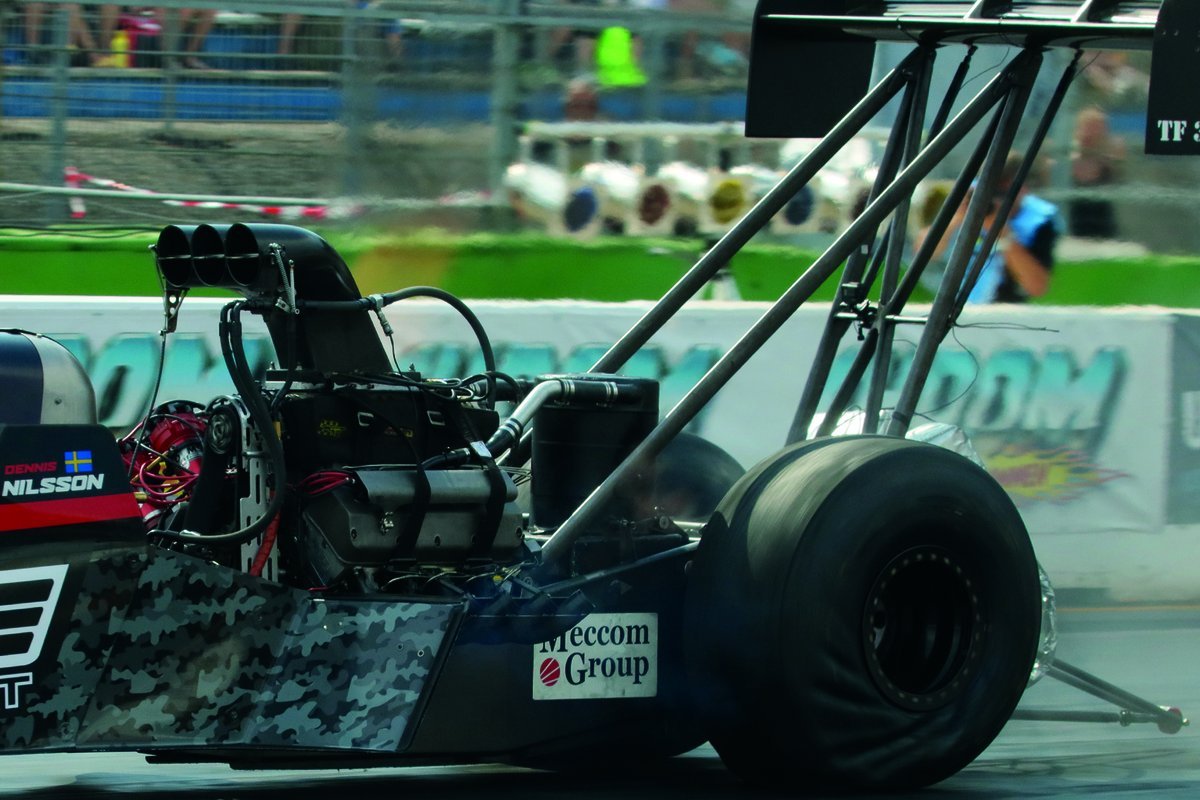
The most famous supercharger in America started out as a breathing aid for a bus engine. That silver box sticking out of a Top Fuel hood, belts screaming, is a direct descendant of a part GM bolted to the side of a two-stroke diesel in 1938 so the thing could run at all. And the machine at the center of that story, the Roots blower, does not compress air inside itself. Half the internet says it does. It doesn’t. By the end of this you’ll know why, and you’ll never hear that whine the same way again.
Chapter one of this series was about the naturally aspirated engine, the one that takes whatever the atmosphere pushes into it and makes do. Roughly 14.7 psi at sea level, less in Denver, and no amount of clever plumbing changes that number. Forced induction is the decision to stop accepting it. Somebody builds a pump, the pump stuffs air into the intake at more than atmospheric pressure, and every cylinder fills with more oxygen than it could ever pull in alone. More oxygen means more fuel can burn, and more fuel burned means more power from the same displacement.
There are two ways to spin that pump. You can harvest the exhaust, which gives you a turbocharger, and that’s next chapter. Or you can drive it straight off the crankshaft with a belt or gears, which gives you a supercharger. The supercharger came first, and it has one trick the turbo has spent a century trying to copy: the engine and the blower are mechanically tied together, so the moment the crank turns, the blower turns.
Two branches, four families
Every supercharger in this article is driven by the engine itself. That’s what makes it a supercharger. But what happens to the air once it’s inside is where they split, and getting this split wrong is the source of most of the nonsense written about them.
Branch one is positive displacement. These machines trap a fixed slug of air on every revolution and physically move it from the inlet side to the outlet side. Spin them twice as fast and they move twice as much air, more or less, at any engine speed. In Europe this whole branch is called “volumetric,” which is a decent description: they move a volume.
Branch two is dynamic. These don’t trap anything. They throw the air, accelerating it to enormous speed with a spinning wheel, then slow it down in a carefully shaped passage so that speed turns into pressure.
Inside those two branches live four families. The Roots blower: two lobed rotors spinning in mesh inside a housing, positive displacement. The twin-screw, also called the Lysholm after the Swedish engineer Alf Lysholm, whose rotor design it is: two helical rotors, one male, one female, threading into each other, also positive displacement. The scroll, which Volkswagen sold as the G-Lader: one spiral wobbling against another, positive displacement again. And the centrifugal: a bladed wheel flinging air outward, the only dynamic one in the group and, mechanically, the intake half of a turbocharger with a belt where the turbine should be.
Roots and twin-screw look like close cousins, two rotors in a box. The difference between them is the whole myth.
The Roots doesn’t squeeze. It slams.
Picture the Roots from the end. Two rotors, usually two, three or four lobes each, turning in opposite directions, never quite touching each other or the case. As a lobe sweeps past the inlet, it opens a pocket between itself and the housing wall. Air at atmospheric pressure fills that pocket. The rotor keeps turning and carries the pocket around the outside of the case, toward the outlet.
Here’s the part that surprises people. During that whole trip, the pocket doesn’t get any smaller. Nothing is squeezing it. The air inside arrives at the outlet at the same pressure it had at the inlet.
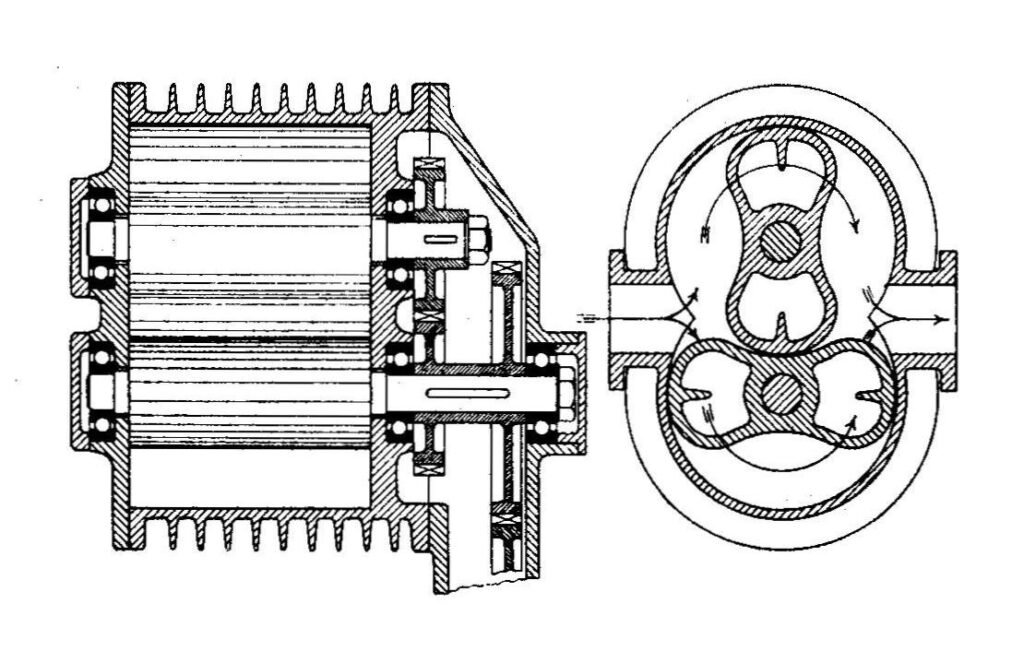
So where does the boost come from? From the engine not keeping up. The blower is moving more air per minute than the engine can swallow, so the intake manifold is already packed with air at, say, 10 psi above atmospheric. When the pocket of low-pressure air cracks open to the outlet, the high-pressure manifold air rushes backward into it. That backflow equalizes the pocket with the manifold in an instant, and then the lobe pushes the whole lot forward into the engine. The compression happens in that collision at the outlet, not in a gradual squeeze inside the case.
Engineers call this external compression, to contrast it with the internal compression of the twin-screw. It’s why purists insist the Roots is a blower, not a compressor: it’s a displacement pump that moves air into a space where pressure is already waiting. And it’s a big part of that sound. Every pocket that opens to the outlet gets a slug of backflow, thousands of times a second, and those pressure pulses are much of the whine you hear from a Roots-blown car a block away. Gear noise and rotor vibration add to it, but the discharge pulses are the signature.
That collision costs something. Slamming air up to pressure all at once, instead of raising it gradually, turns a chunk of the work into heat and turbulence. And because the rotors never touch, there are fixed clearances that leak more as boost rises. So the old rule says the Roots runs out of breath as you ask for more pressure, and for the old GMC-pattern blowers that was true.
Then Eaton, out of Michigan, went to work on the design. Its TVS rotors have four lobes twisted 160 degrees, and the outlet port is shaped to ease that backflow instead of letting it hit like a wall. Eaton quotes pressure ratios up to 2.5, which is roughly 22 psi of boost at sea level, and peak isentropic efficiency above 70 percent. That’s the unit Chevrolet put on the LS9 in the 2009 Corvette ZR1: a 2.3-liter TVS on a 6.2-liter V8, 638 horsepower, and a claimed top speed past 200 mph. The Roots still pays more of a toll as boost climbs. There’s just no magic number where it stops working.
The twin-screw actually compresses
The twin-screw looks like a Roots with ambition. Two rotors, a housing, belt drive. But the rotors are long helical screws, one with convex lobes and one with concave flutes, and as they turn, the pockets of air trapped between them travel along the length of the rotors while the space around them gets smaller.
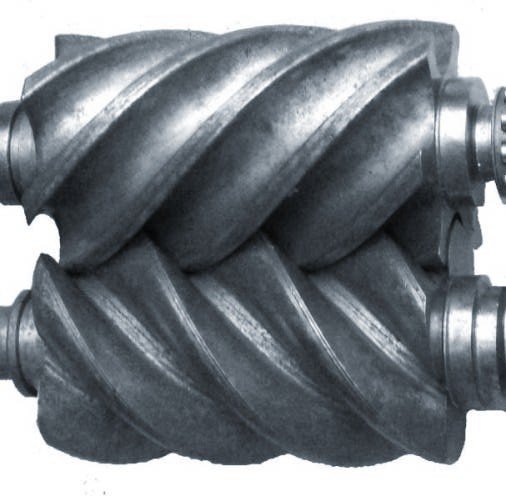
That’s internal compression, the version everybody pictures when they hear the word. The air leaves the inlet at atmospheric pressure and is already squeezed by the time it reaches the outlet, so there’s no violent backflow at the discharge. Less wasted work, less heat added to the charge, better efficiency at high boost. The cost is manufacturing: grinding those helical profiles to the clearances they need is precision work, and twin-screws have always been more expensive than Roots units of the same size.
There’s a catch built into the geometry. A twin-screw has a fixed internal compression ratio, set by the shape of the rotors. If the engine happens to want exactly that pressure, perfect. If the engine wants less, at part throttle, the air arrives over-compressed and some of that work is wasted. If it wants more, the blower still needs a bit of the Roots-style backflow at the outlet to finish the job. And when the throttle is closed and a bypass valve lets the air recirculate, a twin-screw keeps doing more work on that air than a Roots would, which means more parasitic drag at cruise.
The centrifugal is a turbo with a belt
Now the odd one out. A centrifugal supercharger has an impeller, a small wheel with curved blades, spinning at tens of thousands of rpm through a step-up gearbox. Air enters at the hub and gets flung outward to the rim at huge velocity. The impeller itself mostly adds speed, not pressure. The pressure comes from the diffuser and the snail-shaped volute around it, which slow that fast air down and convert its velocity into pressure.
Mind the vocabulary, because the word turbine gets misused here constantly. A turbine takes energy out of a moving gas. An impeller puts energy in. A turbocharger has both: a turbine in the exhaust and an impeller on the intake side. A centrifugal supercharger is just that intake side, driven by a belt instead.
Its personality follows from the physics. Pressure from an impeller rises roughly with the square of its speed, so at low engine rpm it barely makes boost and up top it makes a lot. A centrifugal-blown V8 feels almost naturally aspirated off idle and then pulls harder and harder toward redline. That top-end rush is why Paxton, Vortech and ProCharger built entire businesses on bolt-on centrifugal kits for Mustangs and small-block Chevys.
And Paxton goes back further than most people know. Robert McCulloch’s company built the centrifugal blower Ford offered on the 1957 Thunderbird: the F-code 312 V8, rated at 300 horsepower, built for only that one season and in only a couple of hundred cars. Six years later Studebaker put a Paxton on the 289 in the Avanti R2, and Andy Granatelli took supercharged Avantis to Bonneville and came home with a stack of records.
Wolfsburg’s scroll: the G-Lader
Volkswagen’s take on the problem is the strangest of the four, and it came out of a patent older than the Model T. A French engineer named Léon Creux patented the scroll principle in 1905. Nobody could make it work, because the idea depends on two spirals running against each other with tiny clearances, and early 20th-century machining couldn’t hold them. Air just leaked past.
Here’s how it works. Inside the housing sit fixed spiral walls. Between them runs a displacer, a plate with spirals on both faces. The displacer doesn’t spin. It orbits, wobbling in small eccentric circles driven off the belt. That orbit opens pockets at the outer edge of the spiral, closes them off, and walks them inward along the coil toward the center, where the outlet is. As the pockets move inward the spiral narrows, so they shrink. That’s internal compression, like the twin-screw, done with a completely different motion.
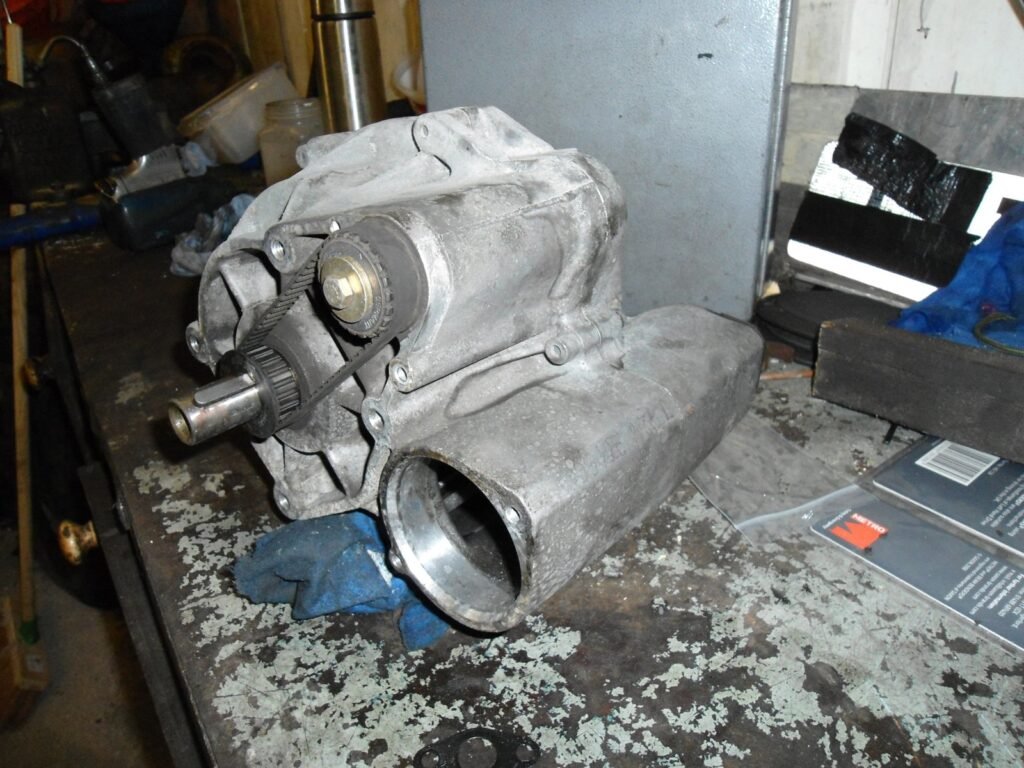
VW put it into production in the 1980s and called it the G-Lader, “Lader” being German for charger and the G coming from the shape of the spiral. There were two sizes, named for the depth of the spiral in millimeters: 40 mm for the G40 and 59.5 mm for the G60. The G40 went into the little Polo, a car America never got. The G60 went into the Golf, the Passat and, most famously, the Corrado. The Corrado G60 did make it to the States for the 1990 model year: a 1.8-liter eight-valve four rated at 158 hp, against a naturally aspirated 16-valve GTI of the same years that sat well below that. European spec was 160 PS and around 140 mph. Stock pulleys gave a maximum of 0.8 bar, about 11.6 psi.
The collector stuff is wilder. The Golf Rallye G60 was a homologation special built in 1989 so VW could go rallying: the engine bored down to 1,763 cc, Syncro all-wheel drive, boxed fenders. And VW Motorsport hand-built 71 Golf Limiteds with a 16-valve head, all-wheel drive and 154 kW, about 207 hp.
Why did the G-Lader disappear? Maintenance. VW marketed it as service-free, and it wasn’t. The displacer’s seal strips rub against the housing and wear, and the bearings need attention. A G-Lader that gets rebuilt on schedule with good parts lives a long life. One that gets ignored loses boost slowly and then can grenade itself internally. Plenty of owners found out the second way, and that’s how a beautiful piece of engineering got its reputation as a time bomb.
The Jimmy blower: from city buses to Top Fuel
Back to that bus. In 1938 General Motors launched the Series 71 diesel, built by its Detroit Diesel division and named for its 71 cubic inches per cylinder. A six-cylinder was a 6-71, a four a 4-71, a three a 3-71. These were two-strokes, and that matters. A two-stroke has no separate intake stroke. It needs air pushed in under pressure to sweep the exhaust out of the cylinder and refill it, a job called scavenging. On the Series 71, that job belonged to a gear-driven Roots blower mounted on the side of the block. It wasn’t there for extra power. Without it, the engine wouldn’t run.
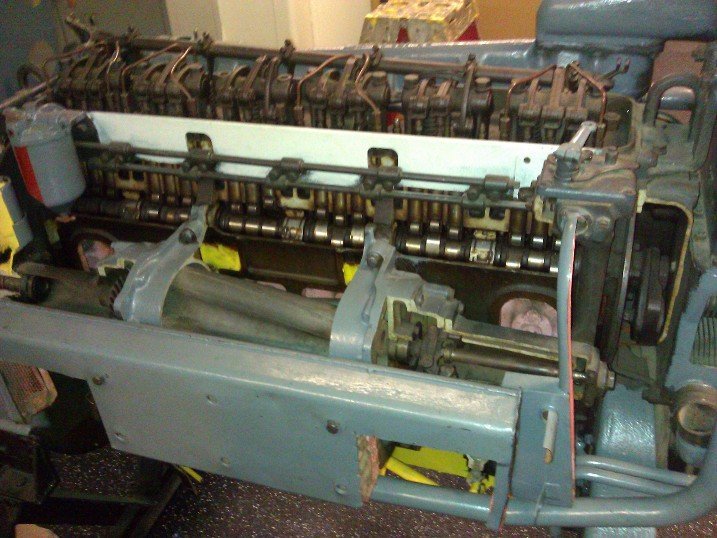
GM built Series 71 engines from 1938 until the mid-1990s and put them in trucks, buses, generators and, during World War II, tens of thousands of landing craft and armored vehicles. When the war ended, surplus blowers were everywhere and they were cheap. Hot rodders called them Jimmy blowers, after GMC.
Barney Navarro is the name usually credited with taking one to the dry lakes. In 1948 he put a GMC 3-71 on a destroked Ford flathead, drove it with four V-belts, and ran 139.75 mph at El Mirage in September of that year, up from 121 mph in July. Everybody noticed. Within a few years the bigger 4-71 and 6-71 were sitting on top of Chrysler Hemis and small-block Chevys, with the ports re-cut and the gear drive swapped for belts.
Drag racing kept asking for more air, and the aftermarket kept building bigger cases: 8-71, 10-71, 12-71, and finally the 14-71 that sits on a Top Fuel Hemi today. Those are purpose-built racing blowers with nothing in common with a Detroit Diesel except the naming scheme. The “71” survives the way a family name does, long after anyone remembers the farm.
Mercedes and the word on the trunk
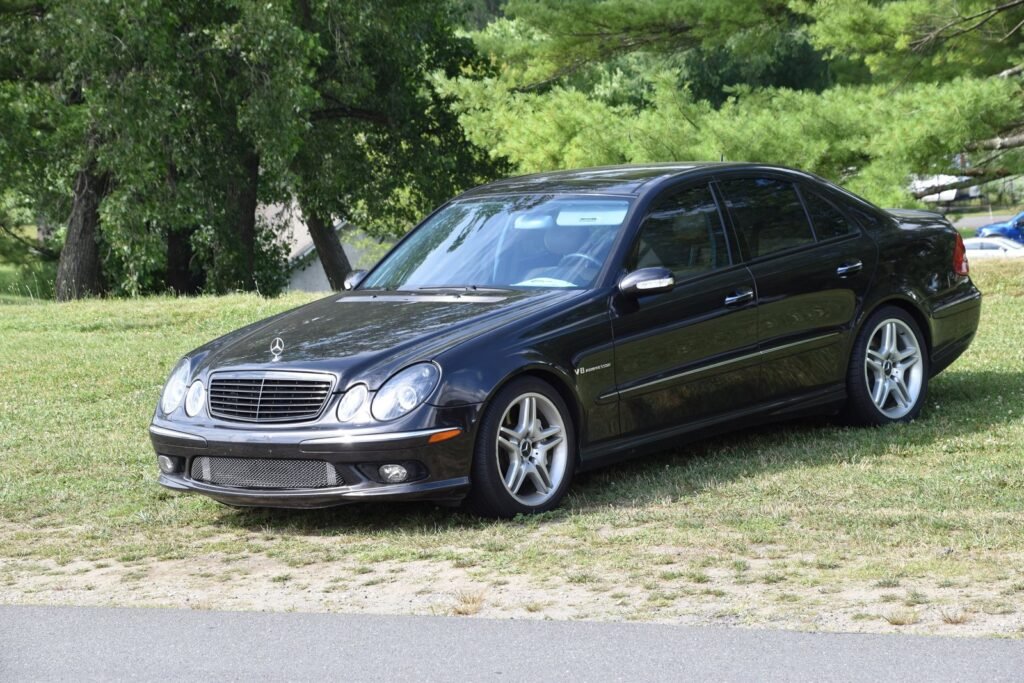
In the 2000s, Mercedes made “Kompressor” a badge. In America the C230 Kompressor was the most common version, a small four-cylinder with a Roots blower giving it the shove a bigger engine would have. Useful, not glamorous.
The glamour was at AMG. The E 55, the SL 55, the CLS 55 and their siblings used the M113K, a 5.4-liter V8 with a twin-screw supercharger built by IHI and a water-to-air intercooler. The SLK 32 and C 32 AMG used the same recipe on a 3.2-liter V6. AMG chose the twin-screw for the reason the physics suggests: at the boost and rpm it wanted, internal compression meant a cooler intake charge, and cooler air means less risk of detonation in a road car that has to survive a summer in Phoenix. For a lot of American buyers these were the first cars that made “supercharged Mercedes” mean something more than a chrome word on the trunk lid.
The Spanish footnote nobody prints
We write from Spain, so here’s the part of the supercharger story that English-language sites skip.
On September 25, 1953, on a straight stretch of road at Jabbeke in Belgium, a Spanish car built in Barcelona averaged 243.079 km/h, 151.04 mph, over the flying kilometer. It was a Pegaso Z-102 with a Touring barchetta body that had run at Le Mans earlier that year, a 2.8-liter four-cam V8, and a supercharger. The run made it the fastest production car in the world at the time. For scale: when Autocar tested an early Ferrari 212 in 1950, it got a little over 116 mph out of it. Pegaso was a truck company, ENASA, run by Wifredo Ricart, an engineer who had spent years at Alfa Romeo arguing with Enzo Ferrari. The Z-102 was absurdly expensive and lost money on every unit, but that day at Jabbeke is on the record.

There’s a second Spanish chapter that even Spaniards barely know. SEAT built cars under Fiat license, including the SEAT 131, its version of the Fiat 131. When Fiat brought out the 131 Volumetrico Abarth in 1981, using the Abarth-developed Roots blower that would later become Lancia’s Volumex, SEAT looked at doing the same. Two supercharged SEAT 131 prototypes were built on the 2.0-liter engine, reportedly good for around 140 hp and 190 km/h. The project went nowhere. One car’s whereabouts are unknown.
What the belt costs
Here’s the bill. Every supercharger is driven by the crankshaft, so every horsepower it spends compressing air is a horsepower taken from the engine before it reaches the wheels. You get back far more than you spend, which is why anyone bothers, but the toll is real and it rises with boost. Big drag-racing blowers can eat several hundred horsepower just to turn.
Engineers have found ways to shrink the toll when boost isn’t needed. A bypass valve can open at light throttle and let the air circulate around the blower without being pushed into the engine, which cuts most of the work. Some systems go further and put an electromagnetic clutch on the pulley so the blower stops spinning entirely at cruise.
What the positive-displacement types give you in exchange is response. A Roots, a twin-screw or a scroll moves air at any rpm, so the boost is there the moment you open the throttle, from just off idle. The centrifugal doesn’t share that, because its impeller needs speed before it makes pressure. So the “no lag” reputation belongs to the displacement machines, not to superchargers in general.
That leaves the obvious question. The exhaust is full of hot, fast, pressurized gas that the engine throws away. Why spend crankshaft power to compress air when there’s free energy blowing out the tailpipe? That’s the turbocharger. The energy isn’t free either, and the toll it charges is a lot sneakier than a belt. Next chapter: the turbo, the compressor map, and why what everybody calls lag is actually two separate things.
Next in the series is the turbo: how a turbocharger works, and why lag isn’t one thing.
Check you’re still alive.
Photos: Auge=mit (CC BY-SA 4.0), Autocar Handbook, 1935 (dominio público), Motorhead (Wikipedia) (CC BY-SA 2.5), Tony Harrison (CC BY-SA 2.0), Seanster1000 (CC BY-SA 3.0), Charles from Port Chester (CC BY 2.0), Jose.cfr (CC BY-SA 4.0).