
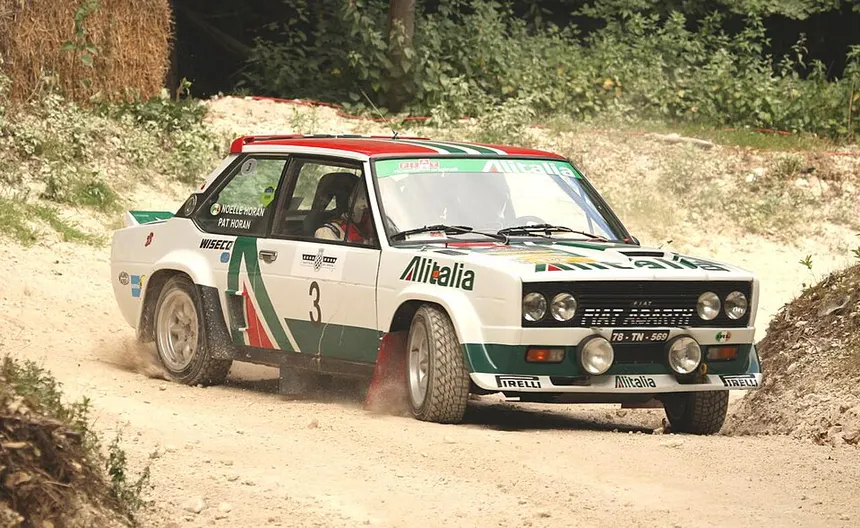
FIAT 131 ABARTH RALLY: The Saloon That Won Three World Championships
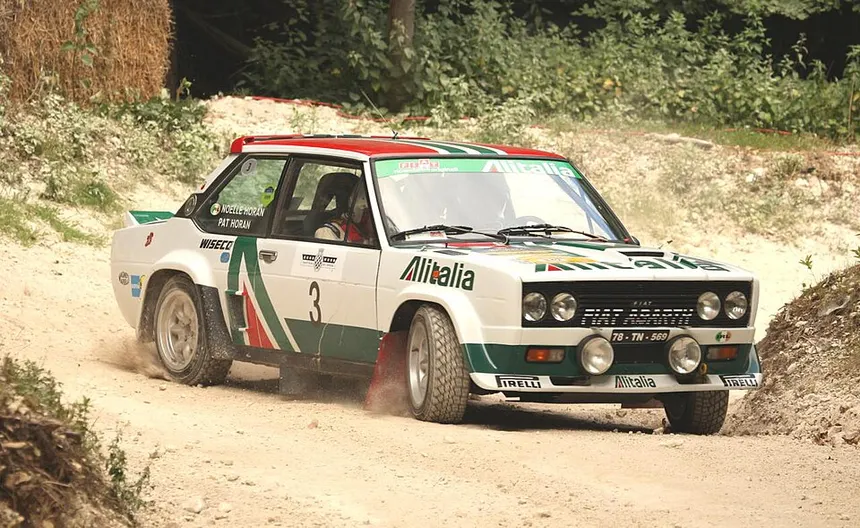
How a family Fiat with a Ferrari-derived engine and a Bertone body swept the world’s rally stages
Walk into a Fiat showroom in Italy in 1976 and ask for a 131 Mirafiori. The salesman would walk you toward a mid-sized family saloon with a 1.3 or 1.6-litre engine, front-only disc brakes, a live rear axle, and a four-speed gearbox. A car for the school run. Ask instead for the 131 Abarth Rally and the conversation changed completely. The salesman called the manager. The manager mentioned waiting lists and order books. Because the car you were asking for was technically the same shell, but built up around a Lampredi twin-cam engine with four valves per cylinder, an independent rear suspension, a Bertone-reworked body, wide wheels with quasi-rally tyres, and a price tag four times higher than the standard 131.
And because, without quite knowing it, you were ordering the homologation base of three World Rally Championships. The 1977, 1978 and 1980 manufacturers’ titles. The last Fiat to win a world rally championship. The last rear-wheel-drive family saloon to dominate the sport. And one of the most beautiful, effective and chronically misunderstood rally cars Europe has ever built.
The backdrop: Abarth changes hands
In 1971, Carlo Abarth sold his company to Fiat. He was 62 years old, running into serious cash flow problems, and ready to step back from a workshop that had spent two decades turning ordinary cars into competition tools. Carlo stayed on as a consultant for a few years, retired to Vienna, and died there in 1979. But the yellow-and-red scorpion now belonged to Fiat.
Fiat had no interest in continuing Abarth’s prototype and hillclimb operations, which were sold off to Enzo Osella, who used them to found the Osella Racing Team. What Fiat wanted was Abarth’s accumulated expertise in converting road cars into competition tools. And to run the newly acquired division, Fiat appointed the engineer who had designed more successful Italian engines than anyone alive at the time: Aurelio Lampredi.
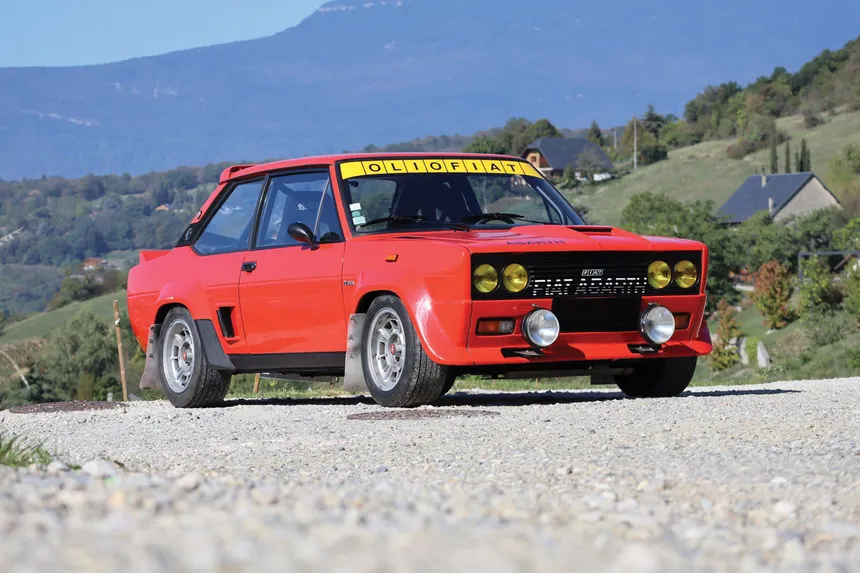
Lampredi, the twelve-cylinder man who became the four-cylinder man
Aurelio Lampredi was born in Livorno in 1917. He studied mechanical engineering in Fribourg, worked at Piaggio before the war, designed military aircraft engines at Reggiane during the conflict, and in the late 1940s joined Ferrari. In 1951 he designed the large-displacement Lampredi V12, the 3.3 to 4.5-litre engine that gave Ferrari its first Formula 1 victory: José Froilán González at Silverstone, 1951, beating the dominant Alfa Romeos. That race marked the transition from Colombo’s small-displacement era to Lampredi’s large-displacement era at Maranello.
Four years later, Enzo Ferrari hired Vittorio Jano following the acquisition of Lancia’s race team. Lampredi was edged out. He left Maranello, joined Fiat, and there, away from the headlines, designed the engine that would prove most successful in the history of rallying: the Fiat Twin Cam, also known as the Lampredi Twin Cam.
It debuted in 1966, mounted in the Fiat 124 Sport Coupé and the 124 Sport Spider. It was an inline-four with dual overhead camshafts, belt-driven (then a novelty), and a valve-clearance adjustment system that placed the shims above the tappets rather than below. That detail, which sounds like trivia, was a workshop revolution. Most contemporary DOHC engines (Alfa Romeo, Jaguar) required the removal of the camshafts to adjust valve clearance, a four-hour job. The Lampredi could be done in thirty minutes.
The engine started at 1,438 cc and grew through its lifespan to 1,995 cc. It was fitted to Fiats, Lancias, Alfa Romeos via SEAT, Morgans, FSOs. It stayed in production from 1966 until 2000. Thirty-four years. And between 1976 and 1992, this engine (or its direct derivatives) won ten World Rally Championships for manufacturers across Fiat and Lancia. It remains, to this day, the most successful engine in the history of the WRC.
The 131 Abarth Rally was its single best chapter.
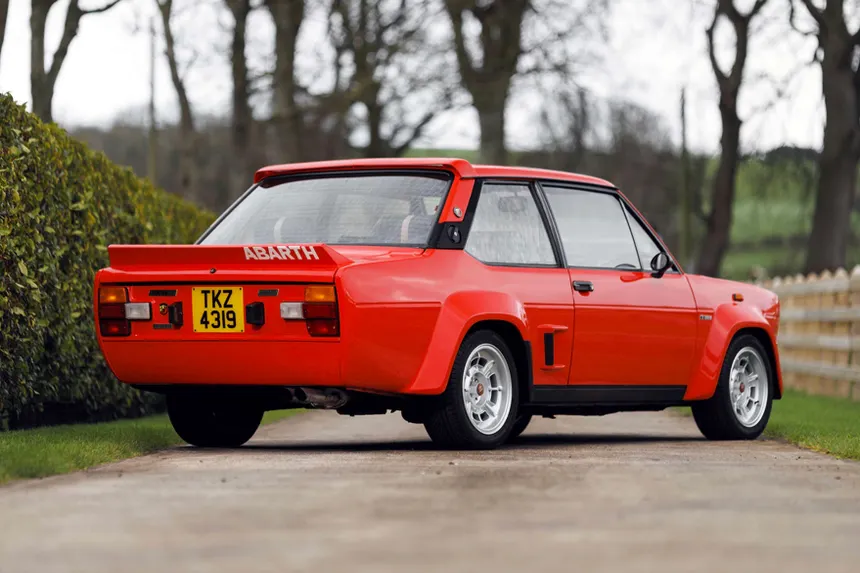
The plan was the X1/9, and it ended up being the 131
Here’s a detail that almost nobody mentions. Abarth’s original intention, when Fiat tasked the division with developing a successor to the 124 Abarth Rally, was to use the Fiat X1/9. The small Bertone-designed mid-engined coupe, with proper independent suspension and the right dimensions for a rally berlinetta. It made every kind of engineering sense.
Fiat killed it. The X1/9 was considered too low-volume and too expensive to homologate. Marketing analysts at the Turin headquarters argued that a rally winner needed to share its identity with a high-volume showroom model, not a niche sports car. The reasoning was old: win on Sunday, sell on Monday. People watching the 131 win a rally on Sunday would walk into a dealership on Monday and buy a base 131 Mirafiori with the 1.3-litre engine. The accounting on that, according to Fiat’s internal forecasts, generated more revenue than selling 500 X1/9s a year.
So in 1975 the chosen base became a three-box family saloon: front engine, longitudinally mounted, rear-wheel drive, live rear axle. The most improbable starting point in the world for a world rally championship project. On paper.
Three companies, three trades
The 131 Abarth Rally was not built by Fiat alone. It was built by three companies in parallel, each with a clearly defined task. The architecture of that arrangement deserves careful attention.
Bodyshells started on the Mirafiori production line as standard two-door 131s. In partially completed state (with the main shell assembled but without final trim), they were shipped to Bertone in Grugliasco. Bertone handled the entire visual and structural transformation. Plastic mudguards front and rear, widened to clear the broader track. Fibreglass replacement for bonnet and bootlid, produced by Turin boat-builder Cigala & Bertinetti, specialists in marine resin components. Aluminium door skins on standard steel frames. Side windows and rear glass replaced with Plexiglass.
But the most important Bertone modification was structural. The interior chassis pressings were reworked to accept an independent rear suspension based on MacPherson struts, in place of the live axle of the standard 131. This is the critical operation. Without that modification, the car would have been useless as a rally weapon. With it, the platform became serious.
Bertone painted and trimmed the cars internally. Only three colours were available from the factory: red, yellow and blue. From Grugliasco the painted shells were trucked to Fiat’s special plant in Rivalta. There they received the Abarth mechanicals: the engine (prepared by Lampredi and his team in Corso Marche 38 in Turin, an 11,000 square-metre facility with 350 employees), the five-speed non-synchronised dog-leg gearbox with Colotti ratios, disc brakes at all four corners, steering, and the rest of the competition equipment.
The road-going homologation engine was the Tipo 131 AR.000, derived from the Lampredi Twin Cam but with a new aluminium-alloy cylinder head featuring four valves per cylinder and dual overhead camshafts. Displacement was extended to 1,995 cc (stroke lengthened to 90 mm, bore unchanged at 84 mm), compression ratio 10:1, wet-sump lubrication, a single Weber 34 ADF twin-choke carburettor, 140 hp at 6,400 rpm and 172 Nm at 3,600 rpm. Five-speed gearbox. Rear-wheel drive. Disc brakes all round.
Exactly 400 units were produced to meet FIA Group 4 homologation requirements. Of those, 350 were sold through Italian Fiat dealerships to private customers. The remaining 50 went directly to Abarth for competition use.
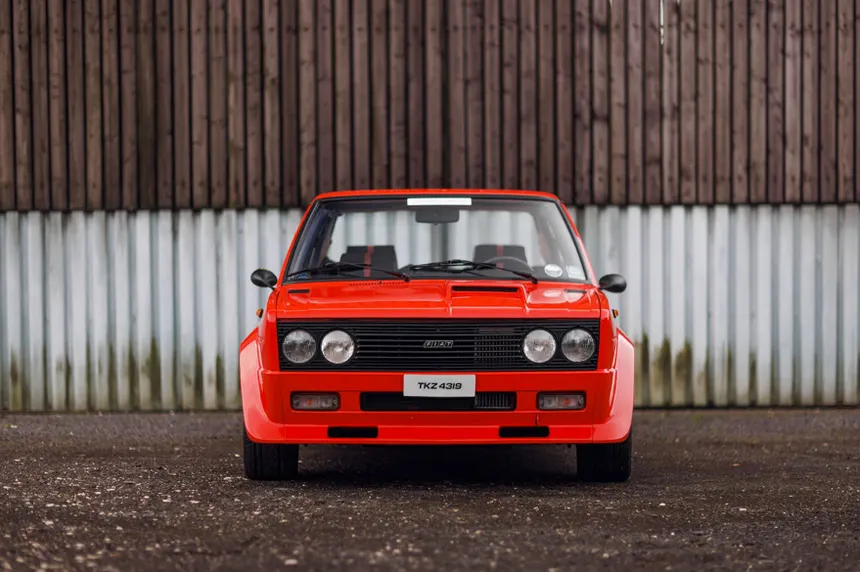
Homologation, first win, first title
On 1 April 1976 the 131 Abarth Rally received FIA Group 4 homologation. Nine days later, on 10 April, it was winning. Markku Alén and co-driver Ilkka Kivimäki took the Elba Rally in Italy. In August, the same pairing scored the car’s first world-rally victory at the 1000 Lakes in Finland. In October, Bacchelli and Rosetti won the British RAC Rally. The 131 was ready before the season for which it had been designed had even begun.
In 1977 the car entered the WRC for a full assault. Five wins in ten contested rounds: Portugal, South Pacific, Quebec, San Remo and Corsica. Manufacturers’ Title secured against the Ford Escort RS1800 by a margin of four points. The first championship for Fiat with the 131 was done. Sandro Munari took the individual Drivers’ Title that year in a Lancia Stratos (Fiat and Lancia had merged their racing operations at the end of 1976 into the EASA structure), but the constructor was Fiat. Lampredi’s department in Turin had delivered.
In 1978 they repeated. Seven victories. Markku Alén won the FIA Cup for Drivers (the precursor of the modern Drivers’ Championship) at the wheel of the 131. And the livery changed: from the Olio Fiat blue-and-yellow of the early seasons to the red-white-and-green of Alitalia, the Italian airline that piggybacked on the 131’s image for its own marketing. The Alitalia livery has since become one of the most iconic colour schemes in the entire history of rallying. People who have never seen a 131 Abarth in person recognise those colours immediately.
In 1979 Fiat finished second (Ford won with Björn Waldegård), but in 1980 they came back for the title. And that’s where Walter Röhrl enters.
Röhrl, 1980, and the car without a livery
Walter Röhrl was born in Regensburg in 1947, son of a stonemason, professional ski instructor until his early twenties, and a rally driver with technical precision that his rivals described as inhuman. His permanent co-driver from 1977 onwards was Christian Geistdörfer. In 1980 he signed for Fiat to contest the WRC in a 131 Abarth Rally. By the end of the season, freshly turned 33, he had become the youngest world rally champion in history up to that point.
The title was decided at the San Remo Rally in October 1980. And the story around that victory is one of the great rally anecdotes.
When Röhrl was preparing to travel from Turin to the south for San Remo, the Fiat factories were on strike. Workers had physically blocked the exit of competition cars from the plant as part of their labour action. To avoid the conflict, the team smuggled Röhrl’s 131 out at night, without livery, without stickers, without anything identifying it as a works car. Just the chassis, the base colours, and the Abarth scorpion where it belonged.
That same car, additionally, had been assigned to Röhrl by the Jolly Club (one of Fiat’s official satellite teams) and it was fitted with the short-travel suspension designed exclusively for tarmac stages. San Remo is not all tarmac. There are broken stages, gravel, stone. But Röhrl didn’t complain. He climbed in, drove the way only Röhrl could drive, and won. With no livery, with the wrong suspension for half the rally, with the factory on strike behind him. That victory gave him the WRC Drivers’ Title and gave Fiat its third and final Manufacturers’ Title.
The actual car with which Röhrl won San Remo 1980 still exists, fully restored, and surfaces occasionally at auctions with asking prices approaching USD 400,000.
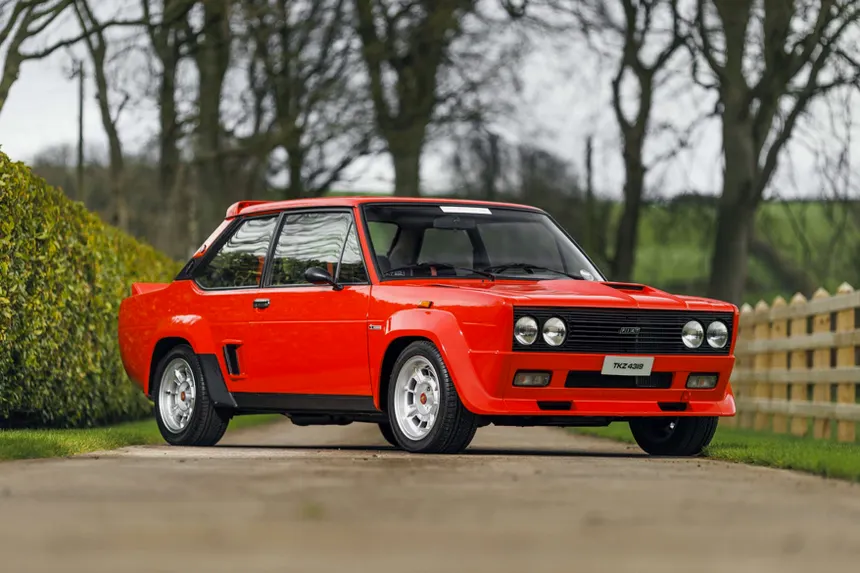
What was actually inside
It’s worth pausing on the competition-spec engines, because the 140 hp figure of the road car massively undersells why this car won world championships.
In race trim, the block remained the 131 AR casing but everything else was redesigned. Kugelfischer mechanical fuel injection in place of the Weber carburettor. New connecting rods and pistons. Magnesium slide throttles. Larger valves. Hand-ported heads. New ignition system. Dry-sump lubrication.
Power evolved over the years. The earliest 1976 cars delivered around 215 hp. By 1980, the cars Röhrl drove to the championship were running 240 hp. Röhrl himself confirmed in a later interview that he had seen dyno figures of 236 hp consistently. Modern restorers working with the late-specification components have reported 245 hp straight off the bench. From two litres, four cylinders, naturally aspirated, in 1980. That is serious engineering.
The gearbox was a five-speed non-synchronised dog-box, with Colotti ratios tailored to each event. Drivers had to double-clutch through every shift. Drive remained rear-wheel, without a limited-slip differential in the earliest cars (later versions had one). Brakes were ZF on the later works cars, with twin-circuit hydraulics and remote master cylinders.
And all of this sat on top of a car weighing 980 kg in road-homologation trim. In competition trim, weight dropped to 940-950 kg depending on the rally. A power-to-weight ratio of roughly 4 kg per horsepower on a three-box rear-drive saloon. Modern turbo hot hatches deliver similar numbers today. In 1980 it was diabolical.
The sound of the Lampredi
There’s a detail that the technical sheets never mention, and that was exactly what set the 131 Abarth Rally apart from any other car on a timed stage. The sound.
The Lampredi Twin Cam in the 131, in competition trim, was a two-litre with a sixteen-valve cylinder head, Kugelfischer mechanical injection instead of the road car’s Weber carburettor, magnesium slide throttles replacing conventional butterflies, and an exhaust effectively unmuted from the manifold onwards. Abarth recommended a maximum engine speed of 8,500 rpm. The Lampredi’s useful power band sat between 7,000 and 8,000 rpm, with the curve only really waking up beyond 6,000.
That, translated into noise, produces three things at once. First, the high, clean register of a 1970s Italian four-cylinder: that dry, mass-free bark that distinguished the Fiats and Alfas from American V8s or German straight-sixes. Second, the instant intake response of magnesium slide throttles. Unlike carburettors, which deliver air with some hysteresis, slide throttles open and shut abruptly. Every input is an audible gulp of intake, almost a crack. And third, the unmuted exhaust, which at 8,000 rpm transitions from growl to sustained scream, high-pitched and unfiltered.
The result is a sound that anyone who attended a 1970s rally describes as “rasping” or “barking”. Not the low rumble of an eight-cylinder. Not the deep purr of a six. A metallic, high, almost violent noise, with a characteristic crack every time the driver lifted off between gear changes. Markku Alén, on Finnish high-speed stages, kept the engine pinned against the limiter for whole minutes at a time. That sound, heard through the trees of a Jyväskylä forest at eleven at night, was the soundtrack of an entire chapter of European rallying.
And precisely because it sounded that way, it was recognisable from kilometres away. On a 1000 Lakes timed stage, before the car was visible, you already knew it was a 131 Abarth coming.
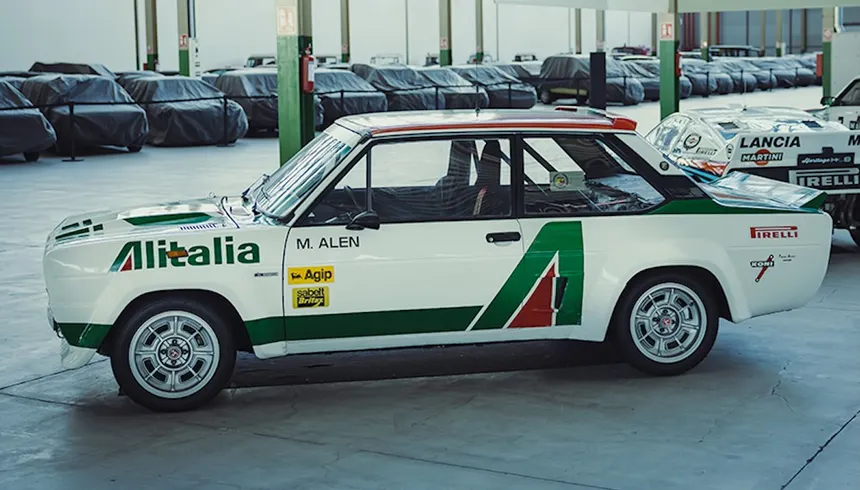
Bertone and the shape
Some cars look as if they were designed specifically for the act of jumping off a rock on a gravel stage. The 131 Abarth Rally is one of them. The boxed wheelarches, that snowplough front bumper with two brake-cooling intakes, the blanked-off scoops on the flanks and bonnet (most of them aren’t real intakes, they’re aesthetic), the dual-element rear wing with the roof-mounted bridge spoiler and the secondary boot-lid element, the quad Cibié round headlamps, the 15-inch wheels wrapped in 195/50 Pirellis.
All of that cosmetic work is Bertone. The Turin design house that in those years was simultaneously working on the Lancia Stratos, the X1/9, the Citroën BX, the Lamborghini Bravo. The most prolific bodyshop in the world at the time. And the styling brief for the 131 came from a team operating under a strict cross-instruction: “stay as close as possible to the base model, both in parts choice and physical appearance.” But at the same time, visually transform the car into something that looked like an animal.
The result works because it retains the original three-box silhouette. It isn’t a fantasy car, it isn’t a coupe pretending to be a saloon. It is a Fiat family saloon, swollen to where the steel will allow, with every additional centimetre dedicated to housing more wheel, more brake, more cooling. It is honest about what it is. And that’s why, even today, you can park one at a gathering and people instantly understand what it was built for.
The end of the line
The 131 Abarth Rally’s career ended in 1981. That year Talbot won the WRC with the Sunbeam Lotus. In 1982 came Group B, and with it the Audi Quattro with all-wheel drive, the Lancia 037 (still RWD but now supercharged) and the new era of nearly-unrestricted technical regulations. Front-engine, rear-wheel-drive cars became obsolete in a single season. Fiat made some attempts at evolution, including V6 prototypes that proved too heavy, but nothing reached official competition.
Between 1976 and 1981, the 131 Abarth Rally won eighteen WRC-qualifying rounds. Three Manufacturers’ Titles (1977, 1978, 1980). One Drivers’ Title (Röhrl, 1980). The three drivers who define the car best are Markku Alén, the Finn who won four 1000 Lakes and three Portugal events with it and remains its definitive interpreter; Walter Röhrl, the German of inhuman precision who extracted from the 131 its only Drivers’ Title; and Michèle Mouton, the French driver who won the 1978 Tour de France Automobile with it, one of the rare championship-round victories for a woman in that era of rallying.
And then, silence. Lancia took over within the Fiat group with the 037 first and the Delta afterwards. Fiat as a brand never returned to the WRC with serious intent. The 131 Abarth Rally remains the last Fiat to win a world rally championship, the last three-box family saloon to dominate the top category, and the final great chapter of rear-wheel drive in rallying.
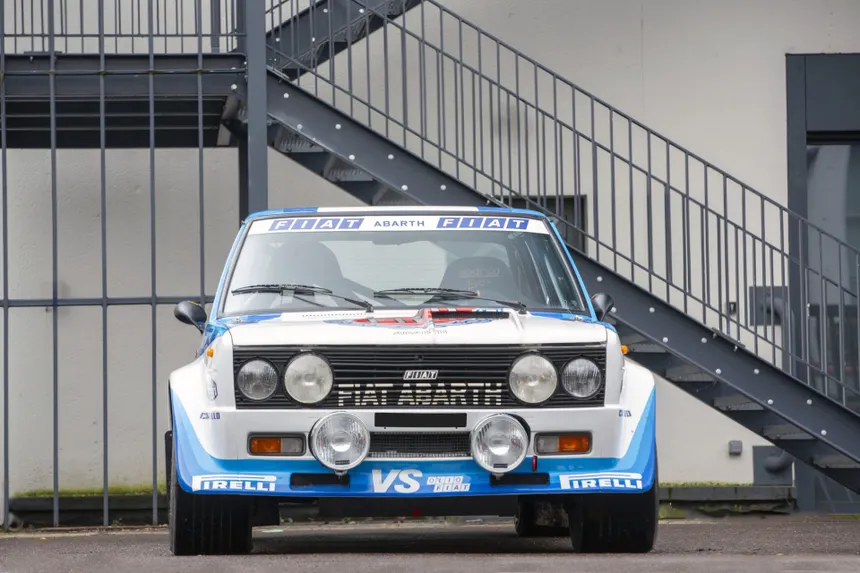
The saloon with four signatures
What makes the 131 Abarth Rally a fascinating object isn’t just its results. It’s the number of hands that touched the car for it to exist.
The bodywork is Bertone. The Italian design house behind the Stratos and the X1/9, reworked to handle the wider track and the independent rear suspension. The aluminium doors and Plexiglass windows come from that thread of artisanal coachwork thinking.
The engine is Lampredi. The man who designed the Ferrari V12 that won Maranello’s first Formula 1 race in 1951, and then spent thirty years at Fiat building the most successful four-cylinder rally engine ever made.
The concept is Abarth. The Turin workshop that Carlo Abarth founded in 1949 and that for two decades had been turning ordinary cars into competition weapons, before passing into Fiat hands in 1971 while keeping the scorpion as its symbol. The scorpion logo sits on the doors of every 131. As it should.
And the business case is Fiat. The decision to use the 131 Mirafiori as the rally base, instead of the X1/9 that engineering logic suggested, came from the marketing analysts at the Turin head office. And it worked. For six years, Italian Fiat dealerships sold 131 Mirafioris at the pace they wanted, because every Sunday a works 131 Abarth was winning a rally somewhere in the world. Agnelli’s calculation paid off.
The 131 Abarth Rally is the kind of car that exists because an Italian industrial group decided, at a specific moment, that spending the money was worth it. It isn’t a car that expresses any individual engineer’s or designer’s personality. It is corporate, top to bottom. Designed by committee. Signed off by accountants. And precisely because of that, extraordinarily good: because when that 1970s Italian industrial committee decided to build a competition car, they did not save a single lira.
Aurelio Lampredi retired from engine design in 1977 but stayed on as director of Abarth Rally until 1982. When he left, the Twin Cam’s championship-winning era ended. Carlo Abarth had died three years earlier in Vienna, far from Turin. Bertone continued producing important cars until its decline in the 2000s. And the regular 131 Mirafiori, the one your father drove to the shops, went out of production in 1984.
But the 131 Abarth Rally stayed. As the last car with which Fiat won anything significant in competition. As Aurelio Lampredi’s final great chapter. As the family saloon that, for six years, was the most complete rally car in the world. And as one of the few cases in automotive history in which a pure, calculated, planned corporate operation produced an object that can only be described by one word: legend.