AUDI RS2: The Audi That Porsche Built
How a five-door family wagon embarrassed the McLaren F1 at the traffic lights
Stand at a traffic light in 1994. To your left, a McLaren F1. To your right, what looks like a slightly aggressive Audi 80 wagon. The lights go green. For the first 1.5 seconds, the wagon wins. By a tenth and a half. After that, the F1 disappears into the distance and the wagon driver is left with the receipts. But for that brief, glorious moment between zero and 30 miles per hour, the most powerful production car in the world was beaten by something a family of four could load up with shopping bags.
This isn’t a forum legend. It’s a number measured by Autocar magazine in 1995, with proper timing equipment, on a proper test track. 1.5 seconds for the Audi RS2 Avant. 1.7 seconds for Gordon Murray’s V12 hypercar. Two-tenths might not sound like much. They are, in fact, one of the most beautiful footnotes in the history of the automobile.
The man with the surname and the man with the empty factory
To understand the RS2 you have to walk into Ferdinand Piëch’s office in 1992. Grandson of Ferdinand Porsche. Nephew of Ferry Porsche. Engineer trained at ETH Zurich. Father of the Audi quattro and of the five-cylinder engine as a brand identity. A man who, for two decades at Audi, had dragged the four rings out of the German premium third-place purgatory and made the company impossible to ignore. By 1992 he was already preparing his move upstairs, to the chairmanship of the Volkswagen Group, where he would go on to consolidate Bentley, Bugatti, Lamborghini and Porsche under a single corporate roof.
Before leaving Audi, Piëch wanted to plant one last flag. A fast family wagon. A car that would shatter the assumption that performance and practicality were mutually exclusive. Something that would put a serious dent in the BMW M5 Touring’s claim to that nascent segment. The problem: Audi’s engineers were drowning. The new A4, A6 and A8 were in development simultaneously, three platforms that would define the brand for the next decade. There were no hands available for a halo-project wagon. Piëch picked up the phone. He called his family.
Porsche was bleeding out
In 1993, Porsche sold 21,124 cars globally. By 2019 that figure would be 281,000. In other words, the Stuttgart marque was running at 7.5% of its eventual capacity. The 911 was in its final air-cooled iteration. The 968 was a facelift of the 944, which was a derivative of the 924, a car launched in 1976. The pipeline was thin. The order book thinner. The company was, by most accounts, two or three quarters away from selling itself to someone with deeper pockets.
What was keeping the lights on at Zuffenhausen was Porsche Engineering: the contract development arm. Porsche designed and built things for other people when nobody at home was placing orders. The biggest such project of the early 90s had been the Mercedes-Benz 500E, an extraordinary piece of industrial logistics: W124 bodies shipped from Sindelfingen to Zuffenhausen, hand-assembled at the Reutter-Bau plant, shipped back to Sindelfingen for paint, returned to Zuffenhausen to the Rössle-Bau building for final assembly and engine installation, then sent one final time to Sindelfingen for delivery preparation. Eighteen days per car. Four cross-city journeys per chassis.
In April 1995 the last 500E rolled out of the Rössle-Bau, ending the contract. It left behind an empty building and a team that had spent four years learning how to build cars the proper way, without watching the clock. The team led by Michael Hölscher, who had been Porsche’s project manager on the 500E.
Piëch made his call at exactly the right moment.
P1
The project entered Porsche’s books under an internal designation: P1. The P stood for Porsche. The 1 meant it was the first. Twenty years before McLaren registered the same name for a hybrid hypercar, there was already a P1 quietly being assembled in southern Germany. A family wagon dressed as a regular Audi.
The donor car was the Audi 80 Avant B4. Mid-sized, front-engined, available with optional all-wheel drive, 4.48 metres long. Nothing exceptional about its silhouette. The donor engine was equally familiar: Audi’s 2,226 cc inline-five with 20 valves, an architecture the company had pioneered in the late 1970s and which by 1992 was producing 230 hp in the S2 Avant. Audi built these engines specifically for Porsche at the Salzgitter plant and shipped them to Zuffenhausen.
Hölscher had a brief: extract 30 percent more power. He overshot it. The KKK turbocharger was replaced by a unit 30 percent larger, running 1.4 bar of boost instead of the S2’s 1.1 bar. The intercooler grew significantly. Higher-flow injectors went in. A new camshaft profile. A redesigned induction system. A free-flowing exhaust manifold. And a modified Bosch URS4/URS6 engine management system from the S4 and S6 family, recalibrated for the new hardware.
The result: 315 hp at 6,500 rpm. 302 lb-ft at 3,000 rpm. In a car weighing just over 1,600 kg. Connected to a bespoke six-speed manual transmission, the only gearbox available, that fed a Torsen-based quattro all-wheel-drive system with a rear electromechanical locking differential.
The numbers everyone quotes: 0-62 mph in 4.8 seconds. Top speed electronically limited to 262 km/h (163 mph), though independent tests recorded up to 166 mph with the limiter removed. Quarter mile dispatched in 13.6 seconds at 102 mph. Through 100 mph in 13.1 seconds. The first Audi to break the 250 km/h production barrier. Faster than any 911 of that year except the Turbo. Equal acceleration figures to a contemporary Porsche 928 GTS, a car that cost considerably more.
And then, of course, the 1.5-second sprint to 30 mph. The number that gave the Autocar test its famous headline. Faster than the McLaren F1. Faster, as the magazine pointedly noted, than Jacques Villeneuve’s Formula 1 car of that season. The reason was traction. Four driven wheels working through a Torsen differential put 315 hp on the road with no slippage and no theatre. The F1, putting 627 hp through two rear wheels, was lighting them up. The RS2 was hooking up and leaving. By the time both cars reached 50 mph, the order of finish had reversed permanently. But until then, the wagon was the fastest thing on the road.
How you build a car when nobody’s checking the clock
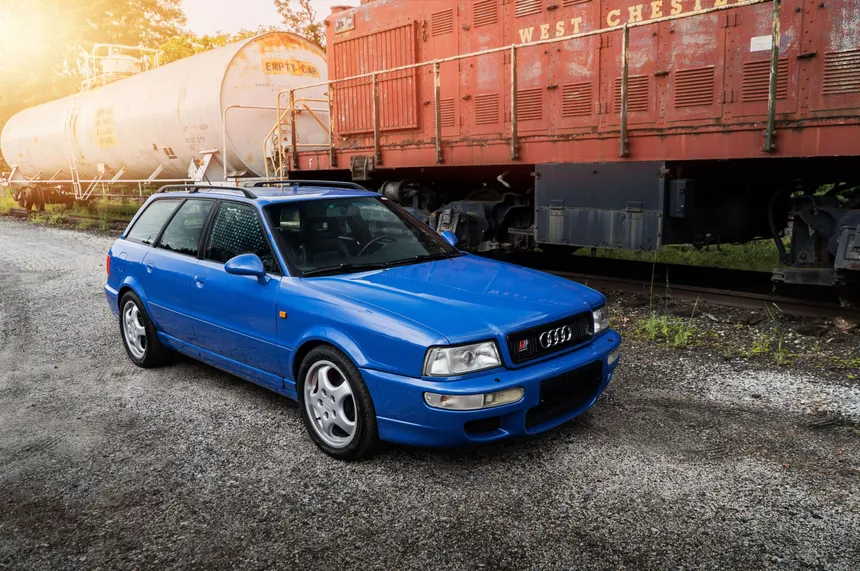
The Rössle-Bau at Zuffenhausen is not a large building. It has no robotic assembly line, no automated paint shop, no overhead conveyor. It is, in essence, a hand-build facility. Cars move between stations at the pace of human assembly. Operators work with calipers and torque wrenches and the kind of pace that lets you actually look at what you’ve done before moving on. The 959 was assembled there. The 500E was assembled there. And between June 1994 and July 1995, exactly 2,891 RS2 Avants were assembled there too. Of those, only 180 were right-hand drive, distributed between the UK, Hong Kong, South Africa and New Zealand. Four were built as saloons rather than wagons, on special order, outside the catalogue.
The arrangement was straightforward. Audi sent painted bodyshells from Ingolstadt to Zuffenhausen, along with any components that could be transferred from existing models. Porsche supplied everything else: the modified engine, the gearbox, the suspension hardware, the brake system, the wheels, the badging, the trim. According to Hölscher’s own estimate, around 20 percent of the finished car was Porsche-developed. None of it was hidden.
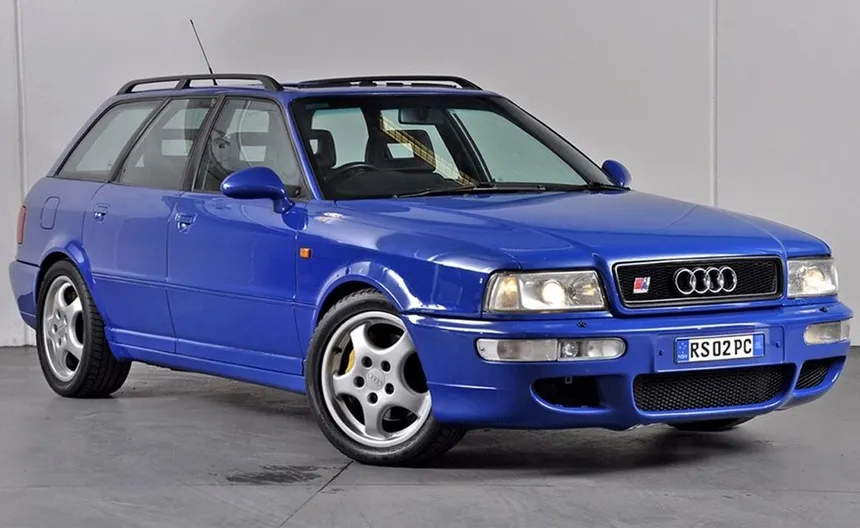
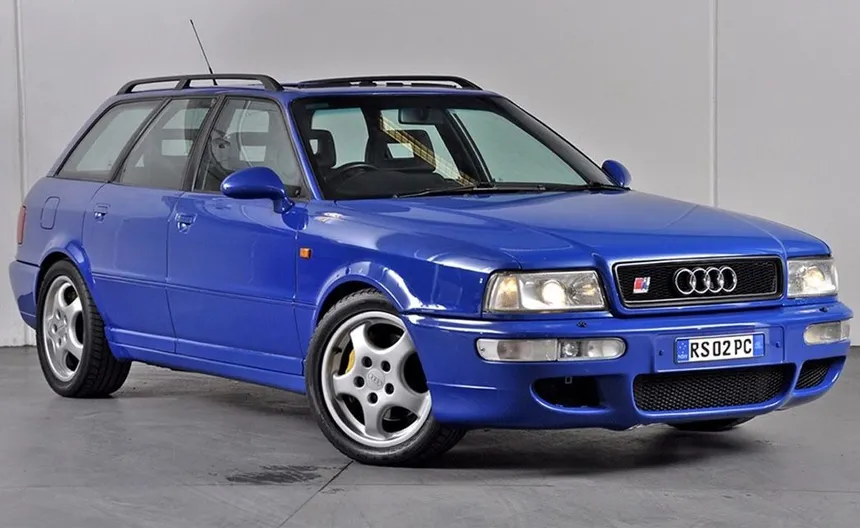
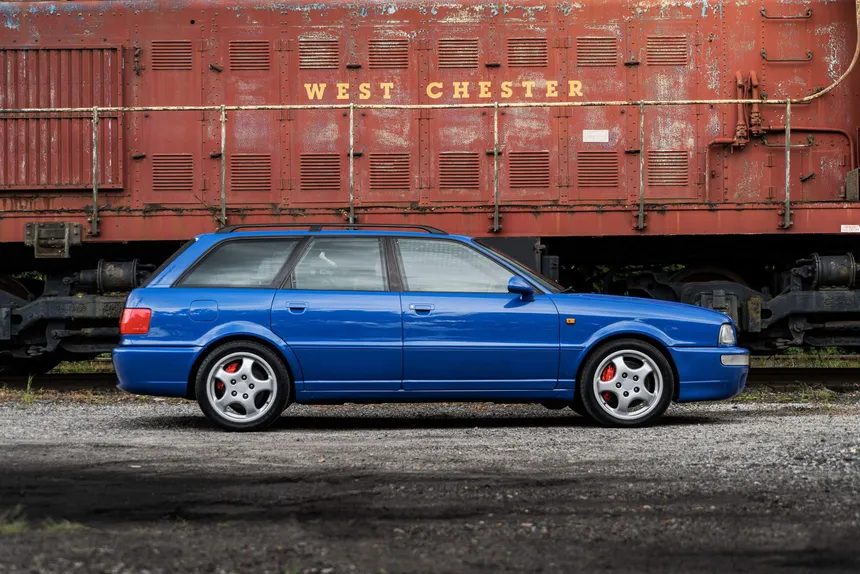
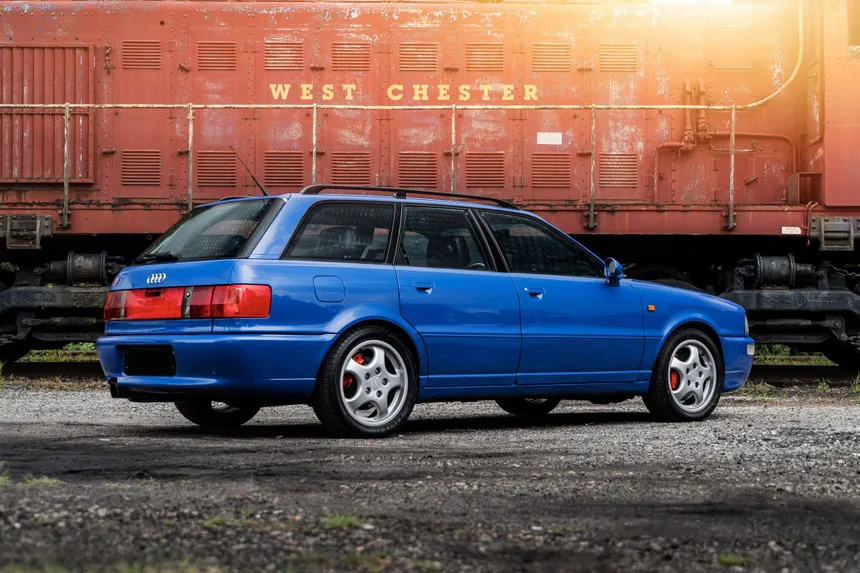
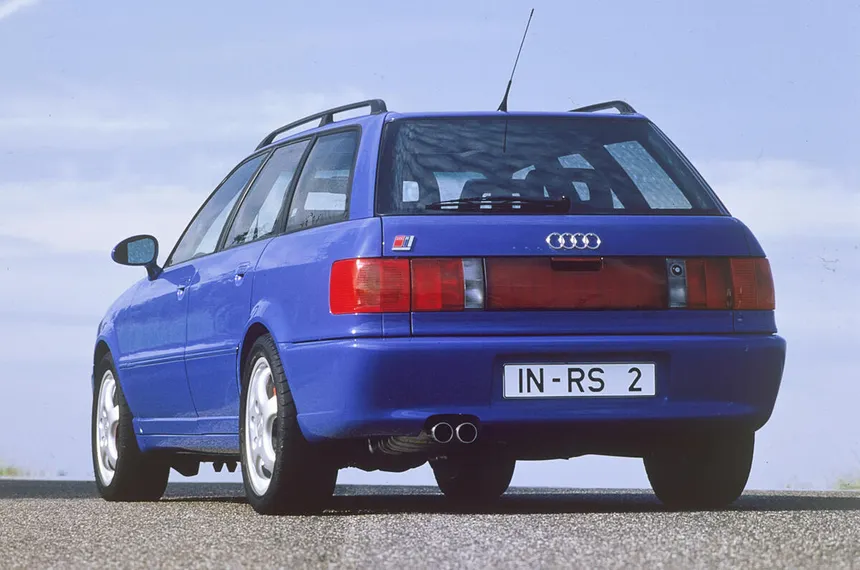
The wheels are 17-inch Porsche Cup, the same design used on the 964 Turbo and the 968 Clubsport. Stamped Porsche. Wrapped in Dunlop 245/40 ZR17 tyres. The brake calipers are Brembo four-piston aluminium units finished in red and engraved with Porsche script. The front discs measure 304 mm with an optional 322 mm upgrade. The rears measure 299 mm. The wing mirrors are lifted directly from the 911 Turbo of the same era, slightly small for the Audi body and therefore recognisable at fifty metres. The front turn signals and fog lamps come from the 964 and 993. The prismatic light bar across the tailgate is a nod to the Carrera 4. The suspension sits 40 mm lower than a standard 80 Avant, with Bilstein gas dampers and uprated springs. Recaro sport seats inside, finished in blue or grey Alcantara, with optional black Nappa leather. Wood or carbon fibre dash inserts. The cam covers wear a Porsche badge. So does the steering wheel. So does the boot lid. So does the grille badge, where the R and the S2 are separated to indicate this is the Renn (racing) version of the existing S2.
Every car received a numbered plaque on the centre console identifying its production sequence. Like a 959, in miniature wagon form.
The shared shed
Here’s the detail that makes the RS2 unforgettable for anyone who pays attention to where things are built. In January 1995, while the final 120 examples of the Mercedes-Benz E500 Limited were being completed at the Rössle-Bau, the first RS2s were already being assembled in the same building, by the same workforce, using the same tools. For several months, Porsche’s hand-build facility was simultaneously producing two of the most significant German cars of the decade. Two utterly different machines, made by the same hands, in the same room.
Very few automotive production facilities in modern history can claim that combination. The Rössle-Bau can. And it explains why an RS2, when you close its door, feels different from a regular Audi 80 of the same year. The panel gaps are tighter. The seals seat with more deliberate pressure. The trim sits flush in a way that mass-produced cars of that era never quite achieved. It isn’t Audi quality control. It’s Porsche craftsmanship, applied to a wagon, by a team that had spent four years building Mercedes 500Es immediately beforehand.
The five-cylinder thing
The RS2’s engine is the Audi 034 ADU. A 2,226 cc inline-five with 20 valves and a turbocharger the size of a small terrier. The five-cylinder configuration deserves its own paragraph, because it is genuinely one of the strangest architectures in mainstream automotive engineering.
A five-cylinder isn’t a small six or a big four. It is a deliberate compromise that produces secondary balance behaviour neither layout can replicate. The firing order is 1-2-4-5-3, which sounds like nonsense until you understand why it works. The sound is unmistakable: a throaty warble that sits somewhere between an inline-six and a tractor, distinct enough that you can identify a five-cylinder Audi from across a car park without seeing it.
Audi pioneered the five-cylinder in passenger cars with the 100 5E in 1976, refined it through the quattro rally programmes of the early 1980s, and made it a brand signature for two decades. The RS2’s engine is the last of the proper, naturally-developed five-cylinder applications before the architecture went into hibernation, replaced by V6s. It re-emerged in 2009 with the TT RS and RS3 generations, now as a deliberate retro flourish rather than a default solution. But the RS2 caught the original five-cylinder at its absolute peak: maximum boost, maximum compression management, maximum extraction from a unit that wasn’t designed for any of it.
The character of the engine matches the bare numbers exactly. Below 3,000 rpm, very little happens. The 30-percent-larger KKK turbocharger needs serious exhaust flow to wake up. Above 3,500, everything arrives at once. 302 lb-ft of torque against the seatback. The Porsche Cup wheels suddenly looking smaller in the rearview mirror of whoever was next to you. The five-cylinder warble climbing through to 6,500 rpm before the next shift. It isn’t linear power delivery. It isn’t modulated. It isn’t refined. It’s old-school turbocharged violence, the way it used to be done, and it remains exhilarating thirty years later precisely because no modern car will ever feel that way again.
The engine itself is famously bulletproof. Despite running peak boost pressures that would shame many contemporary tuned cars, examples with 150,000 miles on the original short block are common. What fails over time is peripheral: the wastegate actuator, the mass airflow sensor, the ageing turbo seals if oil changes have been neglected. The block, the crank, the connecting rods, the cylinder head, all of them outlast their owners.
How it actually drives
This is where the car explains itself, and where the official legend meets the road testers’ notebooks. Because in 1994 the RS2 had the reputation of being the fastest thing off the line in Europe. And the reputation of having a steering rack that didn’t quite live up to the rest of the package.
The verdict is remarkably consistent across thirty years of reviews, from the original Autocar tests to the contemporary retro drives. The RS2’s steering carries proper weight. It is unmistakably tuned for something faster than a standard 80 Avant: more body, more substance, sharper turn-in at the straight-ahead position than the soft, vague centre that plagued so many German cars of the period. The wheel self-centres correctly. The first inputs into a corner come back crisp and direct, with no dead patch around centre. So far, so good.
The problem is feedback. There is weight, there is precision, but there is almost no information coming up through the column from the contact patches. Evo magazine described it as “relatively weighty steering, though it lightens up a bit when you push on, but feel is noticeable only by its absence.” Octane Magazine used the blunter word: “dead-feeling steering came in for criticism.” Retro Motor concluded “the nicely-weighted steering is sadly devoid of any meaningful feedback.” It is the most repeated criticism in serious road tests of the car, and it has been the same criticism for three decades.
The reason is structural. The five-cylinder sits longitudinally and unusually far ahead of the front axle, the classic congenital quirk of Audi quattros from that period: heavy engine forward of the steering wheels, nose pulling the car through corners rather than following them. That weight bias kills the steering’s ability to transmit what the front tyres are actually doing. You know where you’re pointing, but you don’t know how much grip remains, you don’t know when the limit is approaching, and you don’t know what the road surface is asking from the suspension underneath.
In normal fast driving, this is invisible. The Torsen quattro grips so hard, and the suspension is so composed, that the car corners with absolute conviction and explodes out of bends as if physics were optional. The trouble is that when you push the RS2 to its actual limit, you can’t feel where that limit is. The car doesn’t warn you. When it lets go, it lets go without notice. It is a steering rack tuned to make the car feel solid at autobahn speeds, not to make it communicative on a B-road.
Everything else around the steering, however, is well-judged. The body feels safe-deposit-vault solid. The car is small by modern standards (4.58 m long, 1.70 m wide, narrower than a contemporary Honda Fit), visibility is excellent, the Recaro seats hold you exactly where they should, and the bespoke six-speed manual has a short, satisfyingly mechanical action. There is some body roll. Damping is firm but not perfect over mid-frequency bumps. The B4 chassis transmits more of the road surface than a modern car would. But all of that is secondary.
What matters is this: the RS2 asks you to trust its grip and to read its behaviour by intuition rather than by feel. You drive it with your head, not with your hands. And once you learn how it works, you discover that it’s exactly the kind of car it needed to be. A machine that fires forward with everything it has, no permission asked, and leaves you to manage the rest.
What it cost and why it never came to America
Just under DM 100,000 in Germany at launch. Around £45,000 in the UK. Roughly USD 51,000 at the time. By way of comparison, a Mercedes 500E sat at USD 80,000 and a Porsche 911 Carrera was around USD 65,000. Audi’s plan was to build 2,200 units. Demand pushed production to a final figure of 2,891 cars, produced over sixteen months between March 1994 and July 1995.
The United States never received the RS2. The NHTSA decided the car didn’t meet US homologation requirements, and Audi calculated that adapting a 300-unit run for American compliance would lose money. Audi at the time was also still trying to recover from the unintended acceleration claims that had crippled the 5000 in the American market during the 1980s. The brand wasn’t in a position to fight regulatory battles. Today, under the 25-year import rule, RS2s enter the United States legally and command serious money: clean cars trade from around USD 50,000 upwards, with low-mileage collector examples reaching six figures.
What changed forever
The RS2 isn’t just a rare, expensive curiosity from the 1990s. It is the precise moment Audi became the brand it is today.
Until 1994, Audi occupied an unconfident third place in the German premium hierarchy. Technically interesting because of quattro and the five-cylinder, but never quite serious about performance the way BMW and Mercedes were. The RS2 changed that. It opened a performance department that has never closed since. The RS4 followed in 2000, the RS6 in 2002, and then the entire Audi Sport range up to today’s RS3, RS7 and RS Q8.
Without the RS2 there is no RS6 Avant. Without the RS6 Avant there is no fast-wagon segment in the modern sense. Without the segment, BMW doesn’t keep building M5 Touring variants, Mercedes doesn’t bother with E63 Estates, Volvo doesn’t develop the V70 R or the Polestar wagons. The entire premise that a practical car can also be brutally fast, that the school run and the autobahn don’t require two separate vehicles, traces back to a building in Zuffenhausen and to a contract Hölscher’s team executed between June 1994 and July 1995.
Inside Audi, the RS2 also functioned as internal proof. Proof that the five-cylinder could be a serious performance tool. Proof that quattro was a structural competitive advantage. Proof that build quality could match anything coming out of Stuttgart. Piëch had spent twenty years preparing the ground. The RS2 was his last harvest at Audi before moving to Wolfsburg to build the modern Volkswagen Group as we now know it.
The car as a physical object
Park an RS2 today and almost nobody turns their head. That’s exactly its merit. It looks like a normal Audi wagon from the mid-1990s, with mid-1990s proportions and mid-1990s graphics. Only the trained eye picks out the slightly undersized mirrors, the prismatic taillight bar, the wheels that look more 911-Turbo than Audi-Avant. If you walk up closer, the red Brembo calipers confirm the suspicion. If you lift the bonnet, the Porsche-stamped cam covers complete the story. And if you climb in and start it, the five-cylinder does the rest.
It isn’t a perfect car. The steering, as we have already explained, doesn’t tell you what the tyres are doing. The limits are extraordinarily high but they arrive without warning. The turbo lag is exactly the turbo lag that 1994 offered, with all its drama and all its frustrations. But that imperfection is precisely the point. The RS2 demands that you learn it. That you read it. That you respect it. And when you do, you find yourself driving a very specific piece of history.
A piece of history made when Porsche was nearly bankrupt and Audi wasn’t yet Audi, and out of that intersection emerged a car that probably shouldn’t have existed. A 315-hp wagon, hand-built in Zuffenhausen by the same team that built the Mercedes 500E, with a six-speed manual gearbox, four driven wheels, a turbocharged five-cylinder, and an RS badge that didn’t exist before and is now everywhere.
The P in the title
The P1 was for Porsche. It was also for Piëch. The grandson of Ferdinand Porsche who reorganised Audi, indirectly kept Porsche alive by handing them a contract when they were starving, and then walked across to Wolfsburg to consolidate everything under one corporate umbrella.
The RS2 is one of the very few cars in which the entire genealogy of modern German automotive engineering is visible in metal. Porsche blood in every component Hölscher’s team designed. Audi DNA in every decision involving quattro and the five-cylinder. Piëch’s shadow in the concept of the product as an absolute ego exercise. And the hands of the Rössle-Bau workforce, the small Zuffenhausen building where, for a few months, two of the most important German cars of the past three decades shared the same floor.
Only 2,891 people in the world can claim they own one. The rest of us can only tell the story.
And when we tell it, we remember that all of it started with one man named Piëch picking up a phone in Ingolstadt and calling his family in Stuttgart. Without that call, no RS2. Without the RS2, no RS6. Without the RS6, the fast estates of today look completely different. And almost certainly less interesting.