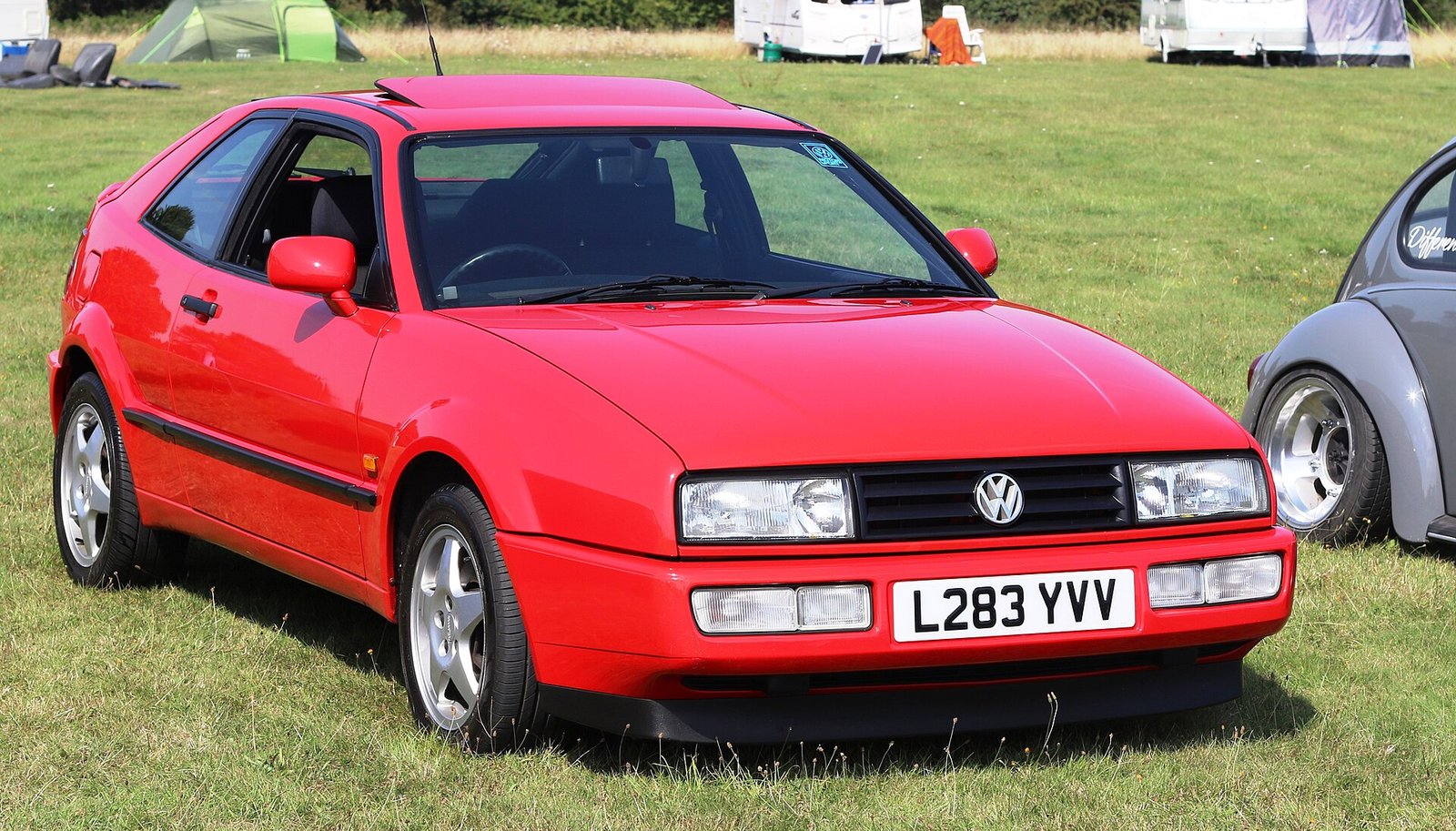
Of the 97,521 Corrados Karmann built between 1988 and 1995, roughly 50,000 were sold in the United States. More than half of a German coupe’s entire production ended up in American driveways. And yet ask most people over here about it today and you’ll get a blank look, or a "wasn’t that the one with the wing that pops up?"
It was. It was also one of the best front-wheel-drive driver’s cars of its decade, and the car that introduced Americans to the VR6. Here’s the whole story.
A Spanish name for a German coupe
The prototypes were called Taifun, German for typhoon. By launch the name had changed to Corrado, from the Spanish verb correr, to run. It fit a company that had already named cars after winds and currents: the Scirocco, the Passat, the Jetta.
The Corrado was supposed to be more than a Scirocco replacement. It was meant to be a step up: more upscale, more technical, more expensive. Production started in 1988 at Karmann in Osnabrück, the coachbuilder behind the Karmann Ghia, the convertible Beetles and the Golf Cabriolet. Every Corrado was built there.
Karmann itself didn’t survive the century that followed. The company went into insolvency in 2009, and Volkswagen took over the Osnabrück plant, which went on building cars for the group. The building where every Corrado was assembled is still a Volkswagen factory today, even if the name on the gate changed.
What was under the skin
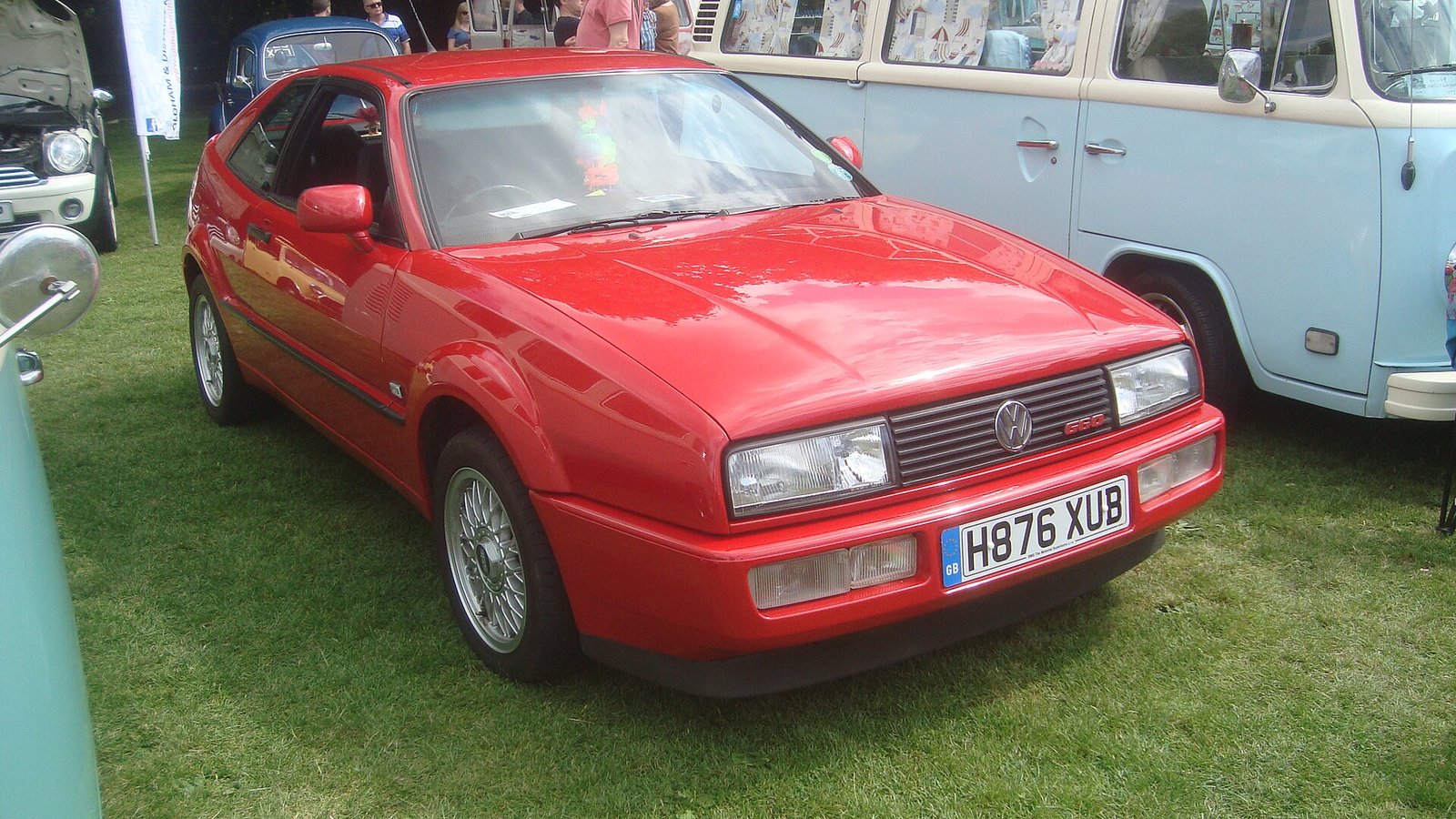
The Corrado sat on Volkswagen’s A2 platform, the same basic hardware as the second-generation Golf and Jetta that Americans knew well. Some of those Golfs had even been built in the US, at Volkswagen’s Westmoreland plant in Pennsylvania, which closed in 1988, the same year Corrado production started in Germany. The VR6 cars got parts from the next generation, the A3: the rear axle and a modified front axle, plus wider front fenders, a new front bumper and a raised hood to clear the engine.
Herbert Schäfer penned a body with tight lines, flush glass, pronounced wheel arches and a chopped tail. It looked fast parked at the curb, and it still does. And then there was the trick everyone remembers.
The wing
The Corrado had an active rear spoiler. In Europe it rose automatically above 100 km/h, about 62 mph. American cars were set to raise it at 45 mph. Below roughly 15 mph it tucked itself away again, and a switch on the dash let you raise or lower it whenever you wanted, which is exactly what every owner did at every stoplight.
Why bother? At speed, air flowing over a car’s roof and down the back speeds up and creates low pressure, which tries to lift the rear end, the same effect that holds an airplane up. A small lip or wing disrupts that flow and pushes the tail back down, making the car steadier at highway speeds. Hide it at low speed and you keep the clean look and lower drag around town.
At the time, that kind of thing belonged on a Porsche. Volkswagen put it on a car you could buy at the same dealer that sold you a Jetta.
The G60: a supercharger with a snail inside
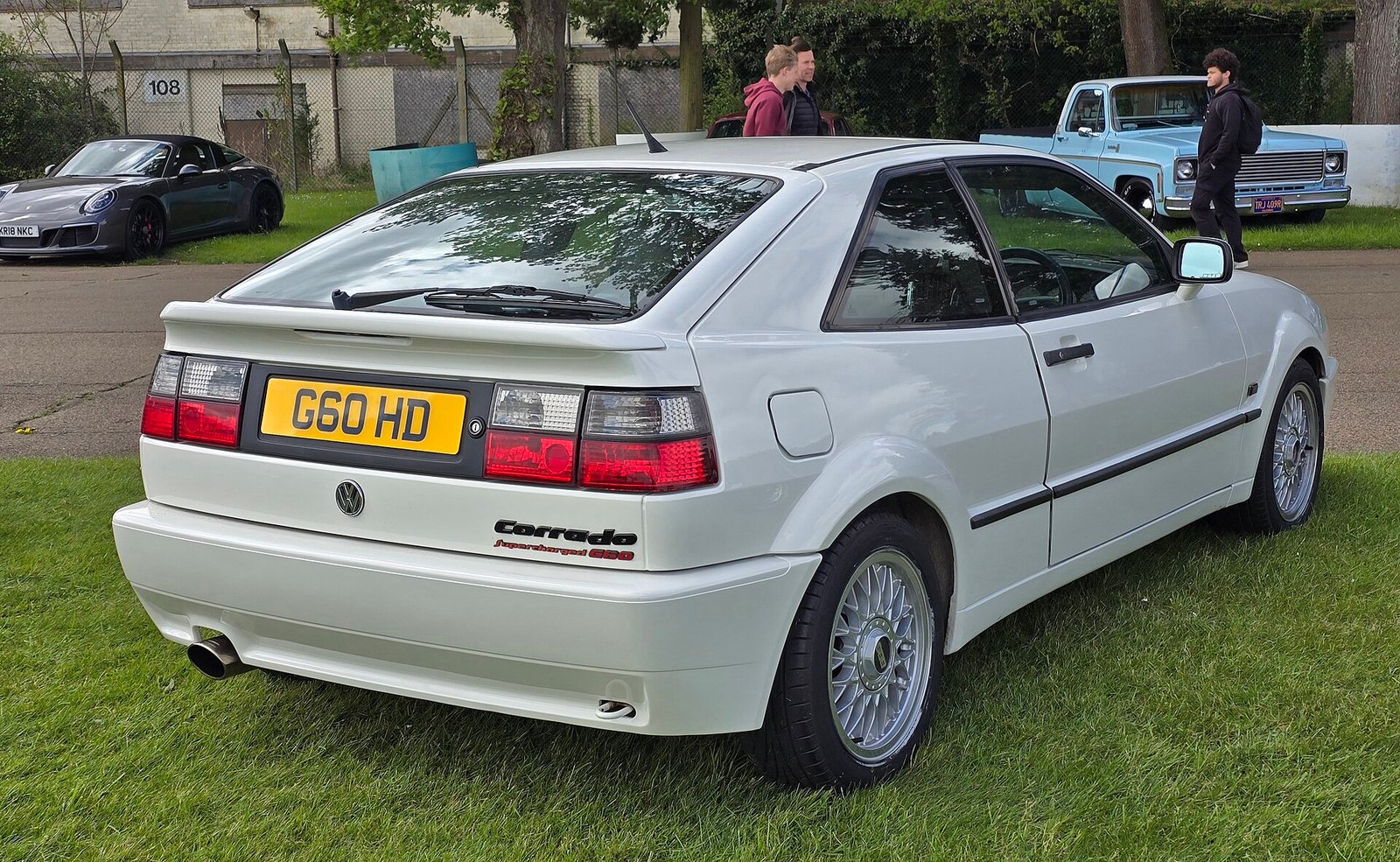
The first Corrados that came to the US had the G60: a 1.8-liter eight-valve four-cylinder fed by a G-Lader supercharger, good for 158 hp. The G-Lader is a scroll compressor: two interleaved spirals, one fixed and one moving in an orbit, squeeze air toward the center. Because it’s belt-driven by the engine, it delivers boost instantly, with none of the lag of a turbo. Volkswagen also used it in the Golf G60, the Passat G60 and the all-wheel-drive Golf Rallye.
It made a distinctive whine and gave the car real punch. It also needed maintenance, and the ones that didn’t get it are the reason "G60 rebuild" is a phrase VW owners say through gritted teeth. Volkswagen stopped selling the G60 in North America after 1992.
Europeans had cheaper options Americans never saw: a naturally aspirated 1.8-liter 16-valve with 136 PS from 1989 to 1992, and from 1993 to 1995 a 2.0-liter eight-valve with just 115 PS. They made sense on European insurance and fuel bills. They also explain why so many Corrados in Europe today are the slow ones, and why a well-kept American SLC can be the more interesting buy.
The VR6: six cylinders in a four-cylinder space
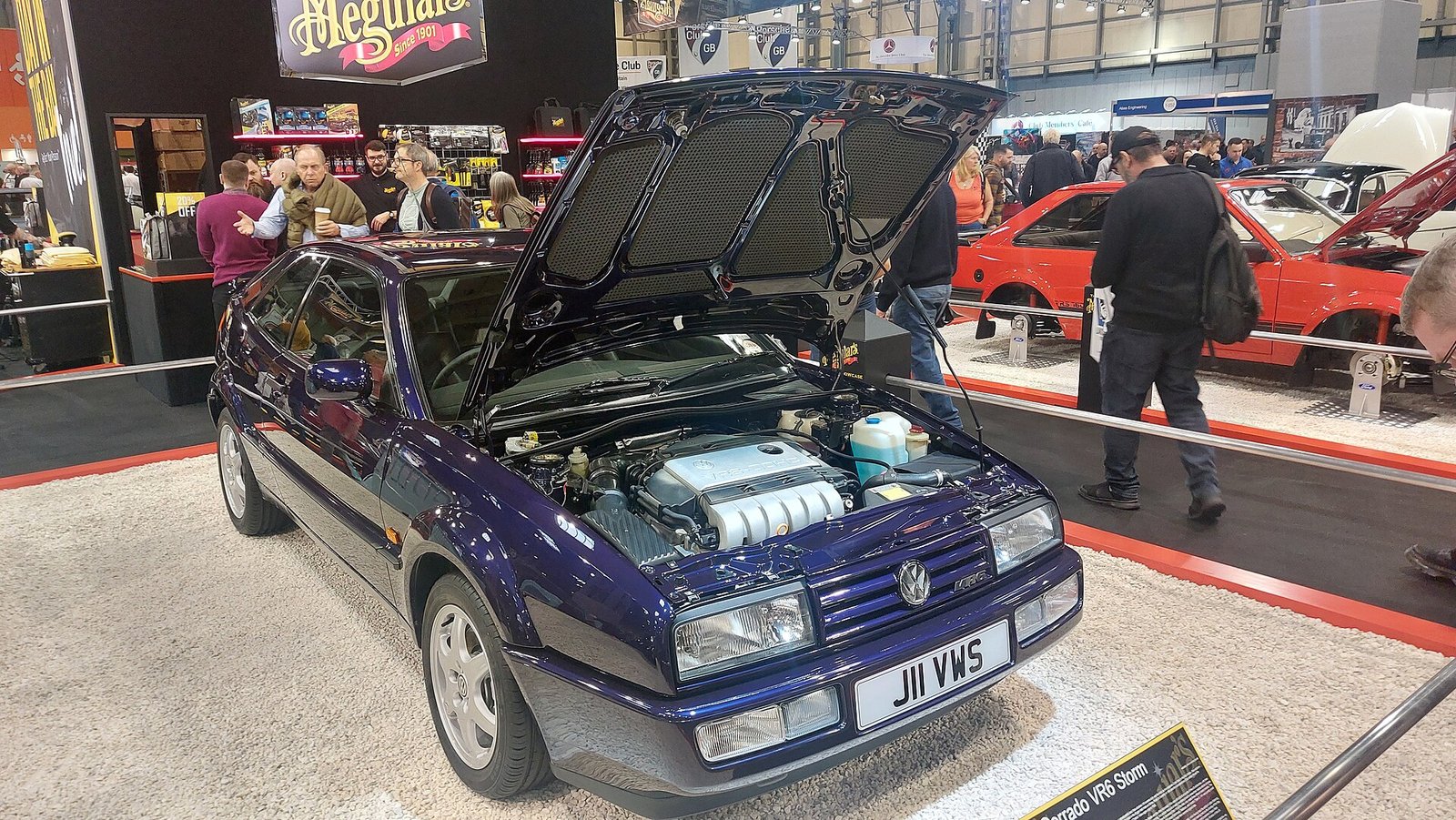
The engine that made the Corrado was the VR6. Volkswagen wanted a six that would fit sideways in an engine bay designed for a four. The answer was a V6 with just 15 degrees between the banks, so narrow that both rows of cylinders could share one cylinder head with two camshafts. The cylinders sit in an almost zig-zag pattern in a single block. "VR" stands for V-Reihenmotor, a V engine and an inline engine at the same time.
In the US the Corrado got the 2.8-liter VR6 with 178 hp from 1992, sold as the Corrado SLC. Europe got a 2.9-liter version with 190 PS from 1991. Either way, it transformed the car: smooth, strong from low revs, and with a hoarse six-cylinder sound nothing else in the class had.
Why was a six such a big deal in a front-wheel-drive car? Because a transverse engine has to fit between the front wheels, and a conventional V6 or inline six is either too wide or too long for a compact engine bay. That’s why most sporty front-drivers of the period ran turbocharged fours. A narrow-angle six gave the Corrado the smoothness and torque of a bigger engine without redesigning the whole front of the car. Packaging, more than horsepower, was the real engineering win.
The VR6 went on to power Golfs, Jettas, Passats and plenty more, and for a whole generation of American VW fans a VR6 badge on the grille became shorthand for the good one. The Corrado was where Americans met it first.
Why it didn’t sell
With all that going for it, the Corrado should have been a hit. It wasn’t, at least not by Volkswagen standards. The first-generation Scirocco sold more than half a million; the second, about 291,000. The Corrado managed under 98,000 worldwide.
Price was the main problem. The Corrado was priced well above what most buyers expected to pay for a Volkswagen. Richard Hammond put it bluntly on Top Gear in 2003: it was too expensive, and nobody bought it.
The timing didn’t help either. The late ’80s and early ’90s were peak affordable-coupe in America. Japanese brands were pumping out sporty two-doors with more horsepower per dollar, and Ford had the Mazda-based Probe. Shoppers compared spec sheets, and on paper the Volkswagen didn’t win.
And Volkswagen’s image in the US had faded since the GTI’s glory days. Asking premium money for a VW badge was a hard sell. The VR6 got rave reviews, but by then the damage was done. The Corrado left the lineup in 1995 with no direct successor.
The rare ones
Most of the special editions never came to the US, which makes them worth knowing about if you ever see one at a show.
The Corrado Storm was the UK farewell in 1995: 500 VR6 cars, 250 in Classic Green with cream leather and 250 in Mystic Blue with black leather, with 15-inch BBS "Solitude" wheels, body-color grille and heated front seats.
The Corrado Campaign is rarer still: six cars built in 1992 as prizes for the six best-performing British dealers, painted Dusty Mauve Pearl with red-brick leather. Four were known to survive as of 2022.
In 1989 Karmann showed a prototype with a 16-valve G60 making 210 hp. It never went further.
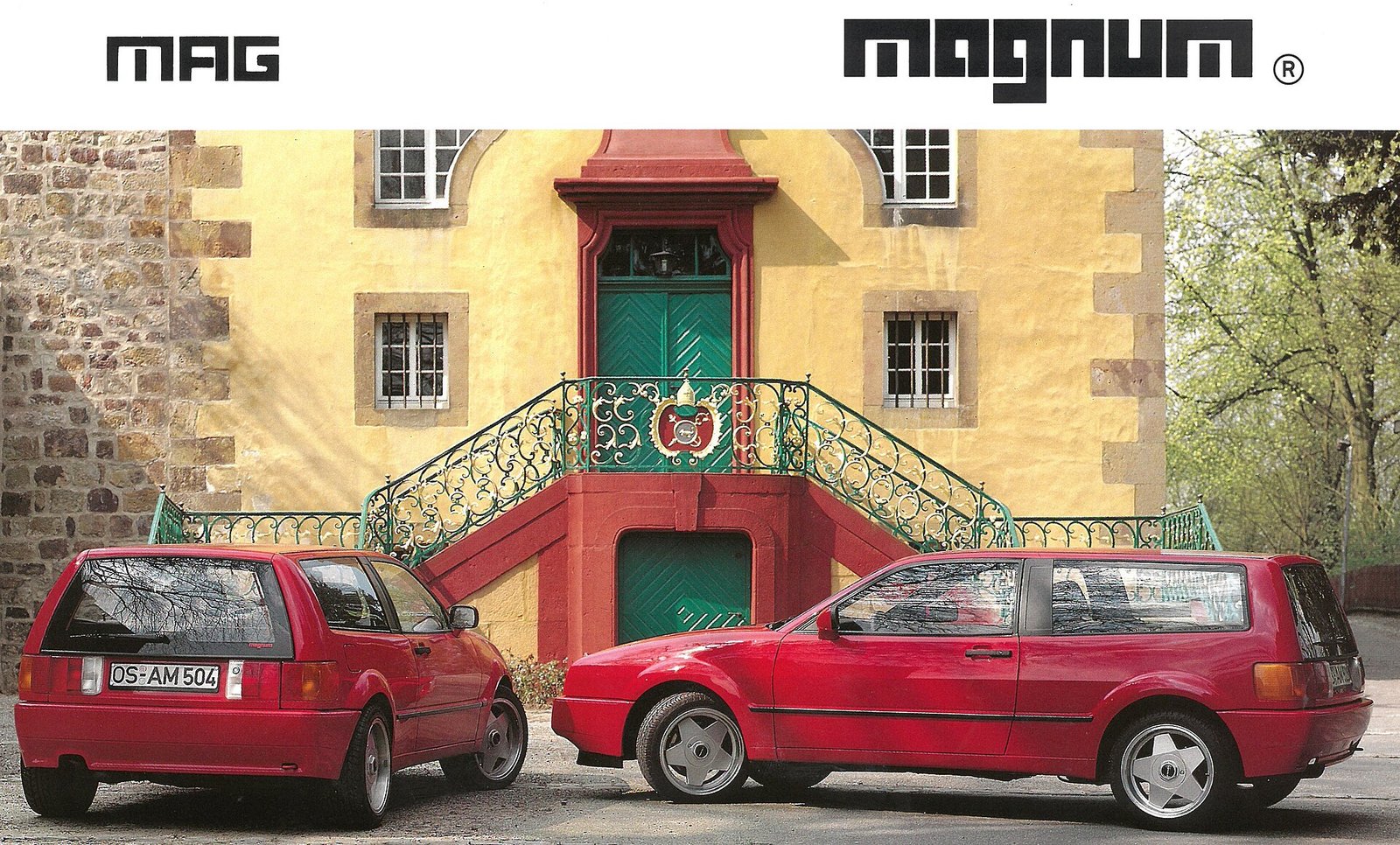
The Corrado Magnum Sport Kombi was a shooting-brake version built by the German firm Marold Automobil in early 1989. The plan was up to 200 cars for Europe; Volkswagen pulled the plug in 1991, and Marold was left with the only two in existence.
And there’s the convertible that never was. Volkswagen commissioned three coachbuilt design studies for the 1989 Geneva show. The one that survives was built by SGS on a Karmann chassis, with a one-off top mechanism, Magnolia Connolly leather and a custom blue flake paint. Volkswagen already had the Golf Cabriolet in Karmann’s lineup, and a Corrado convertible never made it to production.
What critics think now
Time has been kind. Auto Express calls the Corrado one of the best drivers’ cars Volkswagen has ever built. Britain’s Car magazine put the VR6 on its list of 25 cars you must drive before you die. Tiff Needell, reviewing the G60 for the original Top Gear in 1988, called it really very good classic front-wheel drive. And Richard Hammond, the same one who said nobody bought it, also called it a future classic.
Buying one in the US
With around 50,000 sold new here, America is actually one of the best places in the world to find a Corrado. A few things to know:
- VR6 over G60 if you want a car to drive rather than to restore. The supercharger is the expensive weak point.
- Paperwork matters. A Corrado with no service history is a gamble.
- Rust: wheel arches, underbody and around the windows.
- Interior: worn seat bolsters and sagging headliners are common.
- Imports: a European 2.9 VR6 or a UK Storm is now old enough to bring into the US under the 25-year rule, but check authenticity carefully.
How it drives
The seating position is low and right. The VR6 pulls in a linear, progressive way, no turbo to wait for, and starts to sing in the upper half of the rev range. The steering is direct, and like most front-drivers of its time it understeers progressively at the limit, but it will move its rear end if you ask, something modern Volkswagens have been engineered out of.
It’s a car you can drive across a state and still enjoy on the twisty road at the end. For years it also had the advantage of being invisible. That’s changing. More people recognize the shape at a cars-and-coffee now, more of them come over to ask, and the clean, unmodified ones are getting harder to find every year.
The coupe that deserved better
Active spoiler, the first VR6 most Americans ever heard, Karmann build quality and a shape that still looks right more than 30 years later. Volkswagen priced it too high and marketed it too little, and buyers walked past it. The ones who did buy it, half of them American, own something that’s finally getting the respect it was due.
Photos: Charles01 (CC BY-SA 4.0); Kieran White (CC BY 2.0); Calreyn88 (CC BY-SA 4.0); Kieran White (CC BY 2.0); Josef A. Marold (CC BY-SA 4.0). Via Wikimedia Commons.
Check you’re still alive.
6 thoughts on “Volkswagen Corrado: The German Coupe Americans Bought More Than Anyone, Then Forgot”