
Car air filter: how it works, when to change it and the K&N myth
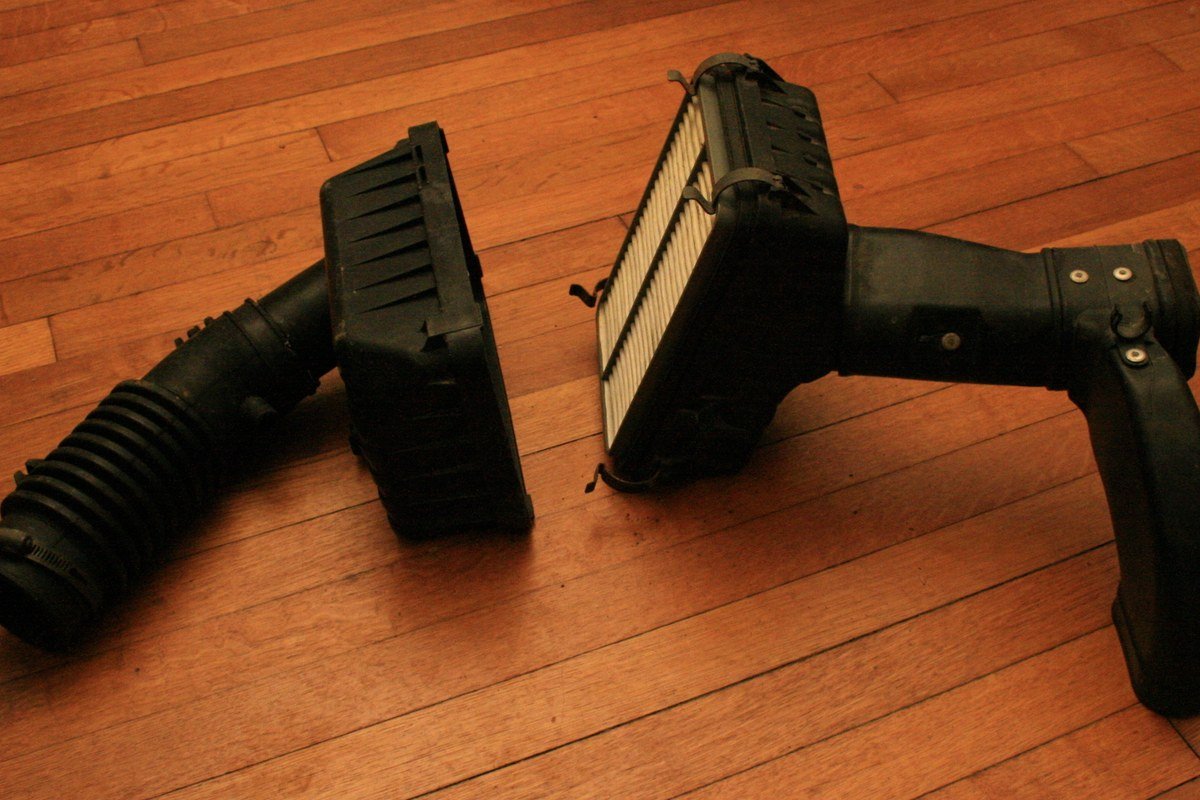
This whole series has been about getting air into the cylinder: under pressure, by pressure waves, with turbos split in two. But there’s one detail we took for granted across all nine chapters that deserves its own bonus, because it’s the first obstacle that air meets on its way to the engine, and because most people treat it like a worthless scrap of cardboard: the air filter. That cheap, throwaway part, hidden in a plastic box, that decides something far from trivial — whether the engine swallows clean air or swallows sand.
And there’s more to it than it looks, because the air filter lives in a permanent contradiction that sums up half of automotive engineering. Its job is to let through all the air it can and, at the same time, not let through a single speck of dust. Two goals at war with each other: the finer you filter, the harder it is to breathe; the wider you open the gate to let air flow freely, the more grit sneaks in. Everything we’re about to cover — the filter types, the arguments, the shop-floor myths — is, at bottom, the story of how that tug-of-war gets resolved. Let’s get into it.
Why dust is the engine’s deadly enemy
First you have to understand what we’re fighting, because otherwise the filter looks like a nothing part. The air an engine breathes is full of suspended particles: dust, ultra-fine sand, soot, pollen. And those particles, the silica ones above all — sand — are abrasive as sandpaper. If they get into the cylinder, they slip between the piston and the wall, between the rings and the bore, and they grind the engine from the inside, bit by bit, on every one of the thousands of strokes the piston makes per minute. An engine swallowing unfiltered dust doesn’t blow up all at once: it wears out in silence, loses compression, starts burning oil and dies years before it should. The air filter is, literally, the only thing standing between the engine and a slow death by abrasion. That’s why a dirt-cheap throwaway part protects one worth thousands.
And the amount of air to be filtered is staggering. A gasoline engine swallows on the order of ten thousand liters of air for every liter of fuel it burns. Do the math: on a trip where you use sixty liters, roughly six hundred cubic meters of particle-laden air have gone through the filter — hundreds of cubic meters of suspended grit. That a folded sheet of paper withstands that barrage, trapping the vast majority of the dirt and letting the air through almost unobstructed, is, when you think about it, a small marvel of engineering we buy for pocket change.
And a note for anyone who’s already gone battery: an EV skips this filter entirely because it burns nothing and doesn’t need to gulp air to live, though it still has a cabin filter; its trick for stretching range lies elsewhere, in recovering energy under braking, and that story is over at Not Enough Battery.
The paper filter: why the pleat is everything, and why a dirty one filters better
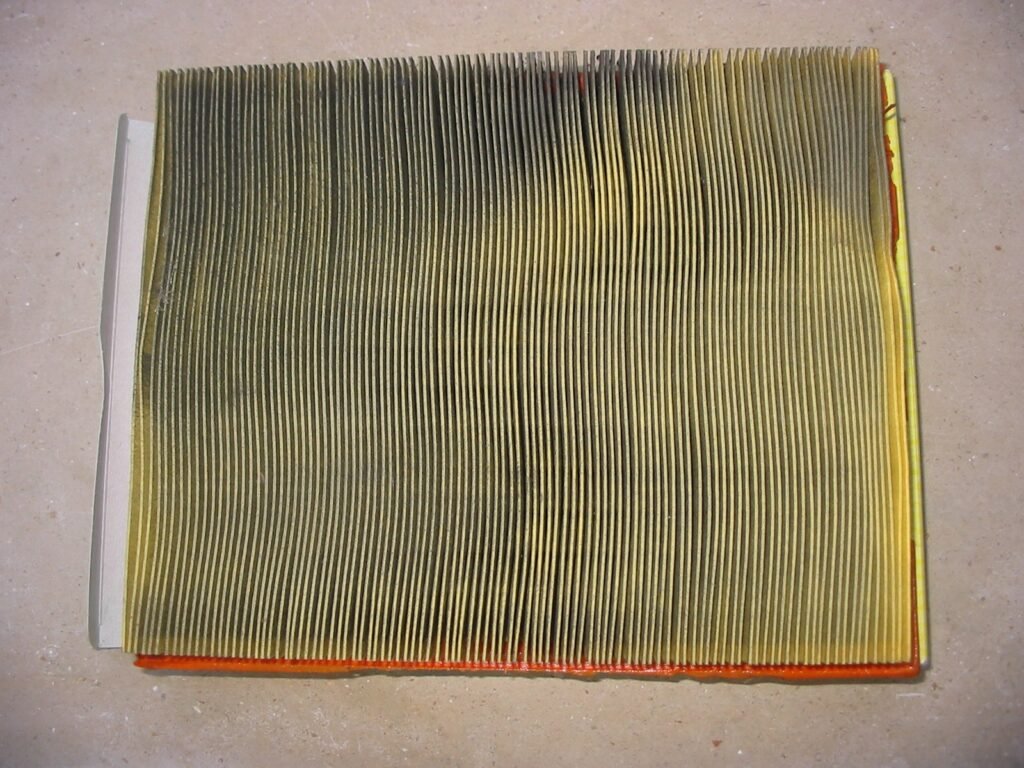
The filter your car came with is, almost certainly, paper. But not just any paper: it’s treated cellulose fiber, built in an accordion shape, with dozens of tight pleats. And that pleating isn’t for looks: it’s the central trick. Folding the paper into an accordion packs a huge filtering surface into the little space inside the box. Unfold the pleated paper of an ordinary filter and you’d cover several times the surface of the box itself. More surface means the air passes more spread out and more slowly through the paper, so it filters well without choking the flow. The pleat is what resolves the contradiction we mentioned: surface to filter fine, spread out so it doesn’t suffocate.
But here’s the good part, one of those facts that dismantles what everyone believes. A paper filter doesn’t work only like a sieve, catching whatever’s bigger than its holes and passing the rest. A lot of the dust buries itself among the cellulose fibers, in the thickness of the paper, and another part builds up as a layer on the surface; both happen at once. And the consequence is genuinely counterintuitive: a slightly dirty filter filters better than a new one. That layer of already-trapped dust narrows the gaps and helps catch the next particles, so efficiency rises as the filter gets dirtier, until it clogs so much it starts strangling the airflow. Hence an idea that sounds like heresy in the shop: a filter’s color, on its own, tells you little. Seeing it dark and swapping it in a hurry often means throwing away a filter that was at its best. So when do you change it? In industrial machinery they measure the actual resistance to airflow and swap at a set limit; in a street car, which has no such gauge, the sensible reference is the maker’s service schedule, shortened if you drive through dusty country. As for what they trap, good cellulose media post sky-high efficiency figures in the standardized tests — measured by mass of dust held, not by particle count — above 99.9%, and the most advanced media, like certain high-efficiency ranges tested under ISO standards, approach 99.999% in that same kind of test.
K&N and the great oiled-cotton war
And here comes the controversial star of this story, the filter that’s divided enthusiasts for fifty years: oiled cotton gauze, made famous beyond measure by K&N, founded in California in 1969 by Ken Johnson and Norm McDonald (hence the K and the N). Instead of paper, they use several layers of woven cotton soaked in oil, sandwiched between two metal screens. The promise is seductive: oiled cotton flows more air than paper, and it’s washable and reusable, not throwaway. Wash it, re-oil it, drive on. For the life of the car.
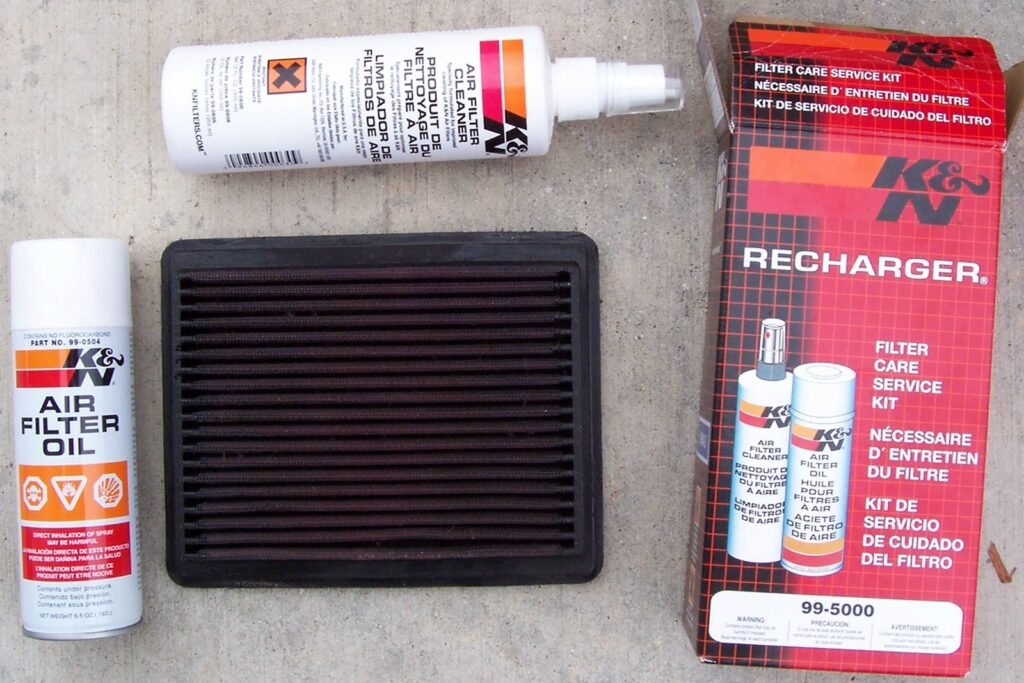
Sounds perfect. Where’s the catch? The usual place: letting more air through tends to be paid for by filtering worse. An independent test under the ISO 5011 standard, dated 2004 and run on a GM Duramax diesel, pitted a K&N oiled-cotton filter against the stock AC Delco paper one: the K&N put up less resistance to incoming air, but let more mass of dust through to the engine than the paper did. More flow, yes, but also more total dirt sneaking toward the cylinders. Be clear about what that test proves and what it doesn’t: it compares those two specific parts, it doesn’t measure how many miles the engine would last with each, and it doesn’t let you say oiled cotton “only belongs in racing.” What it does make clear is the underlying trade: with a filter like this you gain airflow in exchange for a bit more dust getting through, and each person decides whether that swap is worth it for how they use the car and how much they care about wear way down the line. It’s the nuance the advertising skips.
And there’s a second, more modern and more treacherous catch, one that hits cars with a mass airflow sensor — the MAF, the delicate part that measures incoming air and fouls at the slightest provocation. General Motors documented in a technical bulletin that an over-oiled reusable filter can contaminate that sensor and give it false readings that drive the ECU crazy. The bulletin describes the mechanism, but doesn’t say how often it happens or name any brand. Even so, the home re-oiling risk is real: it’s dead easy to overdo the oil when you re-soak the filter in the garage, and that excess rides the airstream to the sensor. More than one enthusiast has spent months chasing a weird electronic fault never suspecting the culprit was their own oil bottle.
The cold air intake and the myth of noise
From filters we jump to where they’re mounted, because that’s home to one of the most beloved myths in driveway tuning: the open cone intake that replaces the sealed airbox, which plenty of people bolt on convinced it adds horsepower. The starting idea is sound: cold air is denser, carries more oxygen, and an engine fed colder air makes a touch more power; we saw that in the intercooler chapter. And a well-designed intake, with the filter fed cold outside air and shielded from heat, can help.
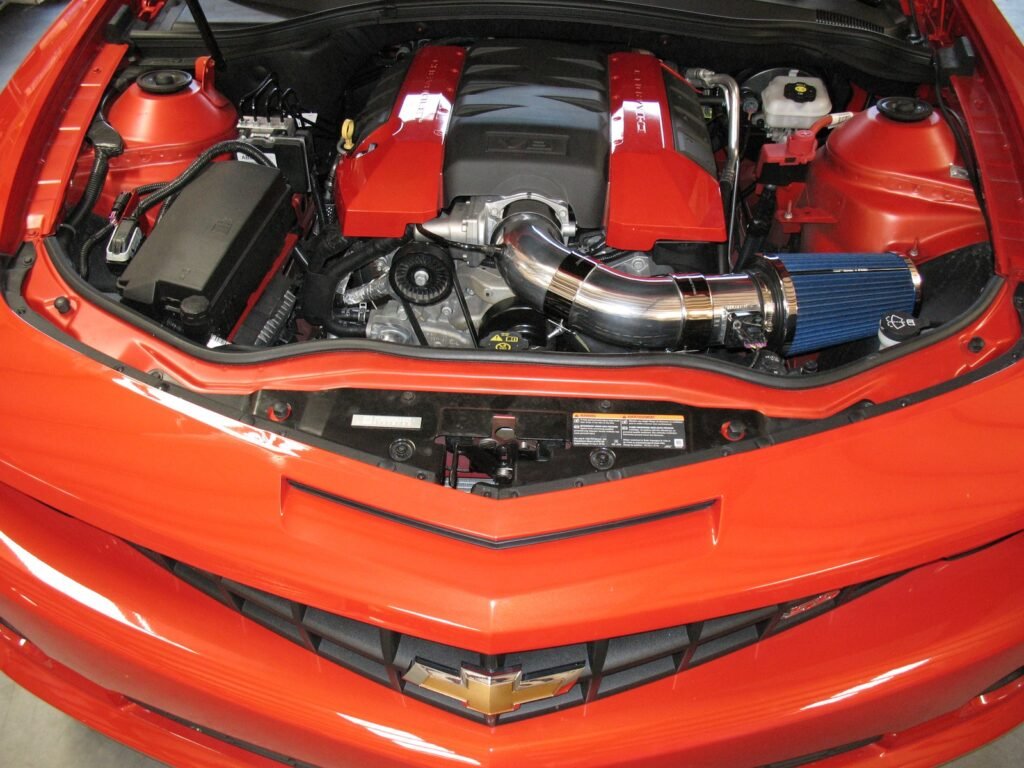
The trouble is that most of the open intakes people fit do the exact opposite of what they promise. Pull off the sealed box and stick an open cone in the middle of the engine bay, and the filter starts sucking the hot air surrounding the engine, which can sit tens of degrees above the outside air. And hot air is less dense air: less oxygen, less power. What you gain on one side — less obstruction — you lose on the other — hotter air — and often the balance is negative or zero. That ugly, boring plastic box the car came with is usually fed by a duct pulling fresh air from outside the bay, precisely so the engine doesn’t swallow its own heat. The engineers didn’t fit it to save money: they fitted it because it works.
So why do people swear their cone intake makes power? The noise. Pull off the box and the engine makes a far louder induction roar under throttle, that addictive hoarse bellow. The brain reads that sound as more force, but sound isn’t power: it’s just sound. On the dyno, many of these intakes don’t make the horsepower they promise, and can lose shove at some rpm while gaining at others, so the final tally depends heavily on the specific design and the car. The noise is free; the power isn’t. Worth knowing the difference before you spend the money.
The Spanish thread: your filter probably came from Zaragoza
Here’s a Spanish thread few would suspect on lifting the airbox lid. For decades, a good share of the filters and intake modules in European cars came out of Zaragoza, from the plant that Mann+Hummel — one of the world’s filtration giants — built in Aragón, and which, by the company’s own account, turned fifty in 2015 (we couldn’t confirm the founding date with an independent source). And we’re not talking just the filter element: there they made the complete intake module, with its dirty- and clean-air ducts, the resonators that tame the induction noise, and even the pipe that carries air to the turbo.
Around that 50th anniversary, the company boasted of supplying intake systems to the SEAT Ibiza, the Volkswagen Polo, the Peugeot 208 and 308 and the Opels built in Spain, and claimed that one in four vehicles built in Europe carried some component from its Aragón plant. It’s worth saying in the past tense and with a date, because the story has a bitter turn: on December 19, 2025 the company told the works council it wanted to lay off close to 150 of its roughly 630 Zaragoza workers, a quarter of the plant, and the news went public in early January 2026. The reason: it would gradually stop making every aftermarket filter element there over the course of 2026, without saying whether that work was moving to other group plants. The workforce dug in and called an indefinite strike; by late February a deal settled on around 120 layoffs and the strike was called off. So that part most people treat as a worthless scrap of cardboard is really a piece of fine engineering with half a century of Aragonese roots, now in doubt. One more factory that was just there, unremarked, wobbling right when we decided to tell its story.
My verdict: the humblest part is the one that actually protects the engine
I’ll close this bonus with an idea that runs through the whole series and that the filter sums up better than any other part: cheap and unremarkable is not the same as unimportant. We’ve spent nine chapters admiring turbos spinning at a hundred thousand rpm and systems that reclaim exhaust energy — spectacular, costly parts. And it turns out the part that really decides how long an engine lasts isn’t any of those, but a folded sheet of paper that costs less than a round of beers.
And here’s my take, no fence-sitting. The car world has an obsession with the flashy — the intake that growls, the washable “race” filter, the accessory that promises horsepower — and a contempt for the boring that costs dearly in the long run. The stock paper filter, ugly and anonymous, filters more than enough, protects the engine for hundreds of thousands of miles and costs next to nothing. Oiled cotton has its following and its logic, but the trade it offers — more airflow in exchange for a bit more dust getting through — makes more sense in an engine that’s opened and inspected often than in the car you’ll commute in every day for fifteen years. The cone intake makes noise, and noise doesn’t move the car. The boring engineering of the sealed box with its paper filter and its cold-air duct is, almost always, better than the accessory that replaces it. And that, maybe, is the last lesson of the whole art of breathing: that sometimes the humblest solution is already the right one, and improving it on a whim means making it worse and paying for the privilege. The engine only wanted clean air. Give it good air, change it when it truly needs it, and it’ll last as long as it should.
Check you’re still alive.
Photos: Ildar Sagdejev (Specious) (CC BY-SA 3.0), Donar Reiskoffer (CC BY 3.0), Royalbroil (CC BY-SA 2.5), Gearheadgirl (CC BY 3.0).