
Seat León Cupra Mk1: the Spanish hatch that ran Audi S3 power and never reached America

In May 2027 a small Spanish hatchback becomes legal to import into the United States, and almost nobody here knows its name. Federal rules let a car that was never sold in America come in once it turns 25, counted to the month it was built. The first Seat León Cupra R rolled out of the Martorell plant near Barcelona in May 2002. Do the math. A front-drive compact with the engine out of an Audi S3, 147 mph flat out and a price that embarrassed its German cousins is about to become fair game for anyone with a port broker and patience.
Seat never sold a car in this country. While American buyers were handed the fourth-generation GTI, Volkswagen’s Spanish brand was building the hottest compact in the whole group’s catalog, and doing it for less money than anyone else in the family. This is the story of how that happened, rung by rung.
Same bones as your Golf, different attitude
The first León went on sale in 1999 under the chassis code 1M. Underneath it sat the Volkswagen Group’s PQ34 platform, the same hardware you’d find under a Mk4 Golf, a Jetta of that era, the first Audi A3, the Audi TT and the Škoda Octavia. A platform is everything the driver never sees: the floor pan, where the suspension bolts on, where the engine sits, the basic wiring layout. The group designs it once and spreads that huge bill across half a dozen badges.
The trick is what each brand does with it. Volkswagen made the Golf sensible. Audi made the A3 posh. Seat got the job nobody else in Wolfsburg wanted: be the young, loud, Latin one. And the body it wore to do that job came from Turin. Giorgetto Giugiaro‘s Italdesign styled the first León, a sloping, rounded hatch that looked nothing like the upright Golf it shared its floor with. In January 1999 Seat also hired Walter de Silva, the designer behind the Alfa Romeo 156, to run its design center. The message from Martorell was clear enough: the Germans could keep the slide rules, Seat was going to sell emotion.
The performance name it chose for that emotion was Cupra, short for “Cup Racing,” a label born in the brand’s one-make racing series of the nineties. On the León it would end up meaning a lot more than a sticker.
The engine Americans already knew
If you owned a Jetta GLI, a Passat, an Audi A4 or a TT in the early 2000s, you already know the heart of this story. It’s the Volkswagen Group 1.8T, a 1,781 cc turbocharged four-cylinder with five valves per cylinder: three to let air and fuel in, two to let exhaust out. Twenty valves on a four-banger sounds like a brochure gimmick. It isn’t. Several small valves give the engine a bigger total opening than two large ones would, so it fills and empties its cylinders faster. Bolt a turbocharger on, a little turbine spun by exhaust gas that crams extra air into the intake, and you have an engine that pulls hard down low and still likes to rev.
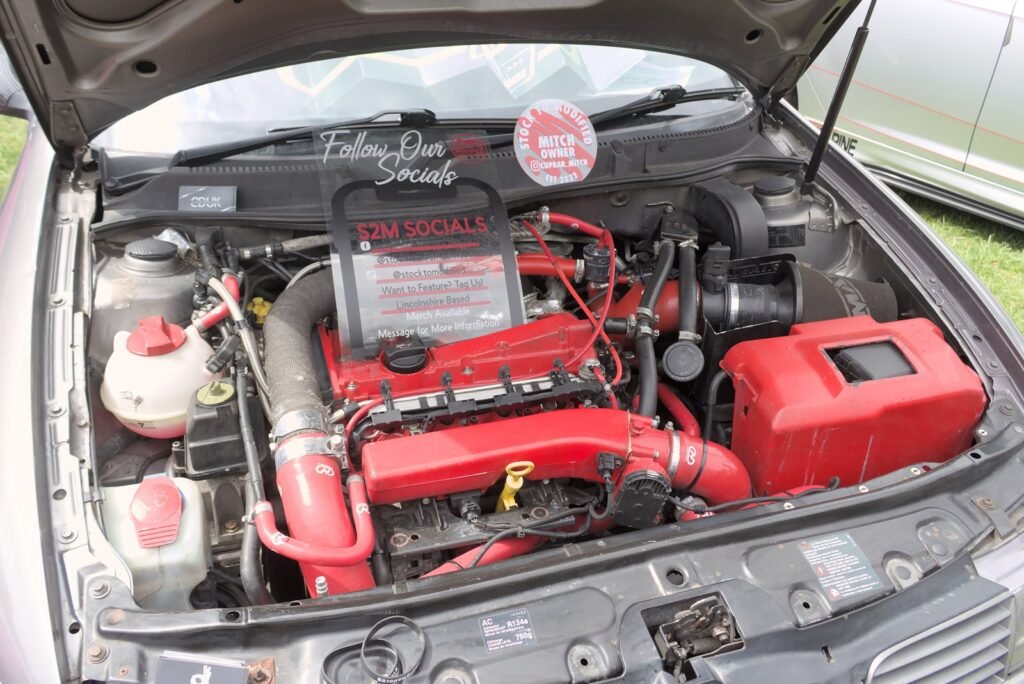
In America that engine topped out at 180 hp in the GTI. The 2003 GTI 20th Anniversary Edition, the one with the six-speed manual and the Recaro seats people still hunt for, made exactly that: 180 hp and 173 lb-ft, for a sticker of $23,225. In Europe the same family went a lot further, and Seat was the one that pushed it furthest in a front-drive hatch.
In Spain the 180 hp León was sold as the Sport and the Sport FR. In Britain, where Seat sold the car with the steering wheel on the right side, that same 180 hp model wore the Cupra badge as the León 20VT Cupra. That’s where the naming confusion starts, and it’s why Seat enthusiasts split the family in two: the Cupra, and the Cupra R. The R is the one that matters.
The weird one: a V6 Cupra with all-wheel drive
Before the R, Seat built an oddball. The León Cupra 4 arrived late in 2000 and stayed in the catalog until 2004, and it skipped the turbo altogether. Under the hood sat the VR6, Volkswagen’s narrow-angle six-cylinder, here in 2.8-liter form with 204 hp at 6,200 rpm and 199 lb-ft.
Americans know the VR6 from the Corrado, the Mk3 and Mk4 GTI and the Jetta, but it’s worth explaining why it was such a strange piece of engineering. A normal V6 has two rows of three cylinders spread wide apart, each row with its own cylinder head. The VR6 squeezes the two rows into a V of just 15 degrees, so tight that a single cylinder head covers all six. You get a six-cylinder barely longer than a four, small enough to sit sideways in a compact’s engine bay, with a deep, smooth growl that four-cylinders can’t fake.
The “4” stood for all-wheel drive, done with a Haldex coupling, a Swedish-designed clutch pack between the front and rear axles. Most of the time the Cupra 4 drove its front wheels. When the fronts started to slip, the clutch locked up and sent torque to the back. The Cupra 4 ran 0-62 mph in 7.3 seconds and topped out at 146 mph, numbers right there with the turbo car that followed. The catch was weight. At 3,472 lb it carried well over 400 lb more than the four-cylinder Cupra R, most of it sitting over the nose, and you felt it every time you turned in hard. It was the plush Cupra, the one that sold to people who wanted the sound, and it’s the one the history books forget. For American collectors it’s also the only first-gen Cupra you can bring in right now: the earliest cars passed their 25th birthday at the end of 2025.
May 2002: the Cupra R lands
The car that built the legend showed up in May 2002. The León Cupra R used a 1.8T with engine code AMK, wound up to 210 hp, with 199 lb-ft available from 2,100 all the way to 5,000 rpm. That flat, wide torque band is the whole personality of the car. Torque is the shove you feel in your back, and having it spread across almost the entire rev range means the R pulls hard in any gear without you having to wring it out.
Seat quoted 7.2 seconds to 62 mph and 147 mph flat out, with a curb weight of 3,012 lb. Bigger brakes, lowered and stiffer suspension and its own wheels finished the job. For context, the Ford Focus RS that arrived in Europe that autumn made 215 PS from a turbo 2.0, and Ford built just 4,501 of them at Saarlouis, in Germany, between October 2002 and November 2003. Honda’s Civic Type R of the same era made around 200 hp from a screaming non-turbo 2.0. The Seat sat right in the middle of that fight, cheaper than the Ford and with far more mid-range than the Honda.

Here’s the part the Seat brochures didn’t shout about. AMK wasn’t a Seat engine. It was one of the two engine codes, along with APY, that Audi used for the 210 hp S3 of the 8L generation. The very first Cupra R was already running Ingolstadt’s performance engine.
2003: the full S3 heart
In 2003 the León got its mid-life facelift, and the Cupra R moved up to the next Audi engine. The new code was BAM, and it was the same 225 hp 1.8T Audi had put in the S3 from 2001 onward, along with the hot TT 225 quattro. Same code, same cylinder head. Torque rose to 207 lb-ft, spread between 2,200 and 5,500 rpm, and the numbers moved accordingly: 6.9 seconds to 62 mph and 150 mph flat out.
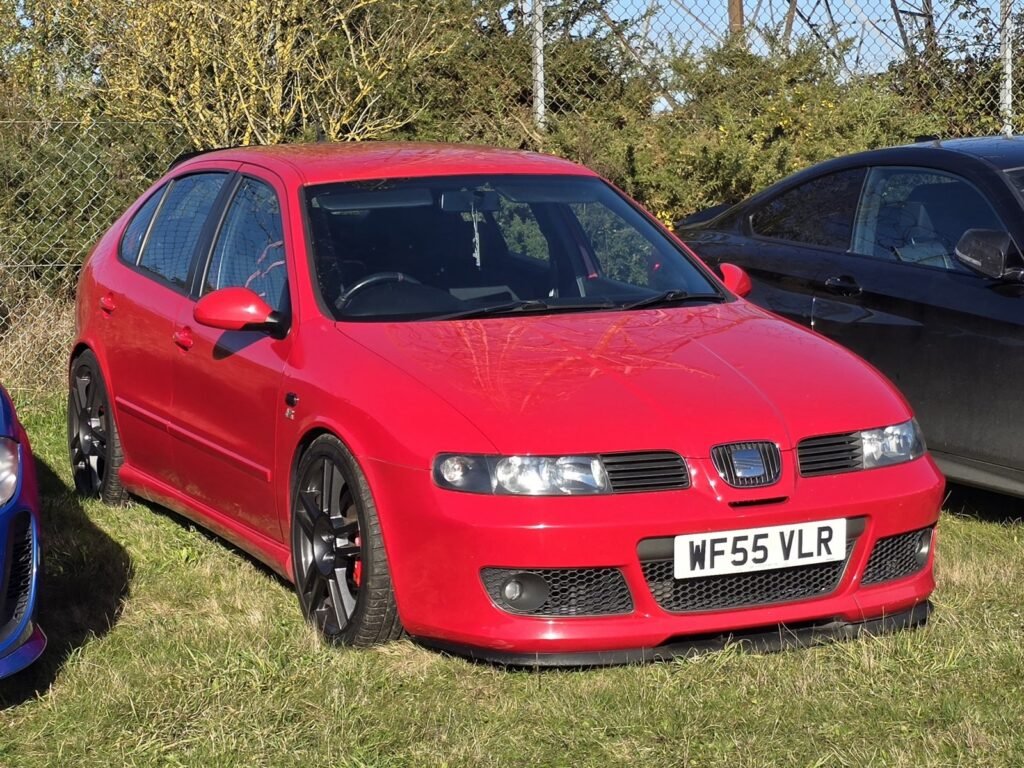
So the León shared its engine with the S3 in both R versions, first at 210 hp and then at 225. People often tell it as if Seat came up with the 225 hp bump on its own. It didn’t. Audi had made exactly that jump with the S3 two years earlier, and Martorell simply followed the same path, step for step, and reached the same number in a cheaper car.
How much cheaper? A Spanish road test of the time priced the 225 hp Cupra R at about €27,295. In Britain, according to Autocar, Seat sold more than 4,000 Cupra Rs between 2002 and 2006, starting at under £20,000. That was Golf money for an S3 engine. To translate it into American terms: imagine Volkswagen of America in 2004 asking $29,100 for the 240 hp Golf R32, a car it sold in a limited run of 5,000, while across the ocean Seat was handing out 225 hp turbo hatches for well under that.
It wasn’t an S3 in disguise, though. The Audi put its power down through quattro all-wheel drive. The León Cupra R stayed front-wheel drive, with its own suspension tuning, its own interior, its own weight. Sharing an engine is a long way from sharing a car. On a twisty road the Seat had to manage 225 hp through the front tires alone, which made it more of a handful and, for a lot of owners, more fun.
The 225 Cupra R stayed on sale until late 2005. The 1M León itself ended production at Martorell in May 2006, after more than half a million were built; published totals range from 514,438 to 534,800 depending on the source. And a footnote almost nobody mentions: not every first-generation León is Spanish. Volkswagen’s 2000 annual report lists 13,401 Leóns assembled at the group’s plant in Brussels, Belgium, to keep up with demand in the early months. A tiny batch, but enough to put an asterisk on “built in Martorell.”
The oil problem you’ll hear about
Every owner forum for the 1.8T says the same thing: these engines burn oil between changes, sometimes enough to scare a new owner. That reputation follows the whole 20-valve 1.8T family, not just the Seat, and it’s spread mostly by owners and mechanics, not by any official bulletin we could find. Pinning it on one specific cause, worn rings or a crankcase ventilation fault, would need engine-specific documentation for AMK and BAM that we haven’t been able to confirm, so treat it as a reputation, not a diagnosis.
What isn’t up for debate is how to live with one today. Any car this old with a turbo needs its dipstick checked often and the correct-spec oil in it, whether it drinks or not. Let the level drop on a 1.8T and the turbo is usually the first thing to pay for it, with a shop bill to match. If you’re looking at a Cupra R to import, ask for the service history and for any record of oil top-ups between changes. That paper is worth more than a fresh wax.
Why this car still matters
The Cupra name today belongs to a separate brand selling electric crossovers and hybrids with big wheels and copper trim. Back in 2002 it meant one thing: the fastest, sharpest car Seat could build, using the best parts the Volkswagen Group had on the shelf. The León Cupra R proved that a Spanish factory with an Italian-styled body could take Audi’s engine, put it in a lighter front-drive hatch and sell it for a lot less than Audi did.

It also wore a badge that, for most of Europe, meant cheap. That’s the main reason clean, unmodified Cupra Rs still sell for less than equivalent S3s and why a lot of them were tuned, crashed or ragged out long before anyone thought of them as classics. The good ones are getting harder to find every year, and in a few months American buyers join the hunt.
The Mk4 GTI was the car Americans got. The León Cupra R was the one Volkswagen kept on the other side of the Atlantic, with more power, a better engine and a price tag the GTI couldn’t match. Mark May 2027 on your calendar.
Check you’re still alive.
Photos: Geoff Jones (CC BY 2.0), Aethonatic (CC0), Mike Roberts (CC BY-SA 2.0), Calreyn88 (CC BY-SA 4.0), Trop86 (CC0).