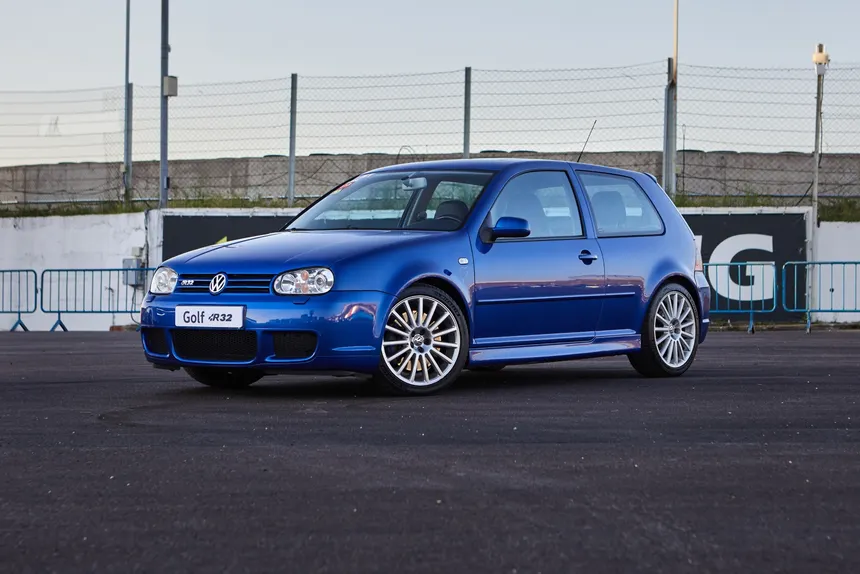
GOLF R32: BACK WHEN VOLKSWAGEN STILL TOOK RISKS
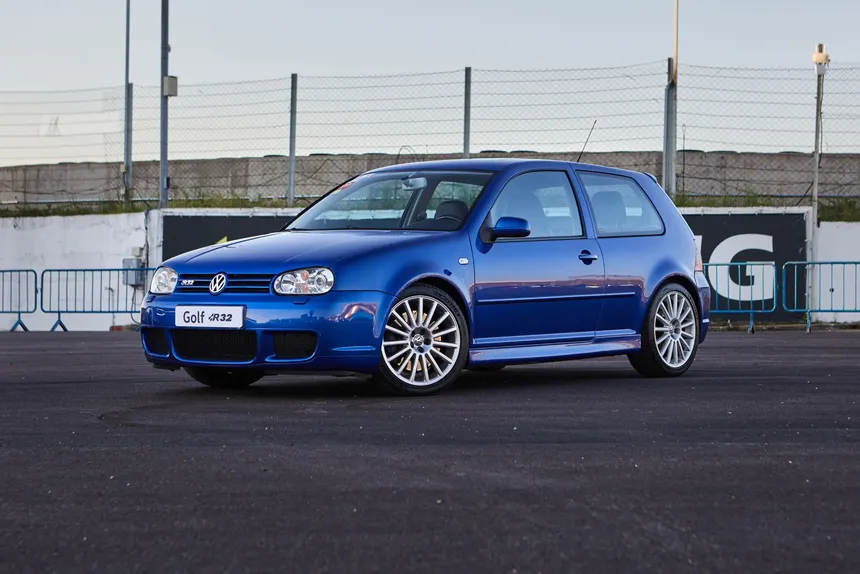
Chris Harris said it once and it stuck: the trouble with modern hot hatches is that they all feel like the same car wearing different jackets. He was talking about the latest Golf R when he said it, but he could have been talking about any of them. AMG A45, RS3, Civic Type R, M135i. Different badges, different prices, same recipe. Two-litre turbo four. Dual clutch. All-wheel drive. Software-tuned exhaust. 0 to 60 in some flavour of four seconds. You drive one and an hour later you cannot tell anyone what was different about it.
The R32 was not like that.
The R32 was the kind of car that should not have been signed off. Take the Golf, the most rational hatchback ever built, the car that defined sensible motoring in Europe for thirty years, and shove a 3.2-litre VR6 under the bonnet. Sideways. Bolt a Haldex system to it. Then debut a transmission technology that did not exist in any production car on the planet. Build twelve thousand of them. Sell them. Then do it again with the next-generation Golf, and again, until somebody upstairs noticed and pulled the plug.
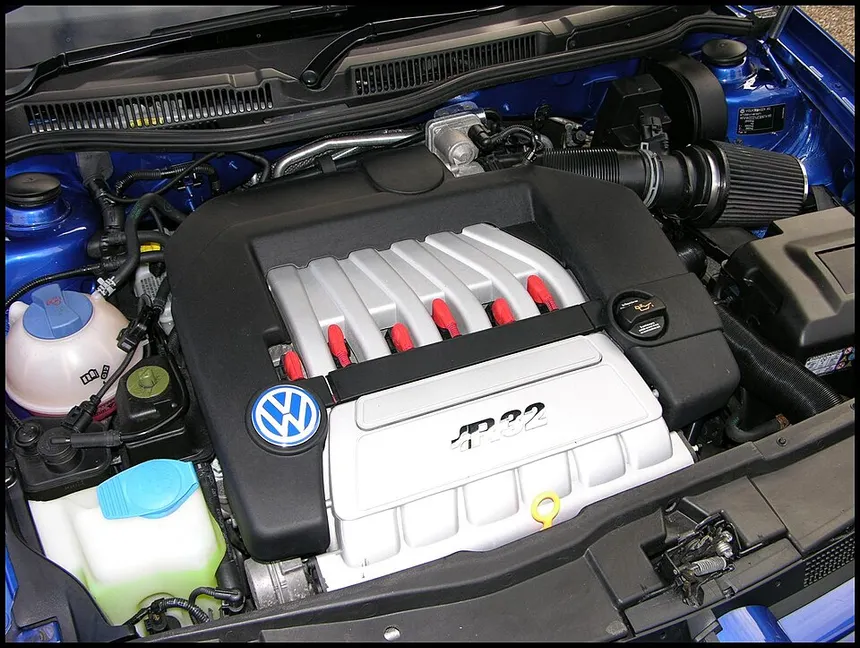
There is a moment when you lift the bonnet of a Mk4 R32 and you cannot quite work out what you are looking at. Six cylinders cannot fit in there. The engine bay was designed for a four. But there it is, jammed in transversely, the sump nearly kissing the subframe. That was not a marketing decision. That was engineers being given permission to do something silly, and going home thinking yes, this is a job worth having.
THE ENGINE THAT SHOULD NOT HAVE FITTED
To understand the R32 you have to understand the VR6, and to understand the VR6 you have to understand what Volkswagen was trying to do in the late eighties. They wanted six cylinders in cars built to take four. A normal V6 was too wide. A straight-six was too long. So they did the third thing.
They took two banks of three cylinders and pushed them together until they were almost touching. Fifteen degrees of separation. One cylinder head shared between both banks. The bores staggered down the block so the pistons would not foul each other. The name came from V for V-engine and the German Reihenmotor for inline. Verkürzter Reihenmotor. Shortened inline engine.
The idea was not original. Lancia had been making narrow-angle V4s since 1922 with the Lambda, and they kept doing it until 1976. Volkswagen took the principle, modernised it, and dropped it into the Corrado and the Passat in 1991. That was the first VR6. By the time the R32 arrived, the engine was on its second generation: 24 valves, 3.2 litres, variable timing on both cams.
The R32’s VR6 produced 240 horsepower at 6,250 rpm and 236 lb-ft of torque at 2,800 rpm. The numbers are not what matter. What matters is how it delivers and how it sounds. The VR6 has a voice that nothing else in the Volkswagen Group ever quite replicated. It is not the angry rasp of an Audi five-cylinder, it is not the flat thrum of a Porsche flat-six. It is its own thing. A thick, woody growl that sounds like an old American V8 has been recorded at the wrong speed and played back through twin centre-exit pipes. The first time you hear one come past at full chat you remember it.
Open one up and the engine tells you a different story. It is dense. Compact in length but heavy in every other dimension. That single cylinder head is a beautifully complicated thing. Changing spark plugs is not changing spark plugs the way it is on an honest four-pot. Doing the timing chain (and yes, you will do it, because they all eventually want it) means hours, patience, and knowing exactly where to put your hands. The VR6 is what happens when engineers solve a packaging problem properly instead of cheaply. Every centimetre of that block had a decision made about it.
And that is before we get to how it drives.
THE FIRST PRODUCTION CAR EVER FITTED WITH A DUAL-CLUTCH GEARBOX
This is the part that most people forget when they talk about the R32. It is the biggest single thing about the car, and almost nobody mentions it.
In 2003, Volkswagen fitted the world’s first production dual-clutch gearbox to the R32. Not a Ferrari. Not a Porsche. A Golf. The Mk4 R32 with DSG was only available in Germany, and even there it was an option most buyers passed over, but it was the first. The first DSG in a road car anywhere on Earth.
The concept was not Volkswagen’s. The patents went back to the 1930s. Porsche had run a rudimentary version, the PDK, in the 962 Group C cars in the eighties. But putting one in a road car, with production-line reliability and at a price a Golf buyer could swallow, that took Wolfsburg working with BorgWarner.
A DSG is, in essence, two manual gearboxes inside one casing. One handles the odd gears, the other handles the evens. Each has its own clutch. When you are in second, third is already engaged on the other shaft, waiting. You release one clutch and engage the other, and the shift happens in milliseconds. That is why it was revolutionary. That is why more than half of all 911s sold today are PDK. That is why a GT3 RS shifts the way it does. All of it. All of it started here, bolted to a transversely mounted VR6 in a Golf.
When a twenty-year-old climbs into an RS3 today and clips a paddle, the technology under his finger debuted in this car. The R32 was the proof of concept for the entire industry.
The funny thing is, plenty of R32 buyers refused the DSG. The manual six-speed was good. Short throw, mechanical feel, synchros that took abuse. In the United States the Mk4 R32 was only ever sold as a manual. The Americans got 5,000 cars in 2004 and not one of them came with DSG. By the time the Mk5 R32 reached America the DSG had matured into what was, for several years, the best automatic gearbox in the world. The Mk5 R32 was the first car most American enthusiasts ever drove with a dual clutch. They never went back.
HALDEX, OR HOW TO PUT 240 HORSEPOWER THROUGH A CHASSIS THAT WAS NEVER MEANT FOR IT
Another problem. You have 240 horsepower. The Mk4 Golf chassis, the A4 platform, was designed for front-wheel drive with four-cylinder engines. Hand the front wheels 240 horsepower and the car torque-steers itself into the next county. The tyres will not last a track day.
Solution: Haldex. The 4Motion system the R32 debuted on the Golf line was a Haldex-based on-demand all-wheel-drive setup. Worth being precise about what that means, because it is not what people often assume. This is not the symmetrical, permanent quattro of an eighties Audi. The R32 is fundamentally front-wheel drive. The rear axle only gets torque when the system detects slip at the front, or when the ECU anticipates that you are about to need it.
Is that worse than a real quattro? On a track, yes. Picture this: you are exiting a fast left-hander, weight transferred outboard, and you bury the throttle while the chassis is still loaded. In a proper quattro, all four wheels claw at the tarmac from the first millimetre of pedal travel. In an R32, the front axle takes the load first, the nose pushes a fraction wide, and a beat later the Haldex finally wakes up and shoves torque to the rear. That beat is invisible on a damp roundabout. On a quick B-road or at the Nürburgring, you feel it. The R32 thinks before it grips, and that thinking takes a fraction of a second. But hold on, this is a Golf, not a racing car. For what it was designed to do, it works. And it worked so well that half the Volkswagen Group ended up using the same architecture. The Audi TT 3.2 quattro of the same era used the same engine, the same gearbox, the same Haldex.
What you actually get behind the wheel is a Golf that gets to 60 mph in 6.4 seconds without drama, without fighting you, without ever asking to be wrestled. You point it, you push, it goes. In 2002, in a Volkswagen Golf, that was an event.
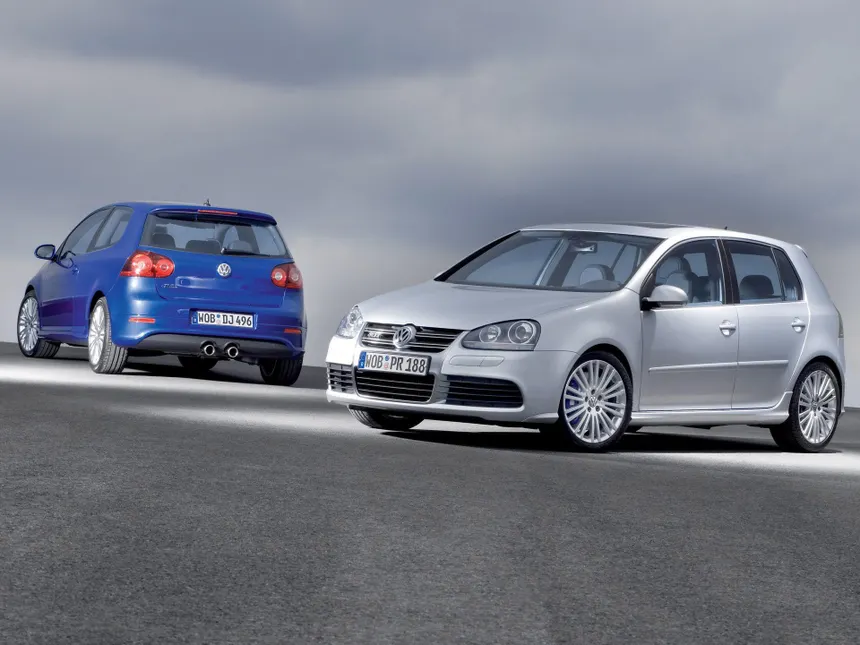
MK4 AND MK5: TWO BROTHERS, TWO PHILOSOPHIES
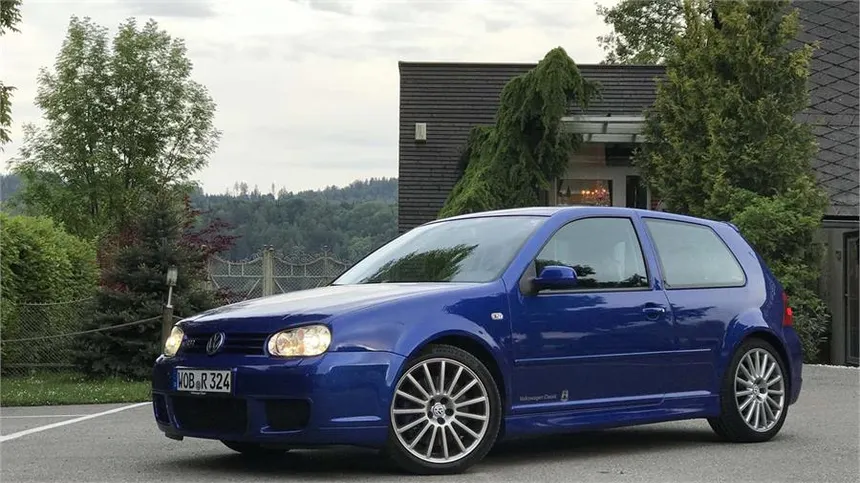
The Mk4 R32 was unveiled at the Wörthersee, the annual GTI gathering in Austria, on 24 May 2002. Volkswagen originally planned 5,000 units. They ended up building roughly 12,000, including the 5,000 that went to the United States for the 2004 model year. The car was an accident of demand. It worked because nobody had asked for it.
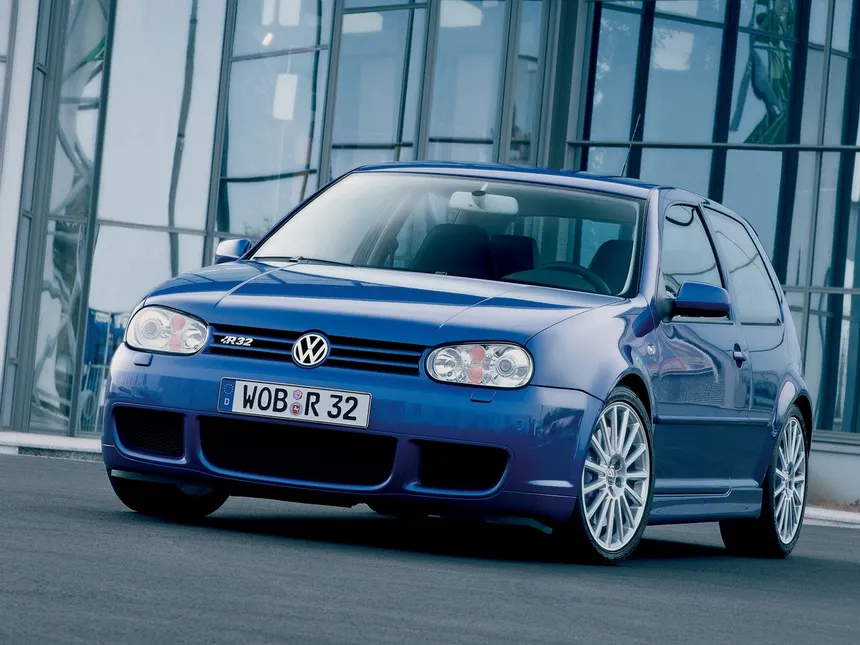
The Mk4 weighed about 1,450 kilograms. 240 horsepower, 236 lb-ft, six-speed manual or six-speed DSG, Haldex 4Motion, 18-inch OZ wheels, twin centre exhaust, deeper bumpers, side skirts, and inside, the detail I like most: blue-tinted instrument surrounds. A tiny thing. But it said the car was different.
The Mk5 R32 arrived in 2005. 250 horsepower, same torque, 1,510 kilograms, 0 to 60 mph in 6.2 seconds, top speed limited to 155 mph. Same recipe, new platform, much better chassis. The Mk5 introduced multi-link independent rear suspension to the Golf, and the R32 was where you felt the difference most. Less understeer. Better turn-in. More balance through a fast corner. But 60 kilograms heavier, and you feel that too.
Which is the better car? Depends what you want. The Mk4 is rawer. Fewer aids, older chassis, more physical. The Mk5 is more grown up. Brakes better, turns in sharper, lap times faster. But the Mk4 is the historic one. The first. The one that introduced the DSG to the world. The one that built the legend.
There is another detail that becomes obvious on a Mk5. You can already see Volkswagen moving towards the homogenised product strategy that defines the brand today. The Mk4 R32 had unique details everywhere you looked. The Mk5 was already sharing too much with the standard GTI. Same lines, same dash, same architecture. The R32 was still special, but the line between special and standard was thinning.
The same thing happened to the sound. Identical engine block, identical VR6, identical twin centre-exit pipework. On paper they should sound the same. They do not. The Mk5 is muted. Thicker firewall insulation, more sound-deadening in the cabin, a more carefully tuned exhaust to clear noise regulations that had tightened since the Mk4 went on sale. Get into a Mk4 and the engine lives in the cabin with you. It is right there, on top of you, and you cannot ignore it. The Mk5 has it on the other side of a wall. From outside, parked next to each other, you would struggle to tell them apart. From the driver’s seat, the Mk4 is having a conversation with you. The Mk5 is reading you a report. And that is exactly the difference between a car built by engineers and a car built by the homologation department.
THE LAST GOLF WITH A SOUL
After the Mk5 R32 came the Mk6. And the Mk6 lost the VR6. The 3.2-litre naturally aspirated narrow-angle six was binned. In its place: a 2.0-litre turbocharged inline four. The EA888. The same engine that, in various states of tune, powers nearly every performance product in the Volkswagen Group catalogue. The name changed too. The “32” was dropped. It was just Golf R now. As if the number had become embarrassing.
The Mk7 R made 300 horsepower. The Mk7.5 made 310. The Mk8 makes 320. Each generation slightly faster, slightly torquier, slightly more refined. And slightly less interesting.
This is what you were getting at. The modern Golf R is the same car with more horsepower. The EA888 gets bumped, the injectors get bigger, a different exhaust, a software update, and another generation ships. Same gearbox. Same Haldex. Same dimensions. The only way to tell a Mk7 Golf R from a Mk8 across a car park is the headlights and the touchscreen. There is no engineering bravery left in it.
The R32 was bravery. The R32 was a group of engineers being told yes, do the strange thing. Take an engine that the rest of the industry was abandoning (a naturally aspirated six, in an era pivoting hard to turbocharged fours) and put it in the most ordinary car you build. Debut a transmission technology nobody else had managed to productionise. Build something your neighbour cannot quite justify but could still take to Tesco.
And then there is the sound. There are cars you identify by silhouette. Others by badge. An R32 you identify by ear. One drives past and you turn your head. Not because it is loud, but because of the timbre. That thick, woody growl out of the twin centre pipes is unmistakable. Now listen to a new Golf R. The exhaust note is processed. It is a four-cylinder with a soundtrack engineered to compensate. The R32 sounded like a car. The Golf R sounds like a presentation.
VALUE TODAY
Take all of that (an engine nobody will build again, a gearbox that wrote a new chapter for the industry, a chassis with proper character, an exhaust note you can identify from inside a building) and you end up with a car that the collector market eventually catches up with. Always too late. But always.
The good R32s are climbing, and fast.
Clean low-mileage Mk4 R32s have been making serious money at the better auctions for a couple of years now. Mk5 prices start lower but the spread is wide, because the bad ones are very bad. You will find Mk5 R32s with 200,000 kilometres, chains rattling, clutch packs failing on the DSG, suspension bushings ruined. The good ones (one owner, full history, untouched) are not cheap, and the gap is going to widen.
Because the world has finally figured out what this car was. They are not making another VR6. They are not going to debut a dual-clutch in a Volkswagen Golf again. They are not going to make a Golf that feels properly different from every other Golf. The R32 is one of the last cars that was designed for the act of driving instead of the act of configuring.
If you own one, look after it. If you do not own one and you have the chance, find one. The window is closing.
Meanwhile, look at the latest Golf R. Look at what it has under the bonnet. Listen to it. Read the options list. Then ask yourself where the people went, the ones in Wolfsburg who in 2002 said: let us do something strange. Let us put a transverse VR6 in this and bolt on a gearbox the world has never seen. Let us do it because it is interesting.
Those people are gone. Or they are still there, but nobody lets them decide anything any more.
Check you’re still alive.