
F1 hybrid engine: the split turbo, the MGU-H and 50% efficiency
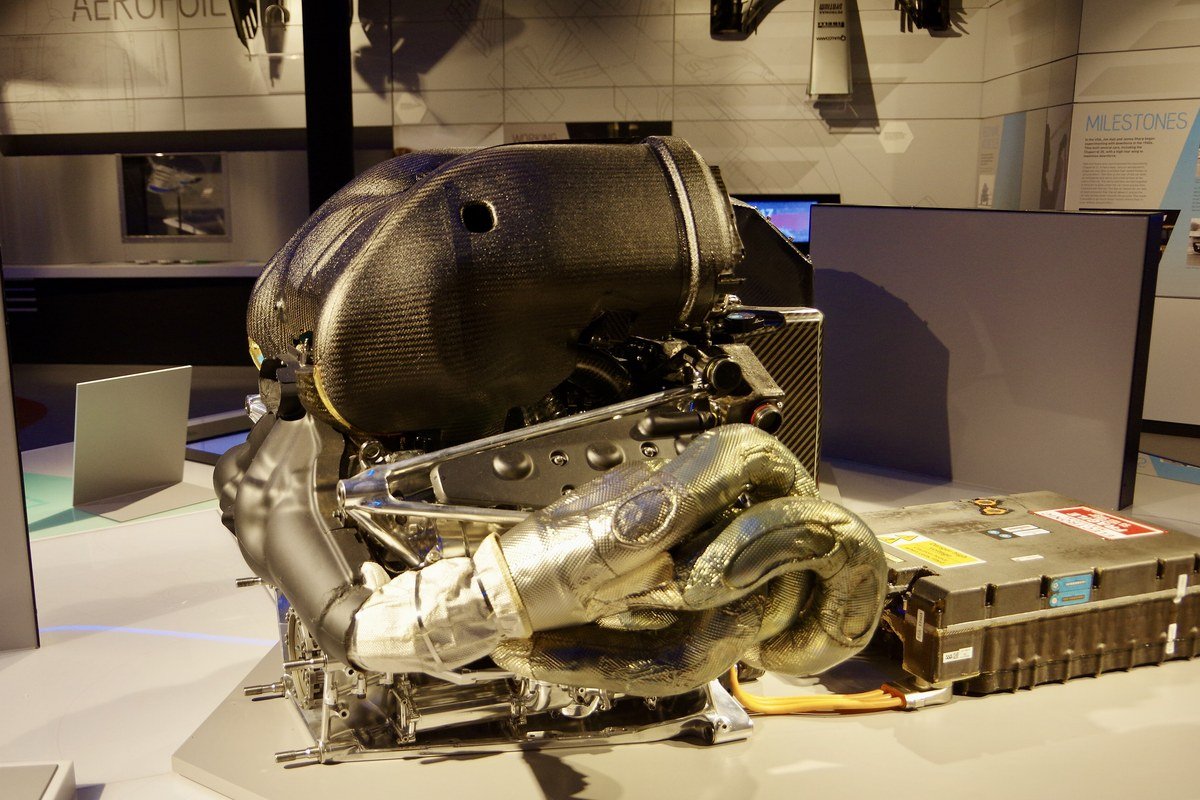
For a hundred years, American horsepower had one answer to every question: more cubic inches. Then Formula 1 bolted a turbo and two electric motors to a 1.6-liter V6, told it to live on a fixed ration of fuel, and got more than a thousand horsepower out of it. This is the last chapter of our series on how engines breathe, and it ends at the top of the mountain, with the most sophisticated breathing machine anyone has ever raced and the part that made it special, the MGU-H, already thrown in the dumpster by the people who write the rules.
We started this series with the naturally aspirated engine, the one that just opens its valves and takes whatever air the atmosphere pushes in. Along the way we stuffed air in with a turbocharger, fought the delay that came with it in the turbo lag chapter, cooled the charge with an intercooler and watched carmakers shrink engines in the name of fuel economy with downsizing. The hybrid Formula 1 power unit is all of that at once, run by people with budgets that would embarrass a small country, though not unlimited ones: since 2023 the FIA has put a spending cap on engine manufacturers, too.
The rule that turned power into an efficiency contest
To understand why this engine looks the way it does, forget the hardware for a second and look at the fuel gauge. The 2014 rules didn’t just set the displacement at 1.6 liters and the cylinder count at six. They rationed the gasoline. A maximum flow of 100 kilograms of fuel per hour, policed by an FIA-approved sensor, and 100 kilograms for the whole race (later raised to 105 kg in 2017 and 110 kg in 2019). That’s the trick that explains everything else.
Think about it from the engineer’s chair. If you can’t pour in more fuel, the only way to make more power is to get more work out of each gram you’re allowed to burn. For the first time in the sport’s history, chasing horsepower and chasing efficiency became exactly the same job. Every bit of energy that left the engine as heat was horsepower you’d paid for in fuel and never used.
And the results got silly. Nobody publishes official figures, so treat these as estimates, but the paddock consensus put the 2014 Mercedes at around 850 hp, and the late-era units comfortably past 1,000. By late 2017 Mercedes itself was saying it was knocking on the 1,000 hp door. From a V6 with the displacement of a Honda Civic.
Fifty percent: the number that made engineers stop and stare
The headline figure is thermal efficiency, and it deserves a minute. Thermal efficiency is the slice of the fuel’s energy that actually comes out as useful work at the engine’s best operating point, instead of escaping as heat out the tailpipe and through the radiator. A regular gasoline engine in a road car typically peaks somewhere in the 30s, and over a real drive it averages much less. Toyota’s best production engine, the 2.0-liter Dynamic Force in hybrid form, is advertised at 41%, and that’s sold as a breakthrough. The screaming V10s that Formula 1 ran in the early 2000s are generally estimated at under 30%.
In 2017, Mercedes said its power unit had gone past 50% on the dyno. More than half the energy in the fuel turned into work. No piston engine you can buy for the street gets anywhere near it. And it wasn’t one magic part. It was combustion tuned to an obsessive degree, low-friction oils, clever use of the exhaust gases and, yes, a lot of energy recovery, all stacking their gains on top of one another.
The star of that recovery, though, has a name.
Splitting the turbo in two
Before the MGU-H, you need to look at the turbo itself, which on the Mercedes looked nothing like the snail bolted to the side of a Ford EcoBoost. Mercedes did something that sounded like a packaging nightmare: it cut the turbocharger in half. The compressor, which squeezes fresh intake air, went to the front of the engine. The turbine, which is spun by the exhaust gas, went to the back. A long shaft ran through the vee of the V6 to connect them.
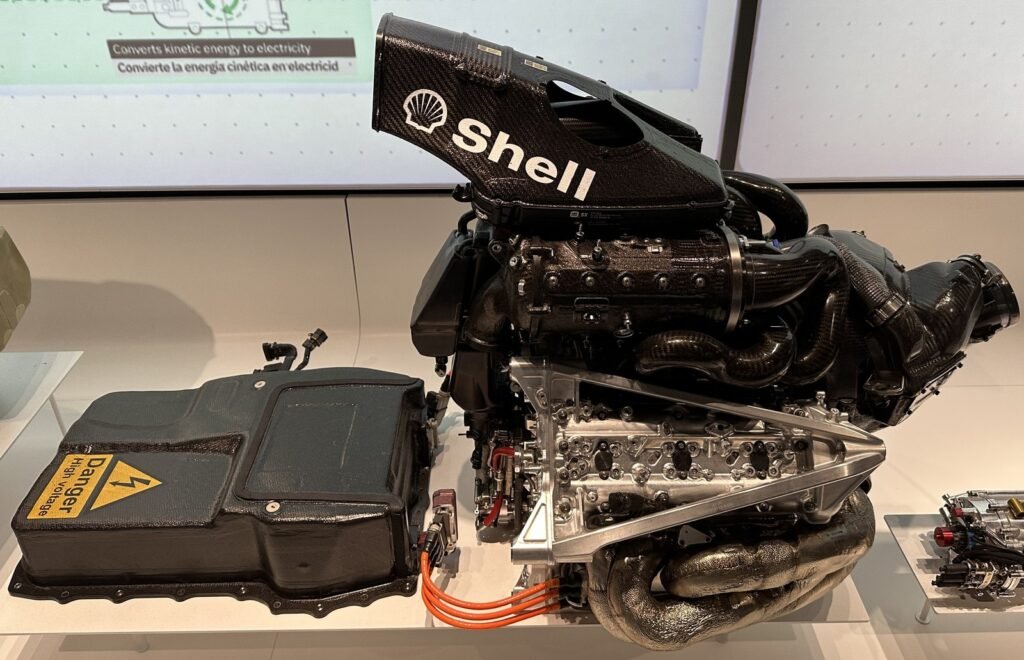
Why bother? Because a turbo normally lives with its hot side and cold side bolted face to face. The turbine is bathed in exhaust gas at several hundred degrees; the compressor is trying to deliver cool, dense air. Compressing air heats it no matter what, which is why intercoolers exist, but putting the compressor right next to a red-hot turbine adds heat you don’t need. Pull them apart and the compressor runs cooler, the charge reaches the cylinders denser, and the cooling system has more margin. Depending on how it’s packaged, the intake path can also get shorter and lose less pressure along the way.
And the space left in the middle of the vee, between the two halves of the turbo, is exactly where the most interesting part of the whole engine sits.
The MGU-H: an electric motor living on the turbo shaft
MGU-H stands for Motor Generator Unit – Heat. Strip off the jargon and it’s an electric machine mounted directly on the turbo shaft, between compressor and turbine. It has two jobs, and each one kills a problem this series has been chasing since the start.
The first job is lag. A conventional turbo needs exhaust flow to spin up, so when you stab the throttle there’s a pause while the turbine gets going. We spent a whole chapter on the fixes: variable geometry, twin-scroll housings, anti-lag systems that set off explosions in the exhaust manifold. All of those try to make better use of the gas. The MGU-H doesn’t wait for the gas. When the driver gets back on the power out of a corner, it grabs the shaft electrically and spins the compressor up itself, in a fraction of a second, then holds it there. Lag doesn’t vanish under every possible condition, but the response becomes close to instant, something no purely mechanical setup ever managed.
The second job is where the efficiency comes from. When the engine is flat out and the exhaust is pushing the turbine harder than the compressor needs, the MGU-H flips roles and becomes a generator. It’s worth getting the chain right, because it’s often told wrong: the MGU-H doesn’t turn heat directly into electricity. The exhaust gas spins the turbine, the turbine spins the shaft, and the generator takes part of that rotation and converts it into current. Energy that in a normal car would simply leave through the tailpipe gets captured and sent either to the battery or straight to the other electric motor on the car.
That other motor is the MGU-K, connected to the crankshaft. It works like the regenerative braking on any EV or hybrid: it harvests energy when the car slows down and hands it back as extra push. The rules kept it on a short leash: 120 kW maximum (about 160 hp), 2 megajoules recovered per lap, 4 megajoules delivered per lap. But here’s the detail that decided championships: the MGU-H had no energy limit. Whatever it pulled from the exhaust could go straight to the MGU-K without passing through the battery. A team that had mastered the MGU-H could keep the electric boost running the full length of a straight while the rival’s battery ran dry halfway down it.
From the pit lane to the driveway: the AMG One
If you want proof that this is hardware from another planet, look at what happened when Mercedes tried to put it on the road. The Mercedes-AMG One, first delivered to a customer in January 2023, carries a road-adapted version of the F1 V6, MGU-H and MGU-K included, and Mercedes quotes 1,063 PS for the whole system. Only 275 were built.

The catch tells you why none of this ever trickled down to your crossover. The engine needs a full rebuild at around 50,000 km, roughly 31,000 miles. The project ran years late because making a race engine idle politely, pass emissions and survive traffic took far longer than anyone at Affalterbach admitted at the launch. A Formula 1 power unit is designed to be pulled apart after a few races. Asking it to behave like a commuter is asking a racehorse to pull a plow.
And it puts a dent in the oldest saying in American hot-rodding: there’s no replacement for displacement. For decades the gospel was a big V8 breathing easy. The replacement for displacement turned out to be a turbo spun by an electric motor and a fuel ration that forced engineers to waste nothing. A 1.6 out-powering most big-blocks ever built, on a fixed diet of gas, is about as clear an answer as you get.
The killing of the masterpiece
Now for the twist. The MGU-H, the cleverest part of the whole package, the one that solved lag at the root and helped push efficiency past 50%, is gone. The 2026 Formula 1 rules removed it.
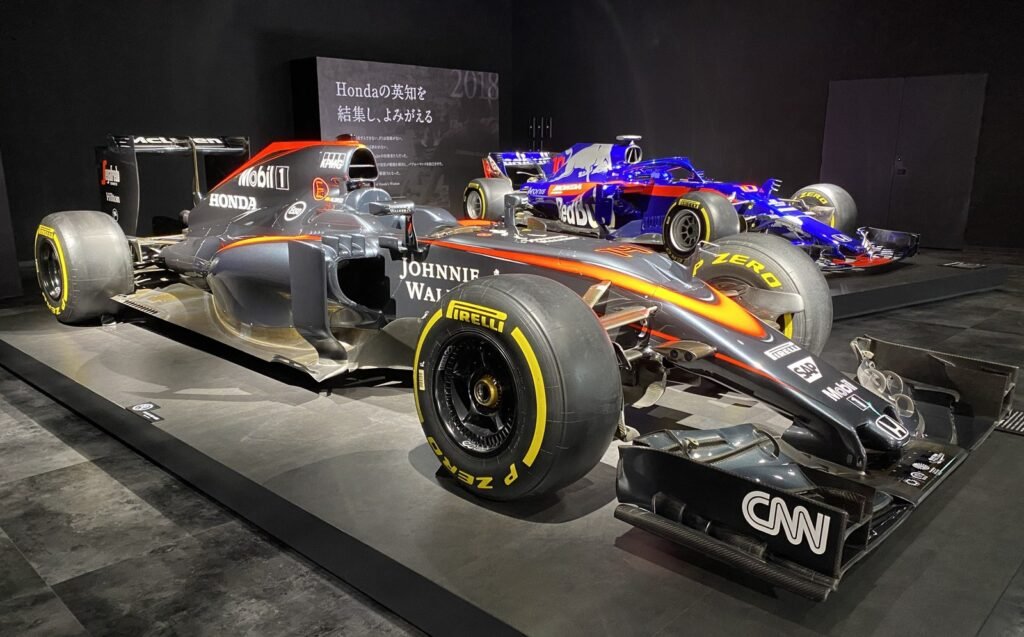
The reasons are the usual ones when brilliant engineering meets a balance sheet. The MGU-H was fiendishly complex and wildly expensive to develop, and it humbled big names. Renault spent years struggling with it. Honda’s return in 2015 with McLaren was a public disaster: its energy recovery couldn’t sustain the electric boost for a full lap, so the car ran out of push halfway down the straights. At the 2015 Japanese Grand Prix, at Suzuka, Honda’s own home track, Fernando Alonso got on the radio and said it out loud: “GP2 engine, GP2!”, comparing it to the junior category one rung below. Honda eventually got it right, and its power unit carried Max Verstappen and Red Bull to the 2021 drivers’ title. But the pain it took to get there tells you how hard the part was.
A component that costly and that hard to tame is poison for a series that wants close grids and new manufacturers. And the new manufacturers were waiting. Audi had made it clear it wanted the MGU-H gone before committing, and it arrived in 2026 as a works team. For American fans, the more interesting arrivals are Ford, back in the sport as Red Bull’s partner on its own power unit from 2026, and Cadillac, which joined the grid in 2026 running Ferrari engines. None of that was happening while the MGU-H was in the rulebook.
So the 2026 formula drops it and reshapes the balance instead: combustion power trimmed to about 400 kW, electric power raised to 350 kW, a split close to fifty-fifty, all burning sustainable fuel. The performance is meant to be in the same ballpark, delivered by a route that’s cheaper and easier for a newcomer to copy.
The best technical solution doesn’t always survive. The MGU-H was probably the smartest way anyone has found to use the energy in an exhaust, the logical end point of everything since chapter one. It wasn’t killed because it didn’t work. It worked beautifully. It was killed because it cost too much, took too long to master and couldn’t be democratized. Perfect engineering lost to the spreadsheet. Again.
The Spanish connection: Madrid opened the next act
There’s a twist of timing that puts Spain right at the handover. The last season with the MGU-H was 2025, the twelfth since the hybrid power unit arrived in 2014. And in the first season without it, the Spanish Grand Prix moved to Madrid. The Madring, laid out around the IFEMA exhibition grounds on the edge of the city, hosted its first Formula 1 race on September 13, 2026. Kimi Antonelli, 20 years old and driving for Mercedes, won it ahead of Max Verstappen and Lando Norris. Barcelona stays on the calendar, renamed the Barcelona-Catalunya Grand Prix.

So the cars that christened Madrid no longer carried the part that made the previous generation legendary. Spain didn’t join the modern Formula 1 map to say goodbye to the masterpiece; it showed up to open whatever comes after it: less combustion power, twice the electric push, sustainable fuel. The curtain on the MGU-H came down the season before. Madrid opened the next act, with a Mercedes on top, the same badge that had ruled the era that just ended.
The engine that learned to waste almost nothing
Line it up against where we started. The naturally aspirated engine of chapter one took in whatever the atmosphere gave it and blew its exhaust out the pipe without a second thought. This one compresses its air with a turbo cut in two, spins that turbo with an electric motor so there’s barely a hint of lag, harvests energy from the exhaust and from braking, and turns it into speed. Same basic recipe, air in, fuel burned, force out, pushed to a level that would have sounded like science fiction to an engineer in the seventies.
Every chapter of this series has been about the same fight: an engineer staring at energy slipping away and looking for a way to grab it. The supercharger and the twincharged setups went after the engine’s reluctance to breathe. The turbo went after the energy in the exhaust. The intercooler went after the density that heat steals. The pressure-wave Comprex tried something stranger still, and also fell by the wayside while it was being brilliant. The Formula 1 hybrid is the end of that road: the engine that wastes the least of all, and still, to be clear, throws away close to half of what it burns, because every last point of efficiency costs more than the one before.
They retired its best part for being too expensive. The naturally aspirated engine breathed on its own and lasted a century. The F1 hybrid learned to lose barely a breath, and its star component lasted twelve seasons, 2014 to 2025.
Check you’re still alive.
Photos: David Merrett (CC BY 2.0), 5225C (CC BY-SA 4.0), Alexander-93 (CC BY-SA 4.0), BWard 1997 (CC BY 4.0), Fábio Alecrim (CC BY 4.0).