
Engine downsizing: why a small turbo engine burns less than a big one

In 2011 Ford did something that should have gotten somebody fired in Dearborn. It took the F-150, the truck that has paid the company’s bills for four decades, and offered it with a V6. A 3.5-liter V6, twin-turbocharged, sold right next to the V8 at a higher price, under a name that sounded like a marketing intern’s homework: EcoBoost. Truck guys were supposed to laugh it off the lot. They bought it instead. That was the moment engine downsizing stopped being a European curiosity for diesel hatchbacks and became the American default.
Downsizing means exactly what it sounds like. You take a smaller engine, bolt a turbo to it and make it do the job a bigger one used to do. A 1.0-liter three-cylinder in a car that once had a 1.6. A turbo four where a V6 used to live. A twin-turbo six in the truck that was born to carry a V8. Plenty of people hate it, and the argument usually turns into a fight about regulators and the death of the V8, which we’ve already had in another piece. This one is about the question underneath: why on earth does it work? A smaller engine making the same power and burning less fuel sounds like a con. It isn’t, and the reason has to do with something nobody puts on a spec sheet: how hard an engine has to work just to breathe.
We’ve spent seven chapters of this series on getting air into a cylinder, from the naturally aspirated engine all the way to the pressure wave superchargers and other dead ends. Chapter eight is where all of that gets cashed in.
The throttle plate is a tax
Start with a gasoline engine you already know, the old-school kind with no turbo. Between the air filter and the cylinders sits a throttle plate, a flat disc on a shaft. Your right foot doesn’t really control fuel. It controls that disc. Push the pedal and the disc swings open; lift and it closes.
At 70 mph on the interstate, a car needs surprisingly little power. Depending on size and shape, maybe 20 to 40 horsepower just to hold speed. So if there’s a 5.0-liter V8 under the hood, that engine is loafing along with the throttle barely cracked. And here is the catch. Every time a piston goes down on its intake stroke, it has to pull air past that nearly closed disc. It’s sucking against a restriction, building vacuum in the intake manifold, the way you’d feel it trying to drink a milkshake through a coffee stirrer. That suction costs energy, and the energy comes out of the fuel you paid for. Engineers call it pumping loss. It never reaches the wheels.
Put another way: a big gas engine at cruise spends a good part of its life strangling itself on purpose so the car doesn’t go faster than you want. Huge capacity, choked down to a whisper, and paying for the privilege.
Now drop in a small engine. To hold the same 70 mph it has to make the same 20-odd horsepower, but from much less displacement, so its throttle sits much wider open. Less restriction, less vacuum, less pumping loss. There’s a bonus effect too. An engine running at a higher fraction of its capacity loses a smaller share of its heat into the cylinder walls, so more of each combustion event ends up pushing on the piston. Engineers describe all of this as moving the operating point into the efficient part of the engine map. In plain English, the small engine spends its day where it’s good at its job, and the big one spends its day where it’s bad at it.
Then there’s friction. Fewer cylinders means fewer pistons, rings, bearings and valves rubbing against something. Mazda put a number on it when it replaced the 3.7-liter V6 in the CX-9 with a 2.5-liter turbo four for 2016: the company told engineers at the Vienna Motor Symposium that the swap cut both friction and pumping losses by about 30%.
And when you do bury the pedal? That’s what the turbo is for. Exhaust energy spins a compressor, the compressor crams air into the cylinders, and for a while the little engine behaves like a big one. We covered the hardware in the turbocharger chapter. Downsizing is just the strategy that uses it: small when you’re cruising, big when you’re merging.
What the numbers actually say
Suppliers and automakers threw a lot of numbers around in the 2010s, and they measure different things, so it’s worth being careful. The International Council on Clean Transportation pulled several of them together in a 2016 working paper. BorgWarner, which builds turbos and so isn’t exactly neutral, simulated a mid-size SUV on the EPA’s city test cycle. Replacing a naturally aspirated 5.0-liter V8 with a 3.5-liter turbo V6 cut fuel consumption by 30%. Going all the way down to a 1.9-liter turbo four cut it by 38%.
Mazda’s CX-9 numbers came from the road. On Consumer Reports’ highway test, the 2.5 turbo used 23% less fuel than the V6 it replaced, which works out to roughly 30% better mpg. Volkswagen claimed about 10% for its EA211 evo engines, the Miller-cycle 1.5 TSI family, over the previous generation, with bigger gains at light load. VW was clear that the Miller timing wasn’t doing all of that alone.
So: a simulation, a magazine test, a manufacturer’s claim. None of them is a final answer. All of them point the same way.
Everyone got on the train
Once emissions and fuel economy rules started to bite in the early 2010s (CAFE here, CO2 targets in Europe), the industry didn’t argue. Downsizing was the cheapest way to lower official fuel consumption without designing a new car around it. BMW started trading its naturally aspirated inline sixes for the turbocharged 2.0-liter N20 four in 2011. Ford’s 1.0-liter EcoBoost three-cylinder arrived in the European Focus in 2012 with 123 hp, the same output as the 1.6 it replaced, and Ford was so proud of it that CEO Alan Mulally was photographed planting a kiss on the engine. Americans could buy the same triple in the Fiesta a couple of years later.
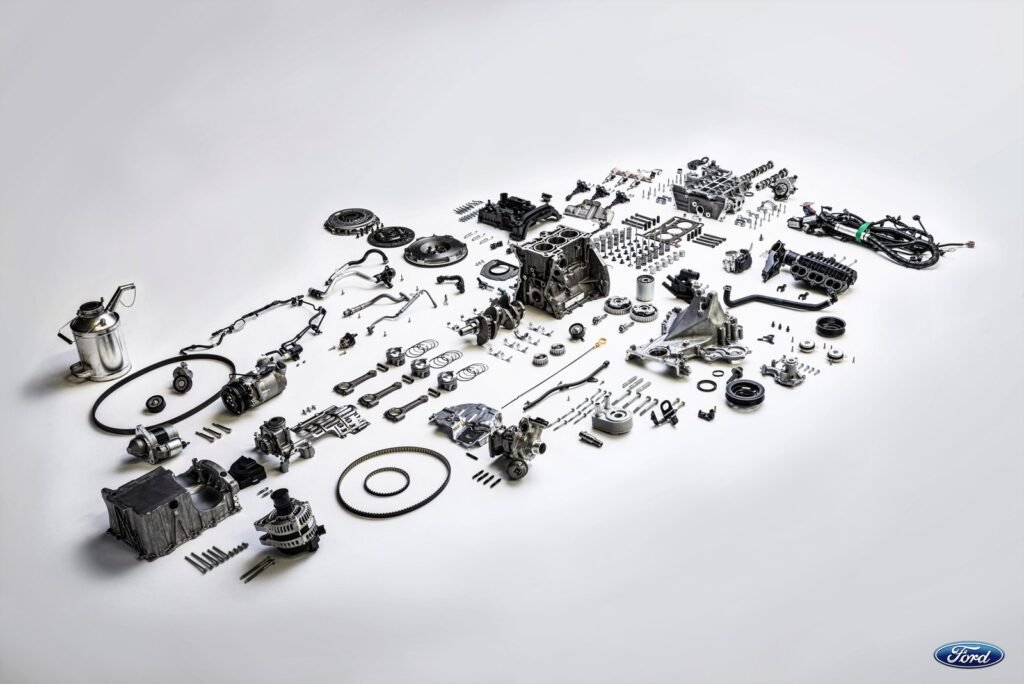
Then there’s the truck. The F-150’s 3.5 EcoBoost didn’t win buyers by being green. It won them on torque. A turbo V6 makes its pulling power low in the rev range, right where you need it with a trailer hooked up, and owners who’d never have touched a “green” engine figured that out fast. Downsizing conquered the pickup bed on muscle, not guilt.

BMW even put a 1.5-liter turbo three-cylinder in a supercar, the BMW i8, though it had an electric motor up front doing some of the heavy lifting.
The bill comes due
None of this is free, and if you’ve read the rest of this series you knew that already. Every trick for breathing better comes with a cost somewhere else.
The first one shows up at full throttle. A small engine making big power has to run high boost, and high boost means hot, dense air in the cylinder. As we saw in the intercooler chapter, hot air under pressure wants to detonate. One common defense is to run the mixture rich under heavy load, spraying in more fuel than combustion needs because the extra fuel cools the chamber as it evaporates. That’s protective, and it’s wasteful. Drive a downsized engine hard and its advantage shrinks, sometimes to almost nothing. It depends on the engine and the driver, but the savings live at part throttle.
That leads to the second problem, the one that ends up on the window sticker. The official test cycles are gentle. They barely ask the turbo for anything, which is exactly where a small engine looks brilliant. Real drivers, especially drivers who bought the car because the turbo felt quick, use the boost. David Greene and colleagues at the University of Tennessee’s Baker Center went through thousands of owner-reported results on fueleconomy.gov in 2015 and compared them with the labels. On average, turbocharged gasoline engines fell short of their labels by 1.7 percentage points more than naturally aspirated ones. Most of that came from turbo pickups, which missed by 6% more than non-turbo pickups, although there were only 67 pickups in the sample. Read that carefully. It doesn’t say a turbo V6 burns more than the V8 it replaced. It says the turbo engine misses its own promise by a bit more. The physics still works. The sticker oversells it a little.
Superknock
And then there was the failure that gave a generation of small turbo engines a bad name. It cracked pistons on cars with almost no miles on them.
To understand it, go back to normal knock. In a healthy engine the spark plug fires a little before the piston reaches the top of its stroke, and a flame spreads across the chamber. Knock happens when a pocket of unburned mixture out at the edge, squeezed and heated by the advancing flame, explodes on its own before the flame gets there. It makes that metallic ping you hear on cheap gas, and depending on how hard it hits, it can do real damage.
Low-speed pre-ignition, LSPI to engineers, is worse. Here the mixture lights itself before the spark plug fires at all, set off by a hot spot in the chamber. That early start can trigger a combustion event with violent knock, a pressure spike so big it got its own name: superknock. Not every LSPI event goes that far. When one does, it’s not a ping. It’s a hammer blow that can bend a connecting rod or break a piston in a handful of cycles.
It hit small, turbocharged direct-injection engines because they stack up all the risk factors at once: big boost at low rpm (lugging in sixth and flooring it to pass a semi), small hot combustion chambers, and fuel sprayed straight into the cylinder where it can wet the walls. The main suspect turned out to be tiny droplets of oil getting into the chamber and acting like a fuse. Then researchers found that calcium-based detergents, a standard ingredient in motor oil, made the problem worse. The fix came from the oil companies as much as the engineers. GM rewrote its dexos1 oil spec, and in 2018 the American Petroleum Institute introduced the API SN Plus rating, largely to deal with LSPI. Automakers also reprogrammed engine computers to limit torque at very low rpm. The most advanced engines on the market, tamed partly by changing what goes into the oil. That’s why the owner’s manual of your small turbo car is so picky about which oil goes in it.
Backing off
The most revealing part of the story is what came next. Some of the tiniest engines met their targets in the lab and disappointed on the road, and their reputation took hits from timing chains, turbos and oil consumption. So the industry eased off. Volkswagen replaced its 1.4 TSI with a 1.5 TSI running the Miller cycle, slightly larger rather than smaller, and went after efficiency through smarter combustion instead of more boost on less displacement. The extra 100 cc is a fact. My reading of it, and it’s my reading, not a settled conclusion: downsizing had a floor, and below it, shrinking the engine stopped paying.

Then there’s Mazda, the one company that never fully bought in. While everyone else put turbos on smaller and smaller engines, Mazda kept refining big naturally aspirated fours. When it finally tried something radical, it was the Skyactiv-X, a gasoline engine that spends much of its time igniting by compression like a diesel, with the spark plug acting only as a trigger. It was clever, hard to build, and never sold in the United States. Even in Europe it’s fading. In 2026 Mazda dropped it from the Mazda3 in the UK and most of Europe, kept it only in the CX-30, and pointed everyone toward the Skyactiv-Z due around 2027. Swimming against the current costs money. Still, it proved one thing: not everybody believed shrink-and-boost was the only answer.
The Spanish connection
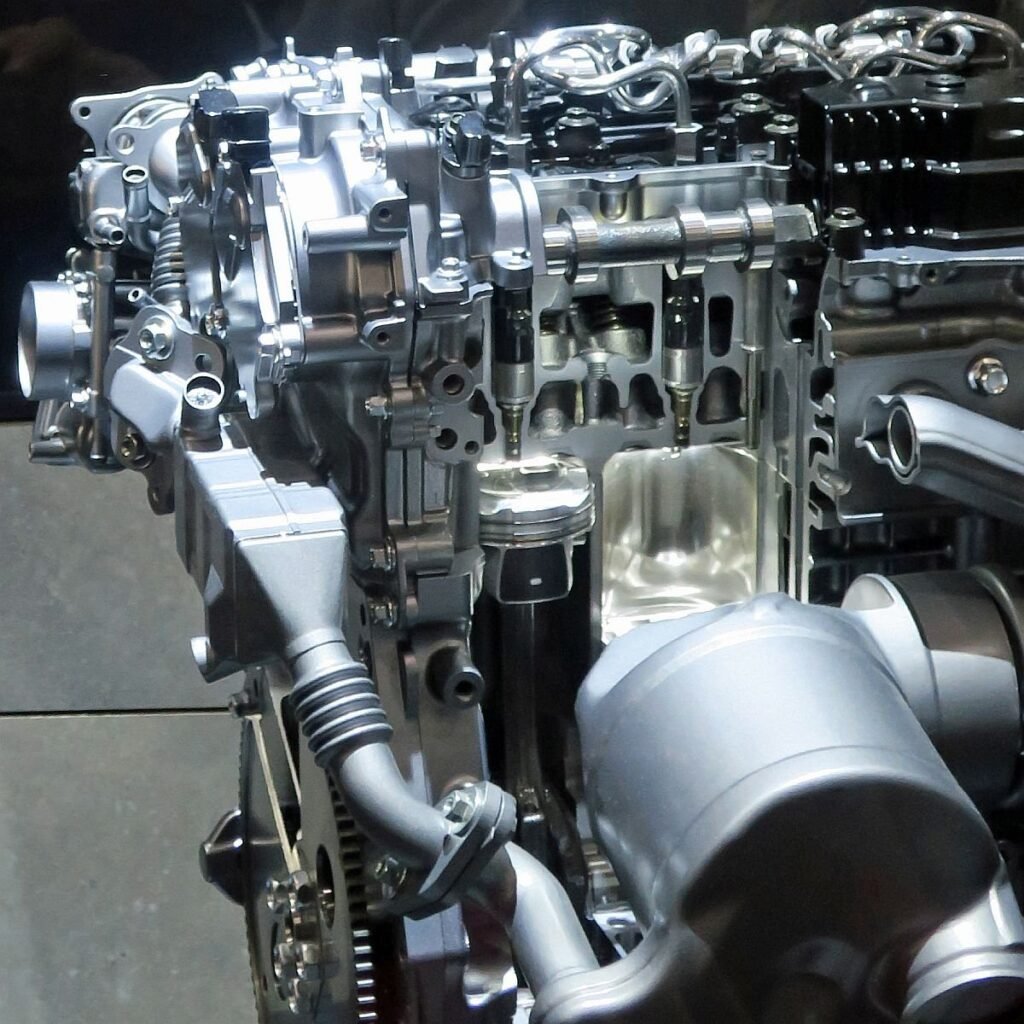
Here’s a part American readers almost never hear about. The 1.0 TSI three-cylinder that powers half of Europe’s small cars goes into SEAT Ibizas, Leóns and Aronas built at Martorell, outside Barcelona. SEAT is a brand Americans never really got, but its cars are about as close as you can get to the everyday face of downsizing. The León made the 1.0 TSI its entry-level gas engine in 2018 and dropped the 1.2 TSI four-cylinder, just as Europe’s tougher WLTP test came in. The engine block itself comes from other Volkswagen Group plants. The cars that made the downsized triple ordinary are assembled in Catalonia.

Scam or miracle?
Neither. The physics is real. A small engine working at a decent load really does breathe better than a big one strangling itself at a crack of throttle, and nobody who understands engines disputes that. But the brochures oversold it. The savings live at light load, they shrink when you drive with some enthusiasm, and squeezing big output from tiny engines brought reliability bills owners hadn’t agreed to.
The problem was the dose. Dropping one step in displacement and adding a good turbo is sensible engineering, and the F-150 proved that a truck buyer will take it if it pulls. A gasping 1.0 hauling a family car at boost pressures that invite superknock is taking the idea further than it goes. Test cycles that rewarded exactly the kind of driving nobody does pushed the industry there, and the industry backed off by itself, adding a little displacement and chasing better combustion as soon as it could. Downsizing taught engines to breathe shallow and slow to save fuel. Then we asked them to gulp air whenever we wanted to go fast, and the deal stopped working.
Check you’re still alive.
Photos: Ford Motor Company (CC BY 3.0), Ford Motor Company (CC BY 3.0), Damian B Oh (CC BY-SA 4.0), NJo (CC BY-SA 3.0), Qurren (CC BY-SA 4.0), Spielvogel (CC0).