Mazda Iconic SP: the last romantic still betting on the engine
Across four articles, NEC has been telling you how the combustion engine game is being played in 2026. We’ve explained how Aramco designs cheap engines to keep petrol alive. We’ve explained how Horse Powertrain quietly assembles the planet’s largest combustion-engine supplier. We’ve explained how Chinese manufacturers build petrol units with Formula 1-grade thermal efficiency while Europe shuts plants. We’ve explained how Toyota spends five years burning hydrogen in endurance racing only to drop that R&D into a road car.
Now comes the fifth piece. The strangest one. The one some readers will tell us we shouldn’t have published.
It’s about Mazda. And it’s about why, while all the previous players move on money, geopolitics or sheer industrial pride, in Hiroshima there’s a team of thirty-six engineers — exactly thirty-six — who clock in every morning to develop the most economically absurd technology still alive in the engine industry. The Wankel rotary engine. The one almost every manufacturer tried and abandoned. The one customers no longer understand. The one European regulation is about to suffocate over emissions. And the one Mazda refuses to let go of.
Why? Because Mazda has no Aramco behind it. No Chinese subsidies. None of Toyota’s scale. What Mazda has is an identity. And the identity of Mazda, since 1967, has worn one name and one symbol. Wankel rotary.
Let’s tell the story properly.
SkyActiv-Z: the first new Mazda engine in twelve years
We start with the conventional petrol engine, because that’s the context that holds up everything else. Mazda hasn’t launched a genuinely new combustion engine since 2014. The SkyActiv-G and SkyActiv-X families both started that year, and they’ve been refined and updated, but no fundamentally new block. Twelve years of engine silence from a brand that calls itself “a driver’s brand”. That tells you something on its own.
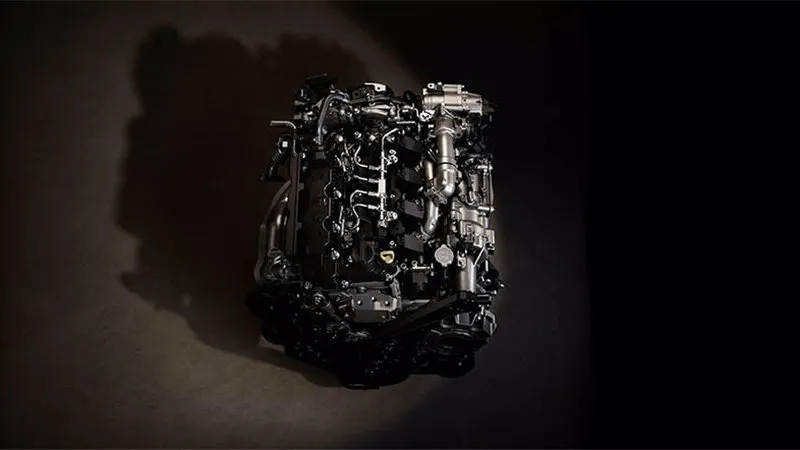
On the 14th of November 2024, during a financial results presentation, CEO Masahiro Moro dropped the first public hint of what was being cooked. “Even in the era of electrification, Mazda’s signature technology, the internal combustion engine, will continue to evolve.” In March 2025, on the official Mazda Mirai Base website, the company published the first technical description of the new engine. It’s called SkyActiv-Z. It’s a 2.5-litre naturally aspirated four-cylinder inline. It will debut in the next-generation CX-5 in 2027. And it carries a technical idea worth stopping for.
The concept is called Lambda 1. It’s thermodynamics terminology. Lambda is the ratio between the actual air entering a combustion chamber and the air stoichiometrically required to burn the fuel being injected. Lambda 1 means the mixture is exactly the theoretical one: not one molecule of air more, not one less. That’s what every road petrol engine targets in part-load operation, where it’s relatively easy to achieve. The trick with SkyActiv-Z is that Mazda is promising to maintain that perfect stoichiometry across the full rpm and load range, under real driving conditions — not just at half throttle. Wide open. Cold start. Hard acceleration. Everywhere.
Why does that matter? Because when a conventional petrol engine reaches full load, engineers traditionally enrich the mixture (feeding more fuel than stoichiometric) to cool the combustion chamber by evaporation and protect internal components. That gives you more power, but it sends unburnt hydrocarbon, CO and soot emissions through the roof. That’s what European and American engines have been doing forever, and what Euro 7 and LEV IV are about to ban outright.
Mazda wants Lambda 1 at full load without enrichment. That’s the cleanest technical pursuit a petrol engine maker can set itself. If it works, the SkyActiv-Z becomes the cleanest conventional petrol engine on the market. And there’s more: the engine is integrated with Mazda’s first proprietary hybrid system. Up to now, Mazda hybrids in markets like the US (CX-50 Hybrid) used licensed Toyota tech. With the SkyActiv-Z arrives the first full hybrid designed in Hiroshima from the first line of the blueprint to the last.
A 2.5-litre four-cylinder version comes first. An inline-six with the same technology comes later. And that matters, because it signals Mazda isn’t abandoning large or premium engines. In a sector where everyone is downsizing displacement and cylinder count, Mazda maintains the inline-six as a future bet. That, in 2026, is practically eccentric.
The RE Development Group: 36 engineers and a symbol
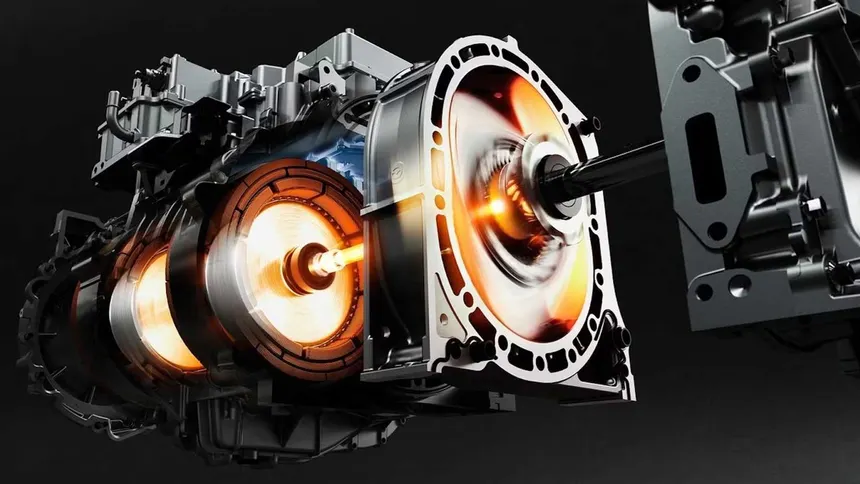
Here’s where the story touches the heart. On the 1st of February 2024, in an official press release, Mazda announced something it hadn’t announced since 2018. It re-established its internal rotary engine development team. They call it the RE Development Group. It consists of exactly 36 engineers. It sits within the Powertrain Technology Development Department.
CTO Ichiro Hirose explained it like this, in the words of the official release: “In Mazda’s history, the rotary engine is a special symbol of our ‘challenger spirit’. We are deeply grateful to all those who have supported RE to date, and are pleased to announce the rebirth of the organisation that develops RE, the engine that has been loved by customers around the world. This time, 36 engineers will gather in one group to make a breakthrough in the research and development of RE.”
Translate that to plain language. Mazda had just spent serious money rebuilding the team that it had officially disbanded in 2018 because the rotary wasn’t commercially viable. You don’t do that to sell more cars. You do it because your brand identity depends on it.
The brief, according to the release, has three missions. One: comply with emissions regulation in major markets, especially European Euro 7 and American LEV IV. Two: develop the rotary as a generator in range-extender systems. Three: research the application of carbon-neutral fuels, including hydrogen.
Is there a product behind it? Yes. And here comes the prettiest piece.
The Iconic SP: the RX-7 nobody saw coming
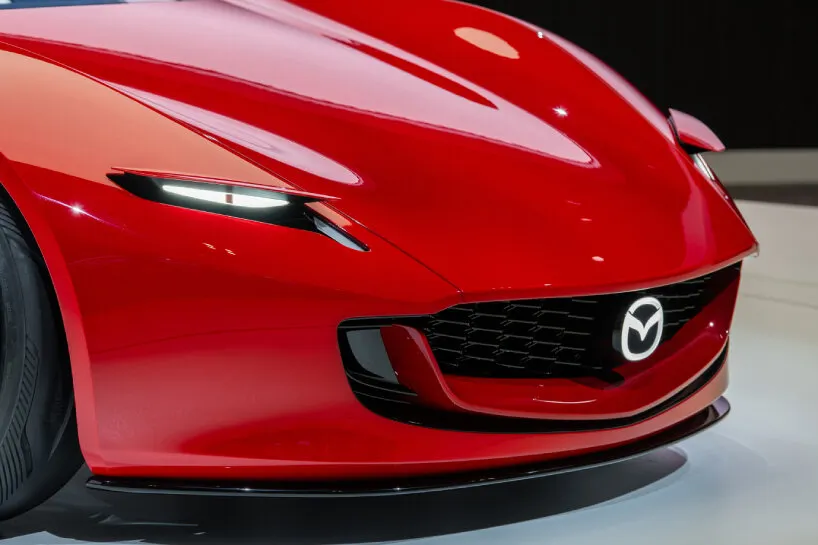
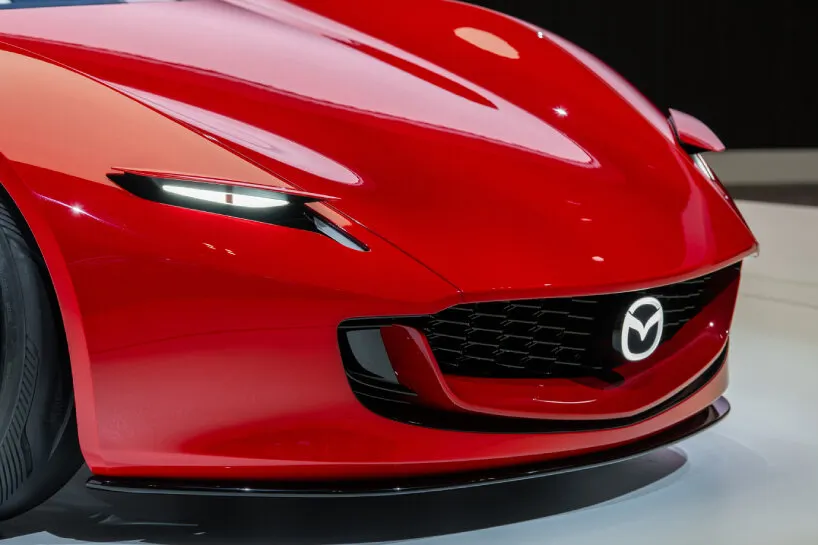
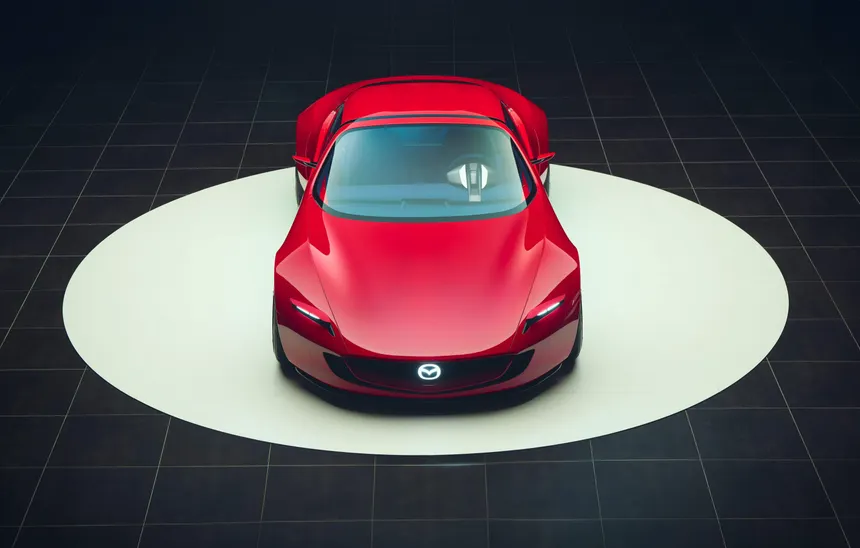
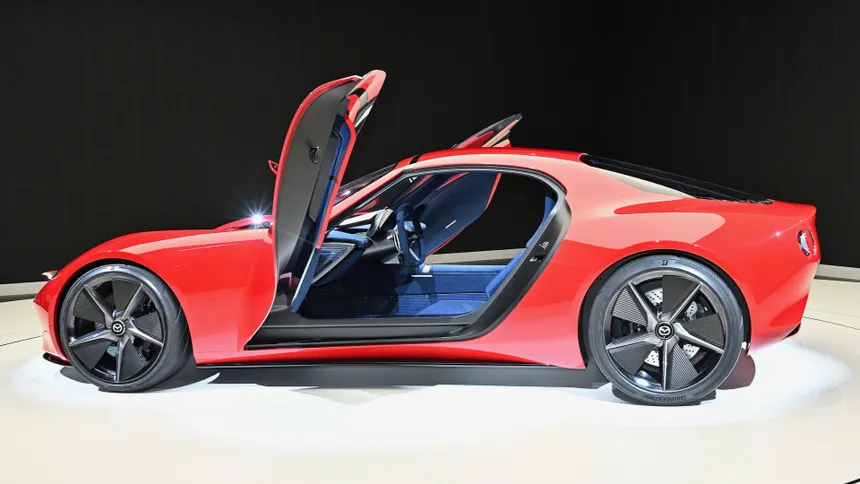
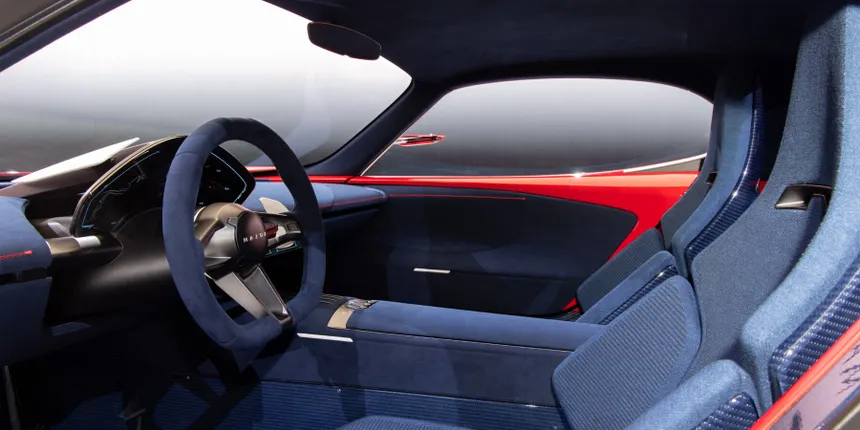
In October 2023, at the Japan Mobility Show, Mazda unveiled a concept that left the industry with its mouth open. It’s called Iconic SP. It’s a compact coupé — 4.18 metres long, 1.85 metres wide, 1.15 metres tall. Weighs 1,450 kilos. FR layout, front-mid-mounted engine. 50:50 weight distribution. Swan doors. Pop-up headlights. Design directly inspired by the FD RX-7, the most beautiful rotary Mazda ever built.
What’s inside? A dual-rotor rotary system. But it doesn’t drive the wheels. The rotary acts as a generator, feeding an electric drivetrain that handles propulsion. Combined declared output: 370 hp. More than the most powerful RX-7. More than the RX-8 Spirit R. Fuel options: conventional petrol, hydrogen or carbon-neutral fuels. The rotary adapts to all of them — that’s its main attraction.
Why use the rotary as a generator instead of a traction motor? Because of its compact size and low centre of gravity. A Wankel takes up half the space of an equivalent-power V6. That lets Mazda place the battery in the centre of the car, the rotary in a low front position, and keep the floor low across the full length of the chassis. Result: a coupé just 1.15 metres tall with front-mounted engine and rear electric drive, perfect balance, far less mass than a battery-heavy equivalent.
And using the rotary as a generator solves the two historical Wankel problems. One: urban fuel consumption. If the engine only runs in its efficiency sweet spot, charging the battery, it doesn’t waste fuel at idle or in low-load acceleration. Two: full-load emissions. Same reason. The rotary spins at its optimum range, never forced to swing from 1,000 to 9,000 rpm every time you bury the throttle. That, according to Mazda’s team, is what’s going to make Euro 7 and LEV IV pass — the very regulations that killed the rotary in 2012.
Timing: the truthful unknown
Here you get the straight answer. Mazda has not confirmed an official production date for the Iconic SP. CEO Moro and CTO Umeshita have said similar things in interviews with Road & Track and Auto News: “we’re almost ready to meet US regulation, we have a good forecast, it’s practically there.” MotorTrend has speculated 2026; other outlets point to 2027 around the SkyActiv-Z launch. But there’s no firm calendar date.
What there is, is declared intent at the highest level. The CEO of Mazda says publicly the Iconic SP is going to production. The CTO confirms regulation is essentially solved. There are 36 engineers working on it since February 2024. And there’s a precedent: the Mazda MX-30 e-SKYACTIV R-EV, already fitted with a single-rotor as a range extender, has been on sale in Japan and Europe since June 2023. It’s the twelfth rotary-powered Mazda in the brand’s history, and the first serious rotary production after eleven years of silence following the last RX-8 in 2012.
That means the industrial line exists. The apex seal suppliers are operational. The machining processes are alive. Mazda doesn’t need to rebuild from scratch. The Iconic SP, if it arrives, lands in an industrial ecosystem that’s already warm.
What sets Mazda apart from everyone else in this hub
In case it slipped past, let’s review the series. Aramco designs cheap engines because it sells crude. Horse Powertrain mass-produces cheap engines because it consolidates Renault and Geely and lets Aramco onto the share register. The Chinese build efficient engines because they have $230 billion of state subsidies behind them. Toyota maintains hydrogen motorsport programmes because it has the revenue of the world’s biggest carmaker and the personal will of a man called Akio Toyoda.
Mazda? Mazda has 36 engineers. Mazda’s 2024 revenue was roughly a tenth of Toyota’s. It’s not a shareholder in any oil company. It receives no Japanese state subsidies specifically aimed at combustion. It has no strategic alliance with a battery maker or a Middle Eastern oil major. The only thing Mazda has is the boardroom decision to keep investing in combustion when almost nobody else does on purely economic grounds.
That is industrial romanticism. And industrial romanticism is exactly what NEC celebrates wherever it still exists, because it’s getting harder to find every year.
Will Mazda survive with this strategy? Frankly, I don’t know. What I do know is this: if you find yourself ten years from now on the highway with a production Iconic SP, its dual rotary spinning smoothly feeding two electric motors at the rear wheels, the car weighing 1,450 kilos instead of the 2,200 of an equivalent BEV, you’ll understand why a few manufacturers refused to follow the herd.
The close
In 2026, while Aramco buys industry, while the Chinese push thermal efficiency into Formula 1 territory, while Toyota races 24 hours on hydrogen and Renault offloads its engines into a joint venture with Geely, Mazda keeps 36 engineers in Hiroshima developing an engine European regulation wants to eliminate and the general market doesn’t need.
That, depending on how you look at it, is either stupid or heroic. I’ll let you decide. What I will tell you straight is this: if in five years from now, when every car has become essentially the same platform with a different badge, there’s still one manufacturer building cars with genuine personality — engines that sound different, architectures nobody else dares put into production — that manufacturer will be called Mazda. And the 36 engineers in the RE Development Group will be the ones responsible.
For us at NEC, that’s more than reason enough to write the fifth article in the combustion hub.
The rotary engine isn’t efficient. It never has been. It probably never will be. But it is the engine that best represents what’s happened between the car industry and the regulators: a technology that still has things to say, smothered by rulebooks that reward the accounting figure and punish anything strange.
As long as one company still refuses to let it go, the world of engines will still have someone worth reading about.
Check you’re still alive.