
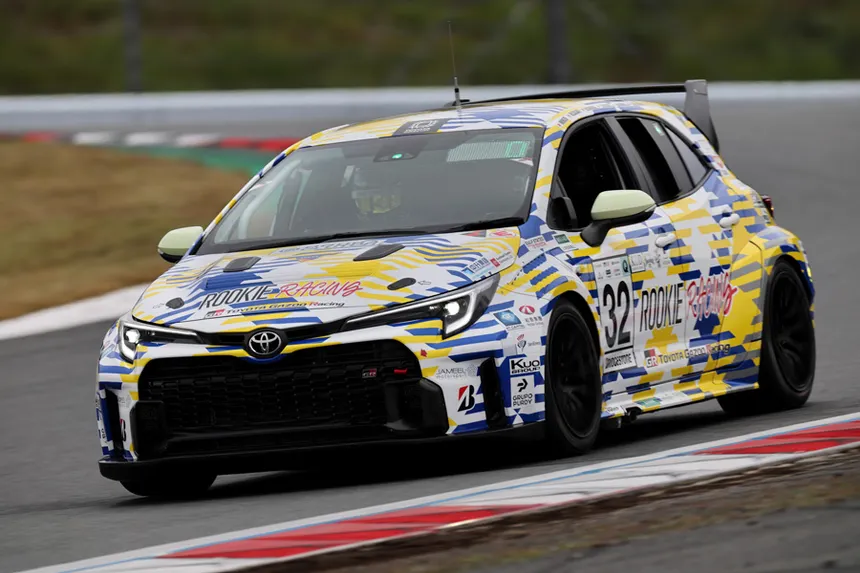
Toyota GRMN Corolla: an engine born in a hydrogen race
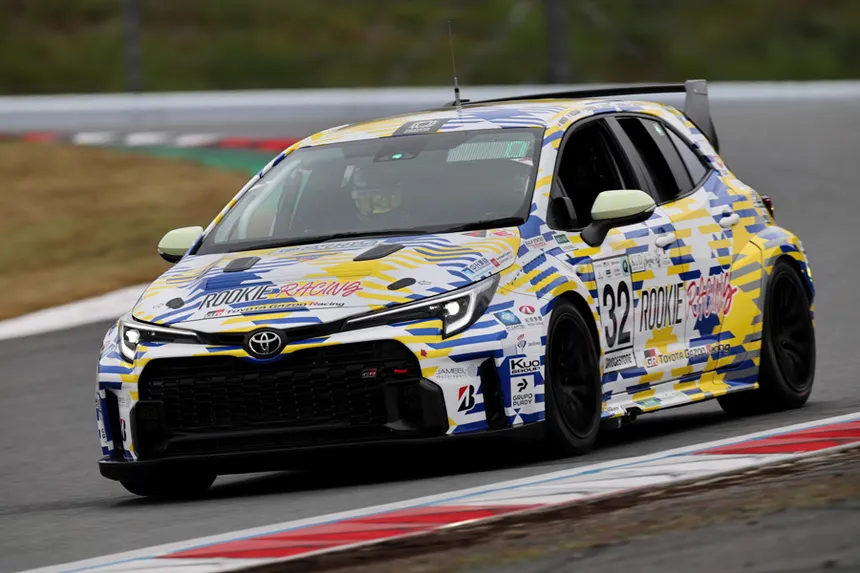
While Europe shuts engine plants and the Chinese exploit the gap to build petrol engines with Formula 1-grade thermal efficiency, Toyota has been quietly doing something nobody else dared try. Something almost nobody has reported seriously. Something that landed, two days ago, in a road car you can actually buy.
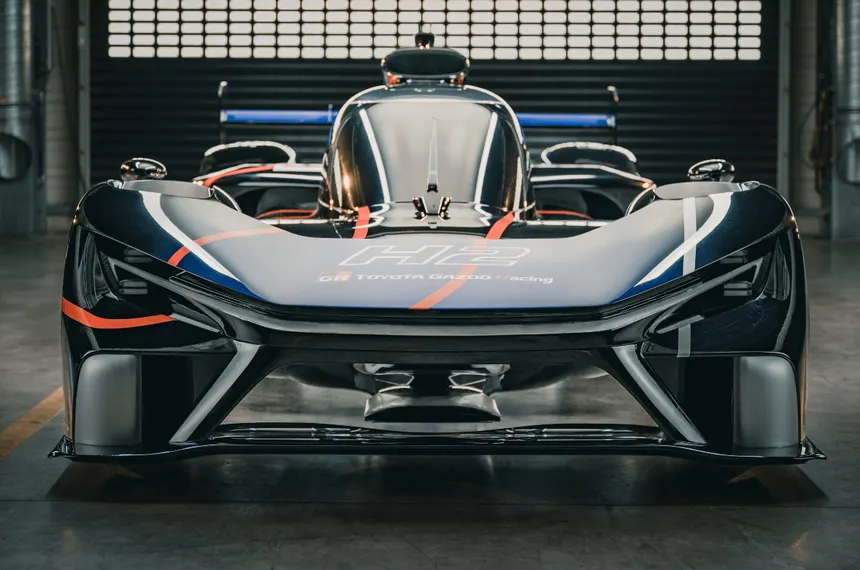
Toyota has spent five years racing a GR Corolla powered by an internal combustion engine running on hydrogen. First gaseous. Then liquid. Twenty-four hours straight at Fuji Speedway, in the Super Taikyu series, with a team led by Morizo — the racing alias of Akio Toyoda, Toyota’s former president, the man who still climbs into the driver’s seat when he steps away from the office. And that car is not a marketing prop. It is a rolling laboratory. A laboratory that, on the 1st of June 2026, gave birth to the GRMN Corolla 2026.
Here’s how the dots connect. It’s the kind of engineering story that reminds you why combustion engines aren’t dead at all.
The engine behind it all: G16E-GTS
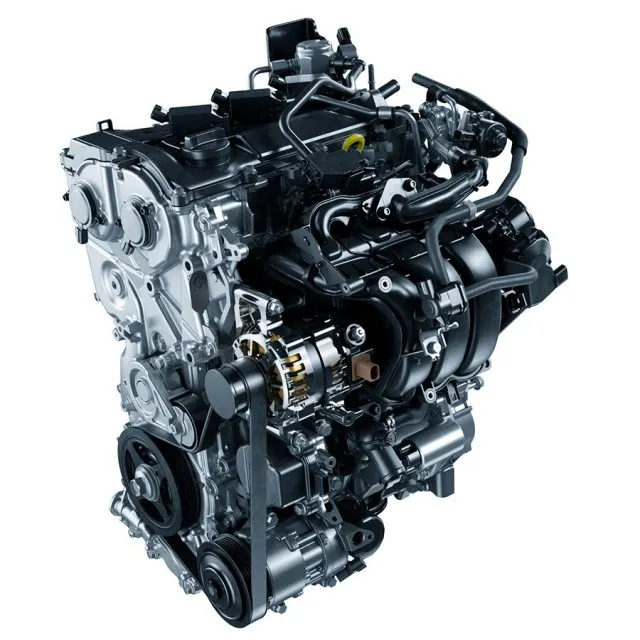
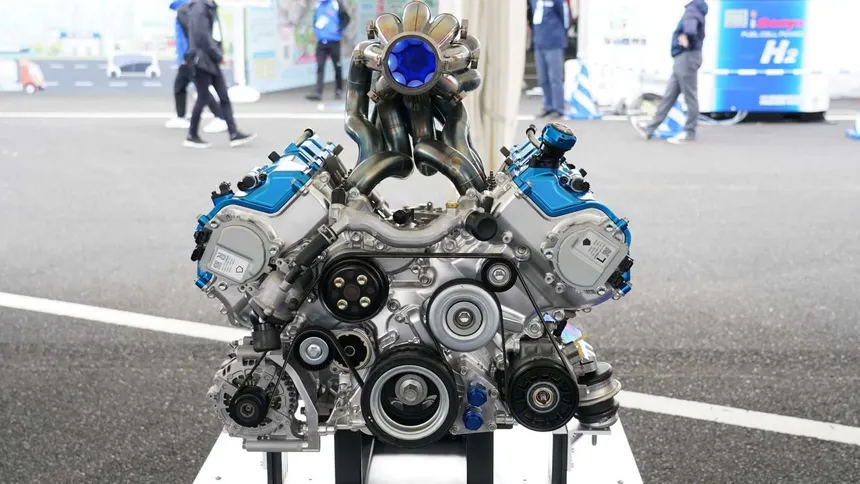
Before getting into hydrogen, you have to understand the engine itself, because without it none of this exists. Toyota’s G16E-GTS is a 1.618-litre turbocharged three-cylinder, built by the Gazoo Racing division since 2020. And it is, without serious dispute, the most extreme three-cylinder engine ever put into volume production.
The verified numbers: aluminium block, DOHC four-valve cylinder head, dual VVT-iW variable valve timing, IHI VB43 or VB50 ball-bearing turbocharger, D-4ST injection combining direct and port injection, 10.5:1 compression ratio. Dry weight: 109 kilos. Read it again. One hundred and nine kilos. That’s less than a midweight sportbike engine, packed into a unit that delivers up to 224 kW (300 hp) and 400 Nm of torque. Specific power density of 138 kW per litre — the highest ever recorded in a Toyota road car engine.
This engine started life under the bonnet of the GR Yaris in January 2020. It moved to the GR Corolla in 2022. And now, in the 2026 GRMN Corolla, it reaches its final evolution. But something important happened in between.
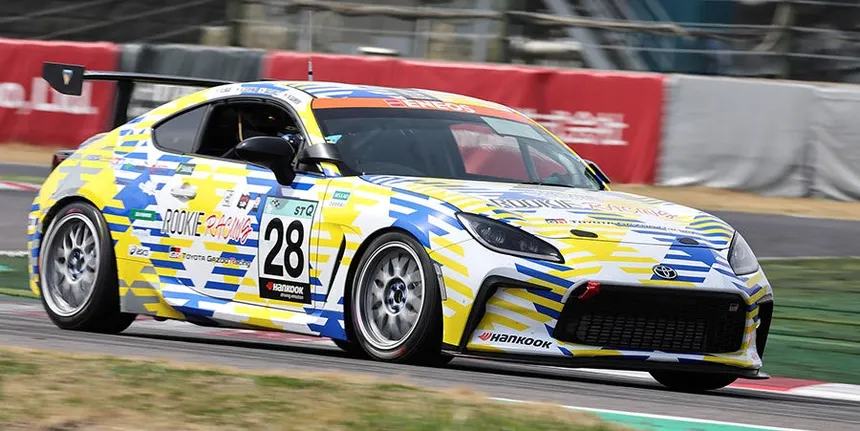
Morizo’s private obsession
In 2021, Akio Toyoda did something no other carmaker CEO does. He took a GR Corolla, stripped out the petrol fuel system, fitted an entire gaseous hydrogen supply system, adapted the G16E-GTS to burn H₂ instead of C₈H₁₈, and entered it in the Fuji 24 Hours. Yes — the real one. Racing against petrol cars. Against LMP3s. Against GT3 machinery.
The kicker is that this hydrogen-burning engine was not a different engine. It was the same G16E-GTS from the road-car Corolla, with the plumbing rewritten. Different injection system, new engine management, but the rest — internals, conrods, crankshaft, pistons, cylinder head — came straight from the production block. That matters. Hold onto it.
Why do it? Toyota said so without dressing it up: motorsport is the only environment that subjects a new technology to such brutal conditions that, if it survives, it’s worth fielding. And 24 hours at Fuji at continuous full load teaches you in a weekend what a test bench takes two years to teach. Especially with hydrogen, which is an awkward fuel: it burns ferociously fast, has no lubricity like petrol, demands different pressure management, different valve cooling, different mixture strategies. If your conventional petrol engine block survives those conditions running on hydrogen, you walk back into the petrol world with knowledge your competitors don’t even know exists.
That’s exactly what happened.
The jump to liquid and the pump nightmare
In 2023, Toyota made the most reckless move yet. It swapped gaseous hydrogen for liquid hydrogen. The reason is thermodynamics: gaseous hydrogen at 700 bar takes up vastly more volume than the same hydrogen cooled to -253°C and turned into a liquid. More fuel density means more kilometres between stops, and in endurance racing that’s the difference between winning and losing. The other side of the equation is just as relevant: a liquid hydrogen tank can be sized smaller, which gives chassis engineers room to breathe inside an already tight C-segment hatchback. A racing GR Corolla is a Tetris board of compromises, and liquid hydrogen frees up centimetres that gaseous hydrogen at high pressure simply cannot.
But liquid hydrogen is an industrial nightmare. It has to be kept at cryogenic temperatures. The tank has inevitable evaporation losses they call boil-off — even with the best vacuum insulation, ambient heat seeps in and turns part of your fuel into gas. And to feed it into the engine you have to repressurise it, which means a pump capable of running 24 hours straight on a fuel at -253 degrees. That pump broke twice during the 2023 race. They had to stop and replace it in the pits, losing half a dozen laps. The team accepted it as the price of admission, because the lessons it was producing about combustion chamber behaviour, valve cooling and injector durability under extreme conditions were worth more than a single race result.
Through 2024 they refined it. In May 2025, at the Fuji 24 Hours, they completed the entire race without replacing the pump. That’s an industrial milestone for any cryogenic system, never mind one bolted to a chassis being driven flat out by professional drivers around a closed circuit. In November of the same year, Toyota went further still: they fitted a superconducting pump physically located inside the cryogenic tank. Superconductors operate with zero electrical resistance at extremely low temperatures — and liquid hydrogen, conveniently, is one of the cleanest cryogenic environments imaginable. The pump exploits the cold of the fuel itself to function more efficiently. The result, officially verified by Toyota: 30% increase in usable tank capacity and a dramatic reduction in boil-off.
In parallel they added another loop: the boil-off gas previously vented to the atmosphere is now recovered, recompressed and routed to a small fuel cell stack to generate onboard electricity. In other words, in five years Toyota has assembled a complete cryogenic hydrogen management system, capable of running 24 hours of race conditions, inside a GR Corolla. While most of the European press kept talking about batteries.
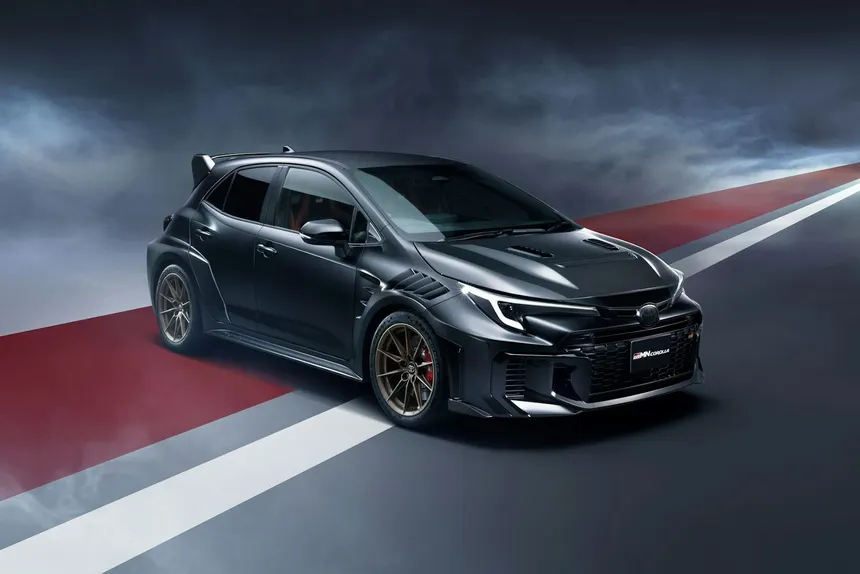
And here’s the master move: the GRMN Corolla 2026
On the 1st of June 2026, Toyota unveiled the GRMN Corolla 2026. It is not a hydrogen car. It is a petrol car, with the same G16E-GTS engine you already know, sold in the United States, Japan and Australia, built at the Motomachi plant.
And Toyota’s official release says this, word for word: “GR has been gaining valuable lessons for the evolution of the internal combustion engine by competing in the Super Taikyu Series with a hydrogen engine-powered GR Corolla, as extended, high-load endurance racing helps heighten not only the potential of hydrogen technology but also that of fundamental internal combustion engine components.”
Read that again. The hydrogen programme is not a standalone project. It is an R&D programme aimed at improving the conventional petrol engine. The lessons from the hydrogen race car have been bleeding into road-car engine development for five years. And the GRMN Corolla 2026 is the first production vehicle where that transfer is explicit and officially acknowledged.
What does it look like in the road car? Peak G16E-GTS torque rises to 302 lb-ft (409 Nm) in the GRMN. The development team specifically reshaped the torque curve in the 4,000-4,600 rpm mid-range, “which is crucial for accelerating out of corners”, according to Toyota. That optimisation came from analysing engine usage on track — data harvested in Super Taikyu with the hydrogen car.
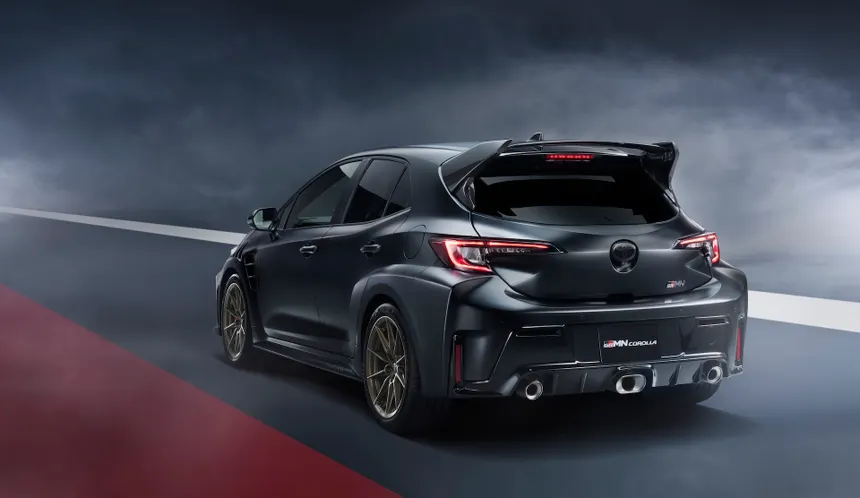
Add an intercooler spray system to maintain stable output at sustained full throttle, a cold-air duct, aerodynamic refinements lifted directly from the hydrogen prototype, and final chassis tuning at the Nürburgring with Akio Toyoda himself behind the wheel. That is the 2026 GRMN Corolla. A car whose final layer of engineering came from a three-cylinder that spent five years learning to burn liquid hydrogen in endurance racing.
The whole philosophy
To understand why this matters, frame it against the rest. As you read this, three philosophies are running in parallel inside the combustion engine industry.
Aramco’s philosophy: the combustion engine is a commodity. Make it cheap, license it to every carmaker, and subordinate it to electric drive. The car runs on electric motors; the petrol engine only contributes when needed.
The Chinese philosophy: the combustion engine is an industrial weapon. Push its thermal efficiency until it touches Formula 1, sell it in 12,000-euro hybrid cars, and eat global market share while Europe distracts itself with the electric transition.
Toyota’s philosophy is the third path and the most romantic. The combustion engine is an engineering object that improves by racing. If you want your petrol engine to get better, have it burn hydrogen in a 24-hour race. If it survives, it comes back stronger. If something breaks, you learn where the limit is. And when you feed the lessons back into the road car, your customer gets the benefit of things your competitor has never seen.
It’s motorsport mentality applied to industrial engineering. Soichiro Honda thought that way. Enzo Ferrari thought that way. Almost nobody in the major European groups thinks that way any more, because there the R&D department answers to regulation, not to competition.
The cost of romanticism
This isn’t efficient from an accountant’s point of view. I’ll say that plainly. Running a hydrogen endurance programme for five years costs serious money. Every cryogenic pump that gave up in Fuji cost serious money. Every superconductor inside the tank costs serious money. Every hour of Nürburgring driving with Akio Toyoda costs serious money.
But Toyota isn’t a shareholder of Aramco. Toyota doesn’t need to license cheap engines to fifteen OEMs. Toyota is what’s left of a philosophy that believes a great road engine demands a better race engine behind it. And in 2026, while the rest of the sector closes plants and argues about whether Euro 7 will arrive on time, that’s almost a quiet act of industrial rebellion.
Will this philosophy survive? Toyota has the revenue and the margins to keep it alive as long as it wants, but not even Toyota is immune to European regulation. The GRMN Corolla 2026 is built in Motomachi for the United States, Japan and Australia, not for Europe. Read that. Three big markets, yes — but Europe isn’t on the list. Europe no longer buys cars that were built racing.
And here’s the question
If the Chinese are building engines that match F1 efficiency, if Aramco is assembling an industrial network to keep petrol alive into 2050, and if Toyota is building a road car directly informed by its hydrogen endurance programme, you tell me one thing.
Who has dropped out of the game?
Europe decided the future was pure electric. And meanwhile, Hangzhou, Detroit and Motomachi quietly split up the real future — which is combustion engineered to the absolute edge of what thermodynamics allows. The 2026 GRMN Corolla will sell for around $50,000 and will reach a handful of privileged markets. If you live in Madrid, Rome, Berlin or Stockholm, you cannot buy one. What you can buy is whatever a manufacturer decides to produce now that its government has forbidden it from investing further in combustion R&D.
There’s the data. You can think whatever you like.
Check you’re still alive.