BMW M Ignite: the pre-chamber ignition that keeps the S58 six alive in the M3, M4 and M2
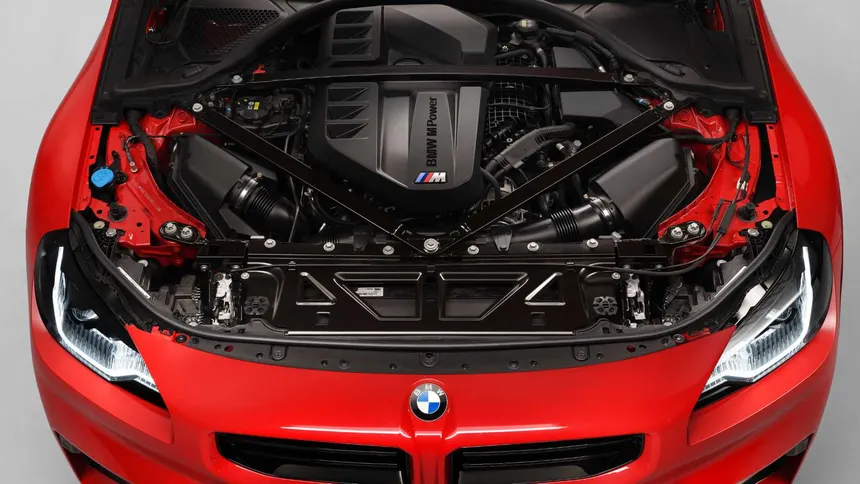
If you buy a new BMW M3, M4 or M2 built from the middle of 2026, the spec sheet won’t look any different. Same 3.0-liter twin-turbo inline six, same horsepower, same torque. But open the cylinder head and you’ll find something no road-going BMW has carried before: a small combustion chamber above each cylinder with its own spark plug and its own ignition coil. BMW M calls it M Ignite, and it’s the reason the S58 engine is still alive.
Why an American buyer should care
Europe’s new Euro 7 emissions rules are the immediate reason BMW developed M Ignite, but American M car buyers are getting it too. BMW builds one version of the S58 for the world, and the US has its own tougher rules coming: the EPA’s multi-pollutant standards for passenger cars tighten progressively from the 2027 model year. An engine that can pass Europe’s new tests under hard driving is in a much better position to keep selling everywhere, including Southern California and China, which has introduced its own new standard.
In other words, M Ignite is how BMW keeps the straight six in the M3 instead of replacing it with a hybrid four-cylinder. For a brand whose fans still talk about the E46 M3’s high-revving six with something close to religious devotion, that matters. Our history of the BMW M3 explains why.
The engine it saves
The S58 is the engine that defines BMW M right now. It’s a 3.0-liter inline six with two turbochargers, first launched in 2019 in the X3 M and X4 M and then fitted to the current generation of M3 and M4 from 2021, and later to the M2. Depending on the model it makes somewhere between roughly 470 and well over 500 horsepower, and it has a reputation for being strong, tunable and, by modern standards, refreshingly mechanical. American tuners have pushed it far beyond factory power, and it has become one of the most popular performance engines in the aftermarket.
It’s also the descendant of a long line. BMW has built straight sixes since the thirties, and the inline six is part of the brand’s identity in a way the V8 is part of Ford’s or Chevy’s. Replacing it would be more than an engineering decision. It would be a change of personality.
Why not just go hybrid?
BMW has gone hybrid elsewhere. The latest M5 pairs a twin-turbo V8 with an electric motor and a battery, and the result weighs about 2,435 kilograms, around 5,370 pounds, a number that shocked many longtime M5 fans. For a sports sedan like the M3, or a compact coupe like the M2, adding that kind of mass would undermine what the cars are supposed to be. M Ignite lets BMW meet the new rules with hardware inside the engine instead of a battery pack under the floor. That keeps the weight down and the character intact, at least for this generation.
What a pre-chamber does
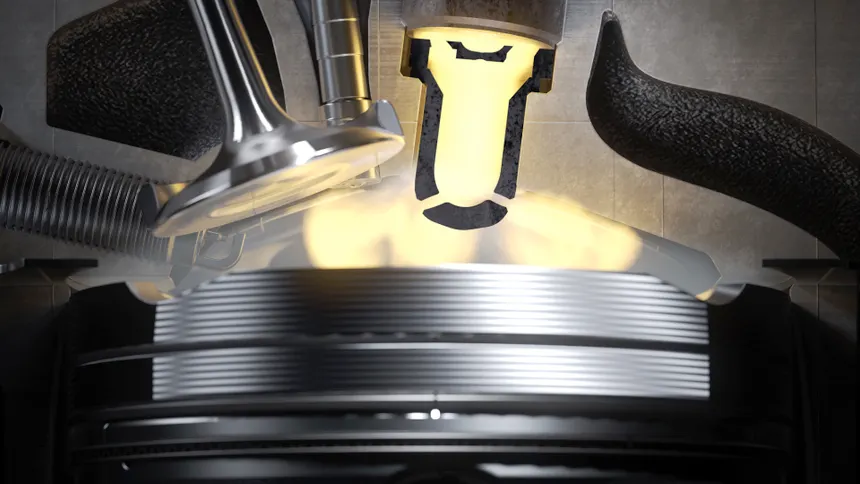
In a normal gasoline engine, one spark plug sits at the top of the combustion chamber. It fires, a flame starts at that single point and spreads outward through the mixture of fuel and air, pushing the piston down. The flame front takes time to travel across the cylinder, and the outer edges of the mixture burn last.
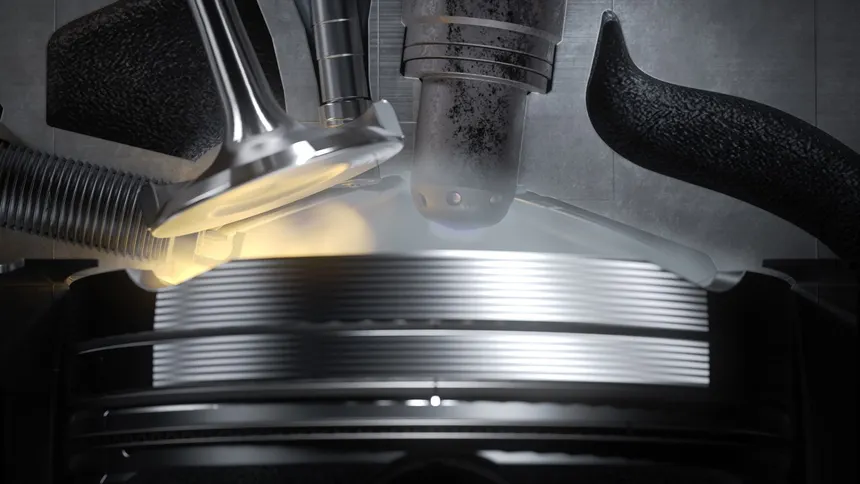
A pre-chamber changes how that fire starts. Above the main combustion chamber sits a tiny second chamber, connected to the cylinder by a few small holes. When the piston compresses the mixture, some of it is pushed into the pre-chamber. A spark plug inside the pre-chamber lights it, the pressure rises sharply, and hot jets of burning gas shoot out through the holes into the main chamber at extremely high speed. Instead of one flame starting at one point, the main charge is lit in several places at once.
BMW’s system uses both. At low and moderate loads the engine runs like a conventional BMW six, with the main spark plug doing the work, because that gives the smoothest, most predictable combustion in everyday driving. When the driver asks for full power, the pre-chamber ignition takes over and the jets light the mixture.
What you gain
Faster, more complete combustion brings a list of benefits that BMW has spelled out.
First, more of the fuel’s energy turns into work on the piston and less into wasted heat. Second, the exhaust gas comes out cooler, which matters for the turbochargers and the catalytic converter. Third, the risk of knock, the uncontrolled detonation that can wreck an engine, drops. That lets engineers raise the compression ratio, and M Ignite comes with a higher compression ratio, along with revised pistons, camshafts and exhaust ports. Fourth, fuel consumption at full throttle falls noticeably. BMW says the biggest gains come exactly where M customers use their cars hardest: long stretches at wide-open throttle on a racetrack. In plain English, your M3 should complete more laps on a tank at a track day.
There’s one more change that gets less attention: the updated S58 also gets variable turbine geometry turbochargers, a first for this engine. Movable vanes inside the turbo adjust how exhaust gas hits the turbine, helping it spool quickly at low rpm and flow freely at high rpm. Variable-geometry turbos have been common on diesels for years, but they’re rare on gasoline engines because gasoline exhaust runs much hotter. Pre-chamber ignition, which lowers exhaust temperatures, helps make them practical.
What thermal efficiency means
Engineers judge combustion engines by thermal efficiency: the share of the energy in the fuel that ends up pushing the car instead of heating the air. For most of the twentieth century, gasoline car engines turned well under a third of their fuel’s energy into work. The rest left through the exhaust and the radiator. Modern engines have improved a lot. Toyota, for example, advertises about 40 percent for its latest 2.0-liter Dynamic Force four-cylinder, and a little more in hybrid form.
Formula 1’s hybrid power units went past 50 percent, thanks to extreme combustion engineering, pre-chamber ignition included, and energy recovery from the exhaust. A road-going M3 engine won’t get close to that, because it has to idle in traffic, start on a frozen morning and survive a decade of ownership. But every percentage point counts, and pre-chamber ignition is one of the few tools left that can still move the number on a high-performance gasoline engine.
The problem with running rich
To understand why this matters for emissions, you need to know a trick almost every turbocharged gasoline engine has used for decades. At full throttle and high rpm, the engine adds extra fuel, more than it can burn. The surplus evaporates and cools the combustion chamber, the pistons and the exhaust, protecting the turbo and catalyst from overheating. It’s called running rich, and it works mechanically. But that unburned fuel comes out the tailpipe as hydrocarbons, carbon monoxide and particles.
Old emissions tests barely touched full-throttle operation, so engineers could get away with it. Europe’s Euro 7 rules, which apply to new models from late 2026, measure emissions across a much wider range of real driving, including hard acceleration. Running rich to protect the engine is exactly what the new rules penalize. Pre-chamber ignition keeps exhaust temperatures down without extra fuel, so the engine can stay at a normal mixture and keep its power.
The dates
BMW says production of the M3 and M4 with M Ignite, across the sedan, Touring, Competition, xDrive and CS variants, starts in July 2026, with the M2 following in August. Displacement, horsepower and torque stay the same. What changes is how the engine burns its fuel when it’s being pushed hard.
BMW isn’t the first
Some coverage has described M Ignite as Formula 1 technology coming to the street. That’s partly true, but pre-chamber ignition has a longer history, and Americans know one chapter of it well.
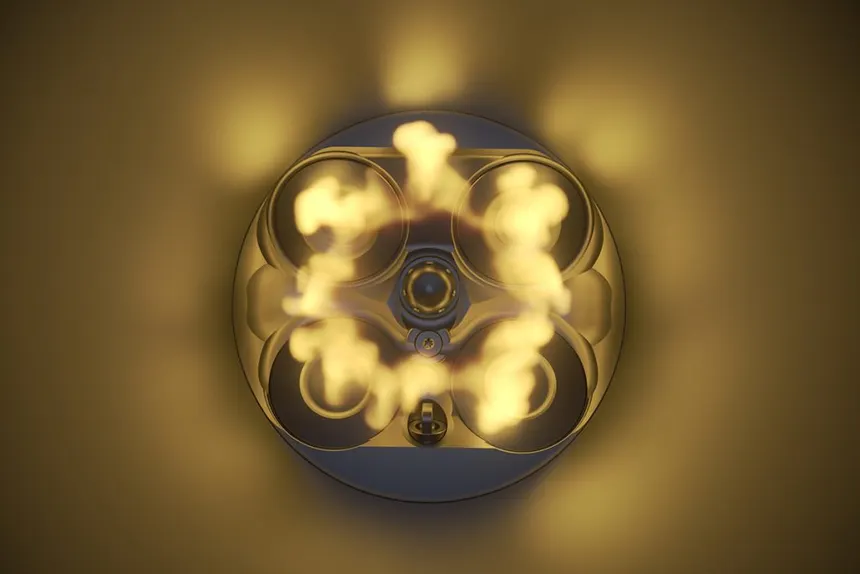
In the early seventies, the US Clean Air Act threatened to make most car engines illegal unless they could cut emissions dramatically. Detroit argued it couldn’t be done without expensive catalytic converters. Honda answered with CVCC, Compound Vortex Controlled Combustion, which used a small pre-chamber with a rich mixture to light a much leaner main charge. The CVCC Civic arrived in the US for 1975 and met the new standards without a catalytic converter. It made Honda’s reputation in America almost overnight, and its success embarrassed the big US automakers.
Honda’s founder, Soichiro Honda, saw the opportunity clearly. While Detroit lobbied Washington for delays, his engineers tested CVCC engines that met the upcoming 1975 limits years ahead of schedule, and the Environmental Protection Agency confirmed it in its own tests. For a small Japanese company that had only recently started selling cars in America, it was a public relations coup. The lesson wasn’t lost on anyone: clever combustion engineering could achieve what the industry giants claimed was impossible.
The idea came back decades later in Formula 1. When F1 switched to 1.6-liter turbo hybrid V6 engines in 2014, the manufacturers developed pre-chamber or "turbulent jet" ignition systems to push efficiency to levels no road engine had reached, eventually more than 50 percent thermal efficiency in the best power units. Mercedes-AMG even built a road car around one of those engines, the Mercedes-AMG One.
The first modern production road car engine to use pre-chamber ignition, though, wasn’t German. It was Maserati’s Nettuno V6, a 3.0-liter twin-turbo that debuted in the Maserati MC20 in 2020, with around 621 horsepower in US terms and a pre-chamber system derived from racing. Maserati put the technology on the road six years before BMW.
Why BMW’s version still matters
So M Ignite isn’t a first. What makes it significant is scale. Maserati builds the MC20 in small numbers. BMW builds M3s, M4s and M2s by the tens of thousands, for buyers all over the world. When a high-volume manufacturer puts pre-chamber ignition into its core performance cars, it proves the technology can survive real ownership, real service departments and real owners who skip oil changes. It also pays for the next round of development and pushes rivals to follow.
Europe’s suppliers have been working on exactly this kind of technology for years. As we explained in our piece on Bosch, MAHLE and AVL, the companies that design the guts of combustion engines don’t think the gasoline engine is dead. They think it’s being pushed into fewer, more specialized markets where it has to be cleaner and more efficient than ever. Performance cars are one of those markets.
What to expect next
Every premium European brand selling performance cars faces the same rules BMW does. Mercedes-AMG, Audi Sport and Porsche all have turbocharged engines that rely on running rich at full throttle, and all of them need to keep those engines legal. It would be surprising if pre-chamber ignition didn’t appear in more of them over the next few years.
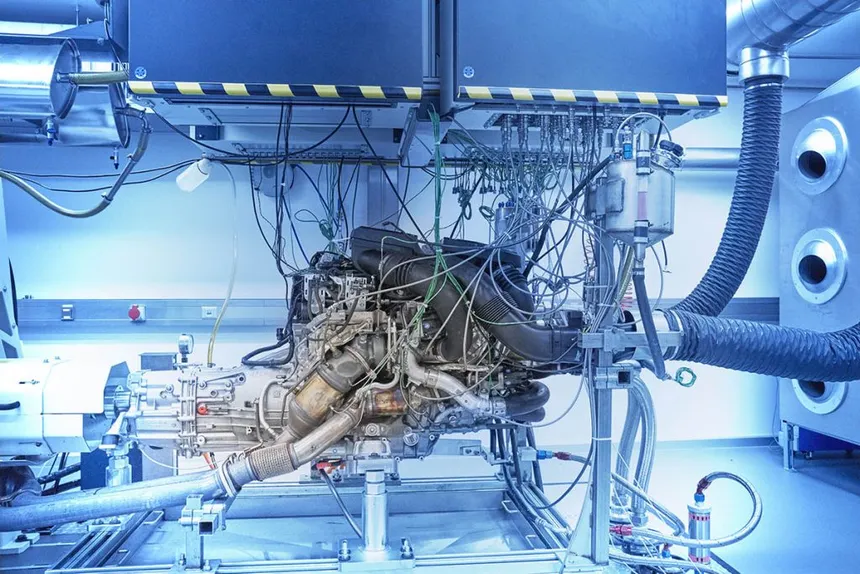
For American enthusiasts, the bottom line is simple. The next time you hear an M3 Competition wind out on an on-ramp, there’s a good chance two ignition systems per cylinder are doing the work. The engine sounds the same, makes the same power, and passes tests its predecessor couldn’t. That’s what keeps a six-cylinder BMW M car on sale in an era of electrification. Whether that buys the straight six five more years or fifteen will depend on regulators as much as engineers, but for now the most important BMW M engine has been given a second life without losing what made it special.
A note on the hardware
There’s a practical side for owners and mechanics too. Each cylinder now has two spark plugs and two ignition coils, which means more parts to service and more to diagnose if something goes wrong. Pre-chamber plugs live in a harsher environment than conventional plugs, and how well they last over years of hard use is something the first owners will find out. History suggests BMW’s engineers will have tested them thoroughly, but the real verdict on any new engine technology always comes from the cars in customers’ hands, five and ten years down the road.
Check you’re still alive.
; ; ; ;