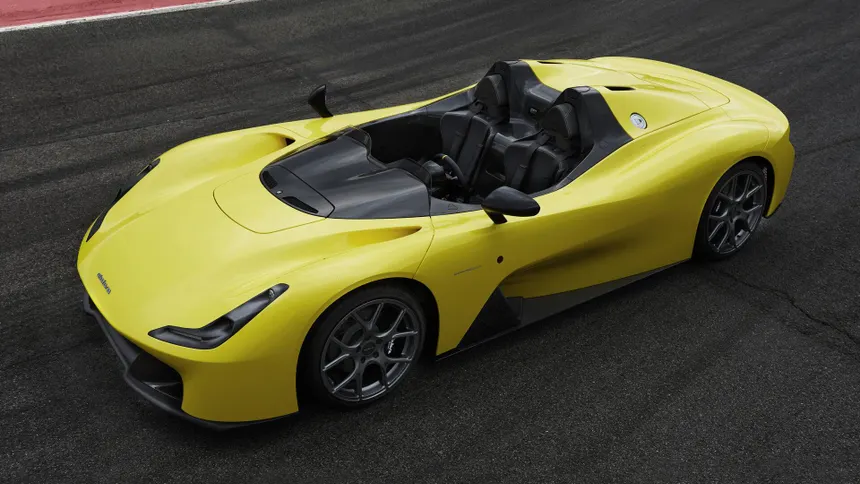
Built by the company that makes every IndyCar. 855 kg. Focus RS engine. No doors
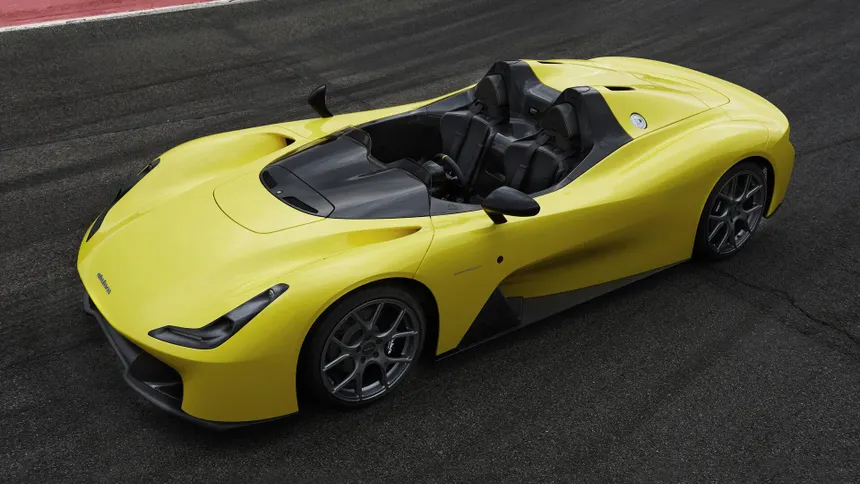
Chris Harris drove it on Top Gear and seemed genuinely puzzled by it. Not in a bad way. In the way you get puzzled when somebody hands you something familiar and it turns out to be wired completely differently.
The Dallara Stradale isn’t a supercar. It looks like one, it costs like one, it’ll do the corner speeds of one — but the engineering logic underneath has nothing to do with Maranello or Sant’Agata. It’s a single-seater racing car that has been talked into tolerating road registration. Not the other way round.
This is what happens when the company that builds every Indianapolis 500 chassis, every Formula 2 monocoque and every Formula 3 tub decides — fifty years after founding — that it wants to put its own name on a street-legal car. There is no marketing department dictating terms. There is no parent group accountant asking for margins. There is just a 81-year-old engineer asking his CEO to build him a car, on Colin Chapman principles, with all the racing chassis know-how the company has accumulated.
The result is a 855-kilo, 400-horsepower, doorless, roofless, windscreenless, manual-gearbox, mid-engined open-cockpit weapon that uses a Ford EcoBoost four-cylinder for power.
It shouldn’t make sense. It makes total sense.
Why Dallara built a road car
For half a century Dallara had been engineering road cars for other people. The Bugatti Veyron chassis. The Bugatti Chiron chassis. The Alfa Romeo 4C and 8C carbon tubs. The KTM X-Bow monocoque. The Maserati MC12. The Maserati MC20 monocoque. The list is long enough that Autocar joked you’ve already lusted after Dallara know-how — you just didn’t know it was Dallara.
What Dallara had never done was put its own name on a road car. Giampaolo Dallara, the founder, wanted that. So he asked CEO Andrea Pontremoli to build him one. Not a hypercar to chase Ferrari and Lamborghini volumes. Not a halo product to launch a new dealer network. A car. With his name on it. Built on the principles he had admired in Colin Chapman since the 1960s: add lightness, take away weight, let physics do the rest.
That’s the brief the engineers were given. That’s the brief they delivered against.
The weight question
855 kilograms dry.
For context: a Lotus Elise Series 3 is heavier. A Caterham Seven 620R is almost identical. A Porsche 718 Cayman GT4 RS is 220 kg heavier. A Ferrari SF90 Stradale is 615 kg heavier. A McLaren 750S is over 300 kg heavier.
You don’t get to 855 kilos by stripping out the radio. You get there by designing the entire car around a carbon-fibre monocoque manufactured in the same Varano plant that builds IndyCar and Formula 2 chassis. You get there by making the entire external bodyshell from carbon fibre. By bolting the seats directly to the chassis without rails or adjustment mechanisms, and making the seats themselves out of carbon too. By not fitting doors, a roof, or a windscreen in the base configuration. By choosing steel brake discs because the engineers genuinely believed steel was better than carbon-ceramic for the intended use.
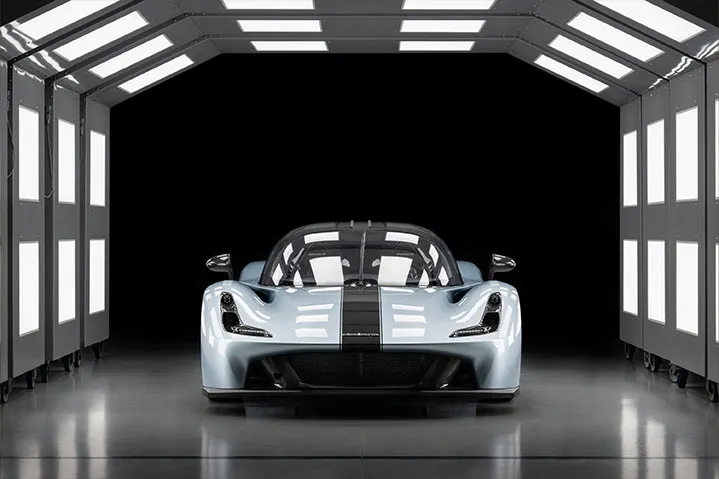
The Stradale is 4,185 mm long, 1,875 mm wide and 1,041 mm tall. That last number makes it lower than a Mazda MX-5. In coupé configuration, the roof of a Stradale is at about the height of a Range Rover’s bonnet line.
The Lego configuration system
The really interesting thing about the Stradale isn’t the weight. It’s the modularity.
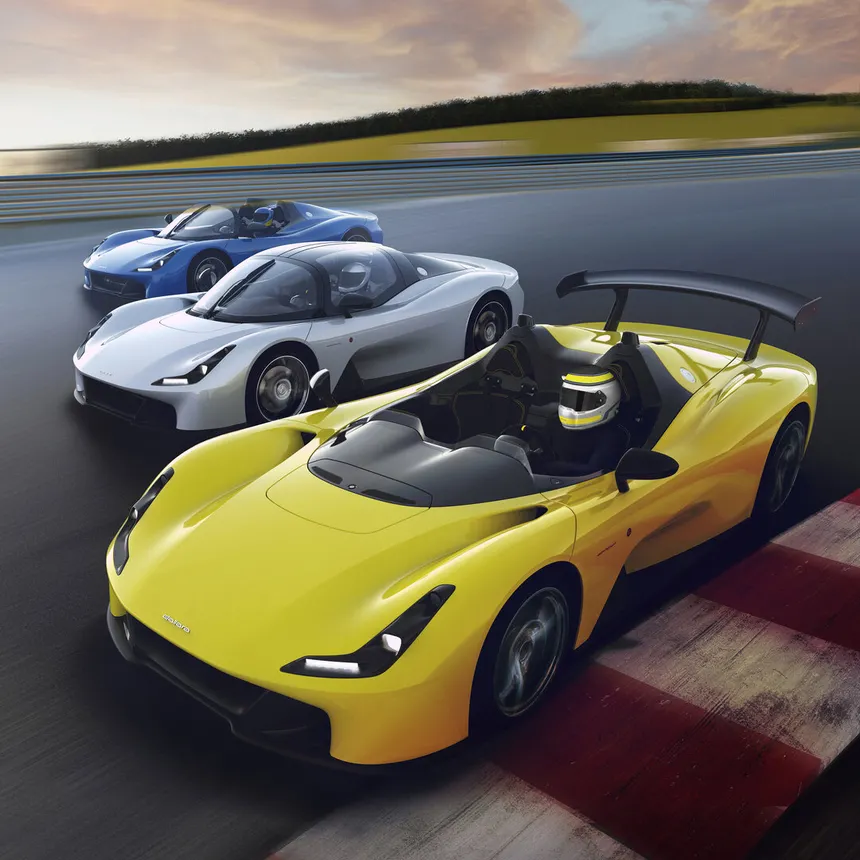
The base car is a barchetta. No doors. No roof. No windscreen. You and your passenger sit fully exposed, like in a Caterham. Five-point harnesses, helmets recommended.
Bolt on a curved polycarbonate windscreen and it becomes a roadster. Bolt on a T-Frame — a central arch that goes over the heads — and it becomes a targa. Bolt on two polycarbonate gull-wing doors and it becomes a coupé.
The entire transformation is done with hand tools. Doors, roof and windscreen are bolt-on, bolt-off, your call on any given Sunday. Want a track day in barchetta spec? Done. Rain forecast? Bolt on the full canopy and you’re a coupé. Going proper hard? Add the optional rear wing — the one that generates 820 kg of downforce at top speed. Roughly the weight of the whole car.
No mainstream manufacturer can do this because no mainstream manufacturer’s business model allows it. Dallara can do it because the Stradale isn’t the company’s business. The IndyCar programme is the business. The Stradale is the founder’s calling card.
The designer’s signature
There’s one detail that doesn’t get told enough. The Stradale was styled by Lowie Vermeersch, the former design director of Pininfarina. The Belgian who supervised the design of the Ferrari 458 and the Ferrari FF before leaving in 2010 to found his own Turin studio, Granstudio.
Vermeersch translated Giampaolo Dallara’s dream into a shape. He said it himself in interviews: giving shape to the Dallara Stradale was, literally, translating Giampaolo Dallara’s dream into a sculpture. The Stradale isn’t a pure aerodynamic exercise with bodywork stretched over it. It is a piece designed by someone who had spent fifteen years working on Ferraris, who understood exactly what Dallara wanted, and who knew where to compromise aero purity so the car would also be beautiful.
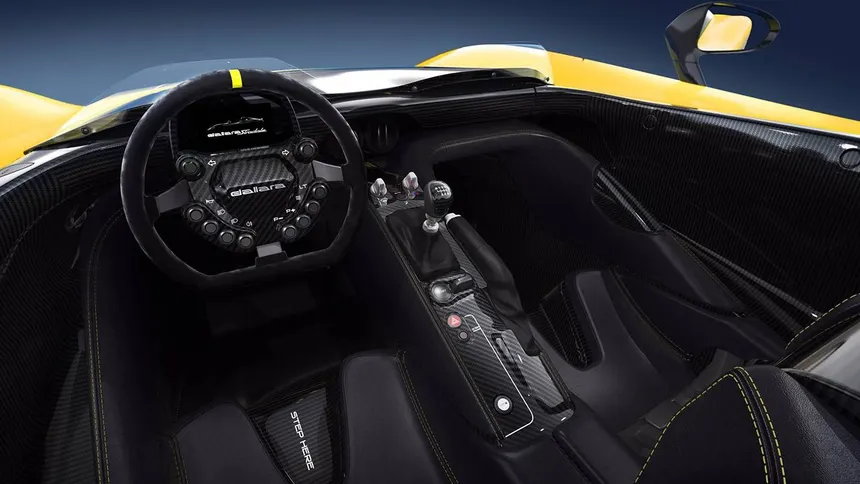
The interior follows the same logic. Carbon fibre shells bolted to the chassis with minimum padding. A motorsport-style central display on the steering column. A steering wheel with every primary control integrated. And one very Dallara detail: the seats have helmet storage built into the back. Because every Stradale is going to a circuit at some point, and there is no boot. No boot means no luggage. No luggage means the helmet rides on the back of the seat.
The Ford Focus RS engine
Now the fun part.
The Stradale’s engine is a 2.3-litre turbocharged inline-four. It’s the same EcoBoost unit that Ford sold in the third-generation Focus RS. Same family. Bosch recalibrates it to make 400 PS (395 hp) at 6,200 rpm and 500 Nm of torque between 3,000 and 5,000 rpm. Same engine architecture as a £30,000 hot hatch, in a £160,000 doorless track weapon.
Stop and think about that for a second. A company whose day job is building IndyCars that run twin-turbo Honda and Chevrolet V6s pushing 700+ hp in qualifying trim, decides to use a four-cylinder British hot hatch engine in its own road car. It could have used a Ferrari V8. A V10. A Lamborghini V12. A Cosworth bespoke unit. Anything.
It picked the Focus engine.
Why? For the same reason it didn’t fit doors. The Stradale isn’t about peak power. It’s about power-to-weight. 400 hp into 855 kg works out to about 468 hp per tonne. A Porsche 911 GT3 RS 992 sits at 423. A McLaren 750S sits at 489. The Stradale is in hypercar territory with a hot-hatch engine. That’s engineering. That is what Chapman meant when he said add lightness.
And there’s a second reason. A homologated mass-production engine has parts. It has dealer support. It tolerates cold starts. It doesn’t blow up if you actually drive it. A bespoke Italian V12 costs six figures in spares before you’ve put it in. Dallara didn’t want the car to sit in a garage afraid of itself. They wanted it driven.
How it actually goes
Zero to 100 km/h in 3.25 seconds. Zero to 160 in 8.1. Quarter mile in 11.4. Top speed limited to 280 km/h (174 mph).
To put that in context: that 0-100 time is the same as a Lamborghini Huracán LP610-4 — a car with a naturally aspirated V10, 610 hp, and all-wheel drive. The Stradale gets there with a four-cylinder and rear-wheel-drive only. Manual gearbox standard, with a paddle-shifted automated manual as an option. Yes — manual. In 2017. From a company that makes IndyCars.
The brakes are steel discs from Brembo. Not carbon-ceramic. Dallara’s argument: steel works better in repeated heavy use, doesn’t need warming, costs sensibly to maintain. It’s an unusual decision. It is a thoroughly reasoned one.
Cornering: 2 g of lateral acceleration on road-legal Pirellis specifically developed for the car. That is Le Mans GTE territory, on tyres you can legally drive home from the track on.
The EXP track-only version
In 2021, Dallara unveiled the EXP, a track-only version of the Stradale. Same carbon monocoque. Same engine architecture, recalibrated for more power. More downforce — 1,250 kg at 286 km/h thanks to the upgraded aero package with swan-neck rear wing. Sequential gearbox mandatory. No road plates, no road homologation.
The EXP is still in production as of 2026. It exists for Stradale owners who already drive the car hard on track days and want the next step. It is a track tool with full FIA-compliant safety, fire system, six-point harnesses and HANS-compatible head restraint.
The delivery that closes the story
The first Stradale built was not sold. It was delivered.
It was delivered in Varano de’ Melegari, at the company’s headquarters, in 2017. It was Giampaolo Dallara’s 81st birthday. The first car carrying his family name on the nose went to him. In the same village where he had founded the company in a garage in 1972, between a church and a football pitch.
That is not marketing. That is a man finally seeing his name on something he made — at 81 years old, in the village where he was born.
Production was planned at 600 units over five years. Before the public unveiling at the end of 2017, 45 were already sold. The car remains in production today alongside the EXP, in the same plant where the IndyCars get built.
Why the Stradale is what it is
The Stradale isn’t the fastest car. It isn’t the most expensive. It isn’t the most exclusive in raw production numbers. There are hypercars with bigger numbers in almost every Excel column.
What it is: the car that happens when the engineers who build the IndyCars decide to make a road car without anyone in marketing telling them what to make. Without needing it to sell in big numbers. Without needing to compete with anyone. Without needing to prove anything that isn’t already proven.
Chapman said the secret was to add lightness. Dallara didn’t add lightness. They never put it on in the first place. The Stradale was born light because it was designed by people who have spent fifty years making cars where every gram is accounted for. They didn’t need a philosophy. They did what they always do.
The first one went to the man who started it all, on his 81st birthday, in the village where he founded the company in a garage between a church and a football pitch.
Check you’re still alive.