Maserati MC12: The Supercar That Forced the FIA to Invent Balance of Performance
Top Gear lapped one. The Stig set a time of 1:18.9 — one tenth faster than the Ferrari Enzo. Clarkson called it twitchy, oversized, and “either a racer, a GT car, or a detuned Enzo in a fat suit.” He couldn’t quite tell which.
That, in three sentences, is the MC12 problem.
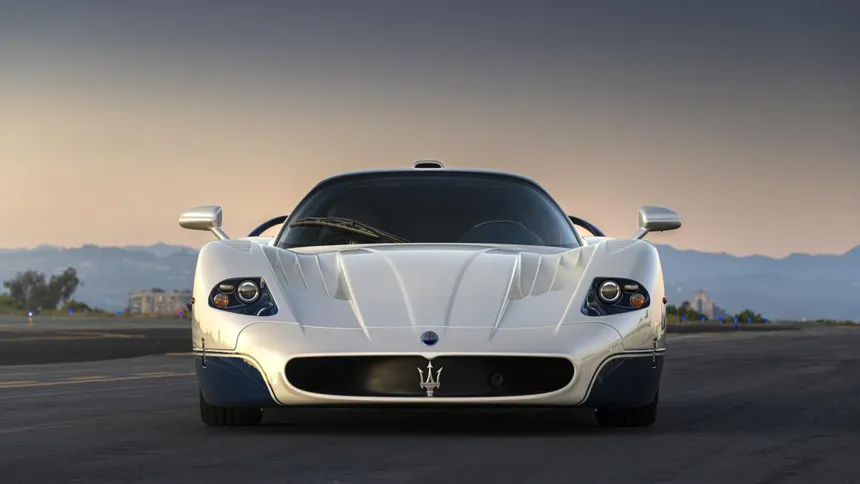
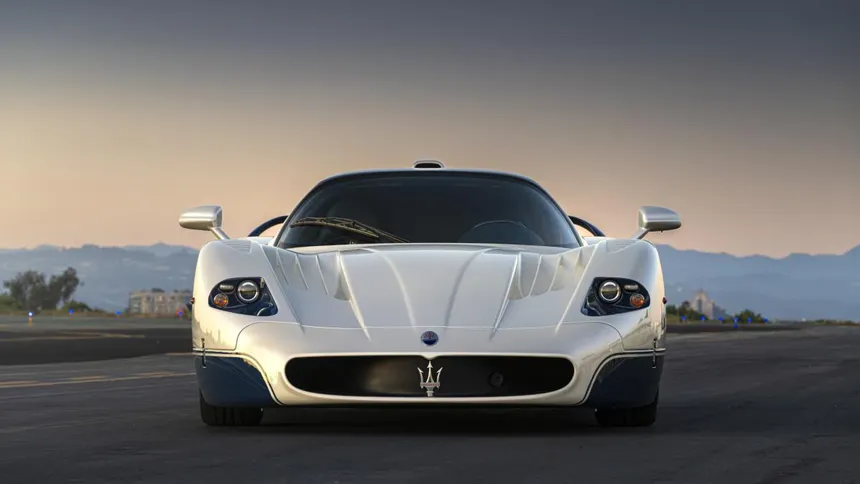
Because the Maserati MC12 has never been an easy car to file. It’s not a supercar in the Ferrari sense — too compromised, too noisy, no rear window, no boot, no radio. It’s not a race car in the Audi R8 LMS sense — it had number plates, leather, air conditioning, and a removable hardtop. And it’s not a hypercar in the McLaren P1 sense — built fifteen years too early, with a normally aspirated V12 derived from another company’s engine.
What the MC12 is, instead, is the car that ended Maserati’s 37-year competition exile, won five consecutive FIA GT Team Championships, took three Spa 24 Hours, and forced the FIA to invent the Balance of Performance system from scratch. All of that while never being allowed to enter Le Mans.
Not bad for a homologation special that nobody wanted to homologate.
A Three-Decade Silence, Then a Hammer Blow
To understand the MC12, you have to understand what Maserati was in 2004. The Trident had not won an international championship since 1967, when a Cooper-Maserati piloted by Pedro Rodriguez took the South African Grand Prix. The intervening decades had been brutal: Citroën ownership, bankruptcy, De Tomaso, eventual rescue by Fiat in 1993. By the turn of the millennium, Maserati made decent GranTurismos and the new Quattroporte, but motorsport was a museum exhibit.
Then Ferrari acquired Maserati. And someone — most likely Luca di Montezemolo and Jean Todt — saw something the rest of the industry missed.
In late 2004, the FIA liberalized GT1 regulations to accommodate the Saleen S7. The rules now allowed purpose-built race cars to compete, provided 25 road-legal examples were homologated. Most manufacturers saw this as a way to make slightly faster versions of their existing supercars. Maserati saw it differently.
Maserati saw a loophole the size of a Ferrari Enzo.
The internal project codename was MCC — Maserati Corse Competizione — for the race version, and MCS — Maserati Corse Stradale — for the road car. Both eventually merged under one name: MC12. Maserati Corse, 12 cylinders.
This is the part that matters: Maserati did not engineer a road car and then prepare it for racing. Maserati engineered a race car and then engineered a road car to satisfy the homologation requirement. Read that sentence twice. Everything about the MC12 — every odd dimension, every interior compromise, every decision that makes the car frustrating as a daily driver — flows from that single inversion.
An Italian All-Star Team
The technical direction went to Giorgio Ascanelli, a Formula 1 engineer with serious credentials. The aerodynamic shape was developed in wind-tunnel testing from a Giorgetto Giugiaro proposal, then refined to its final form by Frank Stephenson — the same Stephenson who designed the first-generation BMW X5, the modern MINI, the Ferrari F430, and went on to pen practically every McLaren road car from the 12C onward.
And then, almost as a footnote in most accounts, there’s Giampaolo Dallara. Yes, that Dallara. The man who engineered the Lamborghini Miura, the De Tomaso Mangusta, the Lancia Stratos chassis. The man whose company today supplies IndyCar, Formula 2, Formula 3, and half the prototype grids in global motorsport. Dallara was brought in to make the MC12 chassis competitive.
When you put Ascanelli, Giugiaro, Stephenson, and Dallara on the same car, the result is not a Maserati. It’s something else entirely.
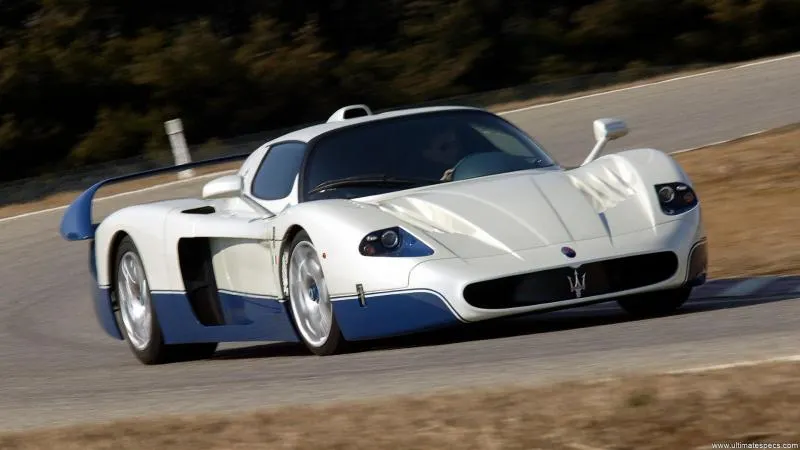
The verified numbers for the Stradale: 6.0-liter naturally aspirated V12, code M144A, 621 horsepower at 7,500 rpm, 481 lb-ft of torque at 5,500 rpm. Zero to 62 mph in 3.8 seconds. Top speed of 205 mph. Carbon-fiber and Nomex monocoque with aluminum subframes front and rear. Six-speed sequential gearbox with Sport and Race modes. Standing weight distribution of 41/59 front to rear, shifting to roughly 34/66 at 125 mph due to downforce.
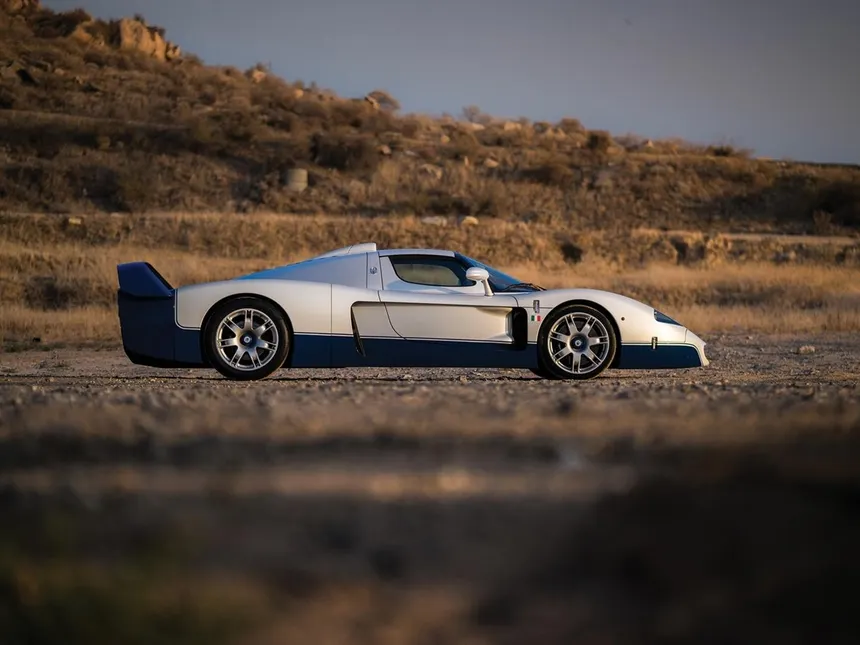
The car is longer, wider, and taller than the Enzo on which it’s based. The only externally visible component shared between the two is the windshield. Everything else — every panel, every duct, every dimension — is bespoke. And here’s a fun comparison Americans will appreciate: the MC12 is wider than a Hummer H2. Not metaphorically. Literally. 1.2 inches wider than a Hummer H2. Try parking that in a Whole Foods lot.
Two batches of 25 road cars were built — 2004 and 2005 — with the second batch 150 mm shorter at the nose to comply with a mid-program FIA rule change. The original launch price was €600,000, around $670,000 at the time. All fifty cars were spoken for before production began. Today, clean examples cross auction blocks for $4.5 to $5 million.
Then there were 12 dedicated race cars built alongside, bringing the total MC12 production to just 62 units.
The Engine: Detuned for the Right Reasons
Here’s where most American write-ups get the MC12 wrong. They quote the 621-horsepower number and note that it’s “less than the Enzo’s 651.” They treat this as a flaw. It is not a flaw. It is a deliberate engineering choice.
The Ferrari Enzo’s F140 V12 was tuned for road performance — peak power, dramatic top-end, screaming theater. The MC12 was tuned for endurance racing. Less peak power, flatter torque curve, more thermal margin, dry-sump scavenging optimized for sustained cornering loads. The cam drive was switched from chains to gears — heavier, noisier, more expensive, and dramatically more reliable at 8,000 rpm for 24 consecutive hours.
If you’ve ever rebuilt a V12, you understand why this matters. Chains stretch. Chains skip teeth under sustained extreme loads. Gears do neither. Switching from chain drive to gear drive in a road car would be insane. Doing it in a race car that has to win the Spa 24 Hours is rational.
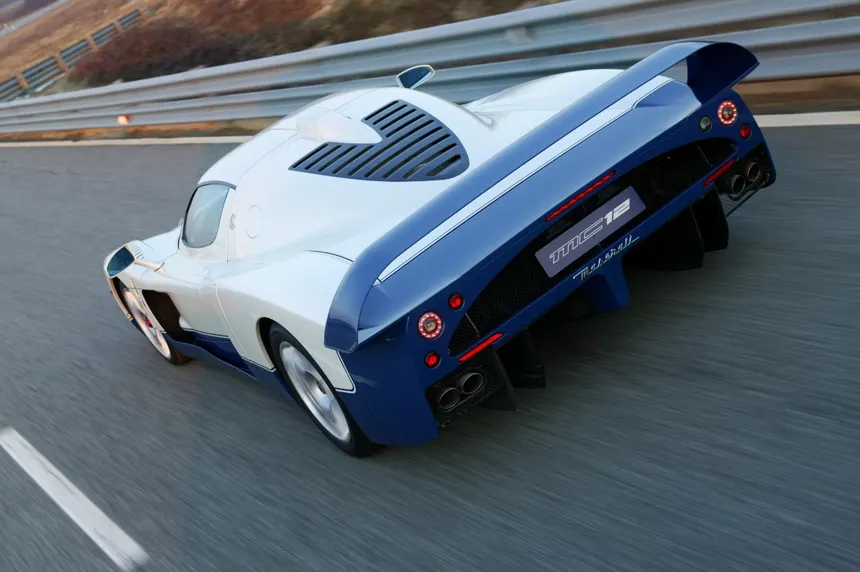
The two-meter-wide rear wing is only 30 mm thick. The underbody is flat. The rear bumper hides massive ground-effect diffusers. This isn’t a styling exercise — these are the kind of aerodynamic decisions you make when downforce, not drag, is your primary metric.
Inside, the MC12 is famously sparse for a six-figure GT. There’s no radio. No stereo. No place to mount one. No glove box. No proper boot. The targa top can be removed but cannot be stored anywhere in the car. The seats are carbon-fiber buckets covered in Brightex, a synthetic material reportedly developed for the fashion industry but ultimately rejected by fashion as too expensive. Carbon-fiber dashboard. Blue leather. A blue starter button. The ovoid Maserati clock. That’s about it.
Read that paragraph again. A car that costs more than a New York apartment and doesn’t have a stereo. That is not an oversight. That is a statement. The MC12 is a track car that happens to have plates.
What Happened on Track Was a Slaughter
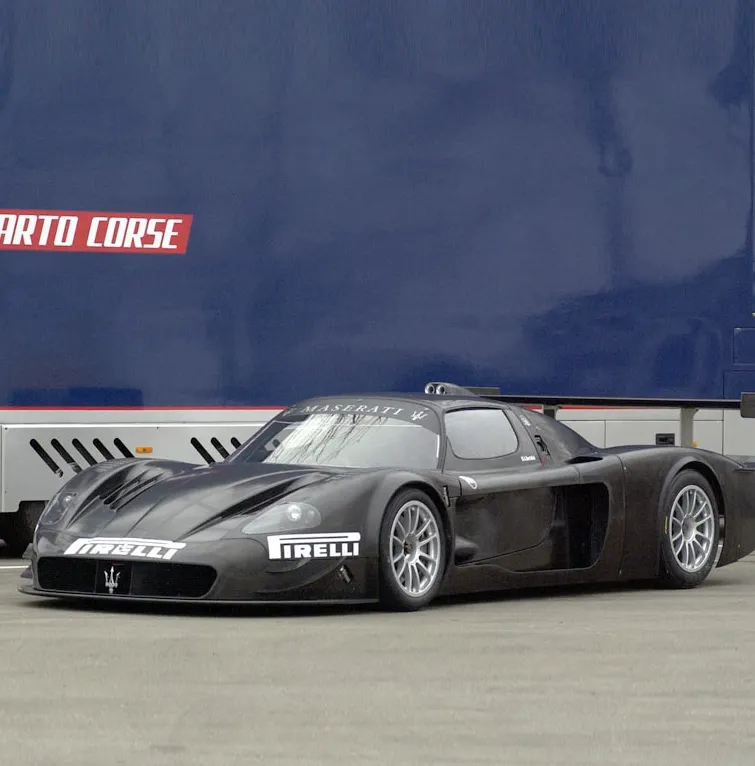
The MC12 GT1 debuted at Imola in September 2004 with AF Corse running the program. The FIA refused to award championship points because, in its view, the road-going homologation requirement had not yet been formally met. Maserati finished second and third anyway. Two weeks later at Oschersleben, Andrea Bertolini and Mika Salo won the race outright. Still no points. At the final round at Zhuhai, the FIA finally homologated the car and counted the points retroactively. Maserati finished seventh in the constructors’ standings, having scored in just one event.
That was the polite opening. The slaughter began in 2005.
Maserati won the FIA GT Manufacturers’ Cup with 239 points. Ferrari, in second place, scored 125 — barely more than half. Vitaphone Racing and JMB Racing took first and second in the Team Cup. Andrea Bertolini and Karl Wendlinger were in title contention at the final race. The MC12 had arrived as something close to invincible.
Vitaphone Racing went on to win the Team Cup five consecutive years from 2005 through 2009. Five. Michael Bartels and Andrea Bertolini split the Drivers’ Championship in 2006, 2008, and 2009. Thomas Biagi added 2007. At the Spa 24 Hours — the spiritual home of European GT racing, where night-time stints through the Ardennes forest decide who’s serious — the MC12 won three times.
Maserati ran the car through 2010 in the inaugural FIA GT1 World Championship, taking yet another team and driver title before quietly stepping back. The category itself collapsed shortly after, transitioning to GT3 machinery in 2012. The MC12 left motorsport not because it was beaten, but because the championship around it collapsed under its own weight.
Six years. Five consecutive team titles. Four driver titles. Three Spa 24 Hours wins. Against factory-backed Aston Martin DBR9s, Lamborghini Murciélagos, Corvette C6.Rs, Saleen S7-Rs, Ferrari 575s and 550 Maranello GT1s. World-class teams, ex-Formula 1 drivers, real budgets. The MC12 ate them for breakfast.
You don’t have to take Bertolini’s word for any of this. He was the factory test driver — of course he loved it. Listen instead to Sven Schnabl, the German technical chief at Vitaphone Racing who ran a privateer program with the car for years. Talking to DailySportsCar, Schnabl was blunt: “It was a downgraded Formula One car. It was far ahead of the Lambo, the Aston. There wasn’t a single strength, the whole package was brilliant. If we ran without restrictors we’d have been miles ahead of the others.” And then this, which says more about the MC12 than any spec sheet ever will: “In 2005, 2006, 2007 as a team we couldn’t start the car on our own. You needed computers, you needed people. To fire up the car before an event, you had to have an Italian come to help.”
If you need one number to anchor the dominance, take this one. At the 2009 Spa 24 Hours qualifying session, MC12s locked out the top three positions and were 1.5 seconds per lap faster than the next car. A second and a half. On a seven-kilometre circuit. In qualifying, where margins are usually measured in tenths or hundredths. That’s not domination. That’s a category mismatch dressed up as a race.
The Le Mans That Never Was
For all the dominance, one race never appeared on the MC12’s record: Le Mans.
The Automobile Club de l’Ouest, which runs Le Mans and the wider Le Mans Series, refused to admit the MC12 to its grids. The official reasoning involved dimensional limits — the MC12 exceeded both length and width restrictions for the LMGT1 class. Maserati did shorten the nose by 200 mm and accept weight penalties to compete in the 2005 American Le Mans Series as a non-points guest entry, running with Risi Competizione under the Maserati Corse banner. Andrea Bertolini, Fabio Babini, and Fabrizio de Simone shared driving duties. The best result was third in class. The MC12 was never allowed to compete for points or for the championship.
The unofficial reasoning is more interesting. Stéphane Ratel, who runs the SRO and the FIA GT Championship, has acknowledged that the decision to allow the MC12 to race in FIA GT against the protests of other manufacturers was — in his words — “maybe the most important moment in the history of modern GT racing.” The ACO, more conservative and more protective of the Le Mans formula, did not share that view.
The result is that the most dominant GT car of the mid-2000s never raced at Sarthe. There is no MC12 chapter in the Le Mans history book. That absence is the loudest argument anyone could make about how good the car actually was.
The Versione Corse: The Real MC12
In 2006, Maserati built thirteen examples — one prototype and twelve customer cars — of the MC12 Versione Corse. Not road legal. Not race legal. Track-day only. A private toy for clients who already owned the road car and wanted to know what it felt like without the restrictions.
The V12 ran without intake restrictors and produced 755 horsepower at 8,000 rpm with 524 lb-ft of torque at 6,000 rpm. Dry weight dropped to 2,535 lb (1,150 kg). Power-to-weight ratio: 1.52 kg per horsepower. Zero to 124 mph in 6.4 seconds. Top speed of 203 mph. Launch price: $1.47 million.
Now look at those numbers again. The Stradale road car produced 621 horsepower from the same 6.0-liter V12. The GT1 race car was throttled by FIA-mandated air restrictors and weighed down by success-based ballast. The Versione Corse simply took the GT1 platform and removed the regulatory handcuffs. No restrictor plates. No ballast. No mandated wing reduction. Carbon-ceramic Brembo brakes without ABS. Race-derived suspension geometry with no concession to street comfort. What you got was 134 horsepower extra over the Stradale — and every one of those horses was already there in the engine, just waiting for someone to stop choking the intake.
The driving experience, according to the small handful of owners who have spoken publicly, was unlike anything else of the era. Gearshift mapping was aggressive. Throttle response was uncalibrated by street-car ECU logic. The suspension transmitted everything. You could drive the car flat-out for twenty consecutive minutes the way a GT1 pilot drives a qualifying lap — and that was exactly the use case. Maserati wasn’t selling a car. Maserati was selling membership in a program. Annual technical upgrades from the Maserati Corse R&D team. Telemetry support. Track-day assistance from factory technicians. Twelve clients, hand-picked, bought their way into the closest thing motorsport had to a private GT1 league.
Ferrari did something similar shortly afterwards with the FXX, but from the prototype side of the family. The Versione Corse came from the other direction: a track car derived from a race car derived from a homologation special. Three layers, and the middle one is where the soul lived. The Stradale was domesticated. The GT1 was restricted. The Versione Corse was the unfiltered version — the closest expression of what Ascanelli, Dallara, and the rest of the engineering team had wanted to build before lawyers and rulebooks intervened.
If you ever see one — and they appear in the wild approximately once per decade — understand that you are looking at the unrestricted answer to a question almost nobody else has ever asked.
A Difficult Closing Argument
Reviewers have always been split on the MC12. Clarkson disliked it on Top Gear. American magazines have called it “user-friendly” and “Speed-Racer-ish.” European purists have loved it for what it was; collectors have loved it for what it cost. Almost nobody has loved it for what most cars get loved for — the act of driving it on a road.
That’s because the MC12 was never meant to be driven on a road. It’s meant to be driven on a track, or admired in a climate-controlled garage, or campaigned in a championship that no longer exists. It’s a homologation special in the purest, most uncompromising sense of the term. The road version exists only because the FIA required it to exist.
Here’s the awkward part nobody wants to say out loud. The MC12 won because Maserati exploited the regulations better than anyone else. It built a thinly disguised Formula One car, called it a GT, and entered it in a championship for “production-derived” supercars. The FIA responded by inventing the Balance of Performance system — a framework that today balances every GT3 grid on Earth. That system exists because of the MC12. Read that again.
Some people will call that cheating. The history of motorsport says otherwise — the MC12 was the latest in a clear lineage, and looking at the predecessors makes the argument sharper, not weaker.
McLaren got there first. The F1 GTR arrived at Le Mans in 1995 as a “GT” derived from the road-going F1 of 1992. On paper, it was a road car prepared for racing. In practice, the F1 had been engineered by Gordon Murray with Formula One rigor from the start — a carbon-fiber tub, central driving position, BMW V12, the kind of road car that made other supercars feel like SUVs. McLaren took five of the top six positions overall at Le Mans 95 and won the race on its debut. The grid never quite recovered from that announcement.
Porsche took the principle further and made it explicit with the 911 GT1 in 1996. This was a purpose-built prototype hiding behind a 911-shaped body. New chassis, mid-engine layout, prototype aerodynamics, and a minimum production run of road-going examples built mostly to satisfy the rulebook. The SRO acknowledges this in its own official history — calling the GT1 “a competition car purposedly homologated for the road rather than a production car prepared for competition.” That sentence is the foundational charge later leveled against the MC12. Porsche built somewhere around two dozen 911 GT1 Straßenversion road cars, charged collectors enormous sums for them, and most never turned a wheel outside of a circuit transporter.
Mercedes tried the same playbook in 1999 with the CLR, aiming at the LMGTP regulations rather than GT1. The engineering didn’t survive contact with Sarthe. Multiple CLRs lifted off the ground during practice and the race. Peter Dumbreck’s car somersaulted backwards through the trees off the Mulsanne straight on live television, miraculously without fatalities, and Mercedes withdrew the program that afternoon. They would not return to Le Mans for twenty years.
Each program told the same fundamental story: a manufacturer with motorsport ambition reading the GT1 rulebook as a creative writing exercise. McLaren honored the spirit of the rules — they raced a car that actually existed as a road car first. Porsche bent them — the road car was a homologation prop for a race car. Mercedes broke them and themselves. The MC12 stands closer to the Porsche end of the spectrum than the McLaren end. The decisive difference is that Maserati actually built fifty road cars, sold every one of them to private buyers who today still drive them on roads, and ran a six-year competition program that won championships every single year of its existence — without losing a driver in the process.
Maserati didn’t invent the strategy. Maserati executed it better than anyone else in its era, and kept executing it for six years while the regulations kept tightening around it.
The MC12 is uncomfortable to evaluate because it forces you to admit that the line between “race car” and “supercar” has always been negotiable, and that the best race-derived road cars in history were always closer to the racing side of that line than the marketing brochures would have you believe.
Fifty road cars. Twelve race cars. Thirteen Versione Corse. Sixty-two units total. Five FIA GT Team titles. Three Spa 24 Hours wins. Zero Le Mans entries. One Balance of Performance regulation invented to slow it down.
That is the MC12. And anyone telling you Maserati doesn’t have a competition pedigree hasn’t been paying attention.
Check you’re still alive.