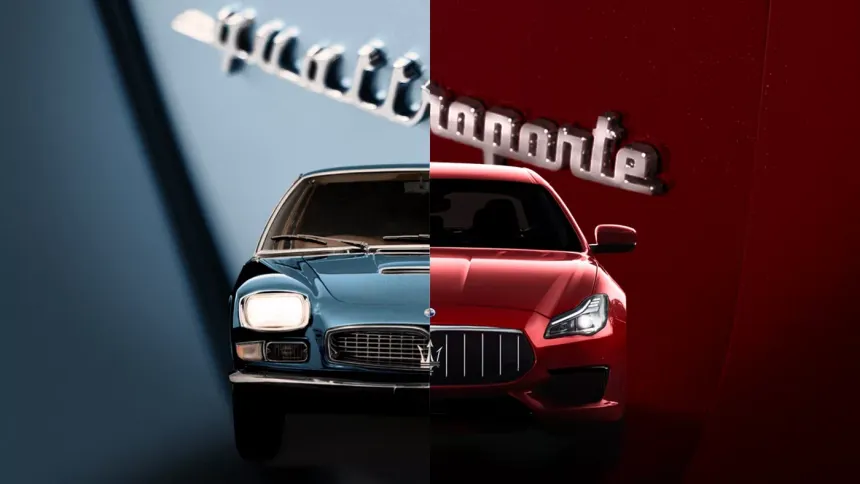
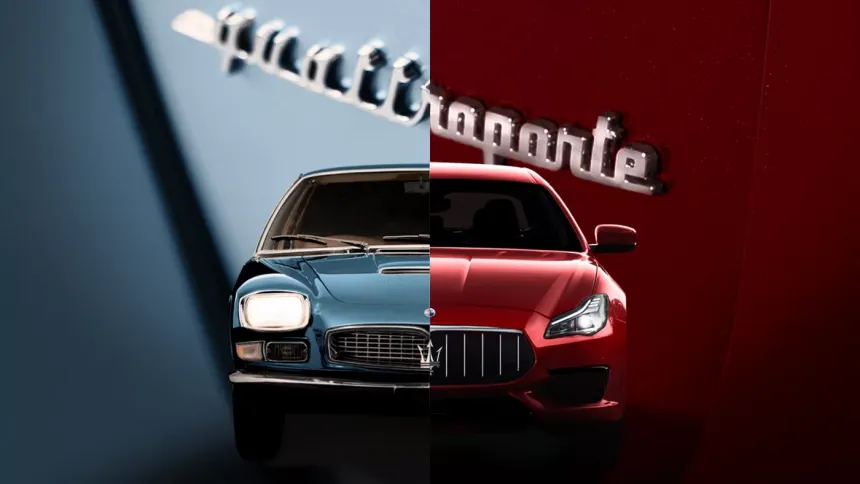
MASERATI QUATTROPORTE: SIX GENERATIONS WITH THE ENGINE WHERE IT SHOULDN’T BE
The sedan that stole a prince’s heart
Picture this. Early sixties. Modena. An engineer named Giulio Alfieri has an idea that sounds like madness: take a competition-derived V8, drop it into a four-door car, and tell the world that a sedan can be the fastest car on the planet. Not a two-seat sports car. Not a GT exclusive to childless millionaires. A car with rear seats. With a trunk. With ashtrays and leather upholstery.
That idea was called Quattroporte. Four doors. Just like that, no metaphors, no poetry. Italians are sometimes brutally literal. And if you’ve ever felt that your four-door car is a concession to adult life, you need to know what happened in Modena between 1963 and 2023. Because the Quattroporte was never a concession. It was a declaration of war.
The Aga Khan’s commission and the birth of a monster
It all started with a royal whim. In 1962, Prince Karim Aga Khan commissioned Pietro Frua to design a custom Maserati 5000 GT, chassis number 103.060. Frua designed an elegant beast. And when Maserati’s bosses — then under the Orsi family — saw the result, something clicked. If Frua could give that presence to a two-door GT, what would happen if they asked him for the same thing with four?
What happened was the Tipo AM107. Unveiled on October 30, 1963, at the Turin Motor Show, alongside the Mistral Coupé. Frua took the essence of that Aga Khan 5000 GT and stretched it, refined it, added two more doors and a cabin that Maserati marketed as “a living room on the move” or, in its blunter version, “a limousine with a racing spirit.”
It wasn’t empty marketing. Under that long, aristocratic hood beat the first series-production V8 in Maserati’s history. An all-aluminum 4,136 cc block with dual overhead camshafts per bank, 16 angled valves, hemispherical combustion chambers and four twin-choke Weber downdraft carburetors. Fed like that, the engine delivered 260 hp at 5,000 rpm. That figure means nothing until you remember the context: in 1963, the Mercedes-Benz 300 SE had 170 hp. The Jaguar Mark X, 265 hp from a 3.8-liter straight-six that weighed considerably more. The Quattroporte was, without argument, the fastest production sedan in the world. 230 km/h top speed, claimed by the factory. With four doors. In 1963.
Construction that nobody expected
And here’s what separates the Quattroporte from every luxury sedan of its era: the structure. While Rolls-Royce and Mercedes were still using body-on-frame construction, Maserati chose a steel monocoque with box-section rails. Lighter. Stiffer. More modern than any direct competitor.
The front suspension was independent, with coil springs and hydraulic dampers. At the rear, the first series used a De Dion tube with coil springs and inboard disc brakes — a pure racing solution, sophisticated and expensive to maintain. Brakes were solid Girling discs on all four corners. A limited-slip differential was optional. Gearbox: ZF five-speed manual or Borg Warner three-speed automatic.
The bodies weren’t built in Modena. Pietro Frua designed and Carrozzeria Vignale built each body by hand. Every single one. By hand. Think about that the next time someone talks to you about “craftsmanship” in a modern car.
Who drove a Quattroporte I
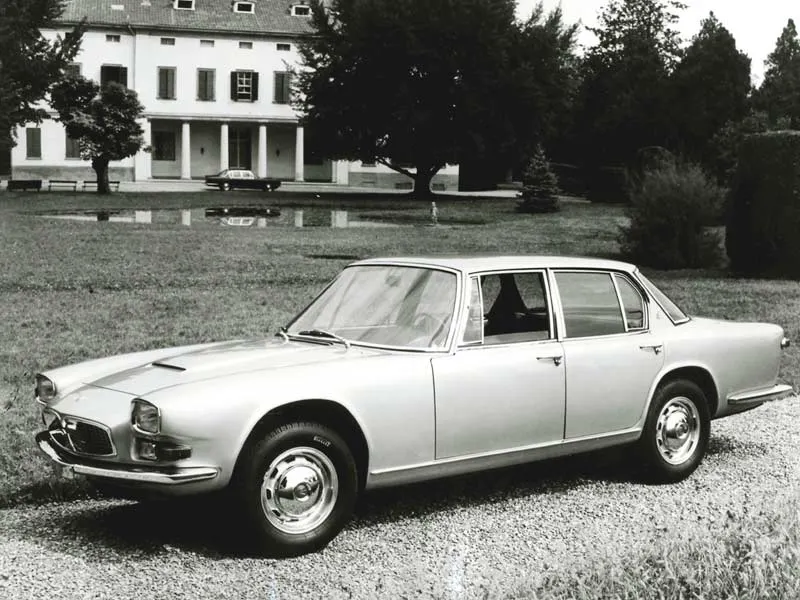
The first Quattroporte’s ownership roster reads like the cast of a film nobody would dare write for fear of seeming over the top. Anthony Quinn. Marcello Mastroianni. Alberto Sordi. Peter Ustinov. Stewart Granger. Prince Rainier III of Monaco. Leonid Brezhnev. The Shah of Iran, Mohammad Reza Pahlavi. And, of course, the Aga Khan himself, who came back for more: in 1971 he commissioned a one-off on the Maserati Indy platform with a 4.9-liter, 300 hp V8, designed again by Frua. That car had its own chassis code, AM 121, and was production-ready. But Citroën, which by then controlled Maserati, killed it to impose its own vision for the Quattroporte II. The prototype ended up being sold. To whom? The King of Spain, who bought it directly from Frua.
The first generation was produced between 1963 and 1969. First series: 251 units with the 4.2 engine, only 8 with the 4.7. Second series from 1966: 435 with the 4.2, 73 with the 4.7 and 3 unique units with the 4.9-liter engine. Total: approximately 770 cars. In 1966 came the twin round headlights (previously mandatory only in the US), the De Dion rear axle was replaced by a Salisbury live axle with leaf springs — technically a step backward but more reliable and quieter, reducing interior noise by up to 20 dB at highway speeds — and the interior was redesigned with a full-width wood-trimmed dashboard and standard air conditioning.
The ghost generation: the Quattroporte II
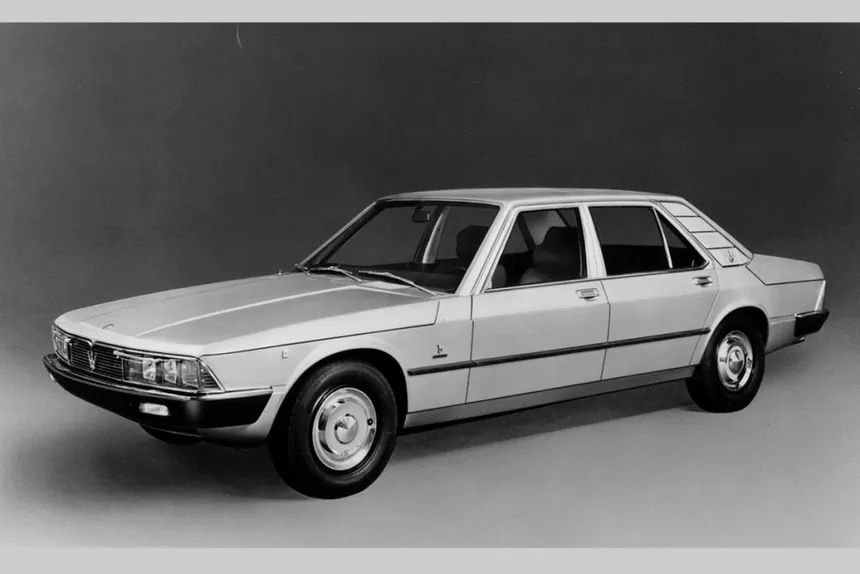
Here the story takes a wrong turn. Citroën bought Maserati in 1968 and decided the next Quattroporte should share its platform with the Citroën SM. The result, unveiled at the 1974 Paris Motor Show, was an angular sedan designed by Marcello Gandini at Bertone, with front-wheel drive, hydropneumatic suspension, directional headlights inherited from the DS, and a V6 producing less than 200 hp derived from the Merak and the SM. For a car bearing the Quattroporte name, it was an insult in horsepower.
The 1973 oil crisis, Citroën’s collapse, and the ownership change buried this car before it was born. Thirteen units were built. Thirteen. All sold to Middle Eastern clients. It’s the rarest Quattroporte in history and, paradoxically, a fascinating collector’s piece: the only Maserati with front-wheel drive and hydropneumatic suspension in the entire saga.
The Quattroporte III: De Tomaso, Giugiaro, and the president with the pipe
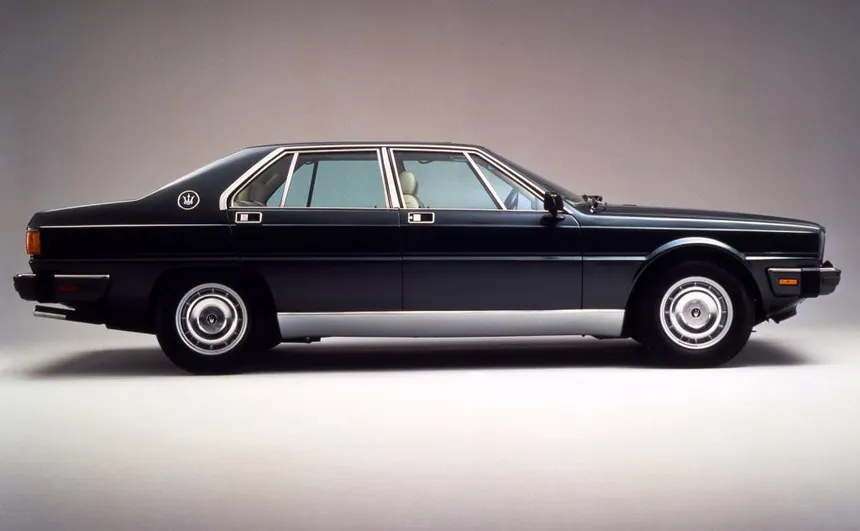
Alejandro de Tomaso bought Maserati in 1975 — with help from the Italian government, which saved 800 jobs in Modena — and the first thing he did was erase every trace of Citroën. The third Quattroporte, Tipo AM 330, was born from the Maserati Kyalami (itself derived from the De Tomaso Longchamp), and dressed by Giorgetto Giugiaro with lines inspired by the Medici I and Medici II prototypes he had presented in 1976 on Maserati platforms.
The V8 returned. In 4.2-liter (255 hp) and 4.9-liter (280 hp) variants, with a five-speed manual or three-speed automatic. Top speed: 220 km/h. The interiors were a statement of Italian luxury without apology. And the car found a client that would change everything: the President of the Italian Republic.
On December 14, 1979, at the Quirinal Palace in Rome, two Quattroporte III units were presented to President Sandro Pertini, one with manual and one with automatic transmission. In 1982, the Presidential General Secretariat commissioned Maserati to build an armored version. What they delivered in 1983 was a car in “Dark Aquamarine” with beige velvet interior, a cabin armored with high-strength manganese steel plating, 31 mm polycarbonate electrically operated windows, an electrically opening roof above the rear seats so the president could stand and greet crowds, a special handle on the back of the front passenger seat for balance, a telephone system, an intercom for external communication, a bar cabinet… and a large ashtray with pipe holder between the rear seats, because Pertini smoked a pipe and specifically requested it. Maserati modified the entire rear bench seat to accommodate it.
But the anecdote that defines the Quattroporte III happened on May 29, 1983, when Pertini visited the Ferrari factory in Maranello aboard his armored Quattroporte. According to protocol, once the presidential vehicle entered the plant, the host was supposed to approach the car. Enzo Ferrari stood still. Ten meters from the Quattroporte. He didn’t move. The elderly President Pertini had to get out of his Maserati and walk to him. The reason? The historic rivalry between the Trident and the Prancing Horse. Enzo Ferrari refused to approach a Maserati. Not even for the President of Italy.
Luciano Pavarotti also chose the Quattroporte III. The photographs of the Modenese tenor aboard his Quattroporte outside La Scala in Milan have become part of the Italian collective imagination.
A total of 2,145 units were built between 1979 and 1990, including 51 of the Royale version (1986), an “ultra-luxury” edition with soft leather power-adjustable seats, burr walnut dashboard trim, an analog clock, a telephone between the front seats, folding tables in the rear doors, and the 4.9 engine updated to 300 hp. The Quattroporte has been the official car of every Italian president since. Until today.
The Quattroporte IV: Gandini downsizes, Fiat enters the scene
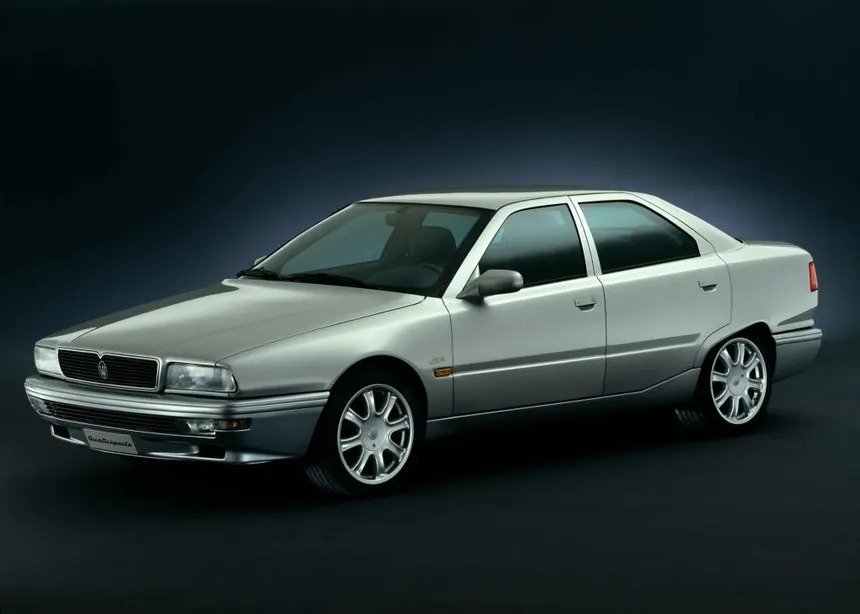
The fourth generation (1994–2001) was the first under Fiat ownership and the most compact of all. Marcello Gandini — yes, the man who drew the Countach — designed a smaller, more aerodynamic car (0.31 Cd) with his unmistakable angular signature at the rear wheels. The platform was an extension of the Biturbo, the engines were twin-turbocharged V6s in 2.0 and 2.8-liter displacements and, from 1996, a twin-turbo 3.2-liter V8 from the Shamal.
It was a lesser Quattroporte. Closer to a BMW 5 Series than to the sports limousine the name had represented. When Ferrari took control of Maserati, they launched the Evoluzione version in 1998 with 400 quality improvements. But the damage was done. The Quattroporte needed to be grand again.
The rebirth: Quattroporte V, Frankfurt 2003
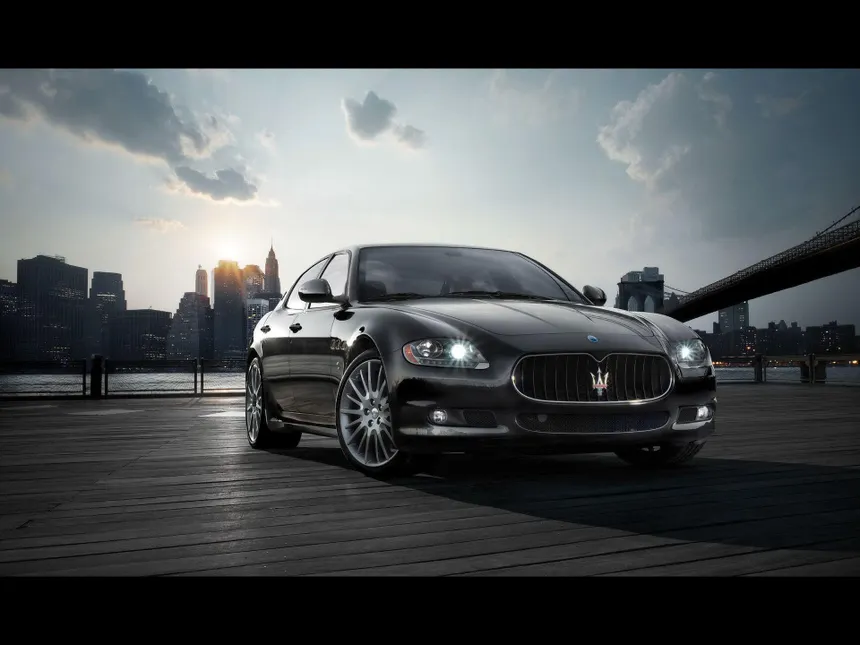
And grand it was. On September 9, 2003, at the Frankfurt Motor Show, Maserati unveiled the fifth generation and the world held its breath. Ken Okuyama, working from Pininfarina’s studio, had drawn the most beautiful sedan of its generation. Flowing lines, a low and wide grille, three vents on the front fenders, A-pillars raked like a coupé’s. It was a design that seemed impossible for a four-door car over five meters long.
But what lay beneath was even more radical. A Ferrari F136 4.2-liter, naturally aspirated V8, mounted in a set-back position behind the front axle with a dry sump. Rear-mounted transmission in a transaxle layout — engine at the front, gearbox at the back — for a 47/53 weight distribution. That’s not a sedan. That’s the architecture of a competition sports car slotted into a luxury saloon.
The engine delivered 400 hp, and the later Sport GT S version, with the block enlarged to 4.7 liters, reached 440 hp. Built at the Ferrari plant in Maranello. Skyhook adaptive suspension as standard. The first transmission was the DuoSelect, a Ferrari-derived automated manual that was criticized for its harshness in city driving — over 70% of buyers chose the ZF six-speed automatic when it was offered from 2007.
The Quattroporte V was the car that saved Maserati in the modern market. It became the best-selling Quattroporte in history. In 2004, Maserati’s sales grew 62% over 2003, and most of that growth came from a single model: the Quattroporte.
The sixth generation: the final chapter (2013–2023)
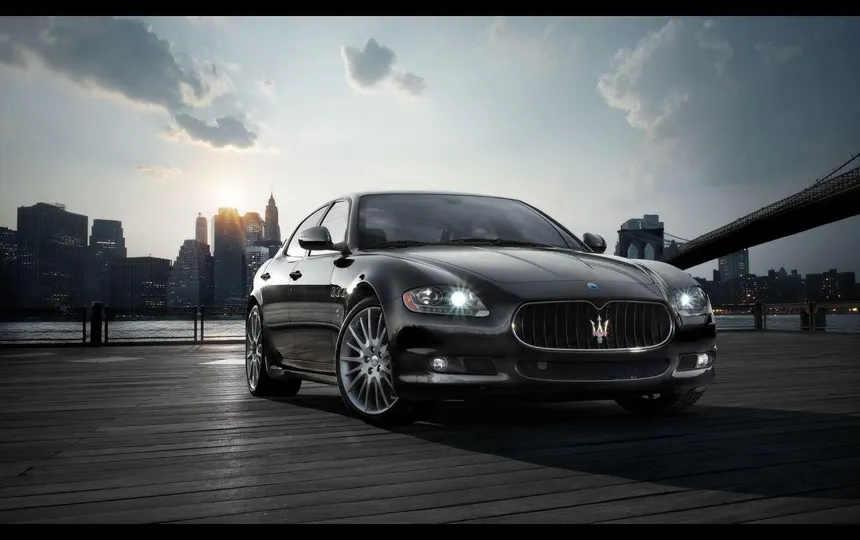
Unveiled at the Detroit Motor Show in January 2013, the Quattroporte VI was the first designed entirely in-house at Maserati’s Centro Stile, without Pininfarina or other external coachbuilders. It was larger than any of its predecessors — 5,262 mm long, 3,171 mm wheelbase — and nearly 100 kg lighter thanks to the extensive use of aluminum in the structure.
The engines, once again built by Ferrari in Maranello, were now turbocharged: a 3.0-liter twin-turbo V6 with 410 hp, a 3.8-liter twin-turbo V8 with 530 hp, and the brutal 2020 Trofeo variant with 580 hp and 730 Nm. Designed under the supervision of Paolo Martinelli, the same engineer who ran Ferrari’s F1 engine department during the Schumacher era. Eight-speed ZF automatic. Q4 all-wheel drive available.
President Sergio Mattarella debuted his Quattroporte VI in “Blu Istituzionale,” a color created specifically by Maserati, with “Black Piano” interior trim and full-grain Pieno Fiore leather. The rear console carries the official crest of the Italian Republic.
In the ten years it was in production, BMW released two generations of the M5, AMG two E63s, Audi two RS6s, and Jaguar killed the XJ entirely. And still, when you saw a Quattroporte parked among its German rivals, it was the one that made you turn your head.
Production ended in 2023. No confirmed successor. Over 75,000 units produced across six generations and 60 years. Featured in or associated with more than 60 films. Official car of every Italian president for over four decades.
What the Quattroporte did for the automotive world
Before the Quattroporte, the concept of a “super saloon” didn’t exist. There was no luxury sedan conceived from minute one to be genuinely fast — not as a marketing accessory, but as its reason for being. The Jaguar XJ arrived in 1968. The Mercedes 300 SEL 6.3, also in 1968. The BMW M5 didn’t appear until 1984. The Aston Martin Rapide, 2010. The Porsche Panamera, 2009. They all came after. They all owe something to the car that an engineer from Parma and a designer from Turin dared to imagine in a factory in Modena in the early sixties.
Six generations. Six distinct personalities. A V8 derived from the 450S competition engine that became the longest-lived and most important engine in Maserati’s history. A president who smoked his pipe in the back seat. An Enzo Ferrari who refused to walk ten meters. A tenor who parked outside La Scala. Thirteen ghost cars with front-wheel drive that should never have existed. And a name that says exactly what it is, without decoration, without excuse.
Quattroporte. Four doors. The sedan that invented the segment and left without asking permission.
Check you’re still alive.