MAYBACH: THE BRAND THAT HAS DIED THREE TIMES AND KEEPS COMING BACK

There are brands that fail and disappear. And there are brands that fail, disappear, come back, fail again, disappear again, and yet someone in a boardroom says: “But this time it’s going to work.”
That brand is Maybach.
And the most twisted part of it all is that the last time… they were right.
But to understand why Maybach is one of the most fascinating stories in luxury motoring, you need to go back to 1909. And you need to start with an angry engineer.
Wilhelm Maybach wasn’t just anyone. He was the technical brain behind Daimler-Motoren-Gesellschaft. The man who, alongside Gottlieb Daimler, developed one of the first high-speed combustion engines in 1885 — the famous “Standuhr.” They called him “The King of Designers.” But when Daimler died in 1900, the company started sidelining him. Corporate intrigue did its job. And in 1907, Wilhelm left. At 61 years old. Absolutely furious and with a very clear idea of what he wanted to do.
On March 23, 1909, he founded Luftfahrzeug-Motorenbau GmbH alongside his son Karl. An aircraft engine company. The main client: Count Zeppelin. Yes, the airships. Maybach engines powered those hydrogen behemoths that glided across European skies. And during World War I, those same engines moved German combat aircraft.
But Wilhelm had something else in mind.
In 1919, the first experimental Maybach car hit the road. In 1921, the Maybach W3 was presented at the Berlin Motor Show. It wasn’t just any car. It was among the first German production cars with four-wheel brakes. A luxury beast designed for people who found a Rolls-Royce too understated.
And here you need to understand something fundamental about Maybach: they didn’t sell cars. They sold a chassis with an engine and a dashboard. The customer took that chassis to a coachbuilder — Spohn, Glaser, Erdmann & Rossi — and there the bodywork was built to measure. Every Maybach was literally unique.
By 1926, the W5 carried an inline-six of seven litres producing 120 hp. But the best was yet to come.
In 1929, Wilhelm Maybach died. His son Karl took the reins. And in an act that was both tribute and statement of intent, he created the Maybach Zeppelin DS7. A seven-litre V12. The name was no coincidence: Maybach engines had powered Zeppelin airships, and now that prestige was being transferred to the road.

In 1930 came the DS8. The definitive Zeppelin. An eight-litre V12 producing 200 hp. Five and a half metres long. Three tonnes in weight — so heavy that in Germany you needed a commercial vehicle licence to drive it. Its price: 36,000 Reichsmarks, according to contemporary records. To put that into perspective: a three-bedroom urban apartment in 1930s Germany cost between 10,000 and 15,000 Reichsmarks. What you paid for a Zeppelin DS8 would buy a flat and leave enough to furnish it.
The buyers were kings, emperors, opera tenors like Enrico Caruso, boxing champions like Max Schmeling, Princess Juliana of the Netherlands. And yes, Nazi politicians too. Joseph Goebbels had one. That’s the part of the story Maybach prefers not to mention in their brochures.
Approximately 1,800 Maybach cars were built before the war. This wasn’t mass production. It was craftsmanship for the elite. Each one cost a fortune and each one was different from the last.
And then the war came. And Maybach went from building Europe’s most exclusive luxury to building engines for the Wehrmacht’s most lethal tanks.
The Maybach HL 210 and HL 230 — 21 and 23-litre engines — powered the Panzer III, IV, V, the Tiger I and Tiger II. Virtually every heavy German tank of World War II ran a Maybach engine. Also the half-tracks like the Sd.Kfz. 251 and the heavy prime movers like the Sd.Kfz. 9.
The Friedrichshafen factory was repeatedly bombed by the Allies. Maybach even relocated part of its production to an underground factory in Central Bohemia, beneath Radobýl mountain, codenamed “Richard I.”
When the war ended, car production was never restarted. Never. Maybach continued building heavy diesel engines for marine and industrial applications, but the cars vanished. The brand was renamed MTU Friedrichshafen. And in 1960, Daimler-Benz bought the company.
For 36 years, the Maybach name gathered dust in a drawer in Stuttgart.
In 1997, at the Tokyo Motor Show, Daimler presented a luxury concept car. The idea: resurrect Maybach as an independent brand to compete with Rolls-Royce and Bentley. The problem was that Daimler had tried to buy Rolls-Royce and Bentley when Vickers put them up for sale, but BMW and Volkswagen snatched them away. So the response was: “If we can’t buy the British, we’ll create our own ultra-luxury.”
In 2002, the Maybach 57 and Maybach 62 were born. The numbers indicated length in decimetres. The 57 measured 5.7 metres. The 62, 6.2 metres. Twin-turbo V12 engine, 5.5 litres, 550 hp. Starting price: over €300,000. You could easily reach half a million with the options.
The launch was spectacular. A Maybach 62 was transported inside a glass case aboard the Queen Elizabeth 2 from Southampton to New York. On arrival, a helicopter lifted it off the ocean liner onto a dock. From there, it was driven to the Regent Hotel on Wall Street.
Daimler predicted annual sales of 2,000 units, with 50% coming from the United States.
They didn’t come close.
The problem with the Maybach 57 and 62 wasn’t quality. They were extraordinary cars. Twin-turbo V12, exclusive leather upholstery, heat-reflecting laminated glass, reclining rear seats with massage, four-zone climate control, 21-speaker sound system. Technologically, they were superior to a Rolls-Royce Phantom in almost every measurable aspect.
But a luxury car isn’t bought with specifications. It’s bought with the heart. With history. With prestige. And there, Maybach had a black hole.
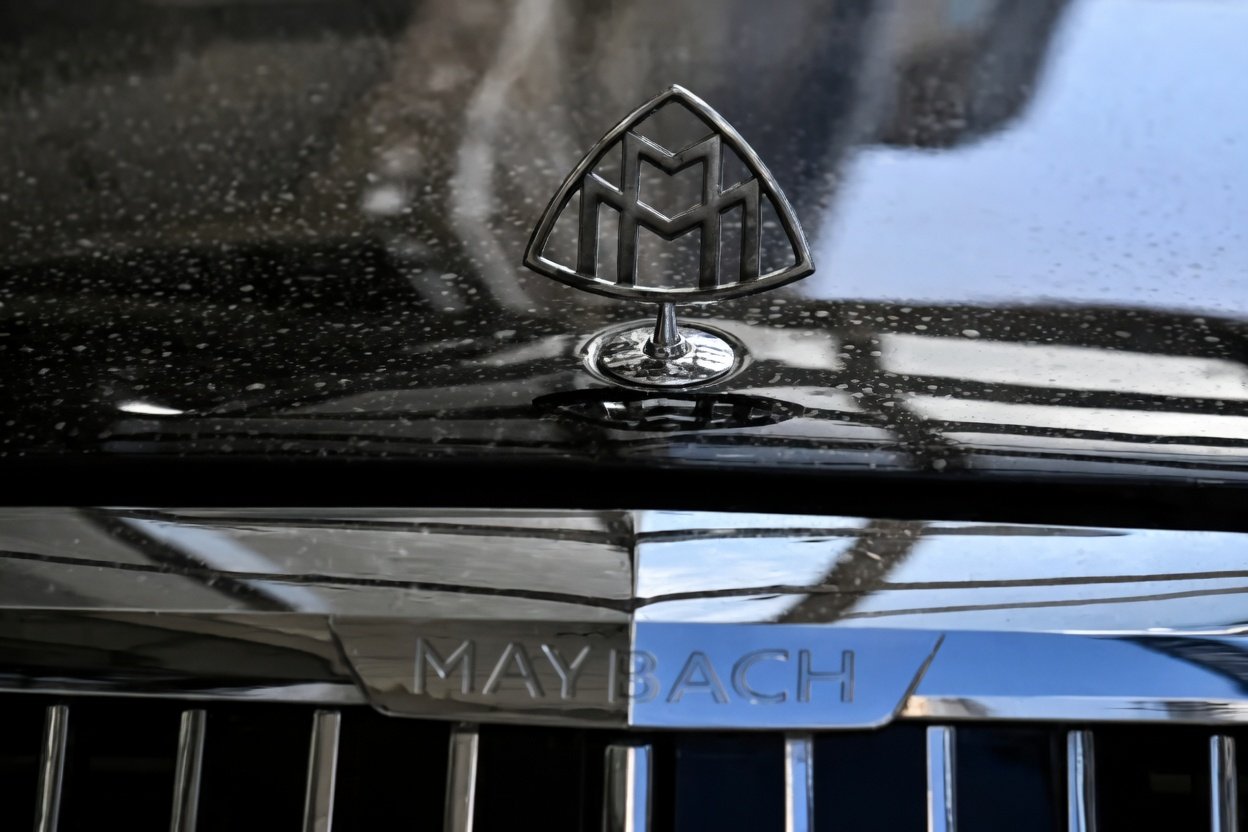
First problem: nobody outside Germany knew what Maybach was. The Zeppelins had disappeared 60 years earlier. Rolls-Royce had over a century of worldwide recognition. Maybach had a nice name and a logo that most people confused with an eyewear brand.
Second problem: the car looked like a stretched Mercedes S-Class. Because in large part, that’s exactly what it was. It shared its platform, factory and many components with the S-Class. Rolls-Royce built its cars in Goodwood, in a separate factory, with an aura of exclusivity. Maybach rolled off the same assembly line in Sindelfingen. Top Gear named it one of the worst cars produced in 20 years. Fortune magazine wrote that Mercedes had missed the chance to buy Rolls-Royce and Bentley, and was now trying to manufacture its own version of prestige.
Third problem: in 2003, the new Rolls-Royce Phantom appeared. Where the Phantom looked to the past with elegance — every interior detail evoking 1930s British craftsmanship — the Maybach looked to the present with cold German technical perfection. It made no reference to its own Zeppelin heritage. None of the pre-war artisanal identity. A design decision, yes. But it lost the emotional battle. Because in ultra-luxury, emotion is the product.
Sales were catastrophic. The best year was 2004, with 244 units in the United States. In 2010, 157 Maybachs were sold worldwide. That same year, Rolls-Royce sold 2,711. The numbers were so humiliating that Daimler estimated a loss of €330,000 per Maybach sold. Total losses exceeding one billion euros.
In November 2011, Daimler announced that Maybach would cease to exist as a brand by 2013. On December 17, 2012, the last Maybach rolled off the Sindelfingen line. In total, approximately 3,000 units were built in ten years. A Daimler executive told the Frankfurter Allgemeine newspaper: “We have concluded that the sales prospects are better with the Mercedes brand than with Maybach.”
Maybach was dead. Again.

But here comes the twist. Because what Mercedes did next was probably the smartest move they’ve ever made with this brand in its entire history.
In November 2014, Daimler announced Maybach’s return. But not as an independent brand. As a sub-brand of Mercedes-Benz. Just as Mercedes-AMG was the sporty sub-brand, Mercedes-Maybach would be the ultra-luxury sub-brand.
The first model was the Mercedes-Maybach S 600, presented simultaneously in Los Angeles and Guangzhou. It went on sale in February 2015. It was no longer a completely different car from the S-Class — it was an S-Class with an extended wheelbase, 20 centimetres longer, with ultra-luxury equipment as standard. And with a price starting at €134,000 in Germany. Not €350,000. Not €450,000. €134,000.
The result? 500 units per month in China alone. In South Korea, the annual target of 200 units was met in three months. In the first year, they surpassed 15,000 units sold globally. By 2019, that figure had exceeded 60,000 units. And with the arrival of the Mercedes-Maybach GLS and the EQS SUV, the range expanded into segments where Maybach had never been.
Think about what that means. As an independent brand, Maybach sold 3,000 cars in ten years with losses exceeding one billion euros. As a Mercedes sub-brand, it sold 15,000 in one year. At a profit.
The lesson is brutal: the Maybach name, without the Mercedes shield, was worth nothing in the modern market. With the three-pointed star in front, it’s worth a fortune.
But it wasn’t just the logo. It was also the price. From over €350,000 to €134,000. And a radical strategy shift: stop competing head-on with Rolls-Royce and Bentley and instead occupy a space where nobody else stood — a Mercedes that was longer, more luxurious, more exclusive than the S-Class, but without pretending to be a different brand. It had no direct rival. And in marketing, that’s pure gold.
That says a lot about how real luxury works. It’s not about how good the product is. It’s about what the buyer feels when they see it. And a Chinese, Russian or American buyer feels something when they see a Mercedes star. They feel nothing when they see a double M they don’t recognise.
The numbers tell a story that no marketing textbook could have predicted. When Maybach was an independent brand, dealers struggled to fill their showrooms. Mercedes bought back 29 US dealers in 2007, reducing the network from 71 to 42. The brand that was supposed to attract 2,000 buyers per year couldn’t even convince 200. But when that same name was printed below a three-pointed star, suddenly China was ordering 500 units per month and South Korea was blowing past annual targets in a single quarter. Russia, a market that barely registered on the original Maybach radar, was consuming over 50% of the entire ultra-luxury segment with Mercedes-Maybach alone.
The car itself was better the second time around, sure. But was it that much better? The honest answer is no. The Mercedes-Maybach S-Class is an outstanding automobile, but so was the Maybach 62. The difference wasn’t in the engineering. It was in the badge. It was in the ecosystem. It was in the fact that buying a Mercedes-Maybach meant joining a world you already knew and trusted, rather than gambling on a name your neighbours wouldn’t recognise.
Some say Mercedes-Maybach is a cynical exercise. That it’s simply an S-Class with two-tone paint and a €50,000 surcharge. And in a way, they’re right. But cynicism doesn’t invalidate results. Mercedes found the formula to make the Maybach name generate money for the first time in decades. They did it by surrendering independence and embracing the reality of the modern luxury market: the umbrella brand matters more than the sub-brand.
Rolls-Royce can afford to be independent because it has 120 years of uninterrupted global recognition. Bentley, the same. Maybach didn’t have that. And when they tried to force that recognition with money and marketing, the market responded with indifference.
The story of Maybach is the story of an extraordinary name trapped in a century that doesn’t know what to do with it. Airship engines, tank engines, limousines for kings, multibillion-euro corporate failures, and ultimately, a golden badge on the grille of a Mercedes S-Class that sells like hotcakes in Shanghai.
Wilhelm Maybach started with anger and a dream. 117 years later, his name survives. Not as he imagined it. But it survives.
And if this brand has proven anything, it’s that no matter what happens, it always comes back.
Check you’re still alive.