
Porsche 911 GT1: the Le Mans race car Porsche had to register for the road
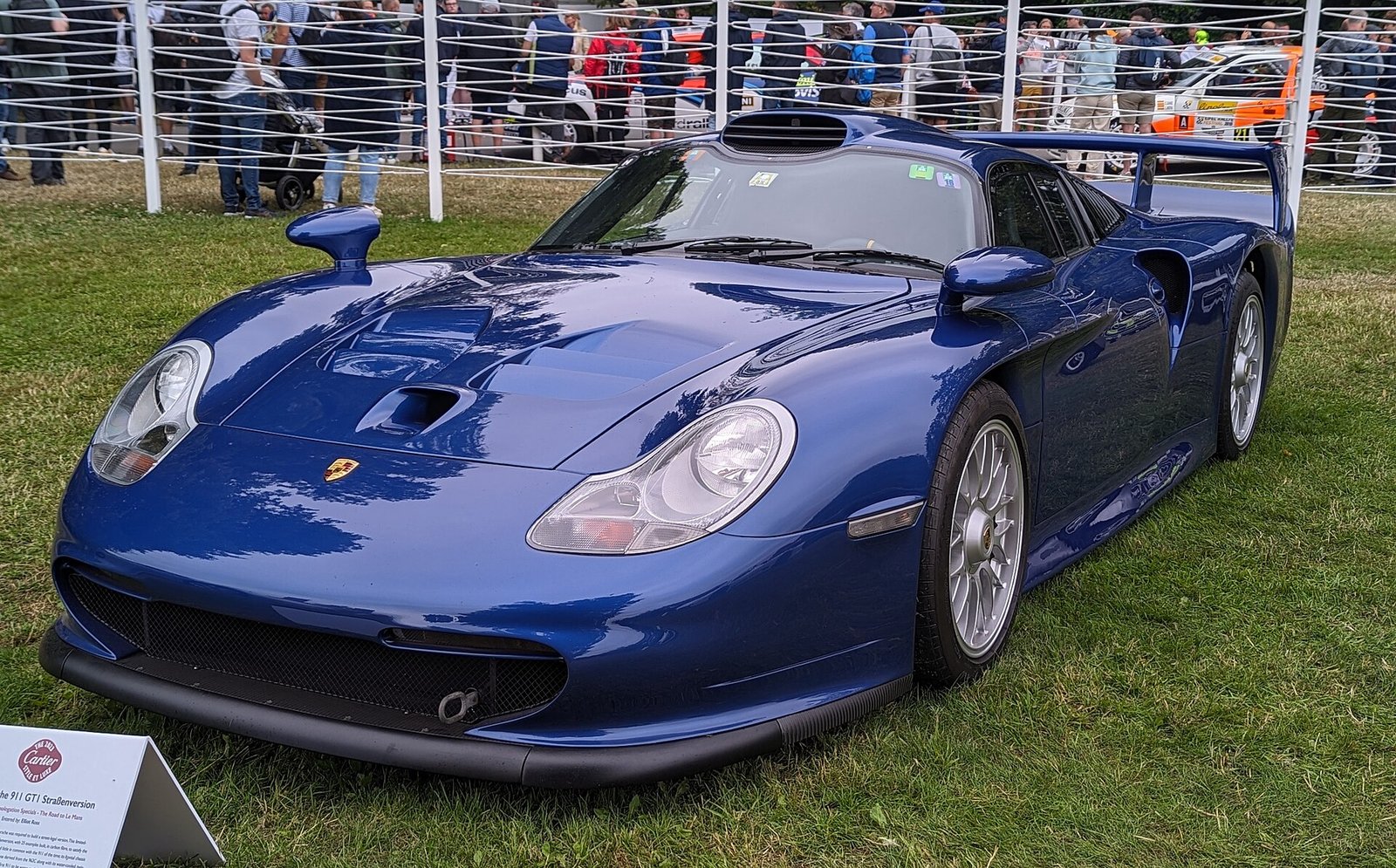
In March 2017, at Gooding & Company’s auction on Amelia Island, a Porsche 911 GT1 Strassenversion sold for $5,665,000. It was one of the very few of these cars legally in the United States, admitted under the federal Show or Display rule, which lets certain historically significant cars that were never certified for US sale be imported and driven a limited distance each year. That detail tells you what the car is. Nobody in Stuttgart ever designed it for an American driveway, or for any driveway. It’s a Le Mans race car that Porsche had to put license plates on so it would be allowed to race.
Getting it the right way around
Most supercars with racing versions start on the road. The McLaren F1 was a road car first, and it won Le Mans in 1995 almost as a side effect of being so fast. The Ferrari F40 went racing because it happened to fit a rulebook. The 911 GT1 runs the other direction. Porsche’s racing department at Weissach designed a car to win at the Sarthe, then did only the bare minimum needed to turn it into something the German authorities would register: a passenger seat, a tiny luggage space, road lights, mufflers and catalytic converters. Everything else stayed race car.
Why Porsche needed it
In the mid-1990s, sports car racing was coming back to life through GT racing. The BPR Global GT Series, and from 1997 the FIA GT Championship, ran cars that had to be based on road-legal models. Le Mans had a GT1 class built on the same idea. McLaren showed up with the F1 GTR and beat everybody at Le Mans in 1995, its first attempt.
For Porsche, which had won Le Mans more times than any other manufacturer, losing to a small British company with a single model was hard to accept. The first response was a racing version of the 993 GT2, the turbo 911 of the day. It was fast in a straight line but no match for the McLaren over a full race. The engine hung out behind the rear axle like on every 911, the car was heavy at the back, and it simply wasn’t a purpose-built racer.
The work would happen at Weissach, Porsche’s development center west of Stuttgart, where the company’s race cars had been designed and tested since the early 1970s on its own test track, far from the factory that built road cars in Zuffenhausen. So Porsche Motorsport handed the job to Norbert Singer, the engineer behind the 956 and 962, the Group C cars that dominated Le Mans in the 1980s. His brief was to build something that would win.
The man with the rulebook
Norbert Singer is one of those engineers whose name means everything to racing people and nothing to anyone else. He joined Porsche in 1970 and spent more than three decades in its racing department, where he worked on the 917, the 935, the 956 and the 962. His reputation rested on two skills. He understood aerodynamics at a time when many racing engineers still treated it as an art, and he read rulebooks the way a tax lawyer reads the tax code, looking for what wasn’t forbidden. The 935 of the late 1970s, with its long flat nose that the rules technically allowed because they didn’t say where the fenders had to end, was his work. The GT1 was the same mindset applied to a whole car. Singer was involved in most of Porsche’s Le Mans wins, and the 1998 victory was among the last of them before he retired.
A rulebook with gaps
The GT1 rules required manufacturers to make road versions of their race cars available for sale. They were vague about how many, how soon and at what price. In the early years organizers were content with a manufacturer’s promise to build a small run. That gave Singer room.
The car he produced was a 911 in name and in face only. A real 911 has its engine behind the rear axle. The GT1 put its engine ahead of the rear axle, in the middle of the car, the layout every serious racing car uses for balance. The front structure came from the 993, which had already passed crash testing and saved Porsche a lot of work for road homologation. The rear was a tubular frame that owed much to the 962, the same car that had already been turned into road-going specials like the Schuppan 962CR. Between them sat a water-cooled flat-six that had nothing in common with the engines in Porsche’s showroom cars, which were still air-cooled at the time.
From the outside, though, it read as a 911. The headlights, the nose and the shape of the cabin told your brain "911," and that was exactly the point for Porsche’s marketing department.
The engine
The GT1’s engine was a 3,164 cc flat-six with four valves per cylinder, two overhead camshafts per bank, full water cooling and two KKK turbochargers. In race trim it made around 600 hp. For the road car Porsche detuned it to 544 PS, about 537 hp, to pass emissions and noise rules.
It came from Porsche’s racing engine family, the line of turbo flat-sixes associated with Hans Mezger that had powered the 956 and 962, rather than from the 911 Turbo road car. Race engine first, catalytic converters second.
The road car weighed roughly 1,150 kg, about 2,540 lb. Porsche quoted 0 to 100 km/h in 3.9 seconds and a top speed around 308 km/h, or 191 mph. Today plenty of electric sedans match that acceleration. In 1997 it put the GT1 in the company of the McLaren F1 and very little else, and the GT1 wasn’t built for drag races. It was built to run the Porsche Curves at three in the morning.
Three faces in three years
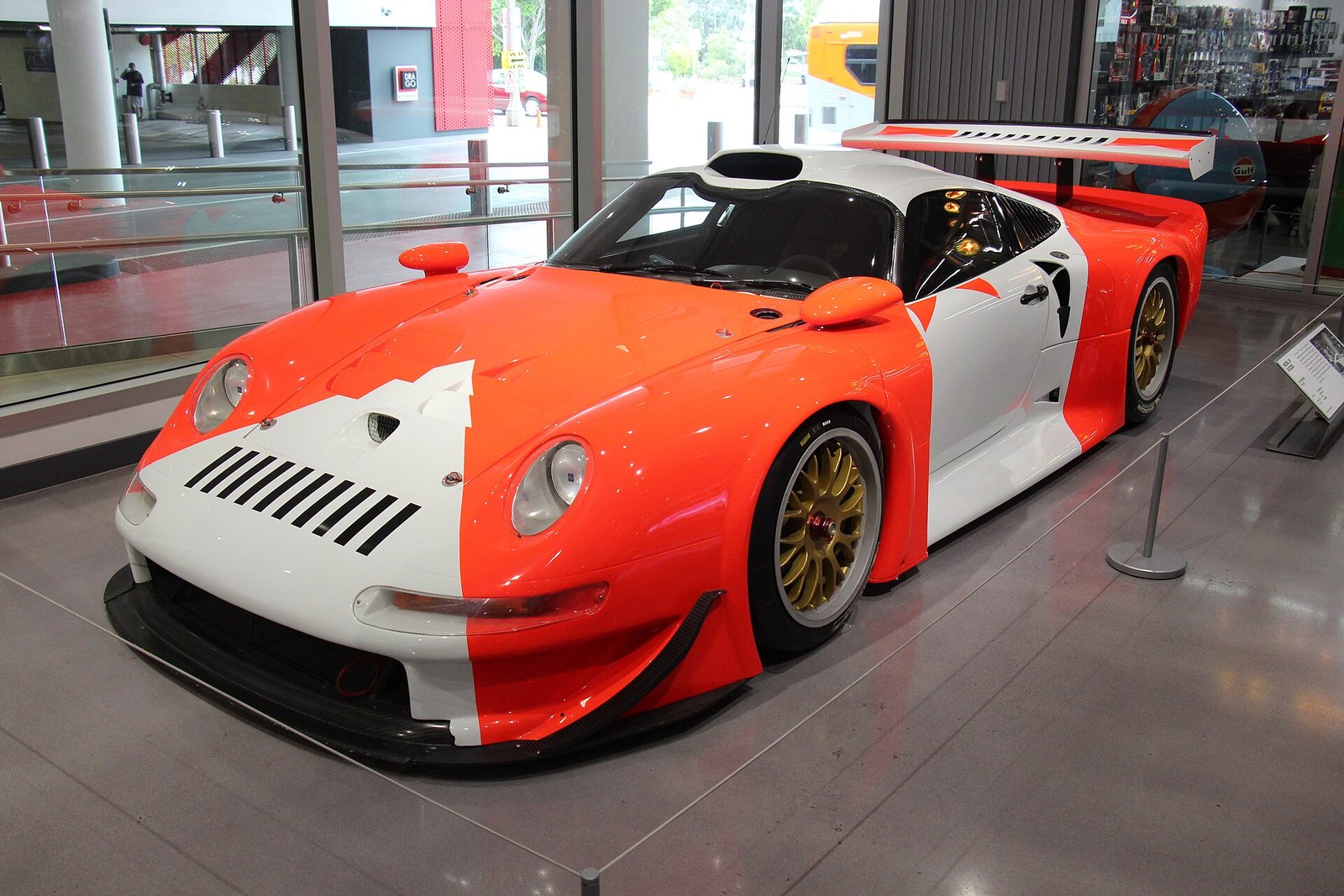
The first GT1s of 1996 wore the round headlights of the 993. Porsche built road prototypes of this version to satisfy the authorities. Late in 1996 the car was revised with new aerodynamics and a new nose, and it received the headlights of the 996, the water-cooled 911 that the public hadn’t even seen yet. That GT1 Evolution raced in 1997, and the road cars built that year, the Strassenversion that most people picture, wear the 996 face.
For 1998 Porsche built what was essentially a new car, the GT1-98, with a carbon fiber monocoque instead of the steel and tube structure, a relocated fuel cell and new bodywork. Because the rules required a road version of the new design, Porsche built a single GT1-98 street car. One. Enough to tick the box.
Production figures for the road cars vary by source, and Porsche itself is vague. The usual estimate is around 25 road-going GT1s from 1996 to 1998, most of them 1997 cars with 996 headlights.
Before the win: 1996 and 1997
The GT1 didn’t arrive and dominate. Its first Le Mans, in 1996, went well on paper: the factory cars finished second and third overall and won the GT1 class, with Hans-Joachim Stuck, Thierry Boutsen and Bob Wollek in the lead car. The overall win went to another Porsche-powered car, the open TWR-Joest prototype, so Stuttgart could celebrate, but the GT1 itself hadn’t won.
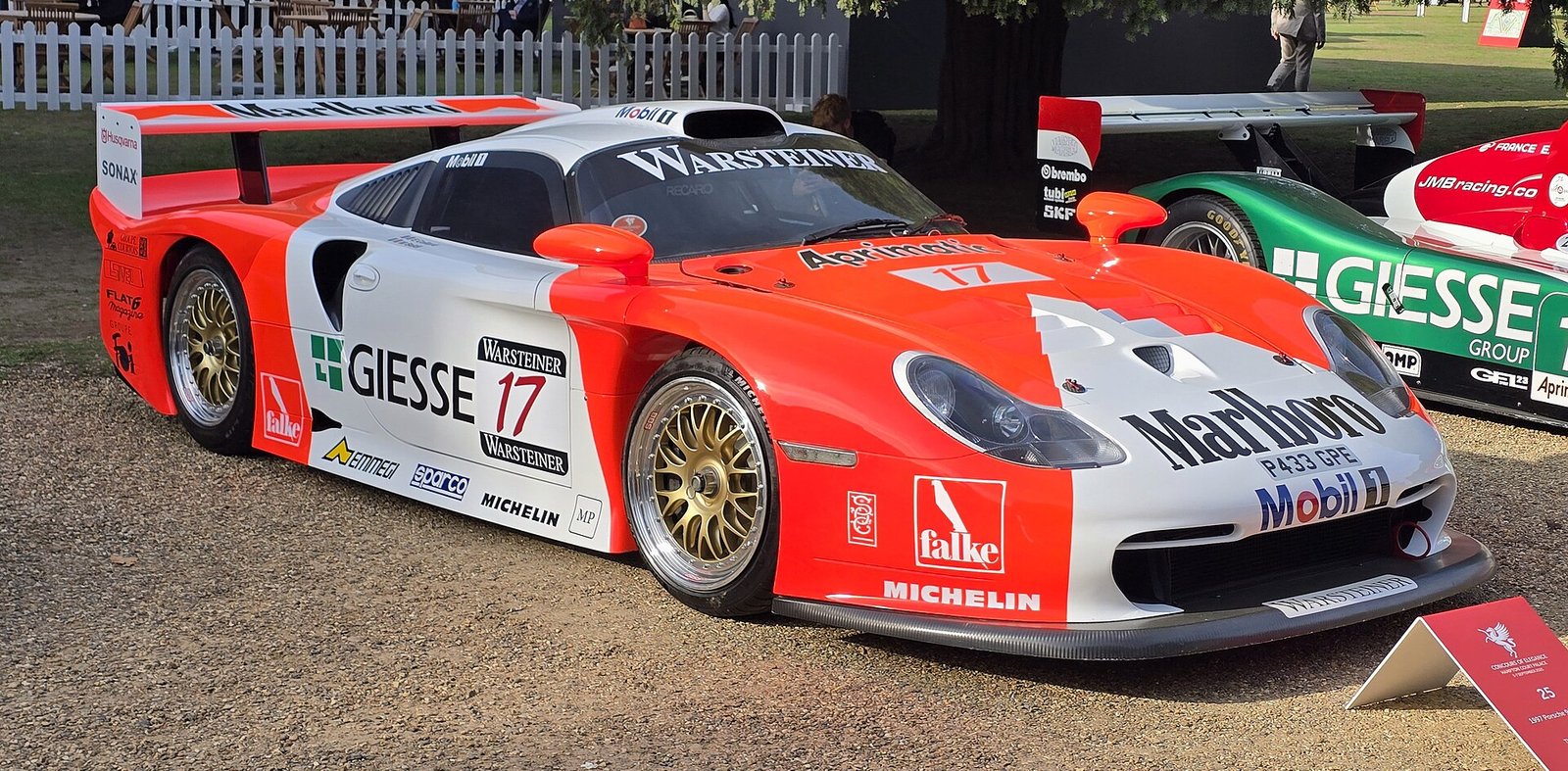
In 1997 things got harder. Mercedes entered the new FIA GT Championship with the CLK GTR, another race car disguised as a road car, and beat Porsche week after week. At Le Mans that year both factory GT1s dropped out, and McLaren’s long-tail F1 GTRs ran at the front of the GT1 field. The 1998 car, with its carbon tub, was Porsche’s answer to being outspent and outdeveloped by Mercedes.
Everyone else was doing it too
Porsche wasn’t the only manufacturer reading the rules creatively. Mercedes built a run of CLK GTR road cars, around two dozen of them, after the racing program had started. Toyota built road versions of the GT-One so it could enter Le Mans in the GT1 class, and Nissan did the same with the R390. In each case the race car came first and the road car was the paperwork. Very few of any of them were ever driven much on public roads.
By the end of 1998 the costs had become absurd and the grids had shrunk. The FIA dropped the GT1 class from its GT championship, and Le Mans moved its top manufacturers into prototype classes, where nobody had to pretend anymore.
Le Mans 1998
The GT1-98 wasn’t the fastest car at Le Mans in 1998. Toyota’s GT-One was quicker, and Mercedes brought the CLK LM. Endurance races are won by the cars that keep running, though. Both Mercedes retired early with power steering failures. The Toyotas ran into trouble too, with the leading car breaking its gearbox with about an hour and a half to go.
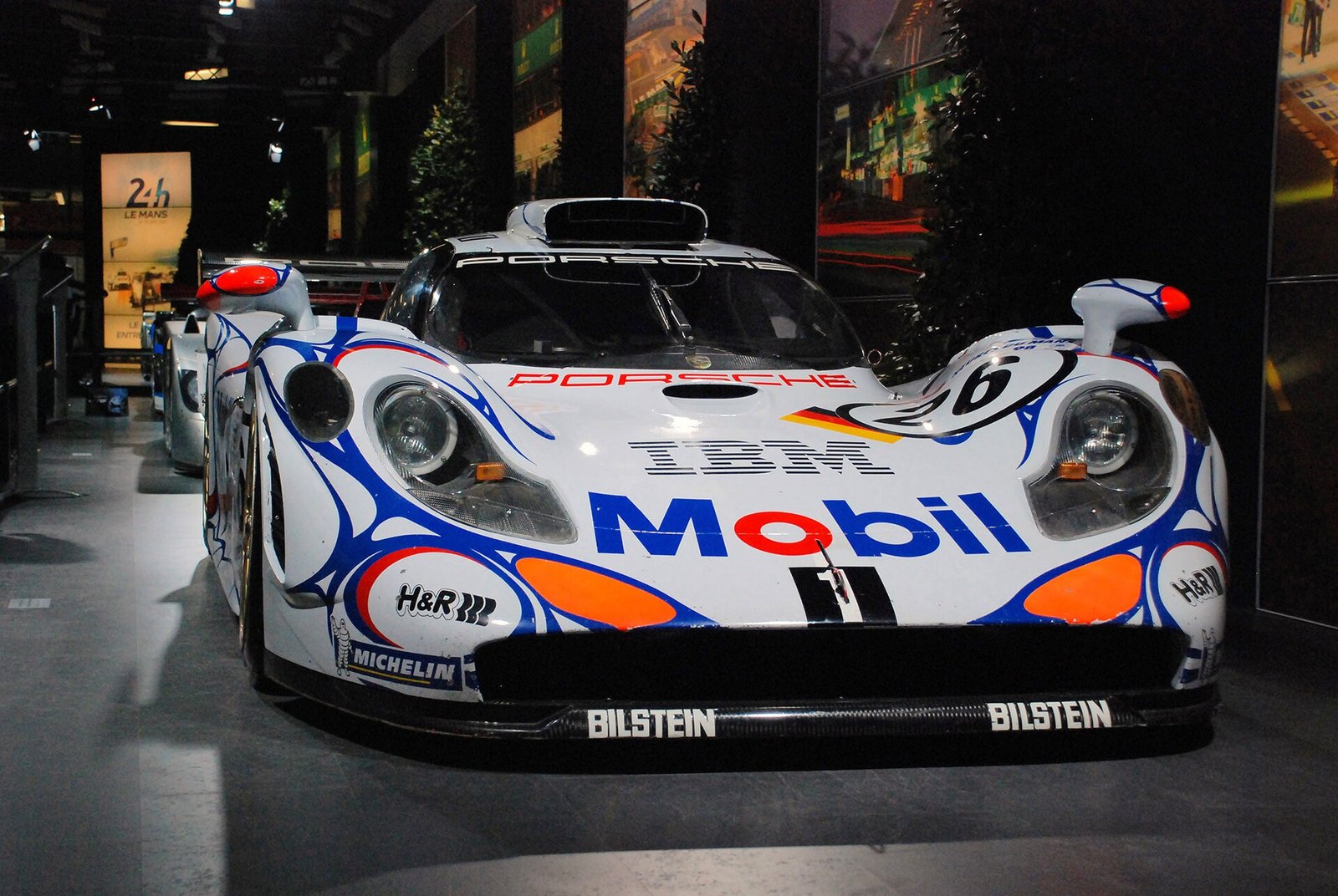
On June 7, 1998, the two factory 911 GT1-98s finished first and second. Allan McNish, Laurent Aïello and Stéphane Ortelli won in car number 26. Jörg Müller, Uwe Alzen and Bob Wollek finished second. It was Porsche’s 16th overall Le Mans victory, a record that still stands. It was also Porsche’s last overall win at the Sarthe until the 919 Hybrid era, seventeen years later.
There’s a bittersweet footnote. Bob Wollek, one of the finest sports car drivers never to win Le Mans overall, came home second that day. He would never win it, and he was killed in a cycling accident in Florida in 2001, on his way to the Sebring 12 Hours.
An American comparison
Americans had their own version of this loophole game, decades earlier. In the late 1960s Ford, Dodge and Plymouth built special street versions of their NASCAR cars purely to legalize aerodynamic pieces for the superspeedways. The Ford Torino Talladega, the Mercury Cyclone Spoiler II, the Dodge Charger Daytona and the Plymouth Superbird existed because NASCAR rules said a production version had to be sold. Those cars at least started as showroom cars with racing modifications. The GT1 went a step further and started as a racing car.
Inside the road car
Open the door of a GT1 Strassenversion and you see Porsche’s attempt to make a race car civilized. The dashboard borrows its shape and instruments from the 993, which helps the car feel like a 911 from the driver’s seat. There are two seats, leather trim and carpets. Behind your head, though, is a turbocharged race engine with very little insulation, and through the floor and the stiff suspension you feel exactly what the tires are doing. A roof scoop feeds air to the engine, a large fixed wing sits at the back, and the body panels are composite rather than steel.
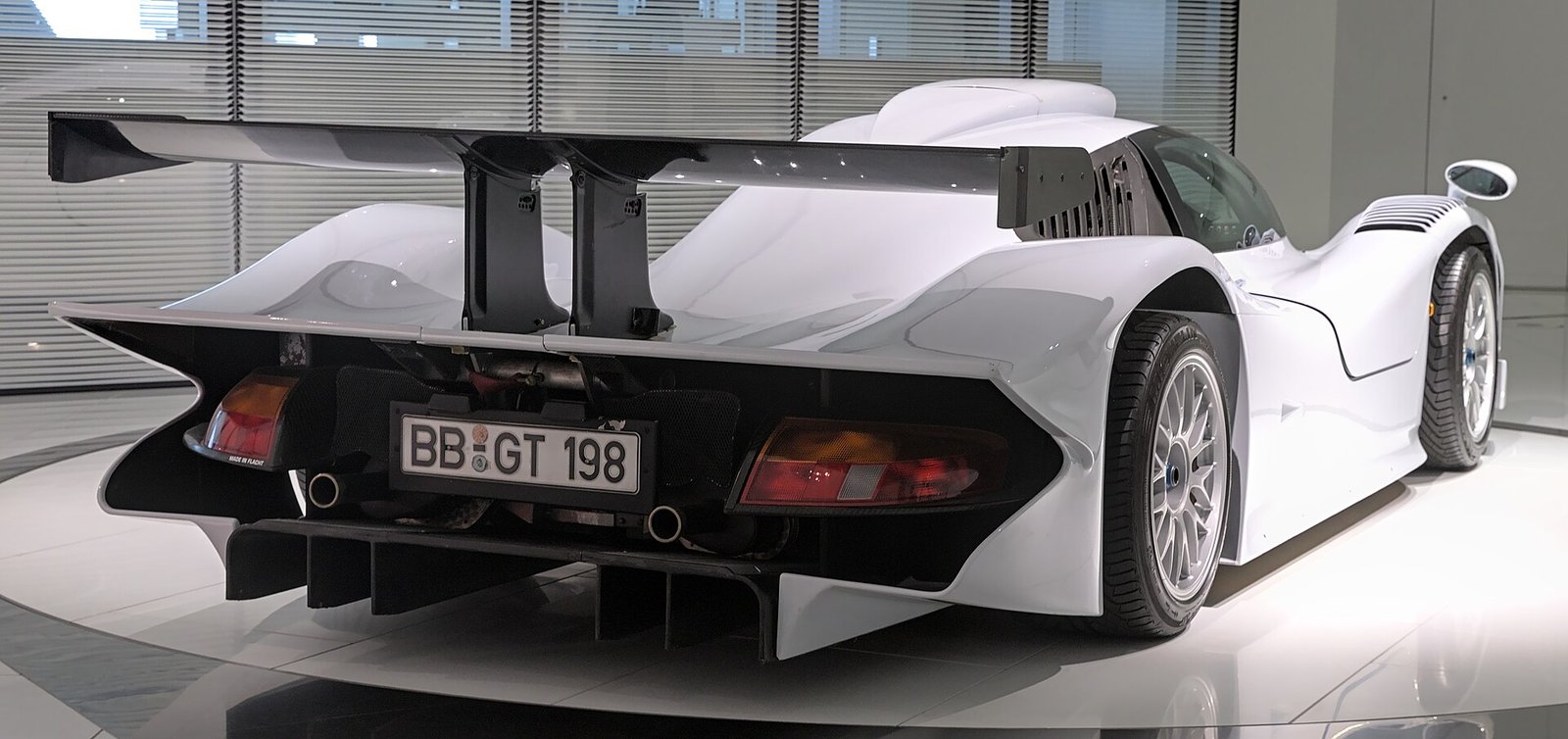
It’s a car you plan a drive around, not one you take to the grocery store. That’s part of why so many have covered so few miles.
The road cars today
GT1 Strassenversions almost never come up for sale. Most sit in collections in Europe, the Middle East and Asia. Every public sale makes news. The Amelia Island result of $5.665 million in 2017 set a record for the model at the time. Several race cars converted for road use by specialists have sold for millions of euros in Europe as well.
What does an owner get? One of the most extreme machines ever registered for the road. A luggage compartment that holds very little, visibility closer to a race car than a GT, cooling designed for racetracks, fuel consumption that would embarrass a pickup and a ride that tells you everything about the road surface. Also, the last time a major manufacturer played the homologation game this boldly. After the GT1 and its rivals, the rules for road versions were tightened, and the whole GT1 class collapsed after 1998 under its own costs.
Why it matters
The GT1 shows what happens when engineers read a rulebook as a map rather than a wall. The rules said "build a road car," and Singer built a race car with a passenger seat. The rules said "it has to pass homologation," and he reused the front of a 993 that already had. Today’s hypercars are developed the other way around: a road car first, with airbags, emissions systems and crash structures, and maybe a racing version afterward. That’s safer and more sensible. It’s also much less interesting.
There’s also an irony in the badge. Porsche spent decades defending the rear-engine 911 against critics who said the layout was a mistake. When it really needed to win, it built a 911 with the engine in the middle and kept only the name and the headlights. The engineers knew which layout wins races. Marketing knew which name sells cars.
The 911 GT1 is the monument to a short window when the rules were loose and the engineers were bold enough to drive a race car through the gap. That’s why one of them could sell in Florida for more than five and a half million dollars.
Porsche got a taste of its own medicine in 2001, when BMW built the BMW M3 GTR road car, a street M3 with a race V8, purely so it could beat the 911s in the American Le Mans Series.
Check you’re still alive.
Photos via Wikimedia Commons: 911 GT1 Strassenversion, Calreyn88 (CC BY-SA 4.0); 1996 911 GT1, Sicnag (CC BY 2.0); GT1 Evolution, MrWalkr (CC BY-SA 4.0); GT1-98 Strassenversion, Alexander Migl (CC BY-SA 4.0); 1998 Le Mans-winning GT1-98, Eduardo Parise (CC BY 2.0).