The Mad Max Interceptor was already dead before they shot it
The Ford Falcon XB GT 351 that Australia had killed off became the most recognizable car in apocalyptic cinema
An industrially extinct car, picked up second-hand for less than seven thousand Australian dollars at an auction in Frankston, modified by four guys in a Melbourne shop called Graf-X International who got paid badly and on time, fitted with a supercharger that roared on screen and didn’t even spin in real life. That’s Mad Max. That’s the Interceptor. And that’s what happens when an emergency-room doctor working night shifts in rural Queensland decides he’s seen too much blood on the asphalt and the only way to explain it to the world is to make a movie.
George Miller wasn’t a filmmaker when he started Mad Max. He was a doctor. He worked shifts at St Vincent’s in Sydney and at rural Queensland hospitals watching what a V8 without a seatbelt does to a human body at 100 mph. That experience — not imagination, not American cinema, not J.G. Ballard novels — wrote Mad Max. And to tell that story he needed a car. Not a movie car. A car the Australian audience would look at and recognize as both familiar and already dead.
The Ford Falcon XB GT 351 ticked both boxes.
The car you couldn’t buy anymore
You have to understand the Australian industrial context to understand why the Interceptor works the way it does. Australia, through the 1960s and into the early 1970s, lived its own muscle-car golden age. Ford, Holden, and Chrysler fought at Bathurst with road-going homologation specials that were essentially race cars with number plates. The Falcon GTHO Phase III of 1971 was the fastest four-door production sedan in the world in its day. 141.5 mph on real asphalt. 350 to 380 real horsepower from the 351 Cleveland. A road car that humiliated American contemporaries on a straight line.
Then came June 1972.
A journalist named Evan Green published a story in The Sun-Herald under the headline “160mph Super Cars Soon”. The article exposed that Ford was preparing the GTHO Phase IV, Holden a V8 Torana, and Chrysler a V8 Charger. Homologation cars you could buy at any dealership. Public outrage exploded. Transport ministers piled on. Insurance companies threatened to drop coverage. Within days, on June 30, 1972, all three manufacturers announced they were cancelling their programs. The “Supercar Scare”, they called it. Australia killed its own muscle-car golden age in a week.
Ford had already built four Phase IV units. Just four. The program was cancelled and what existed got sold off. The XA Falcon that arrived in 1972 had no Phase IV. The XB that appeared in 1973 — the Interceptor’s car — still offered a GT version with the 351 Cleveland, but it was a tamer animal than what could have been.
Then came the killing blow.
In July 1976, Ford Australia launched the XC Falcon. It was the first Falcon sold without a GT version since 1967. Almost a decade of Falcon GT models — XR, XT, XW, XY, XA, XB — and suddenly, gone. Cancelled. The reason wasn’t one thing. It was every thing at once. The Supercar Scare had set the political climate. The ADR27a emissions regulation came into force on July 1, 1976, the very month the XC launched, imposing far tighter limits on carbon monoxide, unburnt hydrocarbons and, for the first time, oxides of nitrogen. Meeting those numbers with a big carbureted V8 was a technical nightmare. And on top of all that, ex-Ford Australia stylist Wayne Draper said it plainly years later: insurance costs for the GT had become prohibitive. Selling a 300-horsepower car in Australia in 1976 meant handing the customer an insurance quote no customer would sign.
The XB GT was the last big-V8 Falcon GT Ford Australia ever built. 949 units total between 1973 and 1976. In the final year of production, 1976, exactly 125 units rolled off the line. Done. End of line.
The car Miller picked for Mad Max was, in industrial terms, a rolling ghost. When Mel Gibson shot the final sequence with the black Interceptor in 1978, that car had been discontinued for two years. You couldn’t buy a new one anywhere in Australia. It would never be built again. The choice was not accidental. Miller — and producer Byron Kennedy, and art director Jon Dowding — needed a car the Australian audience would see and immediately recognize as something that no longer existed. The whole country had given up on big muscle. Miller picked one of the last cars of that species and put it in a film about the end of the world. The metaphor writes itself.
The car they bought for less than a used Toyota
Here’s where it gets so NEC it hurts. Mad Max had a budget of 350,000 Australian dollars. About 300,000 US dollars at the time. That’s nothing. That barely covers a decent detergent commercial today. Miller funded part of the film working weekend shifts as an emergency-room doctor. He edited the picture himself in his kitchen while Byron Kennedy did the sound. Many of the extras got paid in beer. The biker gang in the film was a real gang — the Vigilantes — who had to ride to set every day in costume with prop weapons, carrying a letter from production explaining to whichever cop pulled them over that this was for a movie, please don’t arrest us.
In that context, buying a movie car was unthinkable. So Miller, Kennedy, and head mechanic Murray Smith went to a car auction in Frankston, Victoria. They bought three Australian cars: two Falcon XB sedans, both former Victoria Police vehicles, and a white 1973 Falcon XB GT Hardtop that had been repossessed in Dandenong for unpaid debts. Total for the three cars: under 20,000 Australian dollars.
That 1973 GT Falcon — Polar White, black vinyl interior, 351 Cleveland 4V “big-port” engine with a top-loader manual gearbox, one of only 86 “big-port” hardtops imported to Australia, and one of just six finished in Polar White — was the car that would become the most recognizable cinematic icon in 20th-century Australian culture. And it cost less than a Sydney apartment did that year. The irony: that same car today, in original unmodified spec, would be a six-figure auction lot. They had gold parked in their yard.
Why a Falcon and not a Mustang
This is the decision that separates the Interceptor from any other 1970s movie car. Because there was an alternative on the table, and they rejected it. The alternative was an imported American Mustang.
The Mustang in the 1970s was the default movie car. Bullitt in San Francisco. Eleanor in Gone in 60 Seconds. It was the muscle car international audiences recognized without explanation. If you’re a producer and you want to guarantee that a car reads as aggressive on screen, you put a Mustang in it and move on. It was the safe pick.
Murray Smith — the film’s head mechanic — explained why he killed that option with an argument that has zero glamour and a lot of workshop. An imported Mustang in Australia meant total logistical dependence. Parts took weeks to arrive from the United States. They were expensive. Any mechanical breakdown in the middle of a shoot meant halting production and waiting. And Mad Max could not afford to wait. Mad Max had a 350,000-dollar budget and a shooting schedule that couldn’t absorb an extra week sitting around for a crankshaft from Detroit. If the car broke on a Tuesday, it had to be running on Wednesday.
The Australian Falcon had no such problem. Any country garage in Victoria, New South Wales, or Queensland had Falcon parts. Cheap, accessible, abundant spares. Plugs, gaskets, hoses, crankshafts — all of it a day away, not three weeks away. And the wiring, the components, the Australian metric formats — everything was native. Nothing needed adapting.
That decision — picking the local car instead of the cool car — is what turns the Interceptor into something a Mustang could never have been. The Interceptor isn’t a car loaned by Hollywood. It’s an Australian car modified by Australians in an Australian workshop with Australian parts for an Australian film. What you see on screen is local product. Local product among the last of its kind. It had to be an Australian Ford. It had to be a GT. It had to be one of the last ones.
What they did to the car
Art director Jon Dowding designed the Pursuit Special drawing inspiration from a panel-van concept Peter Arcadipane had sketched in 1977. The idea was to convert a road car into something the audience would see and read as “police special, but not quite, something more”. A hybrid. A car that looks industrial but has clearly been built by hand. An object assembled in a workshop, not in a factory.
Dowding hired Graf-X International, a vehicle modification company in Melbourne, now defunct. Four men worked on the car: Ray Beckerley (general manager), Alan Hempel, John Evans, and a painter named Rod Smythe. What they did to the Falcon is what any enthusiast bodyshop guy in the 70s would have done to his own car if he’d had the money. And that’s exactly what makes it credible.
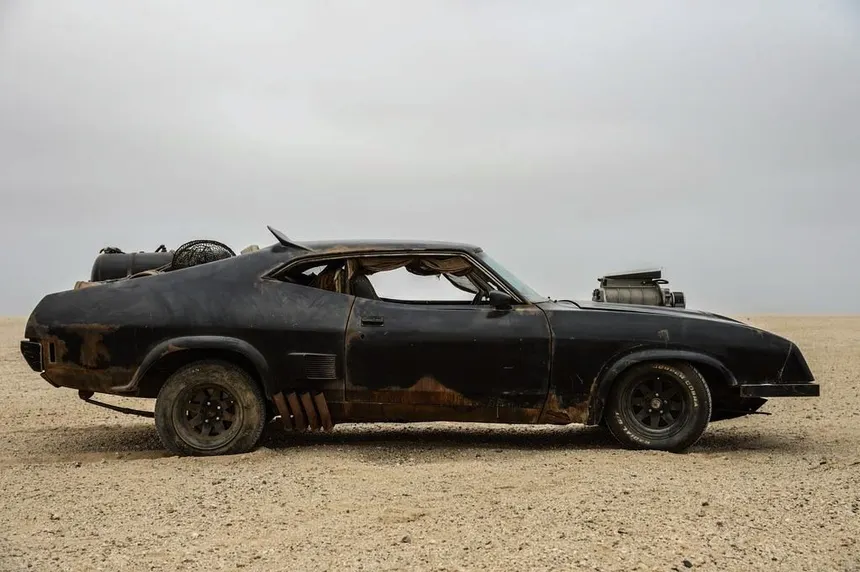
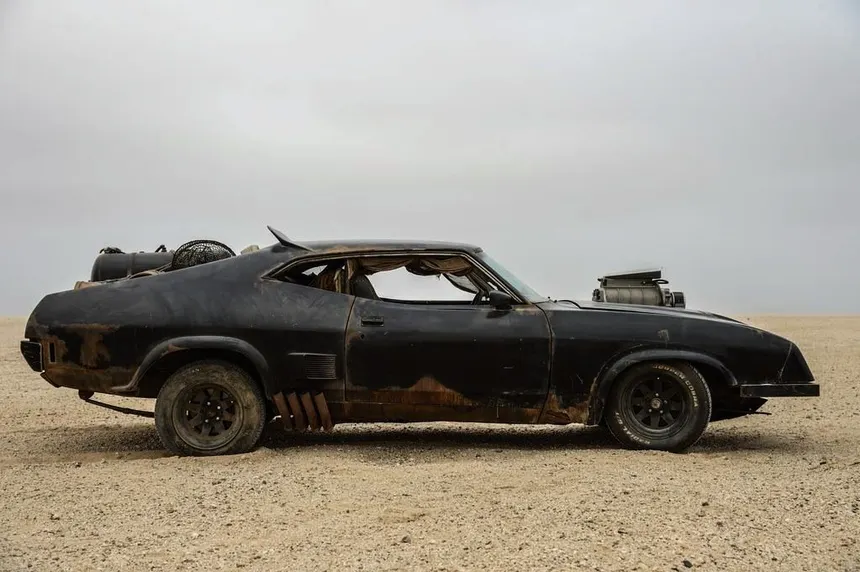
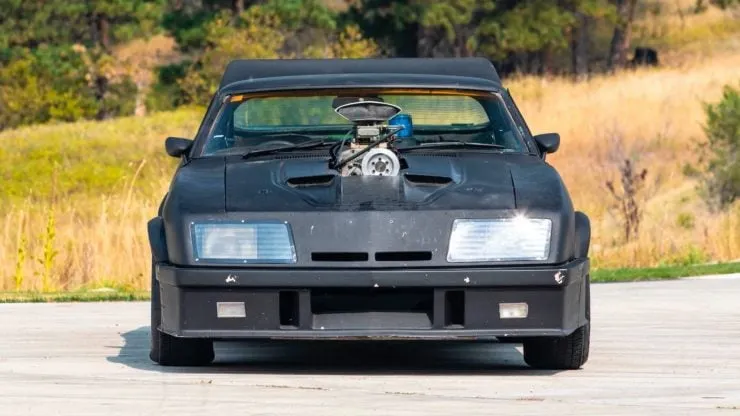
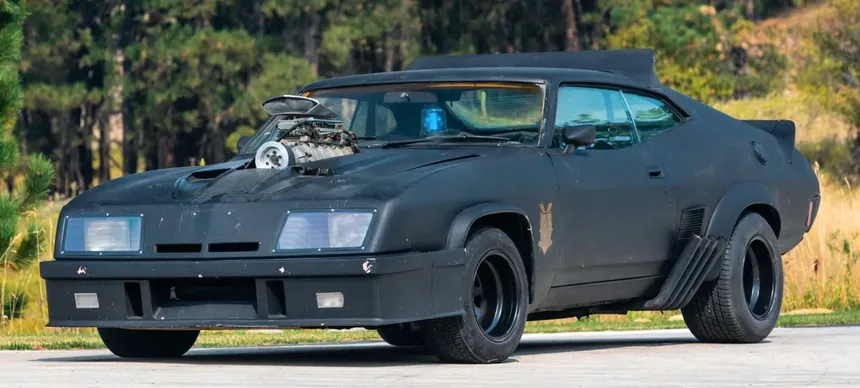
Matte black paint. Fibreglass arches over the wheel wells. A Concorde-style nose cone — a fibreglass piece that gave the front end a reptilian aggression. A boot spoiler. A roof spoiler. Deep aluminium wheels with road tyres. And two elements that need their own paragraphs.
The Weiand 6-71 supercharger. It’s the piece that visually defines the Interceptor. The blower poking through the bonnet, paddles supposedly spinning when Mel Gibson hits the clutch button before launching. Here’s the line nobody mentions: that supercharger didn’t work. It was a prop. A real supercharger can’t be switched on and off at will — once it’s belted to the crankshaft, it’s belted. There’s no clutch. What you see on screen is a mechanical lie that the audience accepts because the film carries you. The real Falcon ran naturally aspirated, 351 Cleveland 4V, around 300 gross horsepower from Ford Australia’s catalogue, four-speed top-loader manual gearbox, and that was it. No supercharger. No nitrous. Just a big V8 doing what big V8s do well.
The eight side exhausts. Four per side, sprouting from the engine and roaring under the doors. Of those eight, only two were functional. The other six were there for visual noise. Another mechanical lie. But it sounded brutal.
These two decisions — the fake blower and the six dead pipes — aren’t production failures. They’re editorial calls from the Graf-X workshop. They knew a real supercharger was impossible on the budget. They knew eight live exhausts would scream so loud the film’s sound recording would be unusable. So they faked what needed faking and kept real what needed to be real. The engine was a 351 Cleveland. The gearbox was a top-loader. The drivetrain did move the car. The rest, scenography. That mix — real hardware with fake cosmetics — is what separates the Interceptor from a conventional movie car. It isn’t a Batmobile. It’s a Falcon that two guys in Melbourne dressed up as a monster in six weeks.
How it was filmed
Miller had no money for cranes. No Steadicam. No proper stunt coordinator. He had the Falcon, a rented Panavision camera, and Victoria highways with no traffic control. The chase scenes in Mad Max — which forty years later are still standard reference in any action-film school — were shot with real cars driving for real on public roads with real bikers riding head-on at the camera.
The first Mad Max is a documentary disguised as fiction. And the Interceptor is the physical lead of that documentary.
The acceleration shots are the car accelerating. No fakery. The engine you hear is the real 351 Cleveland. The smoke off the tyres is real smoke off real tyres on real asphalt. There’s no effect. There’s no CGI — it didn’t exist. There’s no second-unit body double for Mel Gibson. It’s Mel Gibson, age 22, inside a heavy car with no electronic power assist, no ABS, no all-wheel drive, driving at whatever speed the camera and the producer told him to drive. That’s why the film works. What you see is what happened.
George Miller has said in interviews many times that his time in Queensland emergency rooms was the raw material of Mad Max. Australia had one of the highest road-traffic fatality rates in the world during the 1970s. Long straight roads, slack speed limits in some states, big V8s in young hands, alcohol, heat, immense distances. Miller saw the consequences every week. When he shot Mad Max, he wasn’t inventing a dystopian future. He was documenting an Australian present and pushing it forward by a few years.
The Interceptor’s second life
When Mad Max wrapped, the production — Kennedy Miller — couldn’t pay all its creditors. Mechanic Murray Smith had worked on the car for months and was owed money the company didn’t have. The solution was to give him the car. The Pursuit Special, the car that was about to become a global myth, was handed over to Smith as settlement of an unpaid invoice.
Smith tried to sell it. He asked 7,500 Australian dollars. He found no buyers. Owning that car in 1979 was a headache: it burned 10 dollars in petrol just to drive to work and back, parts were complicated, the modifications were so extreme that conventional mechanics refused to touch it. Smith stripped off the fake blower and the side exhausts, left the Concorde nose cone because it kept breaking when he moved it, and toured the car around shopping centres and car shows in Melbourne as promo for the film.
When Mad Max 2: The Road Warrior came in 1981, Kennedy Miller bought the car back or sourced an equivalent for the new shoot. This time the Interceptor wore two large cylindrical fuel tanks bolted to the rear, more weathered matte paint, no Concorde nose because the plot ripped it off. For the cliff-roll-and-explode scene, they used a duplicate. The original survived.
The real car, after Road Warrior, ended up at a wrecker in Broken Hill, deep in the New South Wales desert. From there it moved to another yard, Hilliers Auto Salvage, in South Australia. It sat for years in dusty back lots, parked between rusted chassis, bent bonnets, gutted engines from forgotten Australian cars. That should have been the logical fate for any modified Falcon XB GT from the late 70s — outback scrap waiting for a parts buyer or a final shredder. The difference is that this Falcon was the Interceptor. And nobody knew it. Or nobody said.
In the mid-1980s an Australian named Bob Fursenko found it. Bought it. Restored it. He fitted a new Concorde nose cone and air dam but kept the Mad Max 2 fuel tanks — because they were original, because they were history, because tossing them would have been like tossing a museum piece. The car everyone assumed had been destroyed had been sitting in a rural Australian back yard for years, waiting for someone to recognize it. When Fursenko finished the work, the Interceptor was the Interceptor again.
And here comes the trip no screenwriter would have written. That Falcon — built at the Broadmeadows plant in 1973, sold in Orange (New South Wales) to a customer who lost it to default, repossessed in Dandenong, sold again at a Frankston auction to a group of broke filmmakers, modified in a Melbourne workshop called Graf-X International, driven by Mel Gibson on Victoria highways, handed to a mechanic as payment for unpaid wages, abandoned at a Broken Hill scrapyard, rescued from another scrapyard in South Australia, and restored by an Australian collector in the 80s — eventually crossed the Pacific.
Today that Falcon lives at the Dezer Collection in Miami, Florida. A private collection of hundreds of famous film vehicles, 15,000 kilometres from the workshop that built it and 14,500 kilometres from the scrapyard where it almost died. A car designed for a film about the Australian desert, now parked in an air-conditioned warehouse in Florida, alongside Batmobiles and James Bond submarines. The Broadmeadows plant that built it shut down in October 2016 after 56 years of local production. Ford no longer makes cars in Australia. The big V8s that sat next to the Interceptor in that 1973 showroom are all history now. But the car still exists. It’s in Miami. You’ll see it behind a velvet rope.
It’s one of the few cases where the word “heritage” means something concrete. The Interceptor isn’t in Australia. Australia no longer has the factory that built it, the workshops that modified it, or the industrial ecosystem that made it possible. When that country needs to remember what kind of car it was capable of producing before they shut everything down, it’ll have to buy a ticket to Florida.
Why nobody has replaced it
Forty years after Mad Max, plenty of movie cars have aged badly. Plenty of mechanical characters no longer work on screen. The Interceptor still works because it operates on a layer that few cars reach: it’s both film prop and real industrial object at once.
Anyone can look at a Falcon XB GT and recognize the Interceptor. Anyone with money can buy one today and build their own Pursuit Special — there are entire clubs in Australia, Europe, and the United States dedicated to exactly that. The modification is replicable. The parts exist. The formula isn’t secret. And yet, no replica achieves what the original has. Because the original is a 1973 Australian Falcon, last of its line, built by Ford Australia, with a real 351 Cleveland engine, in an era when Australia still built its own big V8s. The day Australia stopped making Falcons — 2016, the Broadmeadows plant closure, the end of 56 years of local production — the Interceptor was automatically promoted from cinematic icon to historical document.
Mel Gibson didn’t know he was driving the last car of an era. George Miller probably did. He’d watched the end coming in real time from his emergency-room ward. He’d seen the wrecked XY GTHOs, the XB GTs that had run off the road, the rolled Holden Toranas. He knew something was ending. And when he made Mad Max, what he documented wasn’t just the violence of Australian traffic. He documented the end of a kind of car that the world would never build again.
The Interceptor isn’t a movie car. It’s the last photograph we have of an entire industry before they shut the door behind them.
Check you’re still alive.