Smokey Yunick: The Man Who Read the Rulebook Better Than NASCAR Did
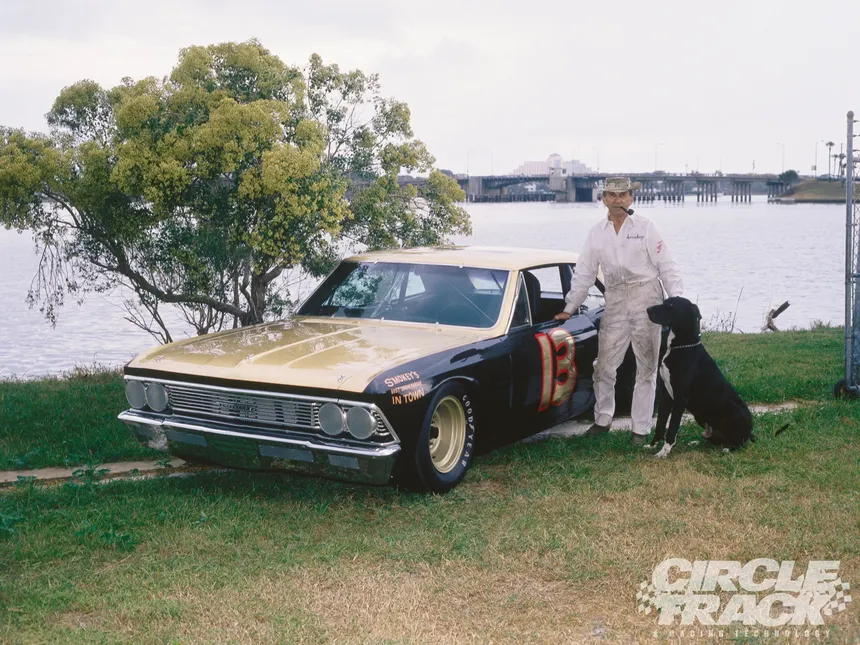
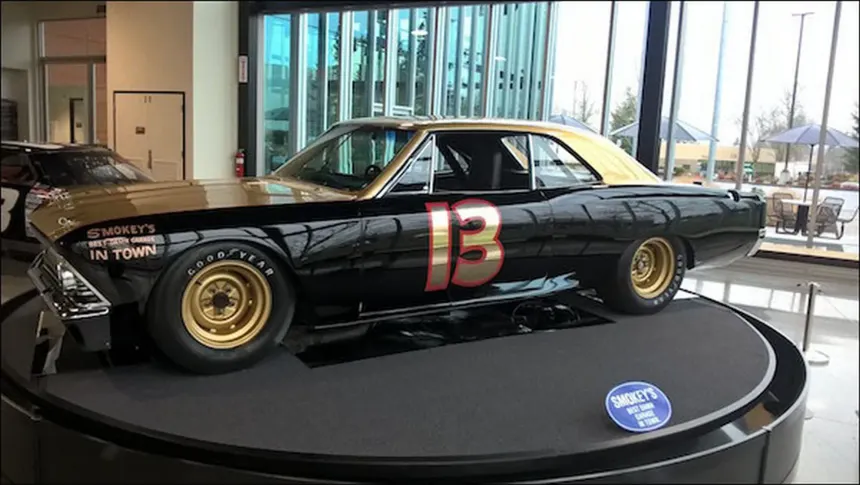
Daytona, February 1968. Joe Gazaway, NASCAR inspector, watches a skinny mechanic in a filthy hat and boots roll into the paddock with a black-and-gold Chevelle. Gazaway and his crew pull the fuel tank out to measure it. They find nine rule violations. They hand him the list.
The mechanic reads it, looks up, and says: “Better make it ten.” He climbs in, fires up the car, and drives it out of the paddock back to his shop — with the tank still lying on the ground behind him.
That story has been told in every NASCAR bar and forum for sixty years. Henry “Smokey” Yunick, the greatest cheater in American motorsport.
Most of the story isn’t true. And that’s the problem. Because the documented version is a lot more interesting than the myth.
A Pennsylvania farm boy who flew fifty missions
Henry Yunick was born in 1923 on a Pennsylvania farm to Ukrainian immigrants. No electricity, no money, and a childhood spent fixing whatever broke because nothing could be replaced. At sixteen he tried motorcycle racing. His bike smoked so badly that the other riders started calling him Smokey. The nickname stuck so hard he eventually had it made his legal first name.
The war pulled him out of the dirt. He enlisted in 1942, ended up piloting a B-17, and flew fifty missions over Europe. Fifty takeoffs not knowing whether he’d land. That kind of math rewires a man. It produces a specific flavor of calm — the kind that, decades later, makes NASCAR inspectors look like harmless hobby cops.
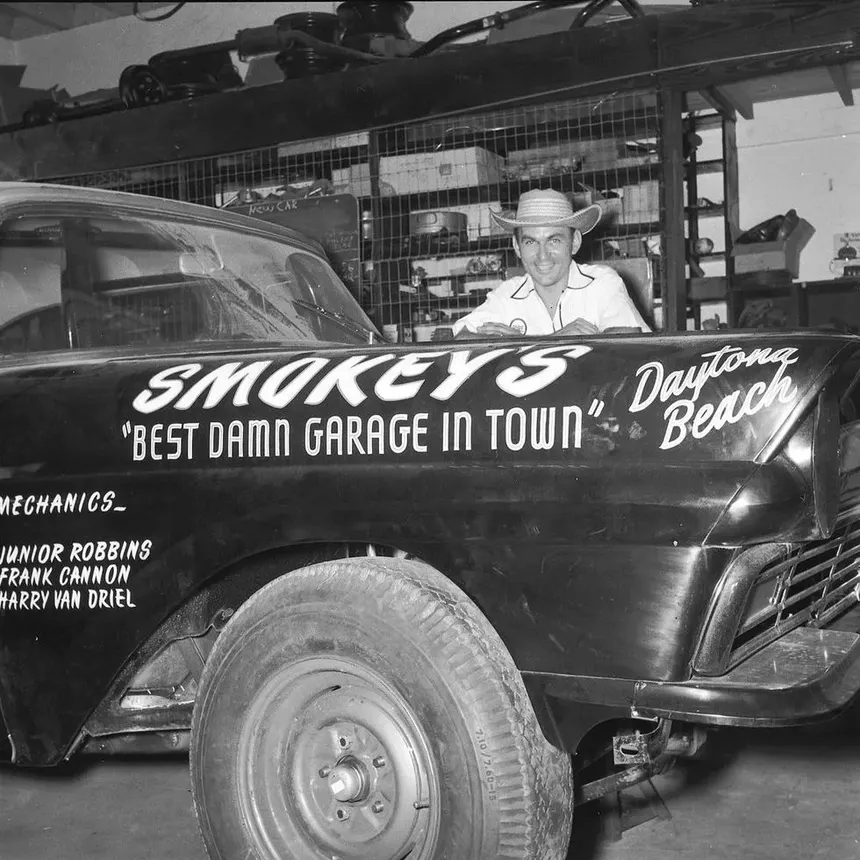
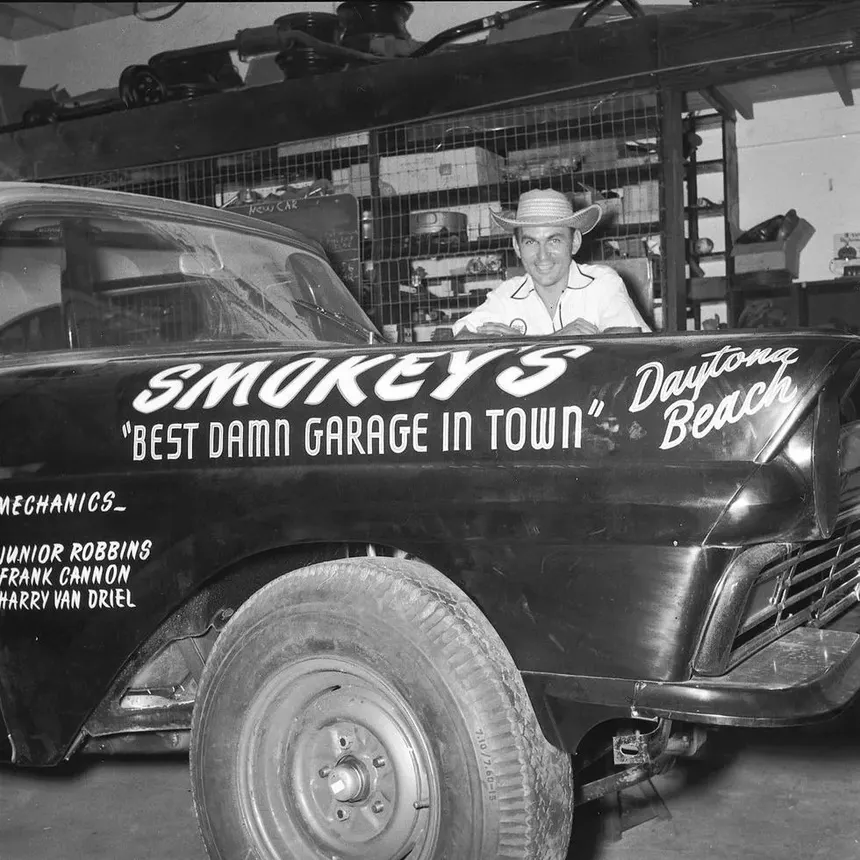
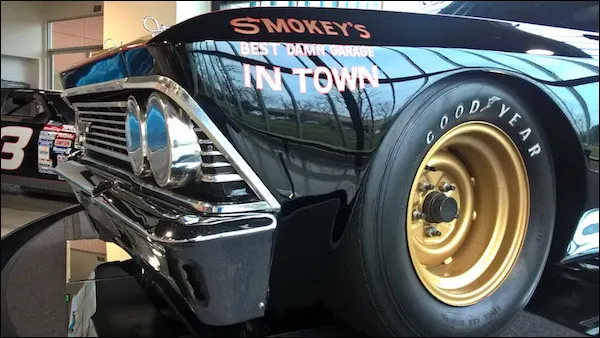
When the war ended, Smokey flew a training run over Daytona Beach and decided that’s where he wanted to live. In 1947 he opened a garage at 957 North Beach Street and gave it the name that would outlive him: The Best Damn Garage in Town. No false modesty. No marketing copy. If your car ran badly, bring it here. If it ran well and you wanted it to run faster, bring it here too.
The mechanic who made drivers win
Marshall Teague, owner of the first serious stock car team in Daytona, invited Smokey to join in 1951. Smokey had never built a race car in his life. He was handed a Hudson Hornet, given a driver named Herb Thomas, and told they needed to win the Southern 500 at Darlington that September.
Darlington in 1951 was a new track. An asymmetric oval that chewed tires and ruined setups. The big teams had been testing for months. Smokey had eight weeks. He built the Hudson in his shop, drove it to South Carolina, and Thomas won. That single victory launched Thomas toward his 1951 and 1953 NASCAR championships, and launched Smokey’s shop into something the rest of the paddock quietly feared. For the next twenty years, the waiting list for Beach Street never shrank.
But the story that really defines Smokey is the 1960 Indianapolis 500.
That year, Jim Rathmann drove a Watson Roadster prepared by Smokey and won the race in one of the most legendary duels ever run at the Brickyard, passing Rodger Ward in the closing laps. In the official record, however, someone else is listed as chief mechanic: a contracted shop manager named Takeo “Chickie” Hiroshima, hired by the team before Smokey arrived. After the win, every member of the crew signed a statement confirming that Smokey had done the real work. Rathmann refused to ask for the record to be corrected. Indianapolis never fixed it.
Smokey never brought it up again. He knew what he’d done. So did the drivers, and that was the currency he cared about. His cars would go on to win the Daytona 500 in 1961 and 1962, take four of the first eight superspeedway races at Daytona, and earn him two NASCAR Mechanic of the Year trophies. Junior Johnson, A.J. Foyt, Mario Andretti and Curtis Turner all came through his shop at some point. If you wanted to win, you went to Beach Street. Everything else was decoration.
The art of reading the rulebook better than the men who wrote it
Smokey had a line he used on journalists:
“In this sport there are only two kinds of mechanics. The ones who cheat and the ones who lose.”
He wasn’t talking about sneaking cocaine into the fuel. He was talking about something more refined. He was talking about reading.
The NASCAR rulebook of the 1960s was written by men who hadn’t thought of everything, because no rulebook ever does. It was a document trying to govern a sport that was reinventing itself every Sunday afternoon. Smokey understood, with more clarity than anyone else in the paddock, that a rulebook is a text. Every text has gaps. And the gaps are wide if you know where to look.
The most famous case is the fuel line. NASCAR specified a maximum tank capacity. Every team complied. But nothing in the rulebook specified the diameter or length of the line connecting the tank to the engine. Smokey fabricated an eleven-foot coil of two-inch diameter fuel line — not eleven meters, as some versions of the story insist — and routed it under the car like a metal snake. That single coil stored nearly twenty extra liters of gasoline. Perfectly legal. Just not in the tank.
That trick is what’s really behind the famous 1968 paddock scene. When the inspectors pulled the tank and handed Smokey the list, the car still had fuel stored elsewhere. Joe Gazaway told the story years later with less poetry than the legend usually gets: the tank Smokey had installed was so small it couldn’t have completed a full race. The gas was somewhere else. Smokey himself acknowledges in his autobiography that he had to add fuel to the car before driving it home. He didn’t drive off on fumes of legend. He drove off on linguistic engineering.
There’s an even cleaner scene. The rules said a team may cut out the Chevelle’s wheel wells for better aerodynamics. Smokey showed up with the wells completely intact. He qualified brilliantly thanks to the improved airflow. Then, only after the car was on the grid, he pulled out a grinder and started cutting metal in front of everyone. When the rival teams protested, he handed them their answer: “The rules say I may remove them. They don’t say when I have to remove them.”
That wasn’t cheating. That was reading.
The Chevelle that wasn’t seven-eighths scale
But the biggest Smokey legend isn’t a rulebook exploit. It’s a rumor about the dimensions of a car.
The story gets told in every NASCAR forum. It says that in 1968, Smokey built a Chevelle at seven-eighths the size of a production car — smaller, more aerodynamic, and waved through inspection as if it were stock. A scale model racing against real cars. The ultimate Smokey trick.
It isn’t true. Smokey himself debunked it in his Circle Track column in October 1987. In 2019 the Dinner With Racers podcast measured the actual car on camera with a tape measure: the dimensions are exactly what they should be. The rumor started when NASCAR, exhausted by Smokey’s creativity, built a physical template to verify the correct Chevelle silhouette. They used a crashed-and-rebuilt Chevelle as their reference, and the template came out wrong. It didn’t fit Smokey’s car. It didn’t fit any other Chevelle either. But “the template didn’t fit Smokey’s car” was a better headline than “the template was badly built,” and that’s the version that traveled.
What was real in those 1966-67 Yunick Chevelles was arguably more impressive than the myth. Flat floor. Chassis shifted to one side for weight bias on left turns. Windows flush-mounted with the body. The most advanced aerodynamics NASCAR had seen. With the first of those cars, Curtis Turner took pole position at the 1967 Daytona 500 and humiliated the heavily funded factory teams from Ford and Mopar. The second car was built for 1968 and never made it through inspection. That’s the one from the paddock scene.
Hot Vapor
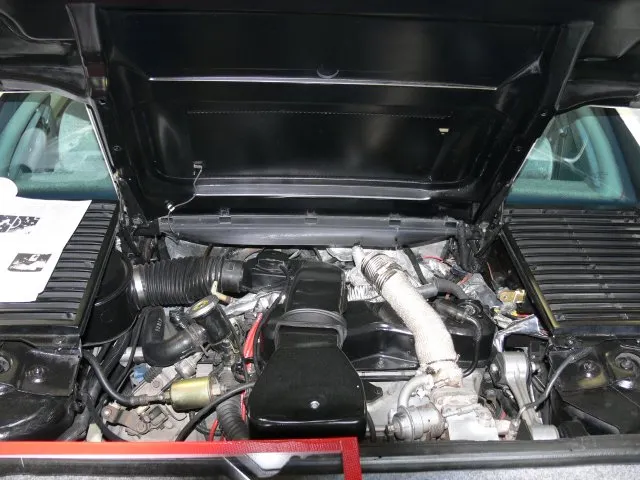
If Smokey had only been a rulebook manipulator, nobody would remember him today. What people don’t forget is his engine.
For more than thirty years, in secret, at the back of the Beach Street shop, Smokey developed an adiabatic-cycle engine he called the Hot Vapor. The concept was elegant. Conventional combustion engines waste enormous amounts of energy as heat that leaves through the exhaust. Smokey designed a system that recaptured that heat, used it to fully vaporize the fuel before it reached the cylinder, and homogenized the charge to a level that carburetors and port injection could only dream of.
He tested it on a 1984 Pontiac Fiero. The stock Iron Duke four-cylinder made about 92 horsepower from the factory. With the Hot Vapor installed, the same block put out 250 horsepower and 230 pound-feet of torque. The car hit 60 mph in under six seconds. It returned more than 50 miles per gallon. In a Fiero. In 1984. Without a single line of electronic engine code. Just a camshaft change inside the stock motor and a completely redesigned intake and exhaust system wrapped around it.
He demonstrated the engine privately to Ford, General Motors, Chrysler, BMW, Volvo, Volkswagen and John DeLorean personally. DeLorean offered twenty million dollars for the patent. The deal was almost signed when DeLorean got arrested in the cocaine sting and it collapsed. The others took notes, thanked him, and did nothing. A carburetor-less, electronics-less engine that doubled output and fuel economy didn’t fit Detroit’s post-oil-crisis industrial plans. The project went into a drawer. Smokey kept the final tuning secrets for himself. His daughter Trush put it plainly years after his death: Smokey was gone, and some of the secrets went with him.
After Fireball
Smokey’s other side started on July 2, 1964, the day Fireball Roberts died from burns after a crash at Charlotte. Roberts had been his driver and his friend. Fire, from that moment on, became an obsession.
Smokey developed the precursor to what we now call a fuel cell — a bladder tank borrowed from aircraft design that wouldn’t rupture and spray gasoline on impact. He brought it to NASCAR in 1970. Bill France Sr. said no. That was the final rupture. Smokey walked out of NASCAR that year and never came back.
In the 1980s he patented a soft-wall crash barrier design for ovals — a conceptual ancestor of the SAFER barrier system that now saves lives on every major American track. Over his career he filed at least nine U.S. patents: variable-ratio power steering, extended-tip spark plugs, reverse-flow cooling systems, a string of engine test instruments. For decades he wrote a column called Say, Smokey in Popular Science, where ordinary readers sent in mechanical problems and he solved them with two paragraphs and a hand drawing. He taught three generations of Americans how an engine actually worked from the inside out. Without a college degree. Without even a high school diploma.
The last cigar
Smokey closed The Best Damn Garage in Town in 1987, saying there were no more real mechanics left worth teaching. He kept working on personal projects until the cancer caught up with him. When a reporter asked in 2000 how he was handling the disease, Smokey said they’d diagnosed him with everything except pregnancy, that a month ago he’d taken all his medications and thrown them in the trash, and that he’d told his doctor he was done with the whole damn circus.
He died in May 2001 of leukemia, at seventy-seven. He’d specified in his will that the entire contents of the shop be auctioned off. He didn’t want a museum. He’d watched his friend Don Garlits struggle for years to keep one running, and didn’t want that fate for his own work. The tools were sold. The buildings were torn down. The one survivor burned in an accidental fire in 2011.
The NASCAR Hall of Fame, to this day, still hasn’t inducted him. The France family never forgave the public fights or the unfiltered opinions Smokey handed out freely. That’s a stain. A stain on NASCAR more than on Smokey. The Indianapolis Motor Speedway Hall of Fame inducted him. The International Motorsports Hall of Fame inducted him. And an eleven-hundred-page autobiography nobody has been able to refute — narrated on the audiobook by John DeLorean — holds the secrets he chose to tell and gestures at the ones he took with him.
What mattered most to Smokey was a phrase he used to describe the whole philosophy of his trade. Slipping a borderline-illegal car past NASCAR inspectors. Walking under a snake’s belly. Not flying under the radar. Walking under the belly. So close to danger you could feel the scales brushing your hat.
That wasn’t cheating. That was knowing, with forensic precision, where a rule begins and where it ends. That was reading the rulebook all the way into the margins. That was understanding, before anyone else in the paddock understood it, that a text written by humans always has a crack wide enough for an entire Chevelle to drive through.
The legend of Smokey Yunick says he was NASCAR’s greatest cheater. The truth is he was the finest engineer NASCAR ever had — and never learned how to honor.
Check you’re still alive.
2 thoughts on “SMOKEY YUNICK”