Aramco’s hybrid engine is a masterpiece. It’s also a trap.
You don’t expect this kind of news from Saudi Aramco. You expect it from Toyota. From Honda. From some stealth outfit in Stuttgart with a whiteboard full of equations. You don’t expect the world’s largest oil producer to walk into Detroit, hire a French race-engine shop, and quietly design the cleverest hybrid powertrain in three decades while half the industry was still arguing about whether electrification was even real.
But here we are.
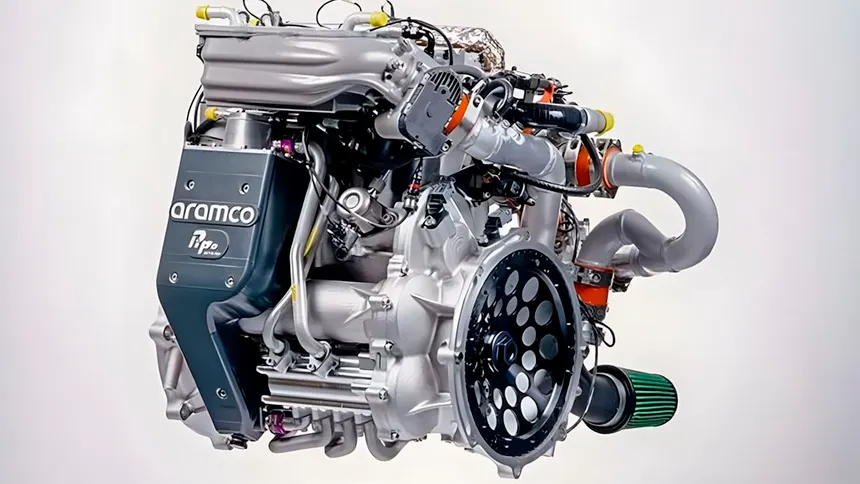
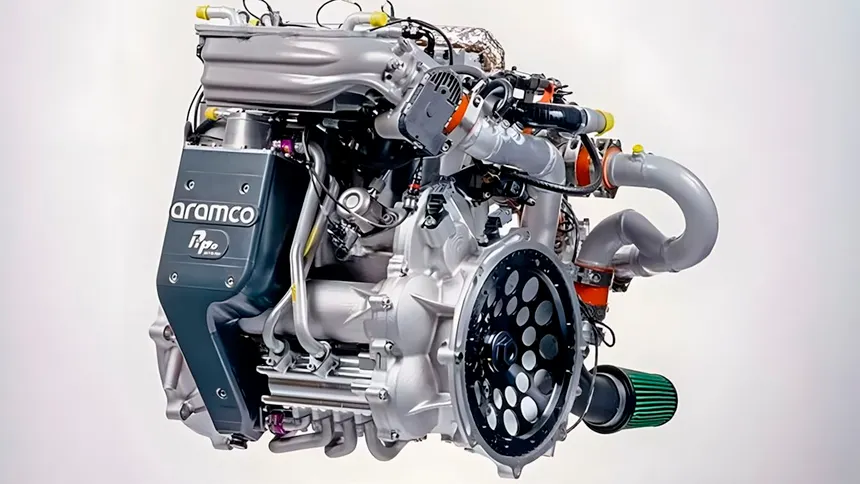
Aramco’s Detroit research centre has unveiled the Dedicated Hybrid Engine (DHE), a clean-sheet hybrid concept that finally asks the obvious question nobody had the nerve to answer: what would an internal combustion engine look like if you designed it, from the first line of the blueprint, to live inside a hybrid?
Toyota has spent nearly 30 years retrofitting non-hybrid engines into Priuses. Every hybrid you can buy today is a compromise — an engine born for one job, bolted to an electric motor and asked to do another. Aramco didn’t compromise. Aramco started from a blank sheet — with a transmission architecture more sophisticated than the Prius’s, and a combustion side simpler and cheaper than anything Toyota, Honda or Hyundai ships today.
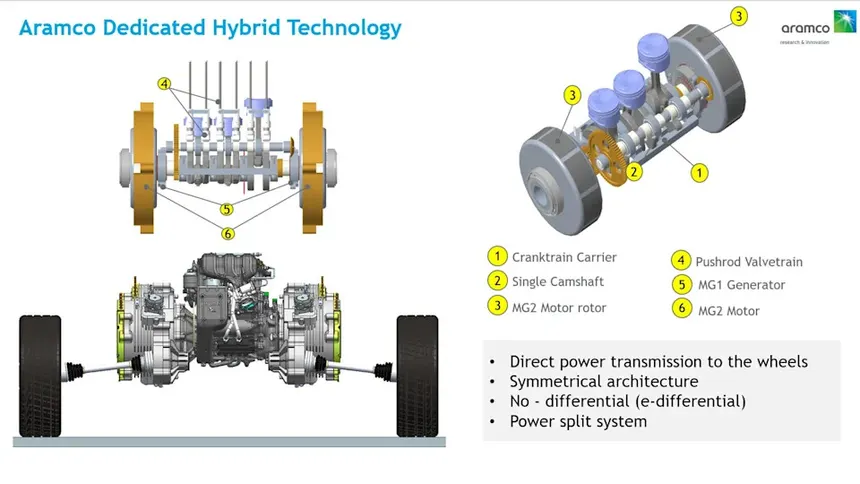
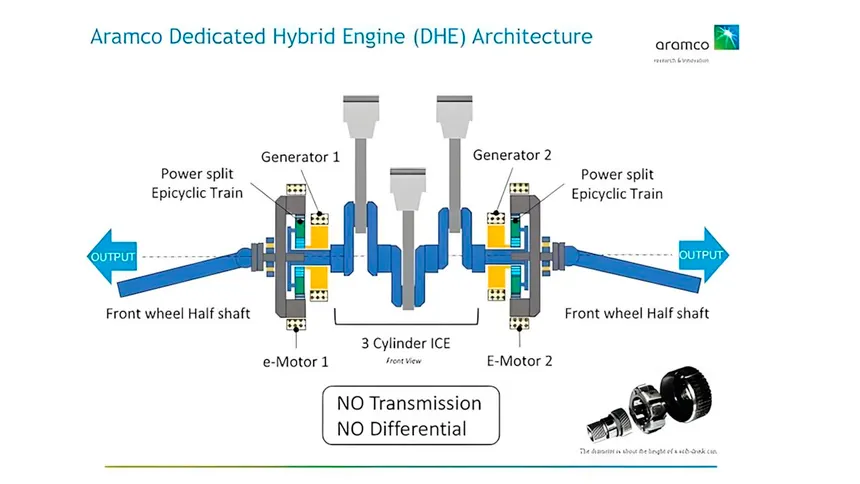
The result is a 1.6-litre naturally aspirated three-cylinder, mounted transversely, with one motor-generator sitting at each end of the crankshaft. And this is where the international press has consistently got the story wrong, so let’s tell it properly. Each end of the crankshaft connects to the planet carrier of an epicyclic gearset. The sun gear on each side drives a motor-generator. The outer ring gear connects to a primary traction motor geared to the wheel. In plain terms: the DHE is a power-split hybrid — what the industry also calls series-parallel, or e-CVT — but doubled up, with a full motor-generator-planetary stack at each side of the crankshaft.
This is not Nissan e-Power. This is closer to Toyota’s Hybrid Synergy Drive, served twice. As in a Prius, the car can be driven with the combustion engine running or off. The petrol engine can contribute mechanically to the wheels through the planetaries when it makes sense, sit there charging the battery when it doesn’t, or do both at once. The electronics make the call.
Why does that matter? Because a pure series hybrid like Nissan’s e-Power pays a real bill on the motorway: 100% of the engine’s output has to pass through the mechanical-to-electrical-to-mechanical conversion chain before it reaches the wheel. That’s losses — roughly 15 to 20% of the energy you generate, exactly when you’re asking the most from the powertrain. A power-split layout like the DHE’s sidesteps that double conversion: at cruising speed the engine can push the wheel directly via the planetary, bypassing the electrical bottleneck. That’s why Aramco picked this architecture over Nissan’s. It’s the cleverer engineering choice.
What’s genuinely new versus Toyota’s setup is that the DHE runs two motor-generators and two planetary gearsets — one each side — which lets it apportion torque independently between the left and right wheels. In other words, it acts as an electronic differential. And because each wheel takes its drive from a separate electric motor, there’s no mechanical differential, no gearbox, no clutch, no torque converter. Four heavy, expensive, fragile components that vanish from the diagram of a modern car.
Old tricks, exactly the right context
This is where the engineering gets cheeky.
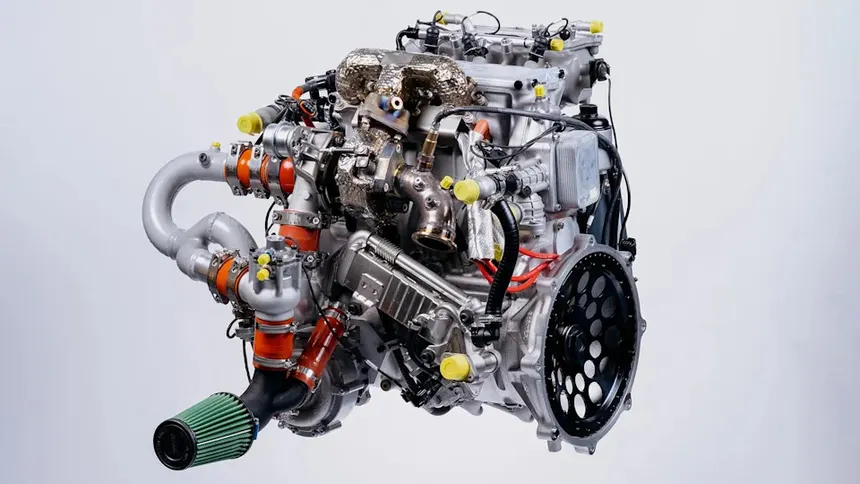
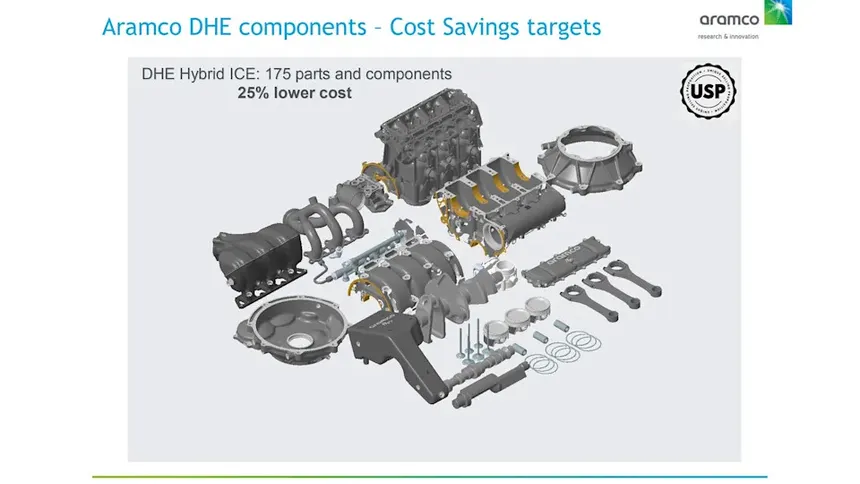
Because the engine only ever runs in a narrow rev band, Nayan Engineer (his real surname, for the record) and his team threw out half a century of accumulated complexity. The DHE uses a pushrod valvetrain. Two valves per cylinder. A single low camshaft. A monoblock casting that fuses head and block into one piece and deletes the head gasket entirely.
If a budget Chinese hatchback launched with these specs, the comment sections would catch fire. Pushrod? Two valves? In 2026?
Here’s the nuance a purist will throw at you, so let’s deal with it head-on. Pushrod engines genuinely have a high-rpm problem: the rods are heavy, they flex, and past a certain speed the valvetrain turns to chaos. That’s exactly why the Japanese moved to DOHC and four valves 40 years ago. But the DHE never sees the far side of 3,000 rpm. The problem pushrods are famous for simply doesn’t exist in this application. It’s not that pushrod is better — it’s that for this job, it’s enough. And “enough”, when the goal is killing cost, is revolutionary.
Toyota fits four valves because its engine has to perform up high too, in a non-hybrid car. Every bit of complexity in a modern engine exists because the same block has to serve ten applications. Break that chain and half the engineering textbook becomes optional. Aramco broke the chain.
They’re not the first to try. They’re the first to try the right thing
People have tried to reinvent petrol before. It’s worth remembering, because it teaches you something.
Mazda spent years chasing the holy grail of combustion — the SkyActiv-X, the first production petrol engine to fire by compression, a problem the industry had circled for two decades. Mazda actually cracked it. It reached showrooms. And it went almost nowhere, because it piled a cost premium of up to 27% onto the base engine for an efficiency gain the customer could barely feel. Decades earlier, Smokey Yunick — the most feared engine man in America — burned the 1980s on his “hot vapour” adiabatic engine, reclaiming exhaust heat and nearly deleting the cooling system. Legendary numbers on paper. A flop in the real world, because the metallurgy of the day couldn’t take it.
See the pattern? Yunick and Mazda both tried to reinvent how petrol burns. They attacked the thermodynamics, the combustion itself, the chemical heart of the engine. And both sank for the same two reasons: cost and reliability.
The DHE doesn’t make that mistake. It doesn’t touch combustion at all. The DHE’s cycle is an ordinary petrol engine’s cycle. What it reinvents isn’t how the fuel burns — it’s how much the whole system costs. That’s a revolution too. It’s just the one nobody had bothered to attempt seriously. Which is exactly why it might work where the others were buried.
Pipo Moteurs is the part nobody mentions
Most coverage of the DHE name-drops Pipo Moteurs in passing, if at all. NEC is going to put that name front and centre, because it tells you how Aramco actually thinks.
Pipo Moteurs is a small French shop in Le Pontet, near Avignon. They build engines for rally teams. For endurance teams. For the Dakar. They’re who you call when you need a one-off competition powerplant that survives 14 hours of abuse without letting go. They design, machine, assemble and bench-test everything under one roof.
Aramco could have hired anyone. AVL. FEV. Ricardo. The biggest names in engine consulting were one phone call away. Aramco picked Pipo. That choice tells you the brief was strange, that Aramco knew it was strange, and that they wanted a partner who wouldn’t murder the idea in the first PowerPoint slide. In Nayan Engineer’s own words, they wanted “engine people”. Not “industry-leading engineers”. Engine people. Anyone who’s had grease to the elbow understands the difference.
“25% cheaper” — cheaper than what?
Aramco says the system costs 23–25% less than a current hybrid. That’s the number every headline will grab. And it’s exactly the number NEC has to lean on.
First: it’s a figure modelled by Aramco itself, not measured on a real production line. A projection, not an invoice.
Second, and bigger: cheaper than what? Aramco compares against “standard hybrid systems” without naming one. Against Toyota’s Hybrid Synergy Drive? Against BYD’s DM-i, which was born cheap and already moves cars by the million? At what production volume — ten thousand units a year, or a million? Per-unit cost collapses with scale, and without that figure a “25%” doesn’t mean much on its own. The underlying logic holds — delete parts, delete cost, and they’ve deleted plenty. But until an engine is rolling off a real factory line, that number is a well-argued promise. Nothing more. And nothing less.
And let’s be straight: the DHE isn’t swimming alone. BYD has spent years selling series-parallel plug-in hybrids under its DM-i badge — Atkinson-cycle engines tuned hard for efficiency, priced low enough to make half of Europe’s industry sweat. Horse Powertrain, the company Aramco part-owns, already fields its X-Range family doing much the same thing. Aramco hasn’t arrived at an empty sea. It has arrived at a sea that already has sharks in it. What changes is the size of the new shark.
The verified numbers
- Displacement: 1,599 cc
- Configuration: inline three-cylinder, naturally aspirated
- Layout: transverse
- Valvetrain: pushrod, single camshaft, two valves per cylinder
- Construction: monoblock (integrated head and block)
- Stroke: long (efficiency-prioritised)
- Dry-sump compatible: yes
- Function: combustion unit integrated into a dual power-split transmission with planetary gearsets. Contributes mechanically to traction via planetary or acts as generator, depending on driving conditions.
- Estimated cost reduction vs current hybrids: 23–25% (Aramco modelling)
- Initial target platform: mid-size SUV
What you won’t read here, because primary sources don’t confirm it: the “175 parts versus a Prius” claim, or thermal efficiency figures of 41–42%. Those circulate in second-hand coverage but don’t appear in Aramco’s official release or Pipo’s. We don’t print numbers we can’t verify.
And now the part nobody tells you
Up to here, most outlets give you roughly the same story. This is where NEC parts company with the herd.
In December 2024, Aramco completed the purchase of a 10% stake in Horse Powertrain at a €7.4 billion valuation. Renault Group keeps 45%, Geely keeps 45%, Aramco takes the remaining 10%.
Horse Powertrain is the joint venture Renault and Geely created to consolidate every combustion engine in both groups under one roof. The engines in Renault, Dacia, Alpine, Nissan, Volvo, Lynk & Co, Polestar — and the third-generation Mercedes CLA, which runs Horse hardware under the bonnet. More than eight million engines and transmissions a year, for over fifteen carmakers. The biggest combustion-engine supplier the modern industry has produced.
Add it up. The world’s largest oil producer owns 10% of the world’s largest combustion-engine maker. And it has designed, on its own, the simplest, cheapest hybrid engine yet shown.
Still think this is an engineering story?
The witness isn’t NEC. It’s the CEO of Horse
Here’s what locks the whole thing down — and it isn’t our suspicion. It’s a public statement.
In April, at the Beijing motor show, Horse Powertrain’s CEO Matias Giannini opened his presentation with a number: by 2040, more than one billion combustion-engined cars will still be on the world’s roads. He said, in plain words, that hybrid technology is “a core solution for achieving net-zero, not merely a transitional technology”. Days later he went further, calling for hybrid engines to be standardised across manufacturers as a way to cut costs.
Read that again. The plan to keep the combustion engine alive into the 2040s and beyond is not a conspiracy theory NEC pulled out of a hat. It’s the business model the CEO of the company — the one Aramco owns 10% of — presents at a press conference, microphone in hand, in front of the whole industry. We’re not exposing a hidden plan. We’re repeating what they say out loud.
Horse itself, by the way, already sells its own family of solutions — the X-Range systems shown in Munich and Beijing — that do exactly what the DHE does: drop a combustion engine into platforms designed to be electric. Aramco’s DHE isn’t a lone project. It’s one more bet inside an ecosystem that is building, piece by piece, the guarantee that petrol stays necessary.
The trap
Lock the pieces together and watch what falls out.
Aramco sells crude. Aramco owns a slice of Horse Powertrain, which builds the engines that burn that crude. Aramco now has a cheap hybrid engine it will offer to anyone willing to license it. Aramco isn’t saving the combustion engine because it loves engines. It’s building, brick by brick, an industrial structure that guarantees cars still need petrol in 2050.
The chain: if hybrids are cheaper than EVs, people buy hybrids. If the cheap hybrid comes from Aramco’s system, manufacturers license it. If the engine is built by Horse Powertrain, Aramco takes a cut of the industrial pie. If the hybrid still burns petrol, Aramco sells the crude. Multiply by a billion cars over thirty years.
It’s brilliant. It’s legal. It’s exactly what you’d do if your country’s GDP rode on the barrel.
And it all works on one condition: Europe and China must NOT hit 100% electric by 2035. If full battery-electric wins, the DHE is left hanging. If it arrives late, Aramco wins the next three decades. Look at the delays to electrification targets, the amendments softening the EU combustion ban, the lobbying to keep e-fuels alive. Every one of those headlines plays into the DHE’s hand.
And as an engine? Is it good?
Yes. No catch. A strategic motive takes nothing away from the technical result — if anything, the strategy is what made the engineering this clean. Aramco doesn’t build cars. It has no engine-maker’s reputation to defend. It could design the exact engine for one narrow job and charge a licence to use it. That’s pure engineering freedom, the kind nobody inside a car company ever gets.
The DHE will probably cold-start better than any current hybrid. It will probably prove more reliable, with fewer parts to fail. It will probably be cheaper to maintain, and it will probably adapt to hydrogen or e-fuels more easily, because the architecture is fundamentally simpler. If this reaches production close to its current form, it’s a serious headache for any manufacturer that doesn’t license it.
The straight call
Good news or bad news for petrolheads?
On the surface, it’s fantastic. Petrol survives. The combustion engine reaches 2050 alive. Your next car might have a three-cylinder humming under the cargo floor while the battery does the pushing. We’ll take it.
Underneath, something smells. The global auto industry failed to reinvent the hybrid for 28 years, until an outsider walked in and embarrassed everyone. Toyota should have built this engine a decade ago. And the future of the car is no longer being settled in Stuttgart, Nagoya or Detroit. It’s being settled in Riyadh, where someone with deep pockets decided to hire an engineer named Engineer and set him loose on the rules everyone else treated as sacred.
The opening line told you this wasn’t an engineering story. Now you see it. It’s a story about who has the money to ask, out loud, the questions everyone else is too cautious to think.
The engine itself? Bloody marvellous.
Check you’re still alive.