
Peugeot 405 T16: the lion in sheep’s clothing
If you’re American and the words “Peugeot 405” mean anything to you, it’s probably one of two things. Either a slightly odd French sedan your neighbor bought in 1989 and cursed until 1993, or a mid-engined monster sliding sideways up a gravel road in Colorado while a Finn steers with one hand and shields his eyes from the sun with the other. The second one wore a T16 badge. So did a third car you almost certainly never heard of, because by the time it existed, Peugeot had already packed up and left the United States.
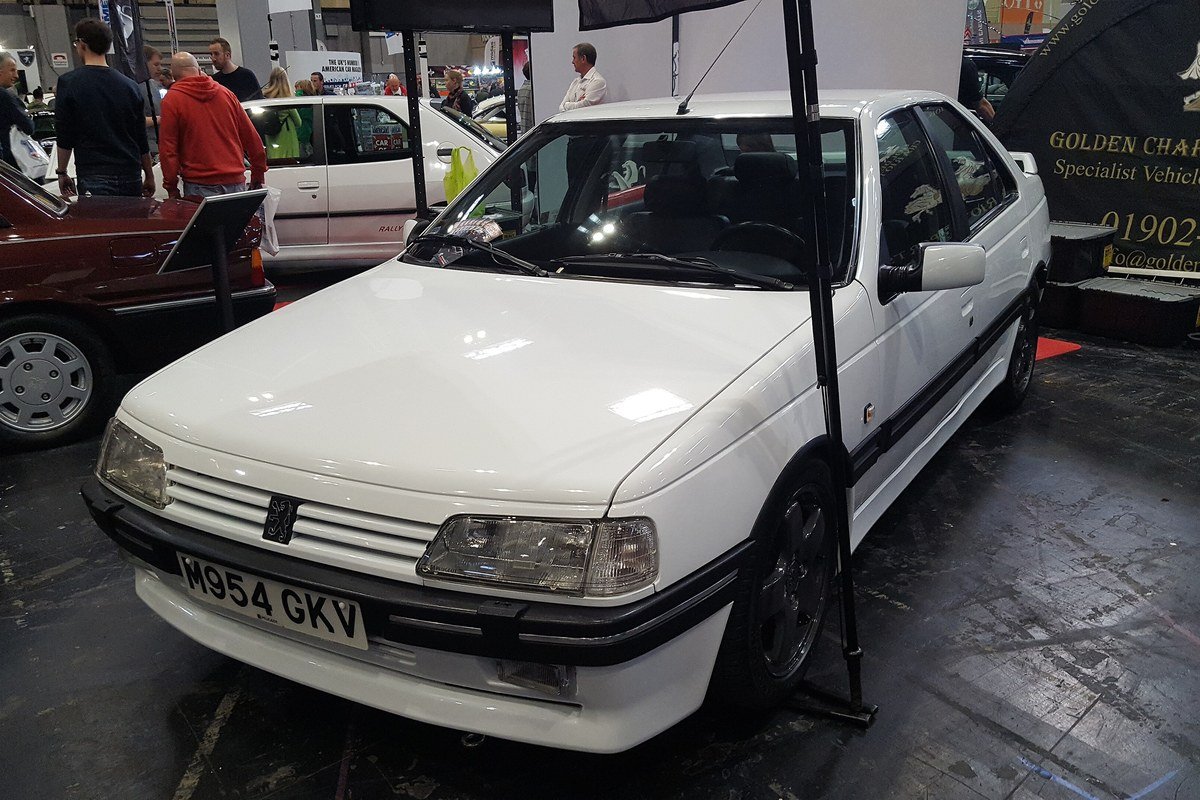
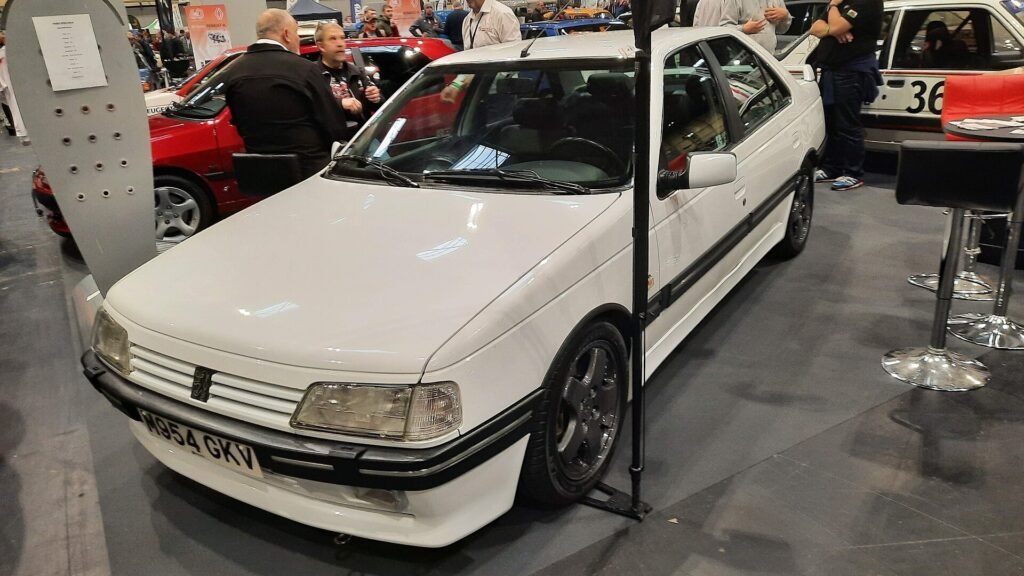
That third car is the one this story is about. A four-door family sedan with permanent all-wheel drive, a variable-geometry turbo, a water-cooled intercooler and a computer that handed you 20 free horsepower when you floored it. Peugeot built 1,046 of them. Not one was sold new in America.
Peugeot’s American exit, and what it missed
Peugeot’s US story ended with a whimper. The 405 arrived in North America at the end of 1988, sold as the 1.9-liter DL and S with 110 hp, a Sportswagon, and the Mi16, a 150-hp, 16-valve sport sedan that the car magazines liked a lot more than buyers did. Sales never took off. After the 1991 model year, Peugeot pulled out of the United States and Canada entirely.
Back in Europe, the 405 was doing much better. It had been styled by Pininfarina, and it won European Car of the Year for 1988 with the biggest vote tally the award had ever seen. By the early nineties, though, it was getting old, with its replacement, the 406, due in 1995. So Peugeot did what car companies rarely do with an aging model: instead of letting it fade, it built the wildest version of all.
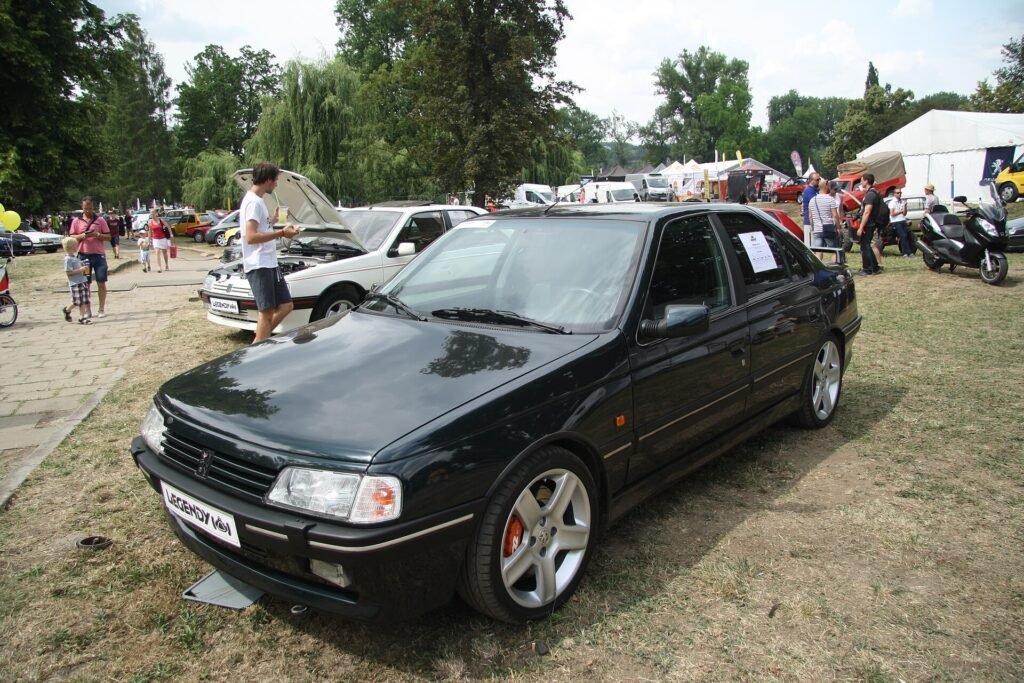
The T16 was unveiled at the 1992 Paris Motor Show, and the first customers got their cars in April 1993. If Peugeot had still been in the US, it would have been a 405 Mi16 with all the volume knobs turned up. Instead, Americans got nothing.
The badge that came down from the mountain
The name was no accident. T16 meant something in Peugeot’s world. It was the 205 Turbo 16 that had won the World Rally Championship in the mid-eighties. And it was the competition 405s that Peugeot Talbot Sport built after Group B was banned, mid-engined prototypes derived from the 205 T16 and wearing 405 bodywork.
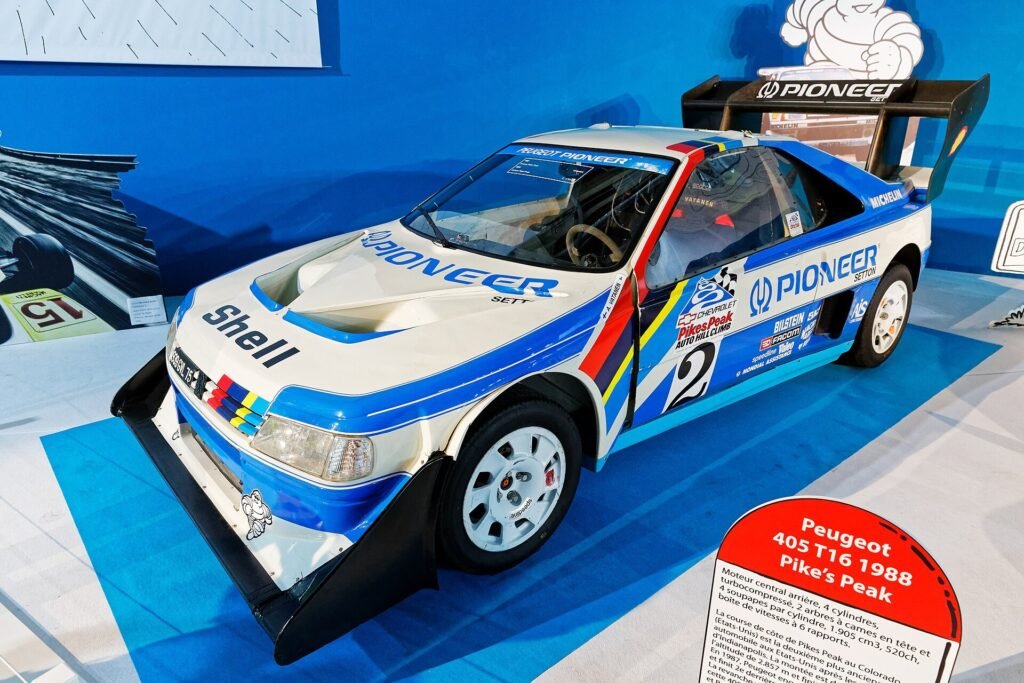
In 1988, Ari Vatanen took one of those up Pikes Peak in 10 minutes, 47.22 seconds, a course record at the time, and the run became Climb Dance, the short film that a whole generation of American car nerds watched on worn-out VHS tapes. In 1989, Robby Unser, from the family that basically owned that mountain, won it again in the same kind of car. The rally-raid version, the 405 Turbo 16 Grand Raid, won the Paris-Dakar in 1989 and 1990 with Vatanen.
There’s a Dakar story that tells you how wild those years were. In 1988, Vatanen was leading when his 405 was stolen overnight from the parc fermé in Bamako, Mali. It turned up later in a vacant lot, out of gas. He arrived late at the start control and was disqualified. A year later he won.
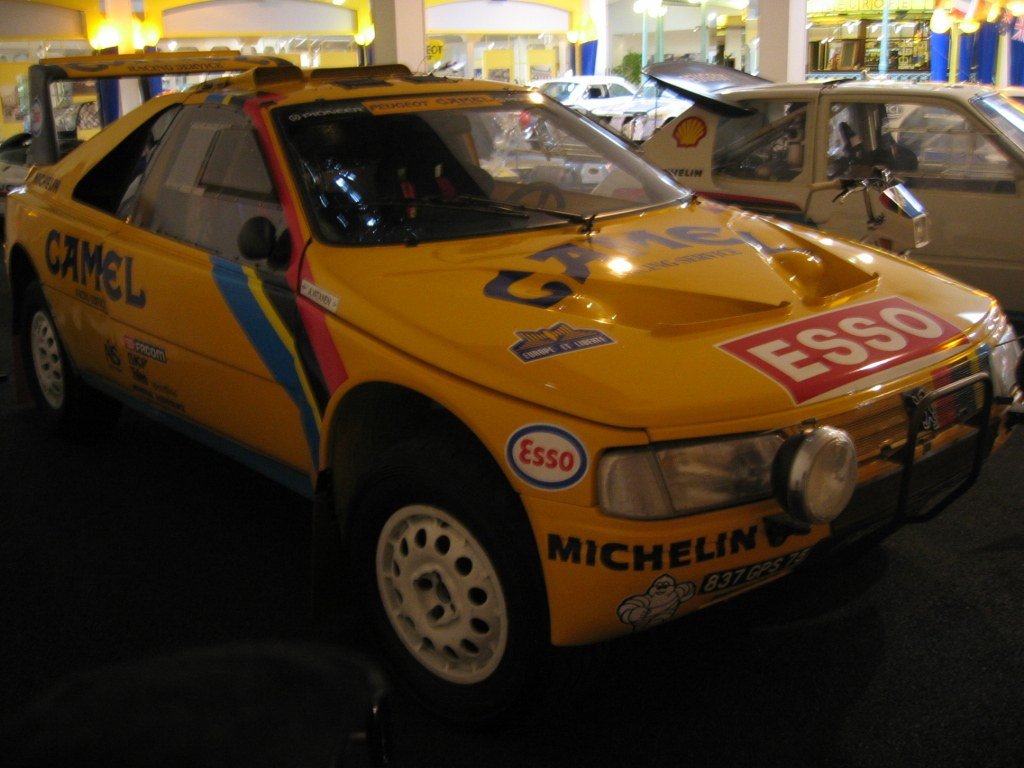
None of that hardware made it into the road car. The T16 sedan kept its engine up front and under a normal hood, with four doors and a trunk. What it took from the race cars was the name, and the attitude.
America’s own variable-geometry turbo got there first
Here’s a detail that should make an American reader smile. When people talk about variable-geometry turbos on gasoline engines, they usually start with the Porsche 911 Turbo of the 997 generation, launched in 2006, which was widely hailed as the first gas-engined car to get the tech. That claim deserves a raised eyebrow.
Nissan had a variable-nozzle turbo on its VG20ET V6 in the Japanese-market Cedric and Gloria in 1985. Honda put its Wing Turbo in the Legend in 1988. And in 1989, Carroll Shelby’s operation built around 500 Shelby CSX-VNTs, Dodge Shadow-based hatchbacks with a Garrett VNT-25 turbo on Chrysler’s 2.2-liter four. VNT stood for Variable Nozzle Turbine.
The Peugeot 405 T16 belongs to that small club. Its turbo was a Garrett VAT25, for Variable Area Turbine. Same supplier, same basic idea, a few years later, on a different continent. To be fair to Porsche, its system ran with much hotter exhaust gas and was a far more complex piece of engineering. But “first” is a big word, and a Shelby and a Peugeot sedan beat it to market by well over a decade.
How the VAT25 tricked turbo lag
A turbocharger uses exhaust gas, which would otherwise go out the tailpipe doing nothing, to spin a turbine. That turbine drives a compressor that forces extra air into the engine. More air means you can burn more fuel, which means more power from the same displacement. We break the whole thing down in how a turbocharger works.
The catch is turbo sizing. A small turbo spools fast but runs out of breath at high rpm. A big turbo makes huge power up top but takes forever to wake up. That delay between your right foot and the car responding is turbo lag, and engineers have thrown everything at it. We covered the whole arms race in turbo lag, variable geometry and twin-scroll.
Today’s diesel variable-geometry turbos use a ring of movable vanes around the turbine. The VAT25 used something cruder and cleverer: a single hinged flap inside the turbine housing that could swing through 28 degrees. Below 2,200 rpm the flap stayed closed, squeezing the exhaust through a narrow passage so it hit the turbine at higher speed and spun it up early. Above that, a pneumatic actuator, controlled by a solenoid valve that took orders from the engine computer, opened it gradually to let the full exhaust flow through. Small turbo at low rpm, big turbo at high rpm, one housing.
The engine: a Mi16 that went to the gym
The engine was the XU10J4TEZ, a 1,998 cc, 16-valve four-cylinder derived from the two-liter in the second-phase 405 Mi16. Peugeot didn’t just bolt on a turbo. It lowered the compression ratio, fitted forged connecting rods and sodium-filled exhaust valves (a trick borrowed from aircraft engines, where the sodium carries heat away from the valve head), and added coil-on-plug ignition and Magneti Marelli multipoint injection.
The other big change was the intercooler. Compressing air heats it, and hot air is less dense, so less of it fits in the cylinder. Most turbo cars of the day used an air-to-air intercooler, a radiator up front cooled by the wind. The T16 used an air-to-water unit: the charge air passes through a heat exchanger filled with coolant, which in turn sheds heat through its own radiator. It’s heavier and more complex, but it keeps intake temperatures steadier when you’re working the car hard. If you want the full comparison, it’s all in air-to-air vs water-to-air intercoolers.
200 horsepower, plus 20 on the house
In normal driving, the T16 made 200 hp (DIN) between 5,000 and 6,500 rpm, according to the spec sheet published by the French magazine L’Automobile Sportive, with 288 Nm (212 lb-ft) of torque at 2,600 rpm. Some sources quote 196 hp, which comes down to which measuring standard was used.
Then came the party trick. Floor it, and the engine computer triggered an overboost all by itself, with no button and no input from the driver. Boost pressure rose to 1.3 bar, about 19 psi (sources disagree on the starting point, with some saying 1.0 bar and others 1.1), and output climbed to 220 hp and 318 Nm, or 235 lb-ft, at just 2,400 rpm. It lasted a maximum of 45 seconds, and only if the intake air stayed below 80°C (176°F). That’s where the water-cooled intercooler earned its keep.
Think of it as a reserve tank of power for a pass on a two-lane road, a long highway on-ramp, or a hard corner exit.
The computer also held back boost in first gear to protect the drivetrain, which is why 0–62 mph took 7 seconds rather than less. Top speed was 235 km/h, or 146 mph. And there was no boost gauge on the dash, only an oil temperature gauge. You felt the overboost in your back, not on a needle.
All-wheel drive that needed no electronics
The T16’s drivetrain came from the 405 Mi16x4, beefed up. The five-speed manual gearbox was lifted from the Peugeot 605 V6, the company’s flagship, with shorter ratios. Behind it sat a transfer case containing an epicyclic center differential, a planetary gear set that splits drive between the axles in a fixed ratio, here 53 percent front and 47 percent rear. Alongside it ran a Ferguson viscous coupling.
A viscous coupling is two interleaved stacks of plates sealed in a can of thick silicone fluid. While both axles turn at the same speed, nothing happens. When one starts to slip and spin faster, the fluid heats up, thickens and drags the slower side along, pushing drive to the axle with grip. No sensors, no software, just physics. At the back sat a Torsen limited-slip differential, which sends torque toward whichever rear wheel has more traction.
Then there was a bit of family DNA. The rear axle carried a time-delayed electro-hydraulic ride-height corrector borrowed from Citroën, Peugeot’s sister brand inside the PSA group, so the car sat level whether it was empty or full of luggage. MacPherson struts up front, trailing arms out back, 283 mm vented front discs and 250 mm solid rears, which French testers felt lacked bite for a car this quick. Curb weight was 1,340 kg, or about 2,950 lb.
The rivals it ran with in Europe
L’Automobile Sportive placed the T16 among the turbocharged all-wheel-drive sedans that ruled early-nineties Europe: the Audi 80 S2, the Ford Sierra Cosworth 4×4, the Opel Vectra Turbo 4×4 and the Alfa Romeo 155 Q4. At home, its natural enemy was the Renault 21 Turbo, and on the road the Peugeot came out ahead. Against the Sierra RS Cosworth, it gave away straight-line pace. The Ford simply had more horsepower.
The most common complaint was the one the Mi16 had heard before: the chassis was better than the engine. That’s no shock from the company that built the 205 GTI, the car that taught a generation what a hot hatch should feel like.
Why almost nobody bought one
The price killed it first. In 1994 a T16 cost 217,000 French francs in France, serious money for a car that looked like a well-equipped 405 diesel. Buyers paying that much want people to notice. Nobody noticed the T16.
Timing was the second problem. It landed when the 405 was nearly at the end of its run, with the 406 already on the way. And the third was complexity. Thierry Houzé, who was selling Peugeots in 1996, wrote on his blog about a T16 that kept coming back to his dealership with a fault none of the mechanics could find. Nobody had been trained on it. Eventually an engineer had to come from the Sochaux factory, and it took months to track down the problem.
The production numbers tell the rest. Peugeot built 1,046 cars, plus four pre-production units based on the Mi16x4. Most were built in 1993 and 1994, and only 80 in 1995, the final year. France took between 395 and 397, and the rest were spread across Europe in small batches. It was never built with right-hand drive, so even British buyers missed out.
The French cops got ten
The T16’s best story is a police one. France’s Gendarmerie had tried the 405 Mi16 in 1989 for its Brigades Rapides d’Intervention, its highway pursuit units, and decided it wasn’t powerful enough. Those units were running Renault 21 Turbos.
In 1995, the Gendarmerie ordered ten 405 T16s. They became the first all-wheel-drive cars in the unit, painted blue with light bars, radio antennas and zebra stripes, and fitted with the Mi16’s cloth seats instead of the civilian leather and Alcantara. They served until 1998, when the smaller, less powerful Peugeot 306 S16 replaced them. One survives today in the Gendarmerie’s museum collection. Motor1 has put the figure at 46 cars, but the two French sources we checked, L’Automobile Sportive and L’argus, both say ten, and that’s the number we’re going with.
What to watch if you import one
The T16 is now old enough to come into the US under the 25-year rule. If you’re tempted, know where it hurts. The transfer case was reinforced over the Mi16x4’s but not enough. L’argus calls it “very fragile,” and hard driving breaks it. A T16 that’s been abused without an upgraded transfer case is a ticking bomb. The center differential can wear early, and the turbo and cast-iron exhaust manifold usually need attention after about 150,000 km, or roughly 93,000 miles. Timing belt every five years or 60,000 km. The engine itself is famously durable. Parts are the real headache: Peugeot no longer supplies many of them, and in a country with no Peugeot dealers, you’re on your own.
A car no spreadsheet would approve today
Look at the bill of materials: a heavily reworked engine, a variable-geometry turbo, a water-cooled intercooler, a dedicated all-wheel-drive system and a gearbox from the flagship, all to sell barely a thousand cars at the tail end of a model’s life. No finance department signs that today. Peugeot signed it in 1992.
It paid for it in sales. The T16 didn’t flop because it was bad. It flopped because it was late, expensive and invisible, and because the dealers who had to sell and fix it weren’t ready for it. In 2012, L’Automobile Sportive valued one at around €8,000. The few that come up for sale now cost a lot more, and the engine alone is worth a good chunk of the car.
What’s left is a five-seat Pininfarina sedan with a variable-geometry turbo more than a decade before Porsche got credit for the idea, an automatic overboost that handed you 20 horsepower without asking, and all-wheel drive that didn’t need a single sensor. And a body that still tells nobody what’s underneath.
Check you’re still alive.
Photos: Kieran White (CC BY 2.0), Jiří Sedláček (CC BY-SA 4.0), Kieran White (CC BY 2.0), Thesupermat (CC BY-SA 4.0), Arnaud 25 (public domain).