Citroën Hydropneumatics: Changed the Auto Industry Forever
The system a self-taught engineer designed in 1954, that Rolls-Royce and Mercedes ended up paying to license, and that Citroën kept in production until 2017
There are three ways to make a car absorb a bump.
The first, used by 99 per cent of the world’s automotive fleet: a metal spring (torsion bar, helical coil or leaf spring) stores energy as the wheel rises, and a hydraulic damper dissipates it. Cheap, robust, easy to build. Its physical limitation: linear stiffness. The more you compress the spring, the more it resists, but proportionally. Choosing a spring is always a compromise between comfort (soft) and handling (firm), and you can never have both at once.
The second, used by American luxury liners and a few sixties Mercedes: compressed air instead of a metal spring. An elastic bag full of air does the springing. Softer in general, allows self-levelling, very expensive. But shares with the metal spring the limitation of linear stiffness — the elasticity of air is also linear under normal conditions.
The third, invented at a desk in the Javel district of Paris around 1953, uses compressed nitrogen as the elastic medium, separated from the body of the car by pressurised oil rather than by a rubber bag. That apparently minor difference (nitrogen + oil instead of air + bag) changed suspension engineering forever.
That third path is called hydropneumatics. It was signed off by Paul Magès, a self-taught Citroën engineer, in 1954. It survived Citroën’s 1974 bankruptcy, the PSA absorption, the 2021 merger with Fiat to form Stellantis, and only officially left the Citroën catalogue in 2017 with the final C5. Sixty-three years in production. And during that time, Rolls-Royce paid a licence fee for it (1965), Mercedes-Benz paid a licence fee for it (1974), Peugeot used it (1990), Maserati used it (1974), Berliet used it on trucks, and the French Army used it on armoured vehicles.
This article takes the whole system apart. Sphere by sphere, valve by valve. No esotericism. No catchphrases. Just what’s inside and why it worked for so long.
Paul Magès: the engineer who joined Citroën at 17
The man who designed the most sophisticated suspension of the 20th century was not a qualified engineer. He was a self-taught mechanic who joined Citroën as an apprentice at the age of 17, in 1925, with nothing more than his hands. He spent a decade in the workshop floor before moving into the technical office.
Magès didn’t write theses. He didn’t publish academic papers. He doesn’t have a particularly developed English Wikipedia entry. What he has is a collection of patents and a technical system that, to this day, no company on earth has surpassed conceptually for the specific problem he set out to solve: how do you make a loaded car and an unloaded car behave identically over bumps?
In the forties, Magès started working on fluid-based suspension prototypes. The idea is simple on the surface: if the spring is a gas (not a metal), and the load is transferred by an incompressible liquid (not an elastic bag), you can adjust the car’s height by injecting or extracting fluid, without touching the spring itself. Height becomes independent of stiffness. Stiffness becomes independent of load. Each parameter is controlled separately. That’s where the magic begins.
The first commercial application arrives in 1954: the Citroën Traction Avant 15-6H (designated 15-Six “Hydraulique”) fits the system to the rear axle only, as a commercial test. The idea works. A year later, in October 1955, at the Paris Motor Show, Citroën launches the DS 19 with hydropneumatics on all four wheels, plus steering, brakes and gearbox actuation all powered by the same hydraulic circuit. The car is unveiled on a moving stage. And Magès himself is the driver. The elegance of the gesture is usually credited to chief designer Flaminio Bertoni, but on that evening at the Grand Palais the hero is the self-taught engineer from Javel.

The physical principle: why a gas solves what a metal can’t
Now the core of why the system works better than a conventional spring. Here a basic gas law has to be understood.
A coiled steel spring obeys Hooke’s Law: the force required to compress it is proportional to displacement. F = kx. Stiffness k is constant. Whatever you do to the spring, its behaviour is always linear. If you want it softer, you have to swap the spring entirely.
A compressed gas (nitrogen, in this case) obeys the Boyle-Mariotte Law: pressure times volume is constant at constant temperature. PV = constant. Which means if you compress the gas to half its volume, pressure doubles; if you compress it to a third, pressure triples. Stiffness is NOT constant. It’s progressive. The more you compress, the more it resists. And the curve isn’t linear: it’s hyperbolic.
That has spectacular consequences for a suspension. A gas-spring system absorbs small bumps with very little resistance (because it’s near its rest position) but stiffens automatically against large bumps (because the gas compresses more and pressure rises faster). That is: soft for small inputs, firm for large ones, with no electronics and no active mechanism. It’s the ideal stiffness curve for comfort and control simultaneously. That free progressive behaviour is one of physics’ biggest gifts to automotive engineering, and Magès was the first to cash it in serially.
The sphere: the heart of the system
The component that materialises this idea is the hydropneumatic sphere. Here’s the physical detail.
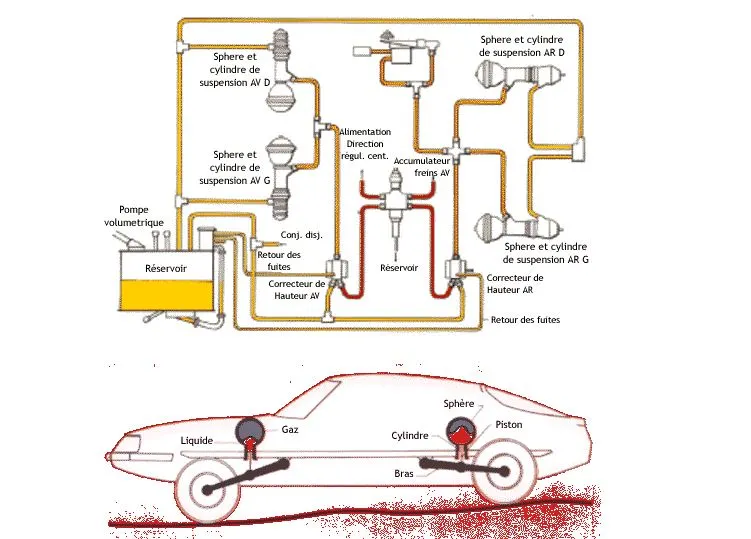
Each sphere is a metal vessel roughly 12-15 cm in diameter, divided internally by an elastic membrane (specialised rubber, varying by fluid) into two chambers:
Upper chamber: contains dry nitrogen at high pressure (between 35 and 65 bar depending on car model and axle position). Nitrogen is chosen for being inert, temperature-stable, and non-degrading to the rubber membrane. Not air: air carries oxygen and moisture, both enemies of elastomers.
Lower chamber: contains hydraulic oil under pressure (red LHS from 1954 to 1967, green LHM from 1967 onwards, orange LDS for the Hydractive system from 1990). The oil reaches the lower chamber through an orifice in the sphere’s base, connected to the suspension cylinder.
Membrane: separates the two fluids. When the suspension rises (because the wheel hits a bump), oil enters the lower chamber and pushes the membrane upward. That membrane compresses the nitrogen in the upper chamber. The gas compresses, stores elastic energy. When the wheel drops back down from the bump, the gas pressure pushes the oil back into the cylinder and the wheel returns to its position. Energy is released.
So far it’s a pure gas spring. The next piece converts that simple elasticity into actual suspension.
Damping by throttling
Oil flow between the suspension cylinder and the sphere isn’t direct. It passes through a calibrated orifice (on some spheres, two different orifices depending on flow direction) that acts as a damper. That is: when oil tries to move quickly, it meets a restriction that dissipates part of the energy as heat. When it moves slowly, the restriction barely matters.
What that means: the Citroën sphere is not just a spring. It’s spring AND damper in the same component. Damping is integrated into the hydraulic flow, not a separate part as on a conventional car (where you have a helical spring on one side and a telescopic hydraulic damper on the other). On Citroën hydropneumatics, those two elements are fused into a single vessel. This integration has consequences.
First: fewer moving mechanical parts per wheel. No damper rod sliding through a casing, no seals under variable pressure. Just fluid moving between two chambers. Mechanically simpler, fewer wear points.
Second: independent calibration of spring and damper. Change nitrogen pressure and you change stiffness without touching damping. Change the throttling orifice and you change damping without touching stiffness. Each parameter is independently tunable, which a conventional system can’t do without dismantling spring and damper.
Third, and this matters: damping is frequency-dependent. At low frequency (slow bumps, long road undulations) the orifice barely restricts and the system feels very soft. At high frequency (fast bumps, pavement-joint vibrations) the orifice restricts much more and the system aggressively dissipates energy. The car is floating on motorways and firm on cobblestones. No electronics. No active components. Just fluid physics.
The pump and the height corrector
So far the system would be passive: a progressive spring with integrated damping. What makes the Citroën system truly unique is the next layer: it’s actively pressurised. Enter the pump.
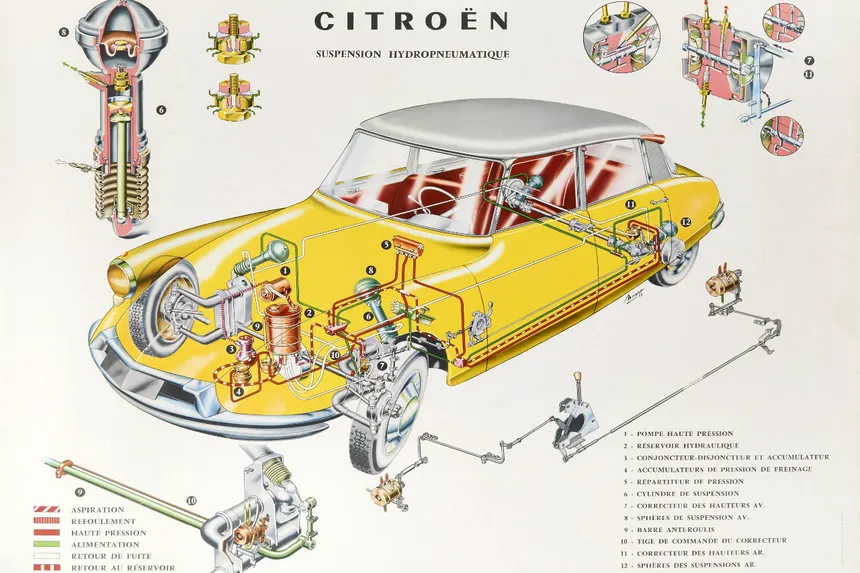
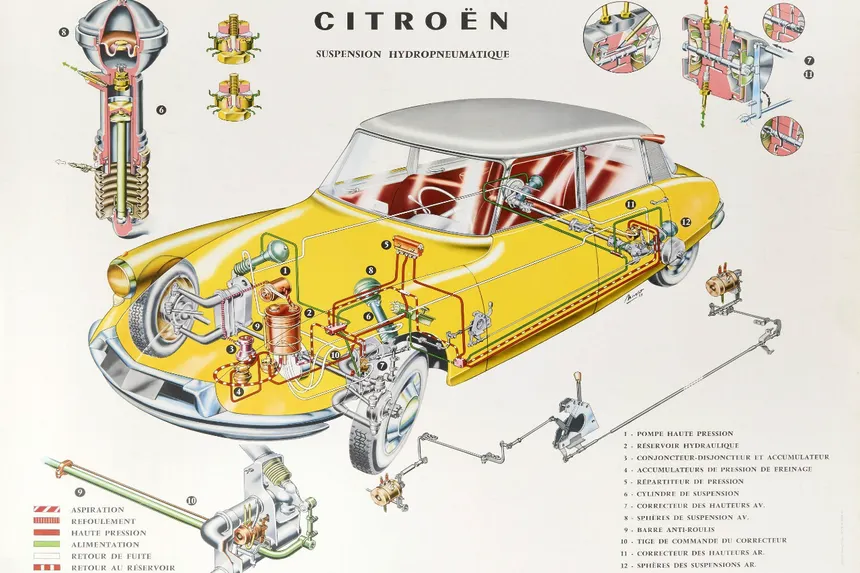
A piston hydraulic pump belt-driven from the engine (seven pistons in the classic DS, refined configurations in later models) generates continuous pressure of 175 bar in the main circuit. That pressure is stored in a central accumulator sphere (yes, another sphere, but this one isn’t a suspension sphere: it’s a pressure reservoir). From the accumulator, pressure feeds the four suspension cylinders, the brakes, the DIRAVI steering (in post-SM models), and the powered gearchange on DS models.
Why do you need external pressure if the gas spring already stores its own? For one thing only, but critical: self-levelling.
The system is connected to a part called the height corrector, mounted near the axle and mechanically linked to the anti-roll bar. The corrector detects whether the axle’s position relative to the chassis is correct. If the car sinks (because you load weight in the back), the corrector opens a valve that lets more oil in from the main circuit to the sphere’s lower chamber, pushing the membrane, compressing the nitrogen and raising the car until the corrector detects the correct height and closes the valve. If the car is too high (because you’ve removed weight), the corrector opens another valve that lets oil out of the sphere to the return reservoir, depressurising and lowering the car. Permanent dynamic balance.
The operational consequence is brutal: the car is always at the same ride height, whatever the load. Drop 700 kg into the boot of a CX and the headlight height doesn’t change. Bumper height doesn’t change. The wind-tunnel-tested shape stays the same. The headlight beam stays aimed at the same point. Weight distribution between axles compensates through each sphere’s internal pressure.
And as a bonus: with a dashboard control, the driver can manually raise or lower the car between five positions (on the classic DS: high for bad tracks, normal for road, low for motorway, and two extra positions for maintenance). The “max high” DS position let it drive over snow, mud or rocks. The “road” position gave 9 cm of ground clearance. The “maintenance” position allowed changing a wheel without a jack — the car lifted itself onto three wheels and the mechanic removed the fourth effortlessly. Each of these functions was simply unreachable for any rival.
The fluids: red, green and orange
The system’s chemical side deserves its own section, because it’s where Citroën fluffed it first and learnt later.
LHS (Liquide Hydraulique Synthétique), red, 1954-1967. Based on castor oil (vegetable) and alcohol derivatives. Citroën chose it because the rubber seals available in 1954 didn’t tolerate conventional mineral oils well. LHS was compatible with those rubbers and offered good cold viscosity. But it had a brutal flaw: it was hygroscopic. It absorbed moisture from ambient air. And the Citroën system, by technical necessity (fluid level in the reservoir rises and falls with car height), couldn’t be sealed hermetically. Air entered the reservoir. LHS absorbed that moisture. Moisture attacked internal metals and rubbers. The system corroded from within.
Old LHS-equipped DSs developed a reputation for mechanical fragility that stuck for decades. It wasn’t a conceptual design fault: it was chemistry’s fault. Citroën knew it.
LHM (Liquide Hydraulique Minéral), green, 1967 onwards. Inert mineral oil, non-hygroscopic, far more stable. To use it, Citroën had to redesign every rubber seal in the system (LHS rubbers were incompatible with mineral oil). From 1967, every hydropneumatic Citroën used LHM. And the corrosion issues disappeared almost entirely. The system’s reliability reputation rebuilt itself.
LDS (Liquide Dynamique Synthétique), orange, 1990 onwards, for the Hydractive models. Synthetic fluid specific to the electronically-regulated systems. Not compatible with LHM or LHS. Each generation has its own fluid. Mixing them by mistake degrades the entire system.
A maintenance detail few know: the three fluids carry distinct colours precisely so mechanics don’t confuse them. Open the reservoir and see green: it’s LHM. Red: LHS (probably a pre-1967 car). Orange: LDS (a Hydractive). The colour is code.
The licensees: when Rolls and Mercedes paid to copy
The system was so superior to anything the market offered that the major European luxury brands ended up licensing it. Few people tell this part of the story.
Rolls-Royce, 1965. The Silver Shadow debuted Citroën hydropneumatics on its rear axle, with self-levelling. Rolls-Royce paid an official licence fee to Citroën for use of the patent. A marque whose identity is built on “the best car in the world” had to publicly acknowledge that the world’s best suspension came from a French manufacturer that also sold farmer utility cars. The Silver Shadow stayed in production until 1980.
Mercedes-Benz, 1975. The 450 SEL 6.9 W116, replacing the 300 SEL 6.3, fit Citroën hydropneumatics under licence. Interesting detail: Mercedes adapts the system. The pump is driven by the M100 V8 engine’s timing chain, not by an external belt as in Citroën cars. And they use it only for suspension, not for brakes or steering (which stay conventional). For several years the 450 SEL 6.9 was the fastest saloon in the world (0-100 km/h in 7.4 seconds, 225 km/h top speed). And in 1978, it became the first production car in the world fitted with Bosch electronic ABS. Mercedes blended Citroën’s suspension with their own braking revolution. 7,380 units built between 1975 and 1980. The Citroën philosophy reached Stuttgart with official permission.
Berliet (French heavy trucks, later absorbed by Renault Trucks) used Citroën hydropneumatics on its heavy transport models in the seventies. The industrial application worked.
Maserati Quattroporte II, 1974. Stretched SM platform, full hydropneumatic mechanicals. The only Maserati in history with hydropneumatics and front-wheel drive. Only a few units were produced because Citroën went bankrupt and Maserati passed to De Tomaso before homologation was completed.
Peugeot 405 Mi16x4, 1990. With PSA controlling everything by then, Peugeot adopted CX hydropneumatics for the rear axle of the 405 Mi16x4. It was the only Peugeot with hydropneumatics in history.
Hyundai Equus / Genesis (second generation, 2009 onwards): adopted a variant of hydropneumatics derived from expired Citroën patents, marketed under another name. Not officially licensed, but conceptually descended from Magès’ work.
The evolution: Hydractive and the end
From 1989, with the Citroën XM, Citroën introduces Hydractive: the old hydropneumatics plus electronic sensors in steering, brakes, suspension, throttle and gearbox, plus a solenoid valve between the spheres that allows effective gas volume to be added or removed depending on driving mode. The driver picks between “sport” (firmer) and “auto” (softer), and the system manages transitions.
Hydractive 2 (1993, on XM and later C5): electronic refinement, more sensors, automatic transition between modes without driver input.
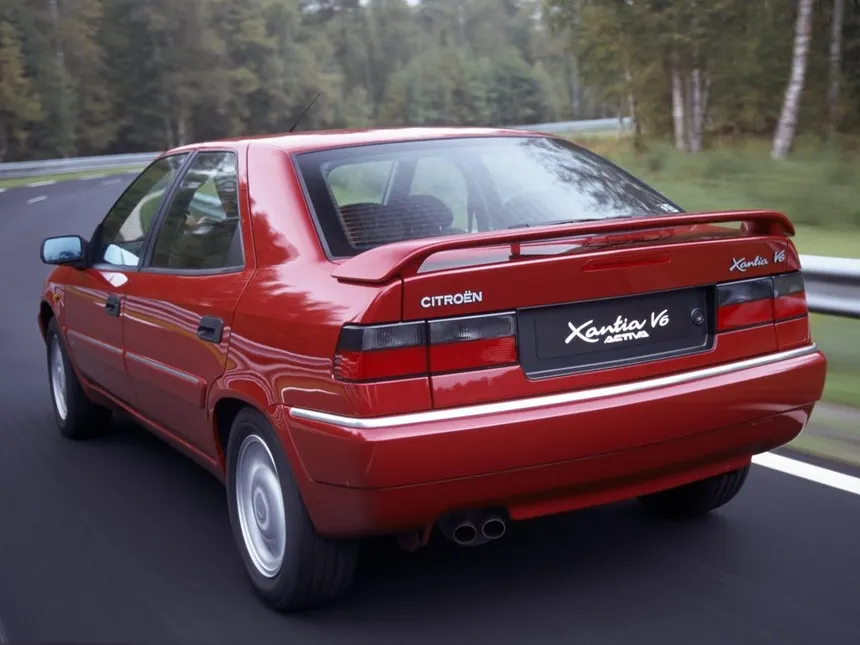
The Xantia Activa: the absolute peak
Before jumping to Hydractive 3, this deserves a full stop. Because in 1994, in parallel with Hydractive 2’s development, Citroën launched the Xantia Activa, and with it a version of the hydropneumatic system that represents the historical ceiling of the entire architecture: the first series-production road car in the world with active hydraulic anti-roll bars. This is the piece most general write-ups skip, and it’s precisely the one that most deserves to be remembered.
The system was called SC.CAR (Systeme Citroën de Contrôle Actif du Roulis, active roll control system). Architecturally, it was an extension of Hydractive 2 with two additional spheres and two hydraulic cylinders mounted on the front and rear anti-roll bars. In total, the Xantia Activa carried ten spheres: four suspension, one central accumulator, three Hydractive 2 (additional variable-stiffness spheres), and two from the SC.CAR system. Ten hydraulic spheres on a single family car.
The operating principle went like this. Three electronic control units monitored, in real time, road speed, steering angle, throttle position and body roll angle. As soon as the car entered a corner and body roll began to exceed 0.5 degrees, the computers sent fluid to the anti-roll bars’ hydraulic cylinders. Those cylinders pressed the body against the roll torque, actively stiffening the bars. In a straight line, the cylinders disengaged and the bars behaved like ordinary hydropneumatic suspension components (soft, comfortable, slack). In a corner, they turned into a rigid sports setup.
Result: up to 0.6 g of lateral acceleration, the car held body roll between −0.2° and 0.5°. Above that, roll rose to a maximum of 1° in the corner’s limit phase, a figure worthy of a track-tuned sports car. Lateral grip up to 1.2 g per manufacturer specification, with a reported 20 per cent grip increase over the standard Xantia. A French family saloon delivering supercar cornering figures without sacrificing straight-line comfort.
And here comes the figure that puts the Xantia Activa into a category of one in automotive history. In 1999, the Swedish magazine Teknikens Värld subjected the Xantia Activa V6 to its famous moose test (elgtest), an emergency lane change designed to simulate the sudden appearance of a large animal on the road. The test measures the highest speed at which a car can complete the manoeuvre without losing control or knocking down the marker cones. The Xantia Activa V6 cleared it at 85 km/h.
That record stood untouched for 26 years. No road car surpassed it from 1999 until 2025. No supercar matched it. The Porsche 911 (997) GT3 RS reached 82 km/h. Many later supercars have finished below it, including the McLaren 675LT, the Audi R8 V10 Plus, and various current models. In 2025, the Porsche Cayman GT4 RS Manthey finally beat it, after more than a quarter of a century. The Chinese Zhiji L6 has reported figures above 90 km/h under the updated testing procedure, but that’s contested. The Xantia Activa V6’s number, measured under the original protocol, remains the historical benchmark.
The point isn’t the record itself. It’s how it was achieved. No advanced traction electronics. No stability control. No advanced ABS. No active differentials. Only a hydraulic system controlling the anti-roll bars in real time. A French family saloon with a V6 engine beat German, British and Italian supercars because its hydraulics managed body roll more intelligently. Magès’ philosophy, thirty-five years later, was still teaching the class.
Xantia Activa production: barely over 18,000 units between spring 1995 and autumn 2001. Of those, fewer than 2,600 had the V6. That is, the car that held the world moose test record for 26 years was built in absurdly small numbers for its category. Two reasons: the system was expensive to manufacture, and official garages were expensive to run it through. When the SC.CAR fails, parts are scarce and repairs require specialists that are hard to find. Many surviving Xantia Activas in Europe still run because their owners are engineers or dedicated enthusiasts who know the mechanics in detail.
The Xantia (all versions, not just the Activa) was the last Citroën to use green LHM and the last to share a single hydraulic circuit for suspension, brakes and steering, in direct inheritance from the 1955 DS. It was designed by Bertone and built at the PSA plant in Rennes from December 1992 to 2001. Total Xantia production: 1,216,734 units. Replaced by the C5 in 2001.
After the Xantia Activa, Citroën never built another car with active hydraulic roll control. The decision was strategic: PSA chose to redirect research toward Hydractive 3, focused on comfort rather than eliminating roll. SC.CAR remained an isolated peak, with no successor, no continuation. One of those episodes where engineering reached the absolute ceiling and the industry, for financial reasons, decided not to keep climbing.
Hydractive 3 and the end
Hydractive 3 (2001, on C5 and later C6): the most radical change. Permanent central pressure disappears. The system pressurises the circuit only when it needs to, reducing consumption and mechanical wear. The gas-spring philosophy and the self-levelling stay, but the pump no longer runs continuously.
Hydractive 3+ (2005, C6 and last C5 evolutions): final iteration. Refinement over Hydractive 3 with more dynamic adaptation capacity.
And then, in 2017, it ends. Citroën officially retires the last hydropneumatic car from the catalogue (the C5 II in its final series). The official reason is commercial: the system is expensive to manufacture, requires specialist maintenance and, crucially, current buyers don’t perceive a difference compared to a well-calibrated conventional suspension with electronic adaptive dampers. The real reason: PSA, soon to be integrated into Stellantis, couldn’t justify maintaining a technical architecture that applied to only one corner of the catalogue and that was being developed in parallel to the common Peugeot-Citroën-Opel platforms.
Sixty-three years in production. Zero conceptually equivalent rivals. The end was not a technical defeat: it was an industrial decision.
Why hydropneumatics still matters
There’s something interesting about this system beyond nostalgia. Worth closing with.
Citroën hydropneumatics is one of the few examples in automotive engineering history where a single physical principle solved five separate problems simultaneously: comfort, self-levelling, adjustable height, integrated spring-and-damper, and pressure sharing with other car systems. Modern electronic adaptive dampers solve comfort. Modern air suspensions solve self-levelling and adjustable height. But they do it as separate problems, each with its own electronics, sensor and actuator. Hydropneumatics solved all of them at once, with physics, with chemistry and with geometry, without a single transistor.
That design elegance — solving separate problems with one coherent idea — is what contemporary engineering is losing. Today, every function in a car has its own independent system, its own ECU, its own CAN bus, its own actuator. The modern car is a collection of point solutions. Hydropneumatics was a design philosophy: one hydraulic circuit doing everything.
That’s why Paul Magès’ system deserves a fresh look every now and then. Not as a relic. As a reminder that well-applied complexity can be simpler than badly-applied simplicity. One pump, one accumulator, four spheres, one corrector, one fluid. Five main components to solve what today takes fifty sensors and a fibre-optic cable.
And the whole thing was signed off by a self-taught mechanic who had walked into Citroën at the age of 17 with empty hands.
Check you’re still alive.