The GT That Sank Citroën and Took Maserati Down Too
Citroën SM: how an Italian V6, a steering system that wouldn’t talk back, and a French manufacturer’s ambition turned the most advanced Grand Tourer of its era into the most expensive industrial bill in seventies European motoring
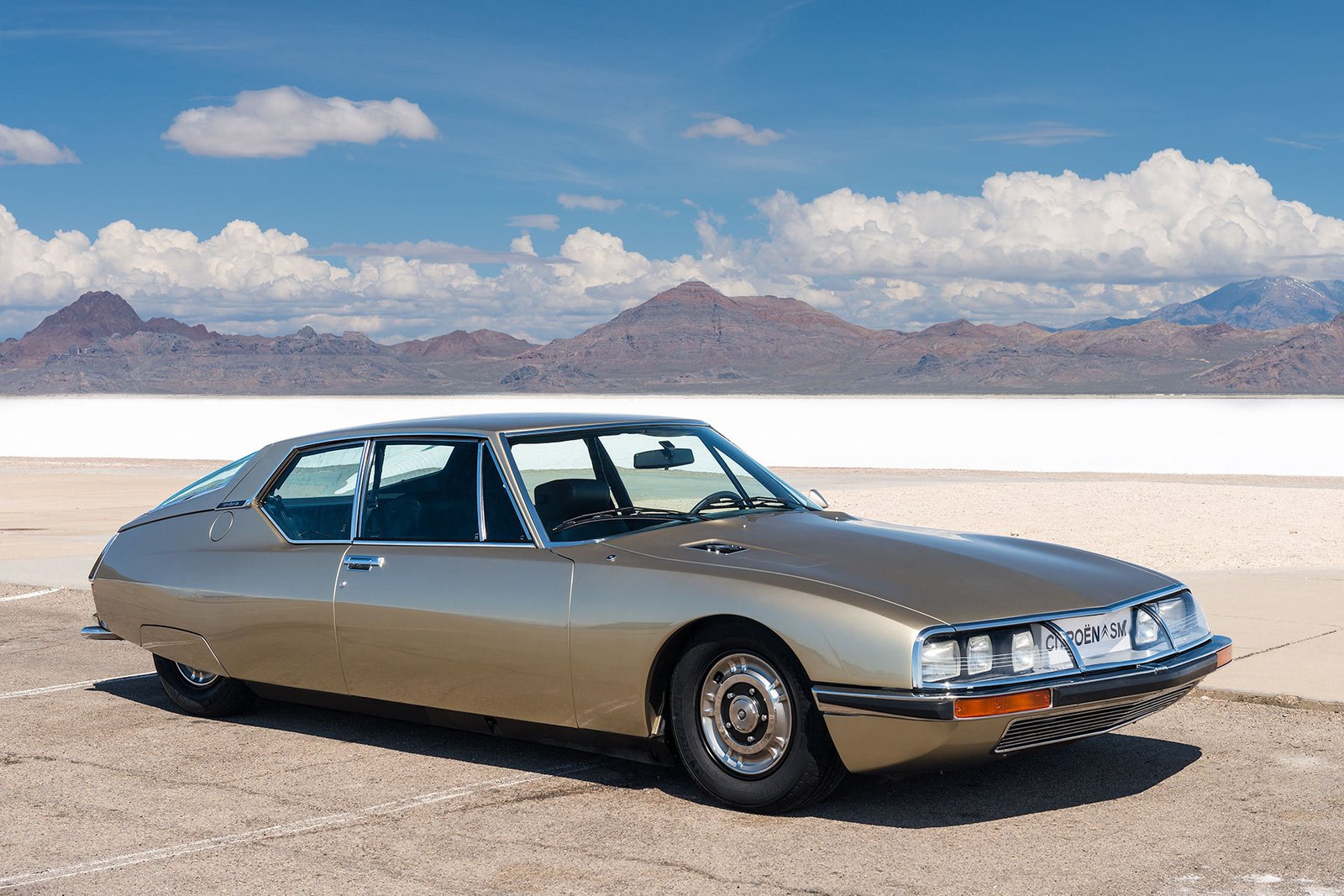
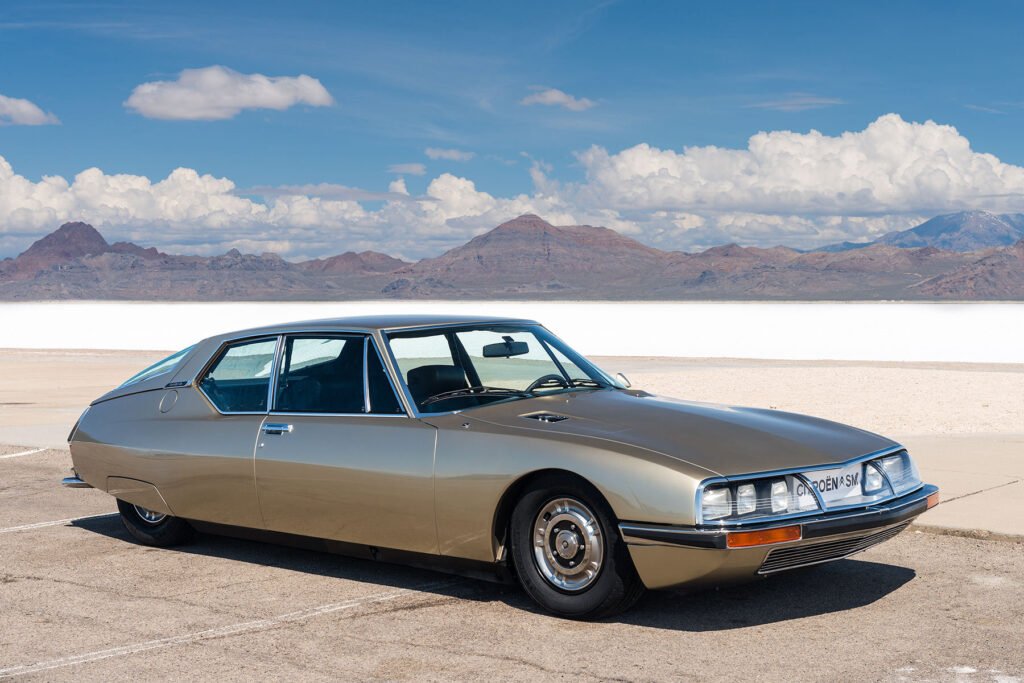
Geneva Motor Show, March 1970. Citroën stand. A low, wide car appears with six headlamps under a single sheet of glass and a nose shaped like one of Cousteau’s divers. It’s called the SM. The two letters never received an official meaning (Citroën never confirmed it conclusively: some say “Sport Maserati”, others “Sa Majesté”), and the car wrapped around them is France’s answer to a question only three or four European manufacturers were still asking out loud: what if we built a Grand Tourer with front-wheel drive, an Italian engine, hydropneumatic suspension, steering that needs no effort, and headlamps that swivel with the wheel?
The answer is the one you’ve been intuiting for half a century: you’d build it once, sell 12,920 of them in five years, ruin the company, take Maserati down with you, and disappear into a forced merger with Peugeot.
The SM is that car. It’s the last truly Citroën Citroën before the rescue. It’s the first and only serious French attempt at a GT capable of fighting with the Mercedes-Benz SLC and the Jaguar E-Type. It’s the car that puts Robert Opron into design history. It’s the car that destroys Citroën’s financial independence. And it is, technically, one of the most fascinating pieces of automotive engineering of the 20th century.
Nothing here goes missed. Let’s go piece by piece.
Project S: what was on Bercot’s desk
The SM’s story does not begin in 1968. It begins in 1961, on a desk at Citroën’s bureau d’études in the Javel quarter of Paris, when someone (most sources point at Pierre Bercot, company president since 1958) writes two letters on a folder: Project S.
The original brief is sober: a sportier, faster version of the DS. Coupé. Front-wheel drive (because Citroën is Citroën, that goes without saying). Same hydropneumatics. More power. More speed. Aerodynamics worked in the wind tunnel.
The problem is the engine. The DS still runs the four-cylinder 2,175 cc block inherited from the Traction Avant with minor evolutions. For a GT aspiring to 220 km/h, that won’t do. Citroën has three options: develop a fresh engine from scratch (expensive, slow, risky), buy one in (faster but bruising for French industrial pride), or buy the whole company and keep the engine forever.
Bercot picks the third. In 1968, Citroën buys Maserati. The full price was never published, but sources agree it was a multi-hundred-million-franc operation, partly financed through bank leverage. Adolfo Orsi stays on as nominal Maserati president, but the marque has now entered French orbit.
Context worth reading: that same year, Fiat bought 49 per cent of Citroën, intending to fold the French brand into its empire. The French state blocked the move (a question of national pride: no Italian was going to swallow Citroën). Fiat returned the shares in 1973 and walked away. So just as Citroën was spending its fortune buying an Italian firm (Maserati), Fiat was spending its own trying to buy the French firm. European automotive geopolitics at the end of the sixties was a knife fight where nobody walked out clean.
Giulio Alfieri and the engine that ISN’T from a V8
This point has to be handled carefully, because almost every general write-up gets it wrong. There’s a myth so often repeated that most people now believe it.
The myth says: “the SM’s V6 is a Maserati Indy V8 with two cylinders chopped off.” That sentence is false, though it has an origin worth understanding.
Here’s what actually happened. Giulio Alfieri, Maserati’s technical director at the time, was tasked in 1968 with designing an engine for the French car. The timeline was absurd. Legend says he sketched it in two weeks, which is probably exaggerated (every “X days” figure in engine history is workshop folklore, not engineering record), but the project was indeed executed at a speed that would feel impossible today.
Alfieri designed a V6 at 90 degrees between banks, oversquare dimensions, twin overhead cams per bank (DOHC), light alloy block, 31 centimetres long, 140 kilograms dry weight. It weighs less than many OHV four-cylinder engines of the same era. Displacement was voluntarily limited to 2,670 cc to stay under 15 French fiscal horsepower (above 16 fiscal hp, France applied a tax surcharge called vignette super that made the car commercially impossible). Three Weber 42 DCNF twin-choke carburettors. 170 hp DIN at 5,500 rpm. Internal designation: C114-1.
So why the V8 myth? Two reasons. First, the 90-degree bank angle is unusual for a V6 (the standard is 60°), and that angle is what V8s normally use. Second, there was an early mock-up that visually resembled a V8 layout. But Maserati historians (Andy Heywood and Marc Sonnery, both regularly cited in the archives) are categorical: the C114 is a new design, not a chopped V8. It may share some basic tooling with the Indy V8, but the architecture is fresh.
The price the engine pays for that 90° angle on six cylinders is one specific drawback: uneven firing intervals. V6s at 90° run the crankshaft loading cylinders with irregular spacing, which produces a lumpy idle and vibrations that only Buick (with its V6 from 1962) had previously confronted. The SM is not a velvet motor at three digits: it’s an engine with character. Contemporary critics noticed. But the car will reach 220 km/h in the carburetted 2.7, and 228 km/h in the 2.7 with Bosch D-Jetronic fuel injection introduced in 1972 (designated C114-03, 178 hp).
Then in 1971, a 2,965 cc version arrives (designated C114-11), producing 180 hp DIN. By 1974 that becomes the only displacement available (with a Borg Warner three-speed automatic), as the 2.7 manual disappears from the catalogue. Five years of production, two displacements, three engine designations. For a car that sold fewer than 13,000 units, that’s striking industrial complexity.
Robert Opron and the most recognisable silhouette of the seventies
While Alfieri wrestles with the engine in Modena, Paris hands the bodywork to Robert Opron, Citroën’s head of styling since 1962. Opron has a short but brutal CV: he worked under Flaminio Bertoni until Bertoni’s death in 1964, brought out the Ami 6, finished the last DS evolutions, and would later sign the CX and the GS. The SM is his moment of maximum freedom.
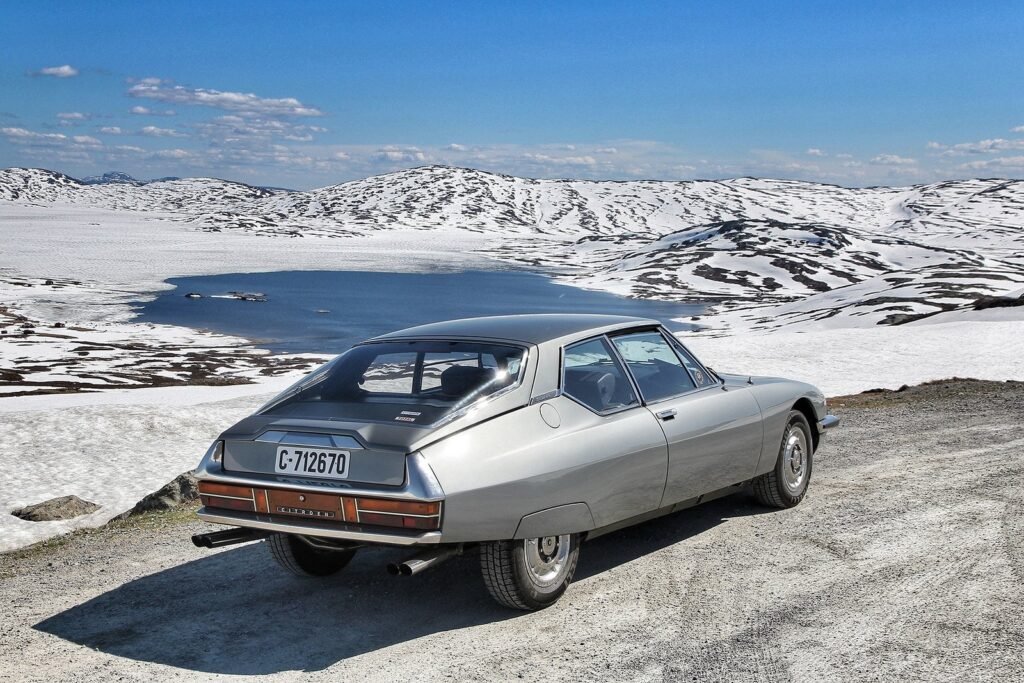
The final shape is pure teardrop. Wide, low nose. Cleanly cut Kamm tail. Rear track narrower than the front (an aerodynamic detail almost nobody copied, which reduces the car’s running shadow). Drag coefficient: 0.26 Cd. For 1970, that’s record-car territory, not road-car territory. It matches some contemporary Porsche sports cars and beats most European GTs of the era.
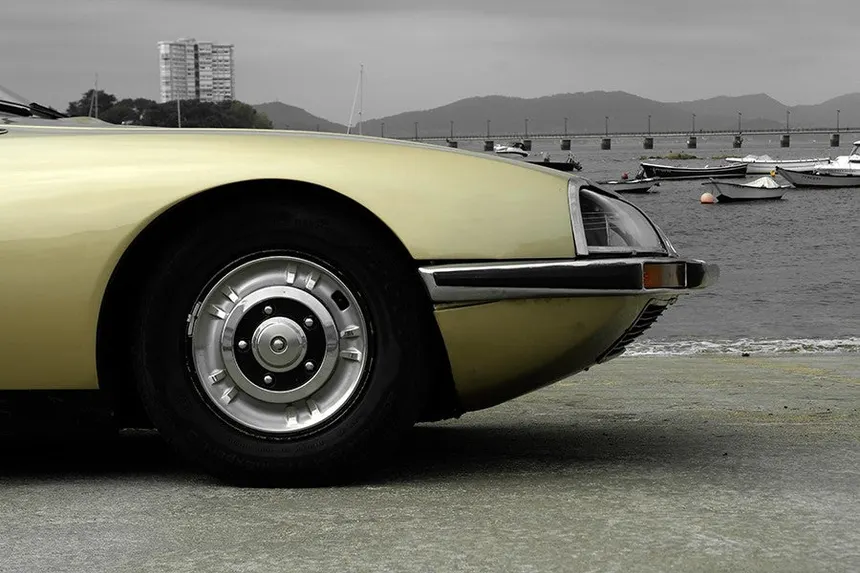
The front end gets the attention: a single sheet of glass covers six Cibié halogen lamps, the inner two swivelling. The idea of headlights turning with the steering wheel isn’t new (the DS21 had them in 1967), but the SM takes it further: the lamps also self-level with the car’s load, connected directly to the hydropneumatic system. That is, they rise and fall automatically to keep the beam aimed correctly regardless of boot weight. While the rest of the European industry was selling cars with three bulbs in the nose and a manual height switch, Citroën delivered an active system coordinating six lamps, the suspension, and the steering wheel. Citroënvie describes it as “one of the most bizarre and complex pieces of over-engineering” the brand ever produced. It’s meant as a compliment.
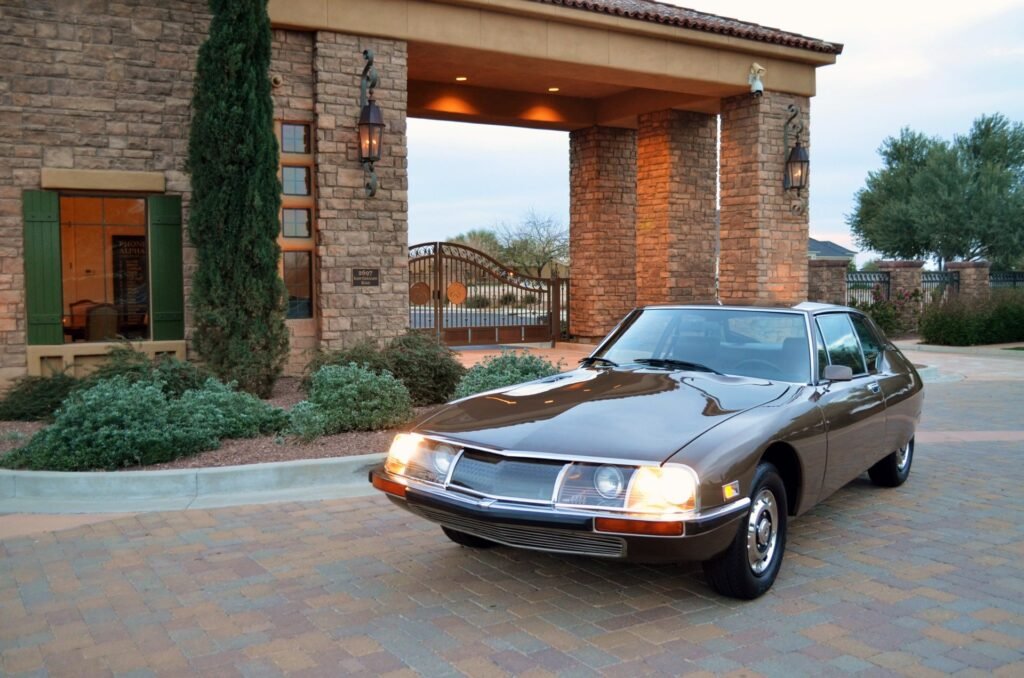
Brutal detail: in the American market, where 1968 federal legislation forbade glass covers over headlamps, Citroën was forced to replace the whole assembly with conventional sealed-beam round lamps. The 1974 federal bumper regulation (the infamous 5 mph rule) eventually pushed the SM out of North America entirely. The European version lost, in the US, one of the visual features that made it unique.
DIRAVI: a steering system that won’t tell you about the road
Here lies the most radical technical piece of the car, and the one most often mis-explained in English-language general write-ups. Pay attention.
Paul Magès, the Citroën engineer who fathered the original hydropneumatics (he signed them off in 1954 for the DS), is tasked with solving a classic problem in powerful front-wheel-drive cars: torque steer. When you push the throttle in a longitudinal-engined FWD car, crankshaft torque transmits to the front wheels and, if the geometry isn’t perfect, the steering wheel pulls to one side. In a 170 hp FWD car, that’s a serious issue.
Magès doesn’t solve it through kinematics. He solves it by physically disconnecting the steering wheel from the road wheels. The DIRAVI acronym stands for “DIrection à Rappel AsserVI” — steering with assisted return. Underneath, here’s the architecture:
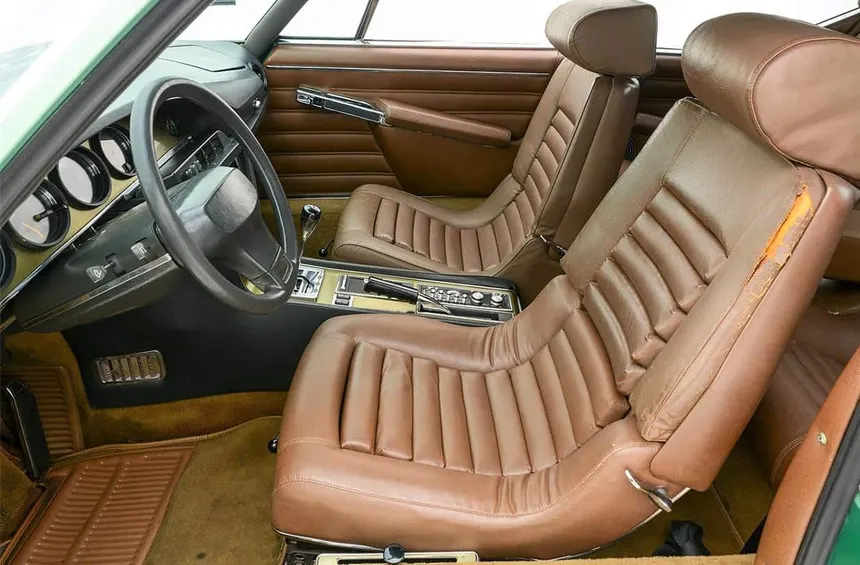
- The steering wheel operates a hydraulic control valve, not a conventional rack-and-pinion linkage.
- That valve manages hydraulic pressure routed to a dual cylinder that moves the road wheels.
- The wheels move under hydraulic pressure, not under mechanical effort from the driver.
- A centrifugal governor coupled to the gearbox output regulates pressure based on speed: at low speed the steering is featherlight (one finger turns it), at high speed it stiffens dramatically (the wheel resists movement, which is exactly what you want at 200 km/h).
- And here’s the strangest piece: forced return to centre. The system actively pushes the steering wheel back to straight-ahead when you release it, even with the car stationary. Turn it and let go: it returns to centre on its own, like a damped pendulum.
- Only two turns lock to lock, instead of the 3.5-4 turns common at the time.
- Variable ratio: up to 9.4:1 at high speeds.
- And, crucially: no road feedback whatsoever to the steering wheel. The driver feels nothing of bumps, grip loss, or skidding. The road simply does not reach his hands.
That last feature is what split contemporary critics. For some, it was the perfect steering system: the car goes where you point it, never deviates, doesn’t respond to small perturbations, and rests the driver’s wrist on long trips. For others, heresy: road feedback is essential information for driving, and removing it is like operating a simulator. A curious historical note: in several European classic-car competition regulations of the nineties, SMs were exempt from the “steering sensitivity” test because their owners protested that the car simply couldn’t pass it.
DIRAVI evolved over time: from the SM it carried into the CX, the XM and the Maserati Quattroporte II (Bertone, 1974). It’s probably the most-copied piece of Citroën engineering taken up by Citroën’s own Italian client before the divorce.
Hydropneumatics scaled to a GT
The SM’s hydropneumatic system is not new technology: it’s inherited from the DS (which debuted it in 1955, also signed by Paul Magès). But on the SM it’s refined for a radically different use: sustained high-speed cruising, motorway distances, real GT duty.
Pressure spheres with diaphragms separating nitrogen (upper chamber) from LHM hydraulic fluid (lower chamber). Four main suspension spheres, one per wheel, plus a central pressure accumulator. The hydraulic pump, as Jalopnik notes, “is the size of a stack of dimes” — yet it generates the pressure that suspends the entire car, operates the steering, the brakes, the automatic gearbox (on the BW3 versions), and the headlight self-levelling. All from a single high-pressure green-fluid circuit.
Three important things the SM does and the DS does not:
- Discs on all four wheels. The DS had discs front and drums rear. The SM has discs all round because its speed potential demands it.
- Inboard front brakes, mounted next to the differential rather than at the wheel. That reduces unsprung mass (the wheels weigh less in their vertical movement) and allows for a cleaner front axle. It’s a competition solution that on road cars only appeared in very special pieces.
- Rear squat braking control: the hydropneumatic system senses heavy braking and actively compensates to prevent the rear sinking (rear anti-squat). It’s conceptual ABS without ABS.
And the aerodynamic detail the suspension delivers without the driver noticing: when you load the boot, the car self-levels. The front ride height doesn’t change. The rear doesn’t change. The wind-tunnel-tested shape stays in the same attitude. An SLC or an E-Type, loaded, changes its rake; the SM doesn’t. That aerodynamic-shape stability granted by hydropneumatics is one reason the SM could do Paris-Nice at 200 km/h average speed with two passengers and luggage. It wasn’t a GT that flinched under load.
Geneva 1970 and the reception
The SM is unveiled at Geneva in March 1970. The European press receives it with a mix of technical fascination and commercial caution. Top Gear‘s later review describes the launch as “a surface serenity floating on an industrial operation at the edge of chaos.” It reaches the US in 1971 and wins Motor Trend Car of the Year 1972, a prize few European cars accessed in those years. It came third in the 1971 European Car of the Year, behind its own stablemate the GS and another rival.
Performance is objectively strong: 220 km/h, 0-100 km/h in around 8.5 seconds, generous touring range, reasonable consumption for a GT of the era. But the car has three commercial problems:
- It’s expensive. In France, the SM costs more than twice a DS21 Pallas. It sits in the Mercedes-Benz 280 SLC bracket.
- The V6 has documented fragilities: the rear timing chain driving the camshafts fails with mileage; the oil pump and ignition are also failure-prone; the air conditioning is electrically complicated. Citroën, as Aronline notes, “swept the problems under the carpet” rather than running recall campaigns.
- The French GT buyer doesn’t exist in sufficient numbers. France, post-WWII, had heavily disincentivised luxury cars through taxation. The niche Mercedes and Jaguar served in Germany and Britain simply wasn’t there at the same depth in France.
The oil crisis and the financial collapse
October 1973. Yom Kippur War. OPEC closes the tap. Crude prices quadruple in six months. The entire Western auto industry built around big, fast, thirsty cars goes into panic. The SM is exactly the kind of car the market suddenly stops wanting.
Citroën meanwhile has several open fronts at once:
- The SM isn’t selling fast enough to amortise its development.
- The Wankel project with NSU (Comotor joint venture) has been a financial black hole. The rotaries in the M35 and the GS Birotor are thirsty, unreliable, and abandoned by buyers after the crisis.
- Investments in the Maserati factory at Modena and in SM tooling are short-term unrecoverable.
- Citroën’s overall cost structure is too heavy for its actual revenue.
In December 1974, Citroën enters formal financial difficulty. The French government intervenes. Peugeot, which had been observing its neighbour patiently for years, buys 38.2 per cent of Citroën in 1974. By 1976, Peugeot holds 89.95 per cent. PSA Peugeot Citroën is officially born.
And in May 1975, the new PSA leadership’s first industrial decision regarding the Citroën portfolio is brutal and clean: Maserati is sold to Alessandro De Tomaso, the Argentine-Italian coachbuilder and constructor already controlling Innocenti and other smaller marques. The operation closes in weeks. Maserati moves out of Parisian orbit into De Tomaso orbit. The Franco-Italian divorce is final.
SM production ends that same 1975. The final units come out not at the historic Javel plant but at Abrest near Vichy, in the factory Ligier ran there. Citroën had moved assembly to Ligier in 1974 because it could no longer afford to keep the Paris line open. 12,920 units in total. Promise: revolutionise the European GT. Reality: 12,920 cars and two ruined marques.
The after-life: parts that survived in other cars
Here’s where the SM gets interesting even posthumously:
- The C114 V6 engine lives on in the Maserati Merak (Tipo AM122), designed by Giorgetto Giugiaro at Italdesign and built by Maserati from 1972 to 1983. 1,830 units. The Merak runs the C114-AM122 (modified version) at 3.0 litres, and uses the Citroën C35 gearbox from the SM. A Maserati with a Citroën gearbox — a sentence that in 1972 was literally unimaginable.
- The Maserati Quattroporte II (Bertone, 1974) is built on a stretched SM platform (the same one Henri Chapron used for the SM Présidentielle four-doors Pompidou commissioned in 1972). The Quattroporte II is technically a four-door SM with Bertone bodywork. It’s a front-wheel-drive Maserati. The Italian marque never made another FWD car again.
- The Ligier JS2, a French sports coupé by Guy Ligier, runs the same C114 in 3.0 form from 1973. Same engine, same supplier, different marque.
- The manual gearbox from the SM ends up in the Lotus Esprit from 1976 onwards, when Lotus picks it for its compactness and its mounting compatibility with a mid-engined layout. A Citroën-SM gearbox in an Esprit. Another improbable milestone.
- And most of the advanced technical solutions of the SM (DIRAVI, swivelling headlamps, refined suspension) pass into the CX of 1974, the next big Citroën, which adapts these ideas to a four-door saloon that sells in far higher volume.
The SM, commercially, was a failure. Industrially, a catastrophe. But technologically, it was an organ donor. Pieces of it stayed alive in cars that never wore those two letters on the tail.
Why the SM matters today
There’s a phrase that circulates about the SM and deserves dissection: “the SM is the moment Citroën overreached.” It’s elegant but unfair.
The SM is not Citroën’s mistake. It’s the natural consequence of a company that for forty years had been building cars by asking the right question (what technical problem do I solve, not what market niche do I fill). The Traction Avant nearly cost André Citroën the company in 1934 for the same reason: investing in engineering faster than the market could pay. The DS in 1955 was financially on the edge for years. The SM repeats the pattern with one twist: this time the car doesn’t make it. Because Maserati is expensive to maintain. Because the oil crisis arrives at the exact wrong moment. Because the French GT market is too shallow.
What the industry learns from the SM is the following:
First, that technical performance does not guarantee commercial performance. The SM beat the SLC and the E-Type on almost every objective metric (aerodynamics, comfort, steering, high-speed stability). It sold a tenth as many. You cannot solve that with more engineering.
Second, that a company cannot sustain two brand identities simultaneously. Citroën and Maserati are radically different industrial cultures. One makes utility cars for farmers and hydropneumatic saloons for notaries; the other makes Italian V8s for collectors with three surnames. Trying to fuse them into one industrial plan was unworkable. PSA understood it, separated them in 24 hours in 1975, and from there Maserati could survive independently and Citroën could recover in a different direction (CX, BX, AX).
Third, and this is the one most often forgotten: the SM proves that technical complexity is independent of the price the market pays for it. The DIRAVI costs the same to produce whether the car sells for 50,000 francs or 30,000 francs. So does the engine. So does the hydropneumatic system. If the car doesn’t scale in volume, that complexity eats the profit and loss account whole.
Many current manufacturers still haven’t learnt that lesson. Which is why coming back to the SM every now and then matters. Not to laugh at Citroën. To understand why the best engineering in the world doesn’t survive if it doesn’t find the right market at the right moment.
The SM is, in that sense, one of the most truthful cars in history: it did what it promised, did it better than almost anybody, and paid for it with its own existence and the existence of the marque that built it.
In an industry full of empty promises, that’s still a precious rarity.
Check you’re still alive.
2 thoughts on “CITROËN SM”