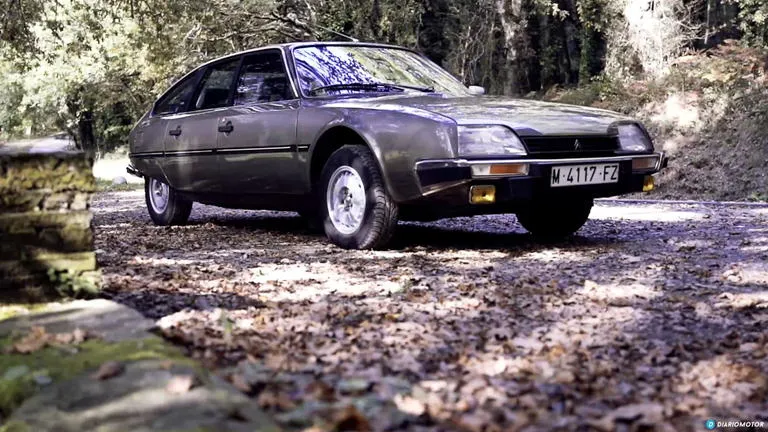
The Last Real Citroën. And the World’s Fastest Diesel.
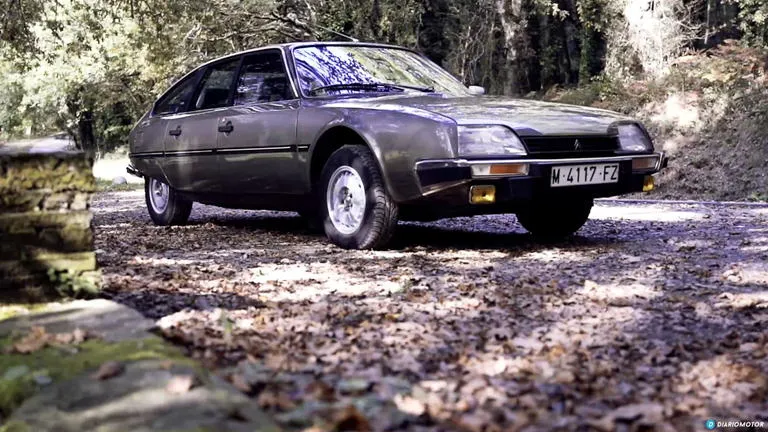
How a French saloon designed to replace the DS ended up setting world records, ferrying a communist head of state to his office, and being the last car with pure Citroën DNA before PSA homogenised the marque
September 1974. Paris Motor Show. Citroën enters formal financial difficulty exactly three months later, in December of the same year. The SM has been in production for almost five years, but bleeding the company’s cash. The previous year’s oil crisis has wrecked the market for large GTs. And Peugeot is watching patiently as it quietly accumulates 38.2 per cent of Citroën.
In the middle of that financial chaos, Citroën does what only Citroën would do: launches its new flagship. Not a prudent car. Not a cheap DS variant. A full replacement for the brand’s most iconic model, with new technology, a spaceship dashboard, a transverse engine for the first time on a Citroën flagship, and the promise of delivering the SM’s engineering to the masses in four-door saloon form.
They call it CX. The two letters, according to official reading, refer to the aerodynamic drag coefficient (Cx in French notation). The paradox: the CX’s actual drag coefficient (0.36 Cd) wasn’t particularly remarkable for the era and didn’t come close to the SM’s 0.26. But the name stuck. It was a statement of intent, not a measured value.
What happened next deserves to be told in detail. Because the CX is many things at once: the last truly Citroën Citroën, the first Citroën built under partial Peugeot control, the fastest diesel saloon in the world for several years, the official car of the East German head of state, European Car of the Year in 1975, and 1.2 million units of a flagship that the French industry has never matched since.
Nothing gets missed here. Let’s go piece by piece.
The brief: replace the DS without killing the DS
The DS had been in production since 1955. By the time Citroën launches the CX in 1974, the DS is 19 years old. It’s the most recognisable French luxury saloon in the world. And the internal question at the bureau d’études was: how do you replace something so iconic without the market reading it as a betrayal?
The answer came from chief stylist Robert Opron, the same man who had signed the SM and the GS, the two CX contemporaries. Opron decided not to try to replicate the DS silhouette, but to translate its philosophy into a modern language. The CX would be 21 centimetres shorter than the DS (4.66 m versus the DS21’s 4.87 m), but with more usable interior space, thanks to a technical decision that required redesigning the whole drivetrain from scratch: transverse engine.
You have to understand what that meant in 1974. No European saloon in its class ran a transverse engine. The Mercedes W123, the BMW E12, the Rover SD1, the Renault 30 TS, the Peugeot 504 — all longitudinal. Transverse layouts were for hatchbacks and superminis (Mini, Simca 1100, Renault 16, Fiat 128, the GS by Citroën itself), not flagships. The CX broke that industrial taboo.
To make it work, Citroën had to develop a completely new transverse gearbox with the differential integrated in the same casing. Once tooled up, that gearbox got sold on: the Lancia Beta and the Talbot Solara later adopted it for their respective platforms. It’s the classic Citroën pattern — develop something radical to solve a house problem, then recover the development costs by selling it to competitors.
The engine, by contrast, was a less glorious inheritance. The initial blocks (M22 at 1,985 cc and M23 at 2,175 cc) were derivatives of the DS units, now tilted 30 degrees forward to fit transversely. Capacity and architecture weren’t new. The French, tied to the puissance fiscale system (fiscal horsepower), couldn’t afford large engines because the tax punished them. The CX never got the six-cylinder its body cried out for. That was its big missing chapter.
The bodywork: Opron given free rein again
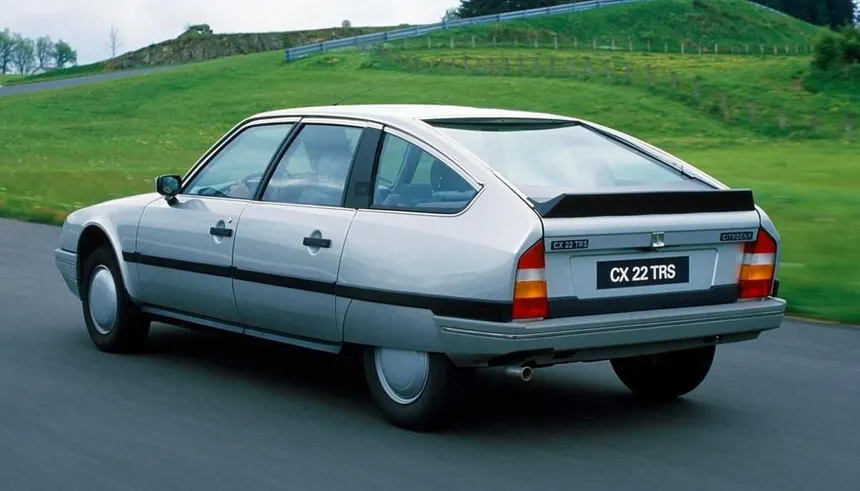
Robert Opron drew the CX bodywork as a natural evolution of the SM, but adapted to a four-door fastback saloon. Three visual decisions define the car:
Concave rear window: the rear glass curves inward, toward the centre of the car. That curvature is functional — it sends rainwater to the centre of the window rather than spreading over its surface, eliminating the need for a rear wiper. The Citroën C6 would repeat the trick decades later. Behind that decision sits aerodynamics, one entire component saved, and visual coherence: the concave window rounds off the fastback rather than chopping it.
Rear track narrower than front: Opron repeated the trick he’d used on the SM. The narrower rear axle reduces the car’s “aerodynamic shadow” in motion and, importantly, softens visually the transition between the rear arches and the tail. On the SM it was teardrop. On the CX it’s fastback. Same idea.
Kamm tail: clean cut at the back, right angle between the roofline and the rear panel. It’s the aerodynamic solution German engineer Wunibald Kamm patented in the thirties and that the whole European industry adopted in the seventies. The CX takes it into the language of a French saloon with clarity. No soft rounding, no afterthought spoiler — just a knife cut.
The result is an unmistakable car. You can’t confuse a CX with anything else. And that’s exactly what Citroën needed in 1974: a silhouette with its own identity, not a DS impersonation.
The Lunule dashboard: radical ergonomics
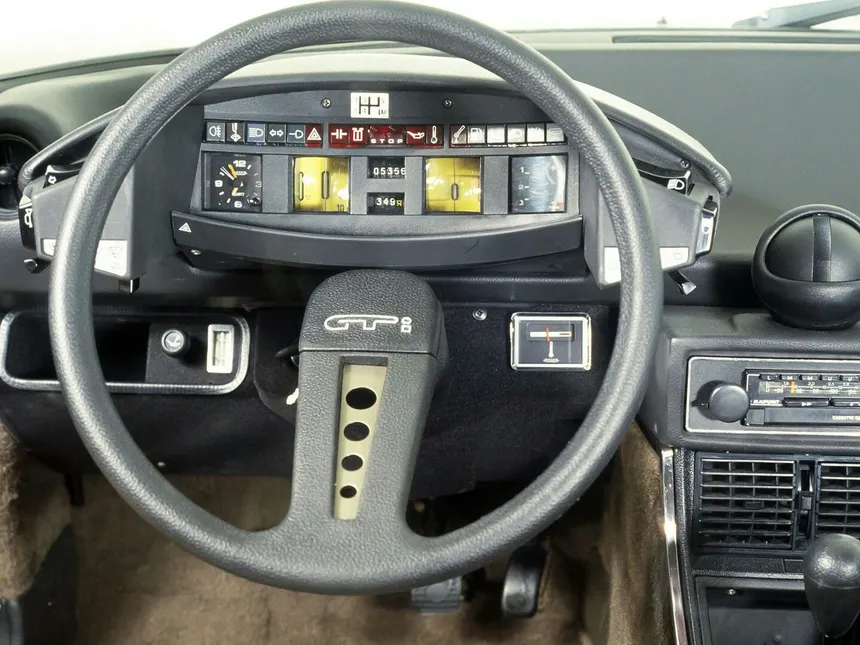
This deserves a pause. Because the CX’s dashboard (Series 1, until 1985) is one of the most interesting pieces of automotive industrial design in seventies Europe. And most general write-ups dispatch it in two lines.
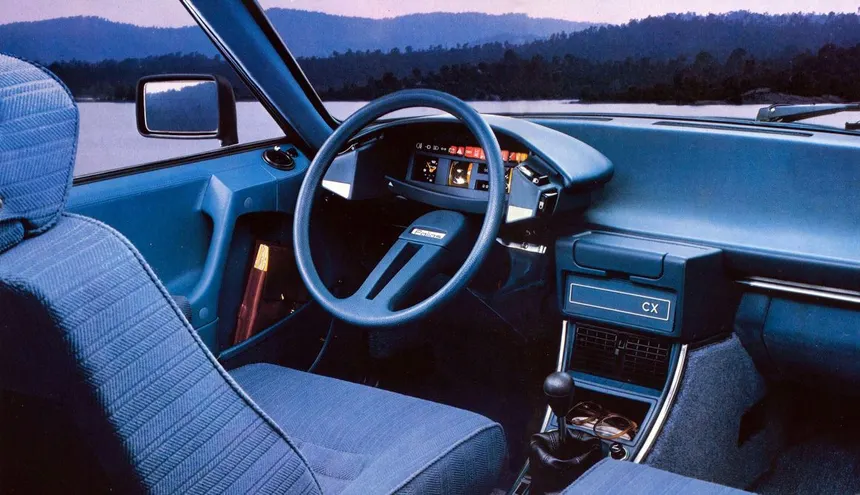
The system was called Lunule (from the crescent-moon shape formed by the driver’s compartment). What sets it apart:
Single-spoke steering wheel, inherited directly from the DS. Large wheel, but only one arm at the six o’clock position, leaving the instrument cluster’s view completely clear.
Drum-roller instrument cluster. The speedometer and tachometer are not conventional needles. They are rotating cylindrical drums with painted numbers passing in front of a fixed window. Speed and RPM always appear at the same point on the dash — only the visible number changes. The idea is ergonomic: the driver’s eye doesn’t have to follow a needle moving across a dial; it just reads a slowly-changing number. The system is closer to an aircraft instrument than to a car gauge.
Stalk-free controls: the most radical idea. On Series 1 CXs, there are no stalks behind the wheel for indicators, wipers, lights or horn. All those controls are integrated into two satellite pods flanking the instrument cluster, within thumb reach without letting go of the steering wheel. The philosophy: your hands never leave the three-and-nine position. Information goes to the fingers, not to the forearms.
That decision was genuinely innovative in 1974, and it split critics. Those who got it called it the future. Those who didn’t called it Gallic eccentricity. The reality is the system worked very well once learnt, but it had a learning curve. Series 2 from 1985, under design lead Geoff Matthews, softened the concept and partially restored conventional stalks, losing identity but gaining familiarity for the average buyer.
Extra detail: the CX was the first Citroën with factory catalytic converters for markets requiring them from the eighties, and the first French car with ABS (on the Turbo variant). The marque, even under the PSA umbrella, kept the innovating drive that had made it famous in the CX.
Hydropneumatics and DIRAVI: technical inheritance from the SM
The CX inherited from the SM two of the brand’s three most radical technical innovations: the refined hydropneumatic suspension and the DIRAVI power steering. The third — the glass-covered swivelling headlamps — was simplified for regulatory reasons (Americans still wouldn’t permit glass covers over headlights).
The CX’s hydropneumatics is not the DS’s, nor the SM’s. It’s an evolution:
- Still uses pressure spheres with diaphragms separating nitrogen (upper chamber) from LHM fluid (lower chamber).
- Still runs suspension, brakes, steering and self-levelling off a single high-pressure hydraulic circuit fed by an engine-driven pump.
- But sphere geometry, height correctors, discharge valves and overall calibration were redesigned for a response firmer than the DS and more compliant than the SM. The CX feels more saloon and less GT than its older sibling.
- And, critically: the CX’s payload, thanks to the self-levelling, was over 700 kg for a passenger car. That made it the saloon of choice for coachbuilders like Tissier, who stretched it to three axles for express delivery work. The estate version, long and with load self-levelling, also served as a base for ambulances and hearses without modifying the suspension.
The CX’s DIRAVI is structurally different from the SM’s DIRAVI. The philosophy is the same (hydraulic steering with assisted return, speed-variable, no road feedback to the wheel), but the mechanical control differs. Among Citroën mechanics, this is one of the most-discussed technical differences between the two cars. The CX steers with less subtlety than the SM but with more operational efficiency: easier to calibrate, cheaper to repair, more stable at motorway speeds.
The CX 25 GTi Turbo: the fastest saloon under French colours
The CX catalogue evolved across its 17-year life. There were modest diesels, 2.0 and 2.2 litre petrol versions, fuel-injected versions, semi-automatic (“C-Matic”), full ZF automatics, and finally the crown jewel: the CX 25 GTi Turbo.
It arrived in 1984 with a 2,500 cc engine, four cylinders, 93 x 92 mm dimensions, a Garrett T3 turbocharger (intercooler added in 1985 with Series 2), and a stated output of 168 hp DIN at 5,000 rpm, with torque of 294 Nm at 3,250 rpm. Five-speed manual transmission. Kerb weight: 1,370 kg. Top speed claimed: 220-223 km/h depending on source and variant. Zero to a hundred in 7.8 seconds.
For a four-door saloon nearly 4.70 m long in 1984, those numbers were insolent. The CX 25 GTi Turbo competed directly with the Mercedes 280 SLC, BMW 528i, Saab 900 Turbo and Audi 200 Turbo of the same period. And it did so with front-wheel drive, hydropneumatics, self-levelling, four discs (vented at the front) and DIRAVI. No other European saloon offered that technical combination.
And then there’s the other side of the catalogue: the CX Turbo Diesel 2.5, also from 1984. Same modified base block, but turbo diesel. 120 hp declared (exact figures vary by year and market). Top speed: 195 km/h. In 1984, that made the CX Turbo Diesel the fastest diesel saloon in the world. Official record, not marketing. Mercedes, BMW, Peugeot — all the major European manufacturers had been chasing the fast diesel for years. Citroën crowned it first. The brand that just years before had been at bankruptcy’s door was now holding the diesel world record with a road saloon.
The CX Prestige and the heads of state
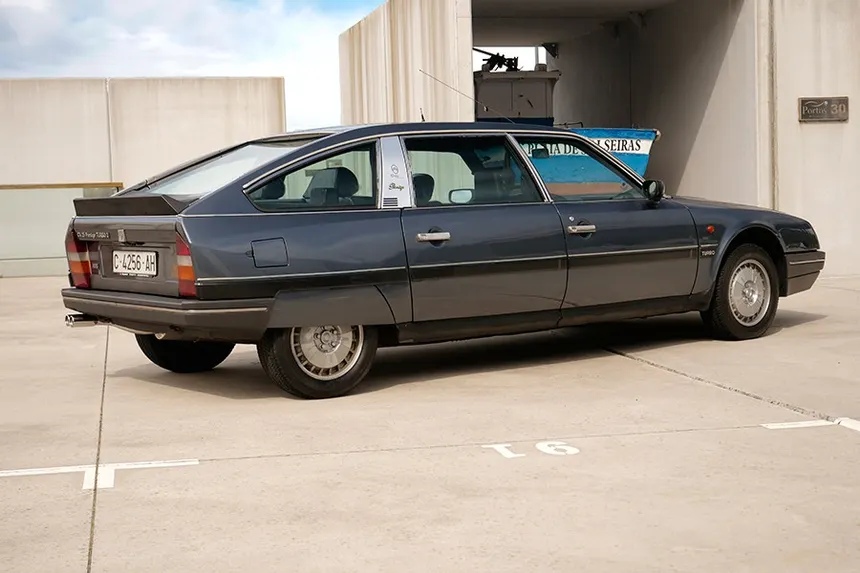
The CX Prestige version was built on a long wheelbase (the estate’s), with a higher roof, 2.4 fuel-injected engine and, later, 2.5 injection or turbo. It was the CX limousine, intended for institutional and representative use.
Here’s the curious part: the CX Prestige became the official car of several European heads of state. The best-documented case is that of Erich Honecker, head of state of the German Democratic Republic (the communist GDR), whose official fleet included several stretched CX Prestige cars with three rows of seats. A communist head of state, at the height of the Cold War, chose as his official car the flagship of a French manufacturer in the process of being absorbed by his own arch-capitalist rival (Peugeot). Politics and mechanics never asked permission before mixing.
Other European and African heads of state used similar versions. The hydropneumatics made it ideal for ceremonial use: silent ride, self-levelling under load (important for motorcades with several passengers), broad visibility thanks to the fastback.
European Car of the Year 1975 and commercial success
The CX took European Car of the Year 1975, voted by 49 journalists from 14 European countries. It was the second Citroën of the decade to win, after the GS in 1971. Three years later, in 1978, the CX reached its peak production: over 132,000 units in a single year. It was the best-selling car in its segment in France, and one of the best-selling in continental Europe.
Cumulative production between 1974 and 1991: 1,041,560 saloons + 128,185 estates = 1,169,745 units. The highest figure ever achieved by a Citroën flagship. No subsequent flagship in the brand’s history (XM, C5, C6) came close.
Manufacturing concentrated at the Aulnay-sous-Bois plant in France, but production also took place at Vigo (Spain), Mangualde (Portugal), Arica (Chile), Koper (Yugoslavia) and Bangkok (Thailand). The estate version, from 1989 until the end of production in 1991, was assembled at Cerizay by Heuliez, the historic French coachbuilder.
The end: the XM as anti-CX
In 1989, Citroën launched the XM as the CX’s replacement. But the CX continued in production in parallel until 1991, which is revealing: the brand didn’t dare close down a car that was still selling well.
The XM was different in philosophy. Angular styling by Marcello Gandini at Bertone (not Robert Opron), platform shared with the Peugeot 605, electronically-controlled hydropneumatic suspension marketed as Hydractive, more conventional dashboard, no drum rollers. As the English Wikipedia summarises it neatly: the XM can be fairly described as the anti-CX. It was a Citroën rationalised under PSA paradigm, not a free Citroën.
The XM sold well at first (annual figures similar to the CX’s late years), but demand collapsed around 1995 and the brand retired it without a direct replacement in 2000. There ends, in practice, Citroën’s line of large-format flagships. The C5 and the C6 followed, both good cars, but already fully integrated in PSA’s technical language.
Why the CX is the last Citroën Citroën
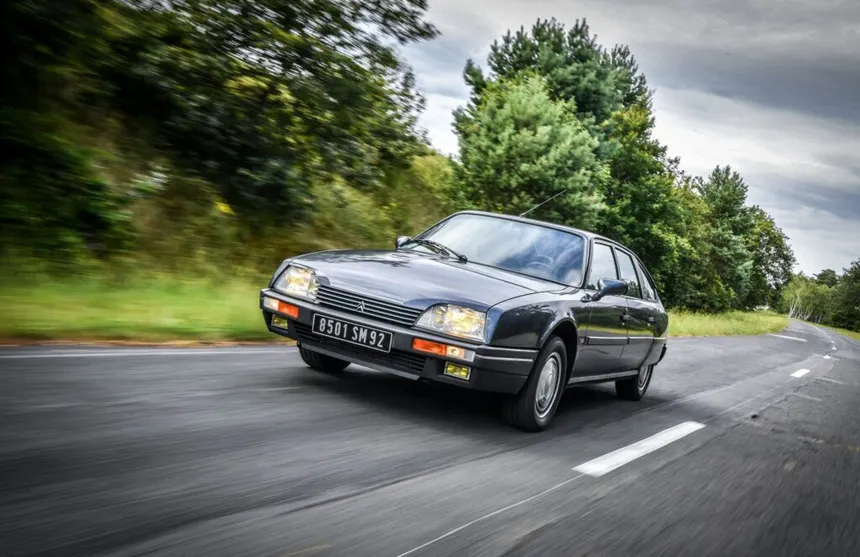
There’s a phrase circulating among enthusiasts: “the CX is the last real Citroën.” The phrase is affectionate, but it deserves to be unpacked, because it has real technical depth.
The argument runs as follows. The DS of 1955 was born inside a Citroën controlled by Michelin, with full industrial and technical independence from the rest of the French industry. Under that same Michelin orbit the 2CV, the Ami, the GS, the SM and the CX were developed. All these cars share one philosophy: solve the technical problem first, decide how to sell it later. Hydropneumatics, DIRAVI, air-cooled flat engine, transverse drivetrain on a flagship, satellite dashboard, swivelling headlamps. All of it born from engineers deciding what problem to solve, without first running through the commercial filter of “what does the market want.”
From the XM on, Citroën is fully integrated in PSA. Technical decisions on flagships become group decisions, optimised for shared platforms, engines, electronics and assembly lines with the Peugeot 605 and later the 607 family. Citroën’s distinct technical identity dilutes. Hydropneumatics survives a while longer (Hydractive in the XM, C5, C6) but disappears in 2017 with the last C5. DIRAVI goes earlier. The drum rollers and satellite dashboard never return.
The CX, in that context, is the last car where all those decisions were taken inside Citroën’s bureau d’études without asking Peugeot for permission. Even though it launched three months before bankruptcy. Even though it lived through the PSA restructuring. Even though it had to make do with engines limited by French fiscal rules. The CX’s technical DNA is 100 per cent classical Citroën.
That’s why, when someone today says “the last real Citroën”, the CX is the answer. And that’s why 1,169,745 units sold isn’t an anecdote: it’s the proof that honest engineering, at the right price point, finds plenty of market.
That’s the lesson the industry still hasn’t learnt. And that’s why the CX still deserves to be looked at every now and then. Not for nostalgia. For learning.
Check you’re still alive.