Nissan R390 GT1: the race car Nissan had to fit with headlights and a number plate to be allowed to run at Le Mans
If you were a manufacturer in the late nineties and you wanted to win Le Mans in the GT1 category — the one that actually won the race overall — you had to comply with one of the more absurd rules in modern motorsport. The regulations required your race car to have a road-going version. Just one. Even a single car was enough. But without a roadworthy variant, no homologation. And without homologation, no Le Mans.
Mercedes built the CLK GTR Strassenversion. McLaren had the F1 GTR behind the F1 road car. Porsche took the 911 GT1 and bolted a thin layer of road-car bodywork around it. Toyota improvised the GT-One. Every major manufacturer of the moment played the same game: design a race car, then reluctantly bolt on a road version with two seats and a token boot to satisfy the ACO. It was a formality. A bureaucratic excuse.
Nissan did the opposite. And that’s where one of the strangest stories in modern Le Mans history begins.
The car built the wrong way round
In September 1996, Yoshikazu Hanawa, then president of Nissan, signed a two-year contract with Tom Walkinshaw Racing. The objective was clear: win Le Mans in 1997 or 1998. TWR was the British outfit that had been dominating European endurance prototypes for years — they had won Le Mans with Jaguar in 1988 and 1990, and the car that had just won the 1996 edition (the Porsche WSC-95 driven by Davy Jones, Alexander Wurz and Manuel Reuter, entered as a works Porsche but operated by Joest) was, technically speaking, a derivative of the Jaguar XJR-14 that TWR had developed years earlier. The deal with Nissan was straightforward: TWR brings the engineering, Nissan brings the money and the engine, both go after the GT1 title.
And here’s the decision that puts the R390 GT1 outside the normal frame. When Nissan and TWR sat down to plan the car, they didn’t design the racing version first and then improvise a road-legal version afterwards. They did the reverse: they designed the road car first, with carbon-fibre monocoque, mid-engine layout, two seats and a real boot, and they derived the competition version from it. On paper, the R390 GT1 is a road car that had its luxuries stripped to take it to Le Mans. In practice, it’s the most candid alibi in the entire GT1 era: a race car they then fitted with headlights and a number plate, yes, but openly assumed as such from the first line of the design brief.
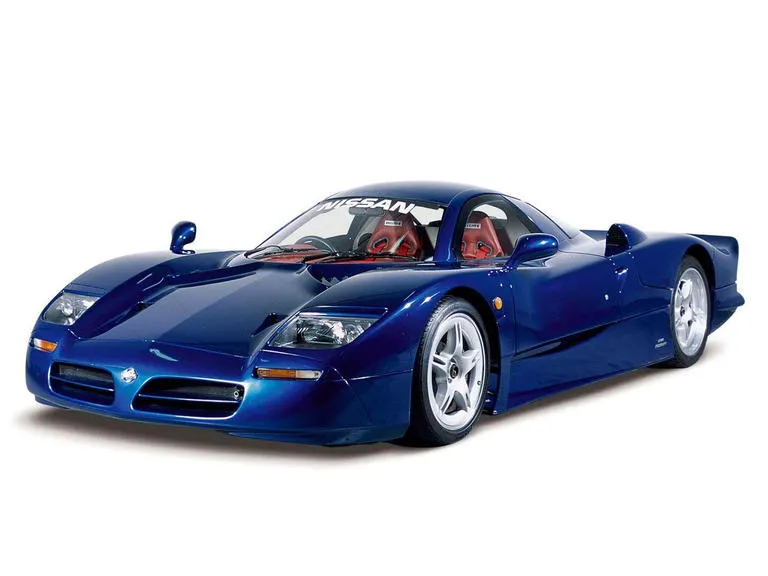
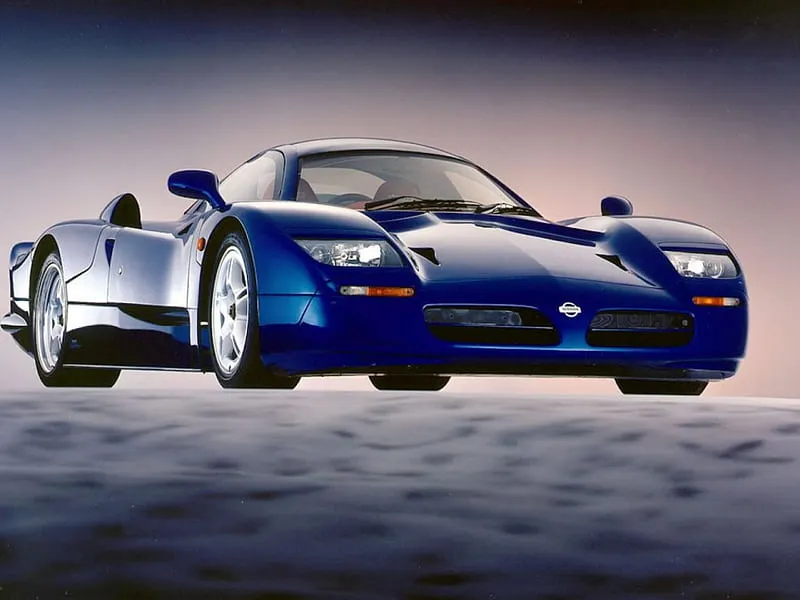
How many road cars did Nissan actually build? Here’s where the story turns almost comic. One. A single unit. Built at Atsugi by Nismo during 1997 to satisfy homologation, originally painted in red and registered in the United Kingdom with plate “P835 GUD.” After 1997, when the rules forced a rework of the rear bodywork and the building of the long-tail for 1998, that same road car was repainted in deep blue and re-catalogued as chassis #2. Same car, two visual identities. The repaint reflects the technical reality of the programme: the 1998 race car had enough geometric differences from the 1997 version to warrant a second photograph in the homologation files, but Nissan didn’t build a second road unit. They built one, updated it, repainted it and reassigned it.
The reason they had to rework the rear is among the most absurd ever produced by Le Mans rulebooks. ACO scrutineers realised in May 1997 that the racing R390 didn’t preserve the usable luggage space of the road car. The GT1 regulations required the race car to retain a functional homologated luggage compartment — the specific figure of 100 litres that floats around some sources is unverified folklore, what actually existed was a requirement for usable space without an exact metric. Nissan and TWR had to redraw the entire rear section in a matter of days to produce a homologation-compliant luggage bay. The exhaust, originally exiting through the rear, was rerouted to the sides for two combined reasons: to make room for the boot, and to address engine cooling problems that had already shown up in testing, where the heat coming off the exhaust was affecting critical components close to the block. Internally, the rapid geometric changes created compromises that would later show up in transmission reliability.
A single road unit. It’s nominally worth a fortune today that will never appear at auction, because Nissan has never sold it and doesn’t seem likely to. When it was catalogued by the manufacturer in its day, the estimated value sat around the equivalent of US$668,000. The figure is theoretical: no actual unit has ever changed hands.
TWR, Callum and the Jaguar in the shadows
If you lift the bodywork off an R390 GT1 and look at the structure, the first thing you see is a carbon-fibre monocoque you’ve seen before. You’ve seen it because it’s essentially the same one as the Jaguar XJR-15 — a road car TWR had built in the early 1990s, derived from the XJR-9 that had won Le Mans in 1988. When Nissan called TWR, the British team didn’t start from scratch. They took the tooling and the moulds they already had from the XJR-15, modified the cockpit just enough, and built around it a car that is structurally a first cousin to the Jaguar. The rear, the front end and the suspension are R390-specific, designed around the GT1 regulations. But the basic chassis has Jaguar blood in it. That’s something most people don’t know.
The exterior design was signed by Ian Callum. Yes, the same Ian Callum who would later turn anything he touched at Jaguar into series-produced art — the F-Type, the XK, the XF, the XJ. In 1996 he was still at TWR, having just finished the Aston Martin DB7. The R390 GT1 is one of his less-celebrated designs precisely because it’s one of his most austere: clean lines, no drama, no exaggerated wings, no Italian curves. Tony Southgate, also of TWR (the father of the Jaguar Group C cars of the eighties), handled the mechanical and aerodynamic side together with Nismo’s Yutaka Hagiwara. The only visible Nissan components on the car were the headlights — taken directly from the road-going 300ZX coupé.
That last detail is worth pausing on. A car aiming to win Le Mans, built by a British team, designed by a Scotsman, with a chassis closely related to a Jaguar, with a Group C-derived Nissan engine, carries as its only identifiable Nissan part a pair of headlights from a road-going sports coupé. It’s the perfect summary of what the R390 GT1 actually was: a collaboration as British as it was Japanese, sold to the world as a pure Nissan.
The heart: the VRH35L
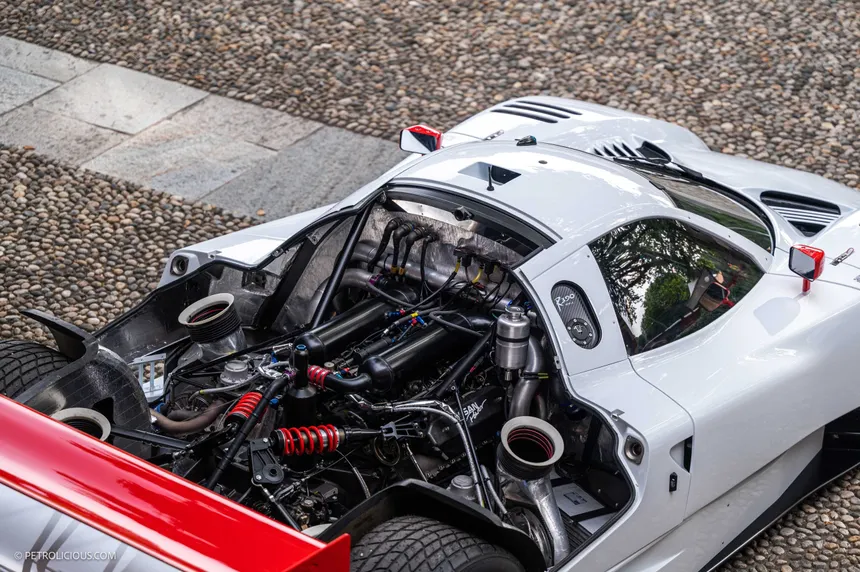
The engine is where the story plugs straight into everything Nissan had been doing in competition since the eighties. The VRH35L is a 3.5-litre V8, 90 degrees, twin-turbocharged, mounted mid-rear. It isn’t a clean-sheet 1997 engine. It’s the direct evolution of the engine Nissan had used in its Group C prototypes through the late eighties and early nineties — the R88C, R89C, R90C, R91C. That engine had been born to run 24 hours straight in prototype racing conditions, and that meant durability was baked into its DNA.
Adapted to the racing R390 GT1, the VRH35L delivered around 640 horsepower at 6,800 rpm. The road-car version is where the figure gets interesting. Nissan’s official Heritage Collection cites 350 PS (345 bhp) for the road-legal car, while specialist press and secondary publications have quoted up to 550 bhp. The discrepancy is explained by what the car actually is: the road engine is essentially the same VRH35L block as the race version, electronically detuned, fitted with road-homologated exhausts and limited turbo boost to comply with European emissions regulations. The real figure, as far as can be verified, sits somewhere in the middle that Nissan never fully clarified in official complete data — and because the car has never been put on a public dyno, no independent source has ever measured it. Xtrac six-speed sequential gearbox. Rear-wheel drive. Race weight: 1,098 kilograms. Those 1,098 kg are the figure that matters, because in the McLaren F1 GTR and Porsche 911 GT1 era — cars that hovered around 1,050–1,100 kg — the Nissan was playing in the correct league.
How did the car behave? The honest answer is that it behaved better in a straight line than in a corner. The R390s were quick down the Mulsanne straight, where the twin-turbo punch and the 1998 long-tail aerodynamics could stretch out. In the corners they lost ground to the Porsche 911 GT1, which had better balance and superior mechanical grip. It was a characteristic of the car the team accepted from the very first test. TWR knew where it could find time and where it would lose it.
1997: the boot disaster
The R390 GT1 made its debut in May 1997, at the Le Mans pre-qualifying. The first thing it did was win the session. The car driven by Martin Brundle, Jörg Müller and Aguri Suzuki set the fastest outright lap, 0.647 seconds clear of the 1996-winning Porsche WSC-95, and a second and a half ahead of the works Porsche 911 GT1. On paper, Nissan had a car to win the race.
Then the ACO inspectors arrived. And this is where bureaucracy and technical reality collided. The scrutineers found that the race car didn’t contain the 100-litre luggage compartment the road car was supposed to have. The GT1 regulations required the race car to preserve the useful interior dimensions of the road version. The R390 didn’t. Nissan and TWR had designed the car to race, not to carry suitcases.
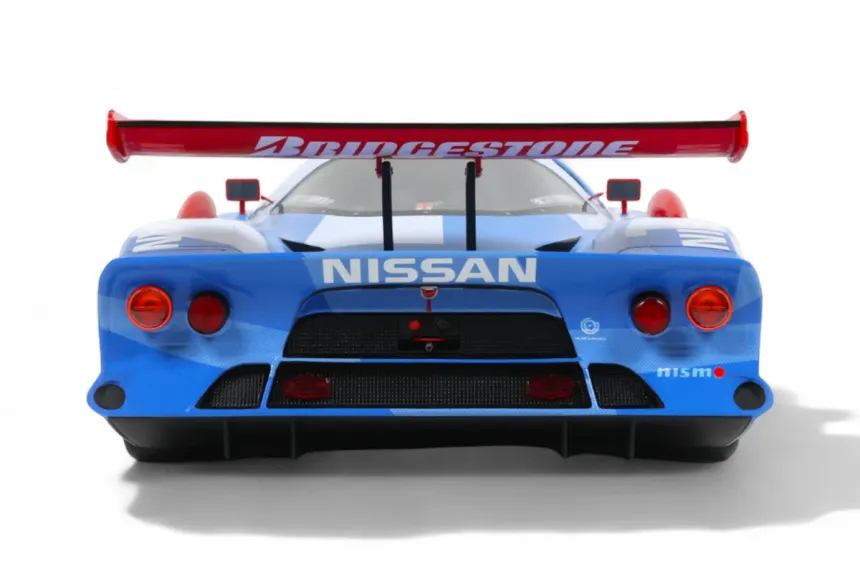
They had to rework the entire rear section in a matter of days. The exhaust was rerouted to the sides to clear internal space. And the technical problem arrived shortly after: the new boot configuration created cooling issues in the gearbox. The R390s began suffering transmission overheating during the race itself. The Le Mans 1997 result: two cars retired with gearbox failures. The third, driven by Hoshino, Comas and Kageyama, dragged itself to a disappointing 12th overall finish. After setting the fastest pre-qualifying time.
For a manufacturer that had spent considerable money assembling a Le Mans programme in partnership with TWR, the 1997 result was a disaster. They had to come back and do it properly.
1998: the podium no Japanese team had ever taken
Nissan rebuilt the car for 1998. Longer tail, new rear wing, new diffuser, the thermal problems solved. Four cars to Le Mans, with top-flight crew lineups — Jan Lammers, John Nielsen, Erik Comas, Martin Brundle, Kazuyoshi Hoshino, Aguri Suzuki, Franck Lagorce, Michael Krumm, among others — and the mission of rescuing the entire programme.
What happened at the Sarthe on the 6th and 7th of June 1998 is hard to overstate. The R390s weren’t the fastest car out there. In qualifying they sat behind the works Porsche 911 GT1-98s and behind the Toyota GT-One, which had been setting blistering times in testing for months. On paper, the Nissans weren’t going to be in the fight.
But what happened is what you only understand if you’ve ever watched a 24-hour race properly: reliability. While the Toyota GT-One broke within hours, while the Porsches suffered punctures, water leaks, spins and long repair stops, the four Nissans kept running. Without drama. As fast as they could, absorbing everything the track threw at them. At three in the morning, the R390s were still circulating. At nine on Sunday morning, still circulating. And when the two works Porsche 911 GT1s had their respective scares — McNish with a water leak, Müller with a spin — the R390 #32, driven by Kazuyoshi Hoshino, Aguri Suzuki and Masahiko Kageyama, found itself running third.
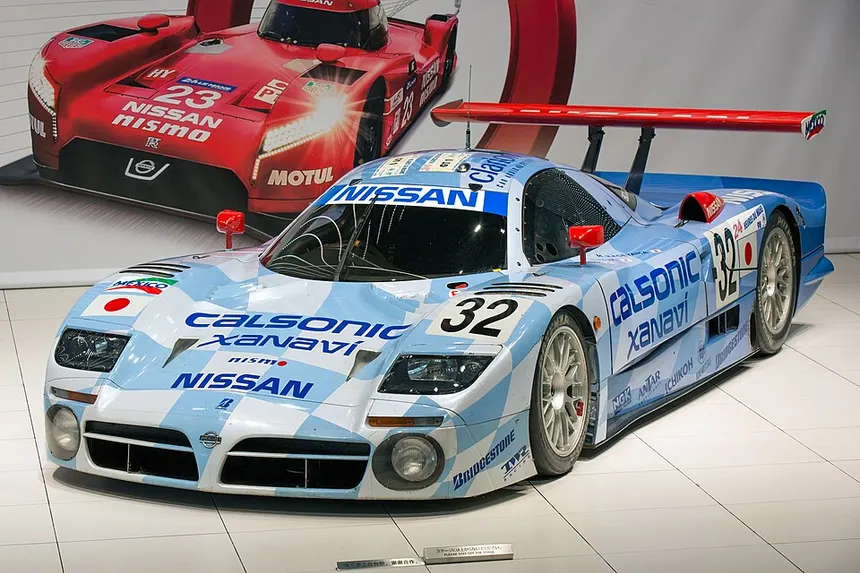
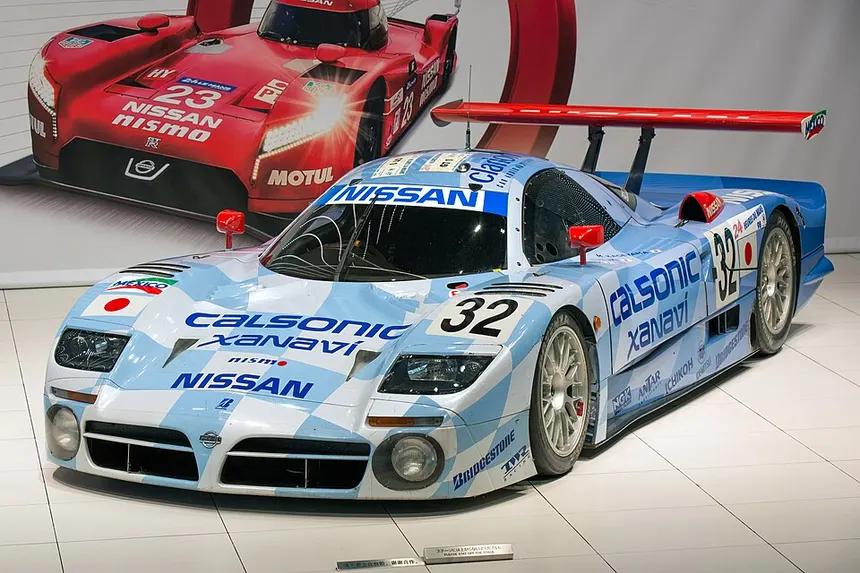
Third is where it finished. Behind the two Porsches that took a 1-2, the Nissan number 32 crossed the line to take a Le Mans podium. The other three R390s finished fifth, sixth and tenth. All four Japanese cars made it to the chequered flag. All four inside the top ten.
There’s something more significant than the positions. That podium for car number 32 was the first outright Le Mans podium ever achieved by a fully Japanese crew. Hoshino, Suzuki, Kageyama. Three Japanese drivers on the rostrum at the world’s most important endurance race. It had never happened before.
What’s left of the R390 GT1
Nissan withdrew from Le Mans GT1 after 1998. The brand moved to prototype racing in 1999 with the unsuccessful R391, then walked away from the discipline entirely until the disastrous GT-R LM Nismo of 2015. The R390 GT1 was left as a historical artefact.
Of the nine catalogued chassis (the #1, which was the road car later repainted as #2 when the colour changed; #3 through #5, the 1997 race cars; #6, destroyed in testing; and #7 through #9, the 1998 long-tail cars), Nissan keeps almost all at its Heritage Collection in Zama. The #32 podium car is there. The chassis #9 — race number 30, internally known as R8 — was kept hidden in Japan for twenty years by agreement with one of the drivers before resurfacing when it was transferred in 2018 to Frenchman Erik Comas, a driver in the 1998 programme, who carried out a full nut-and-bolt restoration in partnership with Classic Racing and Lucien Monte.
The single road car remains in Zama. And in 2024, during the celebrations of NISMO’s 40th anniversary, the podium-winning 1998 R390 GT1 was put on public display at the Nissan Global Headquarters Gallery in Yokohama, alongside the NISMO 270R, the 400R and the Calsonic Skyline GT-R from the JTCC. For many enthusiasts who had only seen the car in Gran Turismo 2 — the video game where the R390 GT1 became an icon of an entire generation — it was the first time they had ever encountered the car in the metal.
The road car has never been put up for sale. It has never been loaned for real-world driving outside controlled events. There is no current public price. The car exists, it still runs, it remains the rarest GT1 homologation special on the planet — rarer than a CLK GTR Strassenversion, rarer than a 911 GT1 Strassenversion, rarer than a McLaren F1 LM. And that matters in an era when GT1 road cars have become auction objects trading above the million-dollar line.
The R390 GT1 fits inside a sentence that defines its place in history neatly: the last Le Mans car Nissan ever built properly. After it came failed experiments, cancelled programmes, broken promises. But in 1998, for 24 hours, four Japanese cars delivered a lesson in endurance reliability at the toughest race in the world. And one of them stood on the podium with a fully Japanese crew for the first and only time in Le Mans history.
Check you’re still alive.