Alfa Romeo Giulia Quadrifoglio vs M3: Alfa’s Long War With BMW
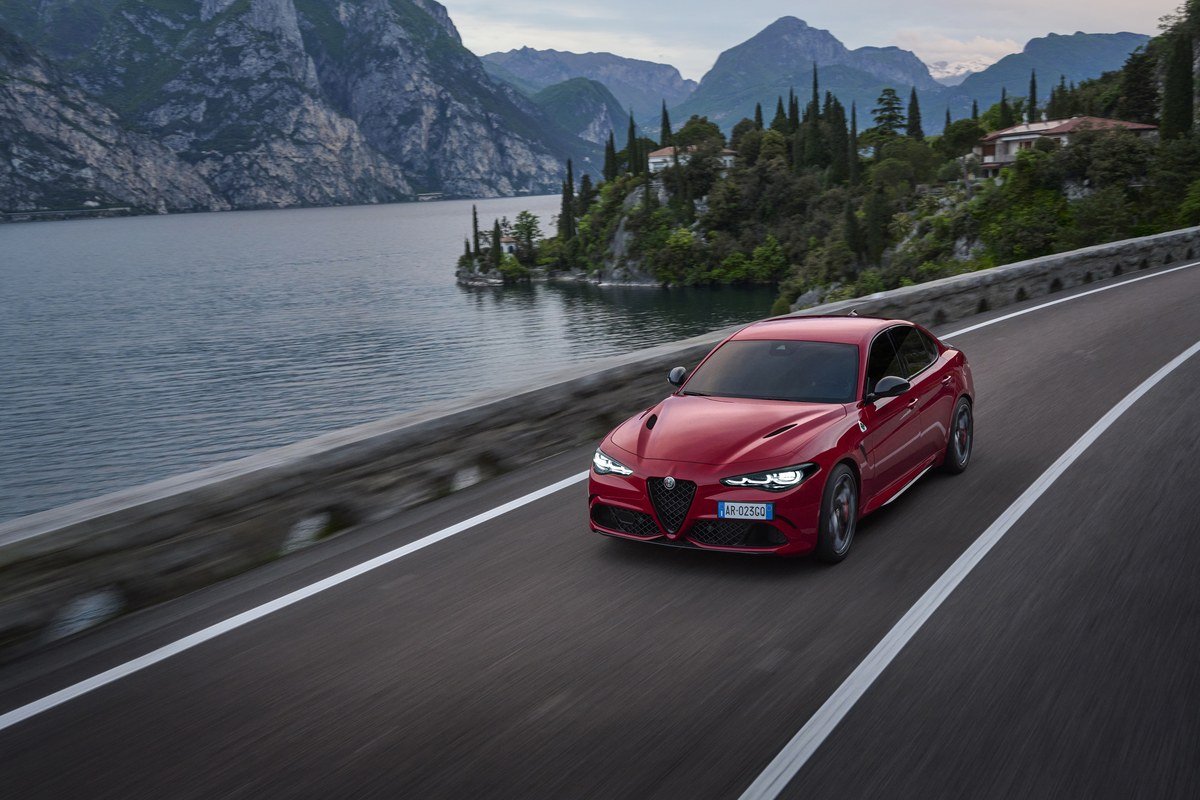
In 1995 Alfa Romeo packed up and left America. The last car it sold here was the 164 sedan, sales had collapsed, and the brand’s name had become shorthand for electrical fires and missing trim. For two decades the only Alfas most Americans saw were Spiders in old movies and the occasional Milano rusting quietly in a driveway. Then, in the summer of 2015, Fiat Chrysler stood up in a museum outside Milan and announced that Alfa was coming back with a four-door sedan built to beat the BMW M3 at its own game.
Nobody believed it. That’s exactly why the Alfa Romeo Giulia Quadrifoglio matters. It delivered on the stopwatch, it delivered in the comparison tests, and then it went and let down a lot of the people who bought one. All of that is part of the story, and all of it gets told here.
The grudge goes back to 1992
Alfa’s war with the M3 didn’t start with the Giulia. It started in Italian touring car racing in the early nineties, when the E30 M3 was beating the old Alfa 75 Turbo, the car Americans knew as the Milano, week after week. Fiat, which had owned Alfa since 1986, decided its racing budget would go to Alfa instead of Lancia, and it moved the engineers who had built Lancia’s championship-winning rally cars across to Alfa Corse, the racing arm that had grown out of Autodelta. Leading them was Sergio Limone, the man behind the Lancia 037 and the Delta.
Late in 1991 Limone’s crew built the 155 GTA: the body of Alfa’s new 155 sedan wrapped around the hardware of a Lancia Delta Integrale. That meant a turbocharged 2.0-liter four-cylinder pushed to around 400 horsepower (that’s the period press figure; Alfa never published one), permanent all-wheel drive and a six-speed gearbox. GTA stands for Gran Turismo Alleggerita, lightened grand tourer, the same name worn by the Giulia Sprint GTA of the sixties.
In 1992 Nicola Larini won the Italian championship in a 155 GTA, with Giorgio Francia second and Alessandro Nannini third. The BMW M3 Sport Evolutions of the CiBiEmme team, driven by Gabriele Tarquini, who was racing in Formula 1 for Fondmetal that same year, and former McLaren and Benetton driver Emanuele Pirro, ended up fifth and sixth. Four Alfas ahead of the best BMW. When Italy banned turbos the next year, Alfa took the fight to Germany. In the 1993 DTM, the 155 V6 TI won 12 of the 20 races and Larini took the title on Mercedes’ home turf. The 155 even cleaned up in Spain, where Adrián Campos, a former Minardi Formula 1 driver, won the 1994 Spanish Supertouring title in one, Luis Villamil repeated in 1995 and Italian Fabrizio Giovanardi took it again in 1997.

Alfa Corse then built a road-going 155 GTA prototype, aimed squarely at the M3 and the Mercedes 190E 2.5-16. Fiat’s management killed it: too expensive, not profitable, and pointless for homologation. One car was built, by Abarth, in 1992. In October 2018 it was due to cross the block at Bonhams in Padua with an estimate of up to €220,000, and it never got there: hours before the sale the owner sold it privately and paid the auction house a penalty to walk away. Nobody has said what the buyer paid. Americans never even got the regular 155. The anti-M3 would have to wait more than twenty years.
Ten engineers and a secret shop in Modena
The man who finally pulled the trigger was Sergio Marchionne, the sweater-wearing CEO who had already rescued Chrysler. In May 2014 he announced a €5 billion plan to rebuild Alfa Romeo around eight new models. The first had to be a rear-wheel-drive sedan to take on the 3 Series, the C-Class and the A4.
He gave the job to Philippe Krief, a French engineer who had been Ferrari’s technical director and the chassis engineer on the 458 Speciale. Krief remembers the exact day he got the call: April 29, 2013. Marchionne told him to build a small team, about ten people at first, and keep it walled off from the rest of the company. They set up in an anonymous industrial park in Modena, next to Maserati’s headquarters, in what everyone ended up calling the skunkworks. Within a year more than 200 engineers were working there, and many of them came from Ferrari.
Their first job was the Giorgio platform. A platform is the shared technical base a carmaker builds several models on: the floor structure, the suspension and engine mounting points, the basic geometry. Alfa hadn’t built a rear-drive sedan since the 75, so Giorgio had to be done from scratch for the Giulia, the Stelvio SUV and whatever came next.
The Giulia was unveiled on June 24, 2015, on the day Alfa turned 105, at the brand’s newly reopened museum in Arese. Only the Quadrifoglio was shown, and, according to accounts we couldn’t confirm with an official source, Andrea Bocelli sang Nessun Dorma. Marchionne told the crowd, in effect, that Alfa had spent thirty years failing and this was the comeback.
Then reality showed up. Development fell behind schedule, and in early 2016 Krief was out, moved over to Ferrari right after Marchionne had publicly admitted the delays. To get the program back on track, FCA rehired Roberto Fedeli, another Ferrari veteran who was working at BMW at the time. The car built to humiliate the M3 was finished by a man who had just walked out of Munich.
Three-quarters of a Ferrari V8
The engine has its own Ferrari backstory. In May 2013 Marchionne brought in Gianluca Pivetti, who ran gasoline engines at Ferrari, to design something exclusive for this car. The early target was around 460 hp, the figure they figured they’d need for a Nürburgring sedan record. By the end it was 505 hp in American spec.
People call it “a Ferrari V8 with two cylinders cut off,” and there’s a reason. It shares the 90-degree angle between cylinder banks and the exact bore and stroke of the F154 V8 in the Ferrari California T, 86.5 by 82 millimeters. Alfa says it’s an all-new design by the same engineer, who reused proven solutions to save time. Both statements are true.
The numbers: 2.9 liters, two IHI turbochargers, one per bank, up to 20 psi of boost, 505 hp at 6,500 rpm and 443 lb-ft of torque from 2,500 rpm, built at Alfa’s engine plant in Termoli, Italy. The block is closed-deck aluminum, meaning the top of the block is solid around the cylinders, which makes it stiffer and better able to handle turbo pressures. It combines direct injection, which sprays fuel straight into the combustion chamber, with port injection in the intake runners.

The crankshaft is where it gets interesting. It has three crankpins spaced 120 degrees apart, and each one carries two connecting rods, one from each bank. That makes the engine shorter and the crank stiffer, but it means the cylinders don’t fire at even intervals: the gaps alternate between 90 and 150 degrees of rotation. That’s where the Quadrifoglio’s raspy, uneven snarl comes from, nothing like the smooth hum of BMW’s inline-six.
The same geometry has a side effect. Looked at on its own, each bank fires evenly, every 240 degrees. Alfa gave each bank its own turbo and its own engine computer, and added cylinder deactivation: when you’re cruising, the three cylinders of the right bank shut down mechanically, their valves stay closed, and the engine runs on the left bank alone to save fuel. On a car rated at 17 mpg city by the EPA, every bit helps.
The intercoolers, which cool the compressed air coming out of the turbos before it reaches the engine, are air-to-liquid units with their own coolant circuit and electric pump, instead of radiators sitting in the airflow.
Carbon where you can’t see it
Krief’s other obsession was weight. The Quadrifoglio uses carbon fiber for the hood, the roof and the driveshaft, and aluminum for the doors, fenders, suspension, front strut towers, rear subframe and the engine itself.
The carbon driveshaft deserves an explanation, because it’s the part nobody sees and one of the hardest-working. It’s the tube that carries power from the transmission back to the rear differential, and it spins at engine speed divided by the gear ratio. The lighter a spinning part is, the less energy it takes to speed it up and slow it down. Saving pounds there is worth more than saving them in a door panel.
With the engine and the heavy hardware tucked between the axles, weight distribution is 50/50, half the mass over the front wheels and half over the rear. That’s a very good starting point for a balanced car in corners, although the final behavior also depends on suspension geometry, tires, damping, aerodynamics, the differential and how weight shifts under braking, acceleration and steering.
Out back sits a torque-vectoring differential with two clutches, one per rear wheel. Instead of splitting power evenly, it can send more drive to the outside wheel in a corner, which helps rotate the car and put the power down with less drama. A central computer called Chassis Domain Control, developed with Magneti Marelli, runs the stability control, adaptive dampers, differential and the active front splitter, a carbon blade under the bumper that moves to add downforce at speed.
The design came from Alessandro Maccolini under design director Marco Tencone. And here’s a detail that explains why the Quadrifoglio looks like the real Giulia rather than a regular sedan with a body kit glued on: according to designer Scott Krugger, speaking to Italy’s Automoto.it, the team designed the Quadrifoglio first. The regular versions came afterward, by taking away the splitter, the diffuser, the spoiler and the extra vents. Nothing on it is an afterthought, and it shows. It’s one of the best-looking Alfas in a very long time.
Seven thirty-two
The Nürburgring record was in the plan from day one. In September 2015 a Quadrifoglio with a six-speed manual lapped the Nordschleife in 7:39, the fastest time for a production sedan. Porsche took it away in June 2016 with the new Panamera Turbo at 7:38.
Alfa answered that September. The same test driver, Fabio Francia, who works for both Alfa and Maserati, took a Quadrifoglio with the ZF eight-speed automatic and stopped the clock at 7:32, six seconds quicker than the Porsche. This time Alfa posted the full onboard video, and you can watch Francia catching oversteer more than once. He later did 7:51.7 in the Stelvio Quadrifoglio to take the SUV record too.
What it cost you in America
The Quadrifoglio went on sale in the US in December 2016 at $72,000 before destination. The destination charge was $1,595, higher than on regular Giulias, because FCA shipped the Quadrifoglio in enclosed carriers, the same way it shipped the 4C. And if you wanted the six-speed manual that set the first Ring record, tough luck: it was never offered here. Every American Quadrifoglio got the eight-speed automatic.
That’s where the anti-M3 story plays differently on this side of the Atlantic. In Spain, the Quadrifoglio launched cheaper than the M3. In America it was the most expensive car in the fight. When Car and Driver lined it up against the competition in its March 2017 issue, base prices were $73,595 for the Alfa, $64,995 for the BMW M3, $61,690 for the Cadillac ATS-V and $73,725 for the Mercedes-AMG C63 S. For 2018 Alfa added more standard equipment and raised the price another $1,500.
What you got for the money was power. The M3 of the day made 425 hp and 406 lb-ft from its twin-turbo 3.0-liter inline-six. The Cadillac ATS-V, built in Michigan and developed at the Nürburgring, made 464 hp from a twin-turbo 3.6-liter V6. The C63 S made 503 hp from a twin-turbo 4.0-liter V8. The Alfa beat all of them on horsepower, claimed 0-60 in 3.8 seconds, and its 191-mph top speed was the highest in the class.
Car and Driver gave the Giulia the win in that comparison. It was the quickest of the four to 60, though the C63’s V8 pulled ahead past 100 mph. The magazine also noted that after warming the car up with remote start, the Alfa died the moment they pushed the start button. The Quadrifoglio and the regular Giulia both made the 2018 10Best list anyway. Which tells you something about how good it was to drive.
Eighty days in the shop
Then Car and Driver bought one for its 40,000-mile long-term test. It turned into a case study. In the first five months, the car spent a full month waiting for the only available Alfa technician to replace the rear differential, and it also needed a new fuel pump. A “service electronic throttle control” warning kept popping up and dropping the car into its normal mode, locking out the sport settings. By the end, the Giulia had spent 80 days in the shop over 14 months, and the magazine told readers to stay away from Quadrifoglios altogether. In July 2019 a Reddit user spotted it on a dealer lot with a little over 43,000 miles and a $41,500 sticker, about half its price new. Car and Driver checked the VIN, confirmed it was theirs, and the story went around all over again.
One car isn’t a statistic. But the pattern repeated: Jalopnik’s own test car threw a throttle fault and refused to accelerate on the highway. The most common complaints on 2017 through 2019 cars are electrical, from batteries that drain to warning lights that come on for no reason. And in 2025, NHTSA published a recall for the fuel pump on 2017-2019 Giulias, with a risk of loss of drive power, which means some cars are still out there without the fix. If you’re shopping used, run the VIN.
Cars built from 2020 on show far fewer complaints, and most early glitches were fixed with software. But in America, Alfa had already left once because of its reputation. Getting it back was always going to be harder than building a fast car.
Specials, and one last one for America
In March 2020, for the brand’s 110th birthday, Alfa revived the GTA name. The Giulia GTA and the track-focused GTAm got the V6 turned up to 540 hp, around 100 kg less weight and an aero kit developed with Sauber Engineering, the outfit then running Alfa’s Formula 1 team, with input from Kimi Räikkönen and Antonio Giovinazzi. Production was capped at 500 numbered cars, the same number required to homologate the original Giulia GTA for racing in the sixties. None of them came to the US. Alfa sold all 500 by September 2021, with plenty heading to China, Japan and Australia.
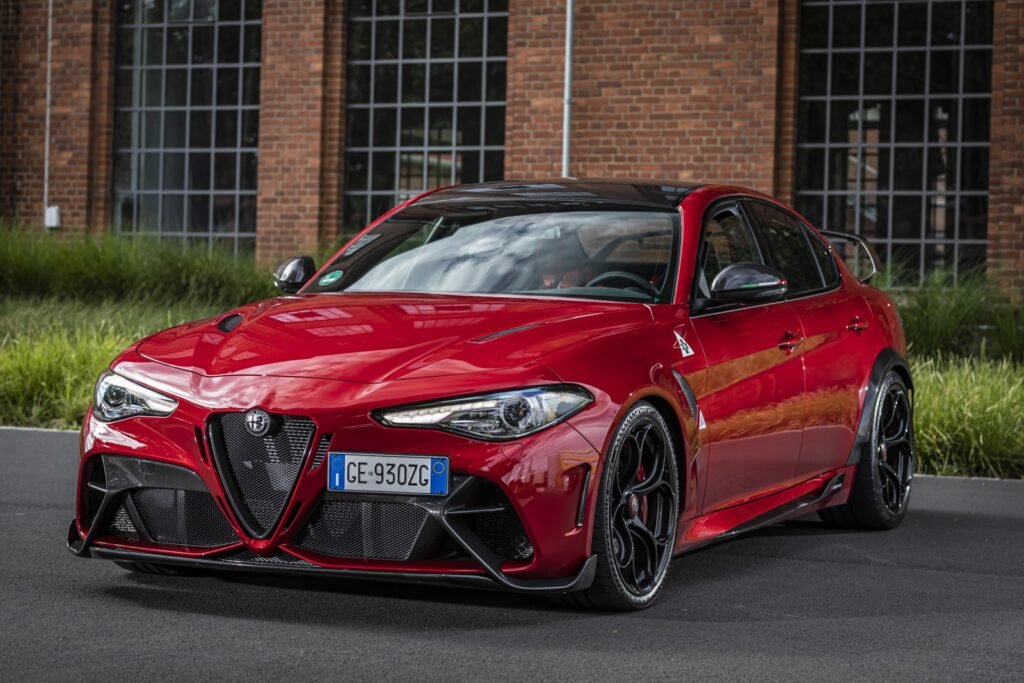
In 2023 the regular Quadrifoglio got its update for the 2024 model year in Europe: 520 hp and, more importantly, a mechanical limited-slip differential. An open differential splits power evenly, and when one wheel loses grip, the power escapes there. A mechanical limited-slip, as soon as the two rear wheels start turning at different speeds, transfers torque to the wheel with more grip through its own internal design, without waiting on a computer. American cars kept the 505-hp rating, and the US got its own farewell: the 2024 Quadrifoglio Super Sport, 72 Giulias for America out of 275 worldwide, at $86,770 before destination. Alfa’s US boss Larry Dominique called it the final chapter of the combustion Quadrifoglio in the United States.

After that, the US was out. The Collezione edition announced at the end of 2025, 63 cars across Giulia and Stelvio honoring 1963, the first year the cloverleaf appeared on a production Alfa, went to Europe, the UK, the Middle East, China and Japan. The Luna Rossa edition, ten cars built with Italy’s America’s Cup sailing team and revealed at the Brussels show in January 2026, makes around 140 kg of downforce at 300 km/h, five times more than a standard car. Word is all ten were sold before the reveal, although Alfa’s release doesn’t say so. In Europe, once the plan to turn Cassino over to electric models on the STLA Large platform stalled, Alfa reopened Quadrifoglio orders in March 2026 and plans to keep building it at the Cassino plant until the end of 2027.
The heir to the 155 GTA
The Giulia Quadrifoglio is the car the 155 GTA Stradale should have been before Fiat’s accountants killed it. It was born with the same obsession, beating the M3, and it pulled it off where it counts: on the Nürburgring, in the comparison tests and behind the wheel. It made 80 more horsepower than the BMW, put six seconds on the Panamera and looked better than anything else in the class while doing it.
It lost where Alfa always loses: the dealer network, the electronics and the patience of the owner. In America that loss hurt more, because Alfa was asking buyers to pay more than for an M3 and trust a brand that had walked out on them once already. A car that costs over $70,000 and spends 80 days in the shop has no excuse. The V6 and the chassis were never the problem. The problem was a company that couldn’t get its house in order fast enough to support the car it had built.
Still, if you want the last great Italian sports sedan with a gas engine, this is it. Buy a 2020 or newer, make sure every recall is done, find a service department you trust and drive it hard while the V6 is still being built.
Before the M3 the Giulia was built to hunt, there was one with no turbos at all: an 8,400 rpm V8 carved out of the M5’s V10. That story is in our BMW M3 E92 V8 piece.
Check you’re still alive.
Photos: Alfa Romeo (Alfa Romeo press), Neil (CC BY 2.0), Alexander Migl (CC BY-SA 4.0), Alfa Romeo (Alfa Romeo press), Alfa Romeo (Alfa Romeo press).