Ford Fiesta RS Turbo hot hatch, the Ford America never got
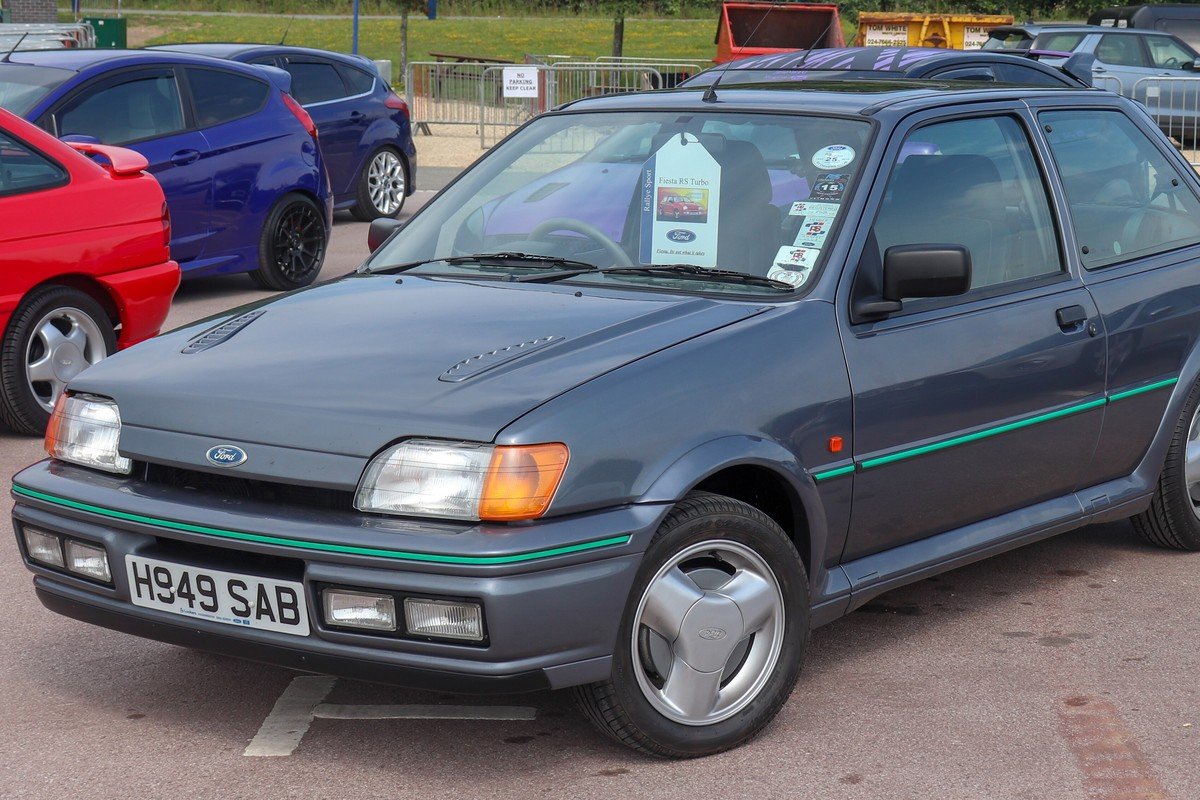
While American Ford buyers in 1990 were being handed Tempos and Escorts with all the fire of a wet newspaper, Ford’s European arm was building a 133-horsepower turbocharged pocket rocket in Valencia, Spain, that would never see a United States dealership. The Ford Fiesta RS Turbo didn’t just skip America: there was no Fiesta in America to skip. The first-generation Fiesta had been sold in the US for the 1978 to 1980 model years, then the American Escort replaced it, and the name didn’t come back until the 2011 Fiesta went on sale in the summer of 2010. So for a generation of American enthusiasts, this car existed only in grainy photos and imported British magazines. Every one of them is now well past the 25-year import rule, so it’s worth knowing exactly what you were missing.
It was a hit and a cursed car at the same time. Fast to the point of insolence, cheap for what it delivered, and so coveted that British insurers ended up treating it like a plague carrier. It thrilled you when you drove it and worried you when you parked it, because you never knew if it would still be there when you came back.
A plant built for the Fiesta
Ford didn’t pick Valencia by accident. The company built its plant in Almussafes, south of the city, specifically to make the original Fiesta, and the first cars rolled out in 1976. Fourteen years later, when Ford decided to build the angriest version of the third-generation car, RS Turbo production stayed exclusively in Spain, according to the Spanish outlets Clicacoches and Eventos Motor. The Mk3 Fiesta was also assembled in Dagenham, Cologne and Saarlouis, but the turbo was Valencian.
It launched in the spring of 1990: English-language Wikipedia says April, the Spanish sources say May. It was sold until 1992. Barely two years on the market, and it still marked a whole generation.
The Escort’s engine, shoehorned in
The Fiesta RS Turbo wasn’t invented from scratch. Ford already had an established turbo performance car in Europe, the Escort RS Turbo, and the plan was to take that proven recipe and drop it into the little brother. The block, pistons and crankshaft came from the Escort RS Turbo, while the cylinder head was borrowed from the Fiesta XR2i, the naturally aspirated warm hatch already in the range.
The engine was Ford’s CVH, a 1,597 cc four-cylinder with an 8.2:1 compression ratio, lower than a non-turbo engine’s so it could take the extra pressure without knocking. Then came the turbocharger, and it’s worth explaining what that part does because it’s the key to the whole car. A turbo is an air pump driven by the exhaust gases normally thrown away out the tailpipe. Those gases spin a turbine at enormous speed; the turbine is joined by a shaft to a compressor, and the compressor forces pressurized air into the engine. More air means more fuel can burn in each combustion stroke, and more fuel burned means more power. That’s how you get big-engine performance out of a small one.
Here’s the detail that shows how cars really get built. The Escort used a bigger Garrett T3. It wouldn’t fit in the Fiesta’s engine bay: there simply wasn’t room between the engine and the radiator. So the engineers fitted a more compact Garrett T2, running about 8 psi of boost. They added an intercooler, a radiator that cools the compressed air so it enters the engine denser, and with that the little Fiesta made 133 PS at 5,500 rpm and 135 lb-ft of torque at just 2,400 rpm. That’s roughly 131 hp in American terms, from 1.6 liters, in 1990.

The numbers depend on who’s measuring
The sources don’t agree, so let’s sort it out. Clicacoches quotes 133 PS at 5,000 rpm in its text and 5,500 in its spec table, and 5,500 is what nearly everyone else gives. Torque comes in at 183 or 184 Nm depending on who you read. Weight moves even more: 910 kilos in the Clicacoches table, up to 945 kilos elsewhere, so somewhere between 2,005 and 2,085 pounds. Performance too. Wikipedia gives 0 to 60 mph in 7.9 seconds and 214 km/h, about 133 mph, flat out; Spanish tests measured 8.1 to 8.2 seconds to 100 km/h and 211 to 213 km/h. None of that changes the picture: 130-plus mph and around eight seconds to sixty in a car that weighed less than a ton.
That weight is what turned the horsepower into dynamite. A strong engine in a heavy car drags itself along; the same engine in a light car flies. To put it in American terms, a 1990 Ford Escort GT, the hottest small Ford you could buy in the US that year, made 110 hp from a 1.9 in a bigger, heavier body. The Fiesta had more power and less car.
Against Europe’s kings of the street
In Europe, the Fiesta’s real rivals were cars Americans never bought new either. The Peugeot 205 GTI 1.9, on sale from late 1986, made 130 PS, weighed around 875 to 880 kilos and ran 0 to 100 km/h in about 7.8 seconds with a 206 km/h top speed. The Renault 5 GT Turbo, in its 1987 Phase 2 form, made 120 PS in roughly 830 kilos. And the second-series Fiat Uno Turbo i.e. of 1989 moved to a 1.4 with 118 PS and around 910 kilos.
The Fiesta showed up late, but it wasn’t there to make up the numbers: it was the most powerful of the four and the fastest flat out. Where it lost was polish. The 205 had the chassis everyone copied, the Renault had rally glory; the Fiesta had power and not much to keep it in check.

Inside, it took its role seriously: Recaro seats that held you through corners like a firm hand, a three-spoke sports wheel and details that set it apart from an ordinary Fiesta. Outside, 14-inch alloys on 185/55 Pirelli P600 tires, RS-badged hood vents and discreet green stripes. It stopped with 240 mm front discs and rear drums, which by 1990 already looked thin next to the 205 GTI 1.9’s four-wheel discs.
No limited-slip, plenty of torque steer
The Escort RS Turbo had a limited-slip differential, a device that splits the drive between the two powered wheels so that, when you accelerate hard out of a corner, the wheel with grip gets the push instead of the other one spinning uselessly. The Fiesta went without it, as Eventos Motor confirms, and you felt it: with 133 PS going through the front axle alone, flooring it made the car tug at the steering wheel while the front tires fought for traction. Americans would later learn the word for it with the Neon SRT-4 and the Cobalt SS. In 1990, Europe was already living with it.
The car everyone wanted to steal
In the early nineties, Britain was in the middle of a genuine epidemic of cars stolen to be thrashed and dumped, what the British called joyriding. Small Ford performance cars, the Fiesta RS Turbo and the Escort, sat at the top of thieves’ lists: fast, easy to break into with the methods of the day, and irresistible to anyone chasing a thrill.
The result was a poisonous spiral. Because they were stolen so often, insurers sent premiums through the roof. Insuring a Fiesta RS Turbo, especially for a young driver, which was exactly the audience that wanted it, became ruinously expensive. The dream hot hatch turned into a financial trap: cheap to buy, crippling to insure, and carrying a real chance of waking up to an empty parking space.
In 1992 Ford dropped it and replaced it with the RS1800, sold in Spain as the XR2i 16v: a naturally aspirated 1.8 Zetec sixteen-valve with 130 PS. Fans often say the turbo’s theft reputation drove that decision, but no official source confirms it. The swap also lined up with Ford rolling its new Zetec engine family across the range.
The oil habit
No portrait of this car is complete without its mechanical quirks. The one owners and specialists mention most with the turbo CVH is oil consumption, usually blamed on the valve stem seals: small rubber parts that seal the passage where the valve stems move, which hardened with heat and let oil slip into the combustion chamber, where it burned. The owner who didn’t check the dipstick risked a serious bill.
There are more weak points any buyer of an imported example should check. The head gasket suffered when the engine overheated, made worse by an engine bay that got rid of the turbo’s heat poorly. Shocks wore out quickly, and the front bushings, the rubber blocks that absorb the suspension’s vibrations, softened with age and made the front end rattle. None of it was fatal on a car that got good oil and a disciplined owner. Anyone who bought one thinking a nineties turbo looked after itself paid for the lesson at the shop.
A name borrowed from General Motors
Here’s a twist American readers will enjoy. When Ford was naming its small car in the mid-seventies, it went through a long list that included Amigo, Metro, Sierra and Bravo. According to Wikipedia, the marketing team preferred Bravo, and Clicacoches goes further, saying it won the internal vote. Henry Ford II vetoed it and insisted on Fiesta.
The catch: Fiesta wasn’t Ford’s to use. General Motors owned it, having put it on Oldsmobiles since the fifties. Ford had to ask the competition, and GM chairman Tom Murphy handed it over for free. If Detroit had been less friendly, this story would be about the Ford Bravo RS Turbo.
What it cost in Spain
In Spain, the RS Turbo listed at 1,920,000 pesetas, according to the period price quoted by Clicacoches. Options were extra: 24,000 pesetas for metallic paint, 60,000 for the sunroof and 99,000 for ALB, Ford’s early anti-lock brake system, which kept the wheels from locking in a panic stop. At roughly 5% of the car’s price, very few buyers ticked that box. It came in only four colors: red, white, gray and black.
One nuance matters here: the theft epidemic and the impossible premiums were mostly a British story. In Spain, where the car was built, the RS Turbo is remembered more as the expensive toy every neighborhood had one of.
Why it’s worth hunting one down today
The Ford Fiesta RS Turbo is one of the great forgotten cars of the small-turbo golden age, overshadowed by the 205 GTI and the R5 GT Turbo when it played in their league. Its reputation for theft is, ironically, one reason clean examples are scarce: many vanished, were wrecked by thieves or scrapped. Finding an original, rust-free car with a careful history gets harder every year, and since there’s no reliable production figure, nobody really knows how many survive.
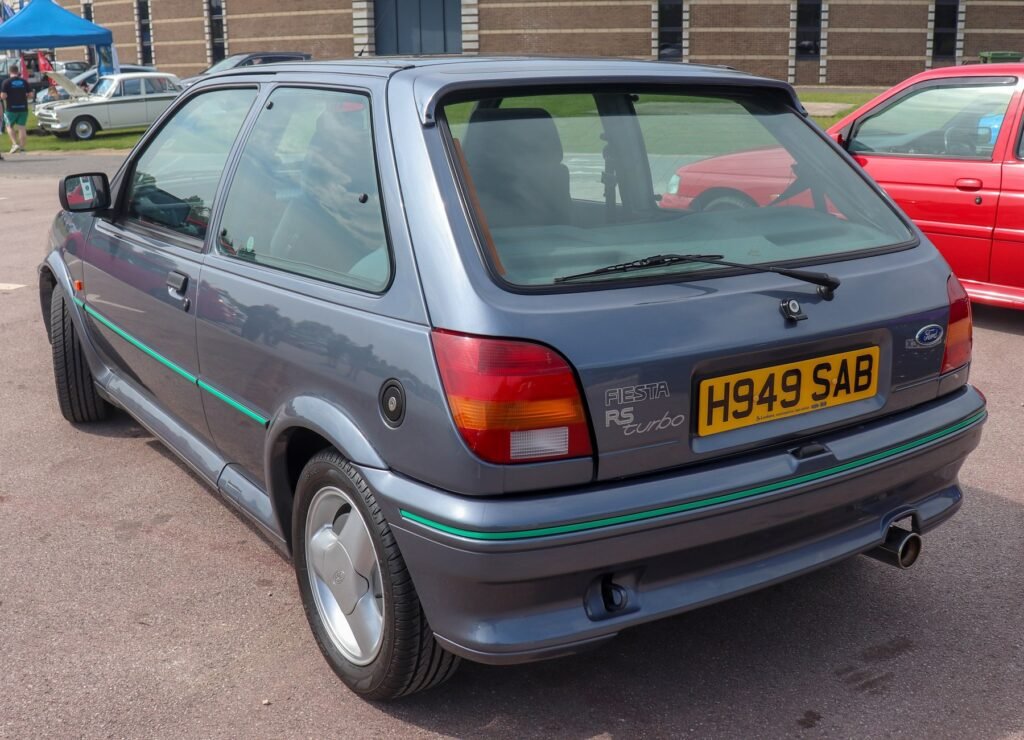
That scarcity, plus the nostalgia of a generation that wanted one when young and can now afford it, has started pushing values up. And before anyone thinks about swapping that engine for batteries, over at Not Enough Battery we looked at the myths around electrifying a classic.
It doesn’t have the Peugeot’s cult or the Renault’s trophy cabinet, but for Americans it has something better: it’s the forbidden fruit that never crossed the Atlantic, a Ford your own Ford dealer never offered you. Its big brother, the Sierra RS Cosworth, came out of Genk, Belgium; this one came from Spain. It made you fall in love and wrecked your insurance in equal measure, and it proved you didn’t need to be German or French to build a legendary hot hatch. You just needed a factory in Almussafes.
Check you’re still alive.
Photos: Vauxford (CC BY-SA 4.0), Vauxford (CC BY-SA 4.0), Kieran White (CC BY 2.0), Vauxford (CC BY-SA 4.0).