Citroën BX 4TC Group B: the rally car Citroën tried to erase
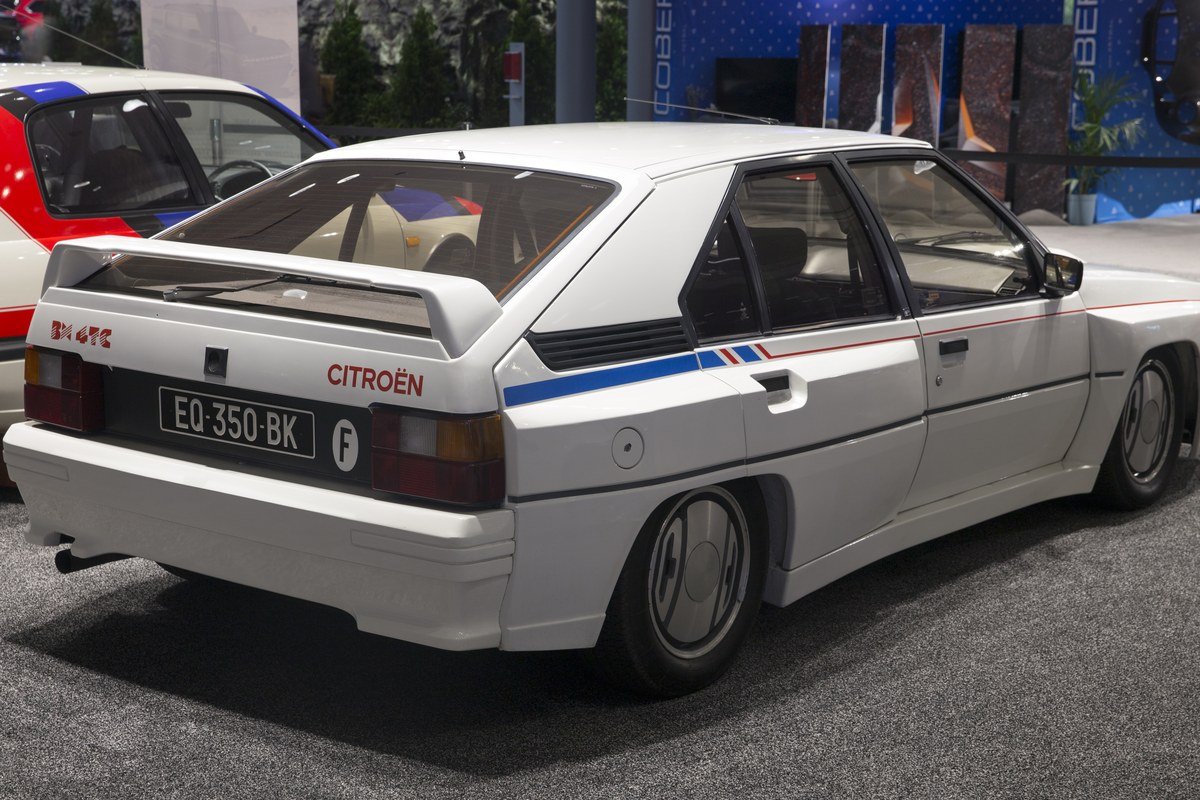
Every American who grew up on Group B videos knows the names. Audi Sport Quattro S1. Lancia Delta S4. Peugeot 205 T16. Ford RS200. They’re poster cars, video-game cars, cars people argue about on forums at two in the morning. The Citroën BX 4TC is not on that list, and that’s exactly how Citroën wanted it. When the car flopped, the company didn’t just walk away. It crushed the unsold road cars, reportedly with a court bailiff on hand to certify the destruction, and it went after the ones it had already sold.
Think about that for a second. A carmaker paying to destroy street-legal cars it had built itself, just so it wouldn’t have to look at them anymore. That’s the BX 4TC. And that’s why the Petersen Automotive Museum in Los Angeles has given one of them a spotlight of its own, a few miles from where Citroën hasn’t sold a new car since 1974.
Two hundred cars and a loophole
Group B worked on a simple deal. Build 200 road-going examples of a car, and you could go rallying with a wildly modified version of it. Two hundred is nothing. Detroit built more Corvettes than that in a slow afternoon. So the rule turned into an open invitation: design a pure race car, slap a license plate on 200 tamed copies, and call it a production model.
By the mid-1980s that loophole had produced the most violent machines rallying has ever seen. Turbocharged, four-wheel-drive, featherweight, with the fastest cars past 500 horsepower by 1986, flying down gravel roads between crowds that stood close enough to slap the fenders. Audi had the Quattro, Lancia had the Delta S4, Peugeot had the 205 T16, the car that set the template that NEC readers will recognize in the later 405 T16. Citroën wanted in.
It picked the BX as its base in 1983, aimed at the 1985 season, and missed it badly. The car didn’t turn a wheel on a test track until December 1985. Running the show was Guy Verrier, a former Citroën rally driver who had grown up in a company that once won rallies with the DS. That history mattered. It made Citroën think it could do things its own way.
A Bizarro World Sport Quattro
If you’ve never seen a BX, picture a boxy, sharp-edged French family hatchback, the kind of car that looks like it was drawn with a ruler. Now stretch the nose by a good few inches, bolt on enormous flared fenders, add wheels from the CX GTi Turbo and a rear spoiler from the BX Sport. That’s the 4TC. Motor Sport magazine later called it rallying’s Cyrano de Bergerac, after the French literary hero famous for his nose. Hagerty went with a “Bizarro World” Audi Sport Quattro. Both are fair.
The long snout wasn’t styling. It was hiding the car’s biggest mistake. By 1986, the winning recipe in Group B was clear: put the engine in the middle, behind the driver, like Peugeot and Lancia did. Citroën went the other way and copied Audi. The engine sat up front, mounted lengthwise, and hung well ahead of the front axle. To be fair to the engineers, the call was made before the 205 T16 had proved how much better a mid-engine car could be. But by the time the BX actually raced, it was already a generation behind.
Here’s why that matters, in plain terms. Hang a heavy engine out in front of the front wheels and it acts like a weight on the end of a lever. The car wants to keep going straight when you turn the wheel. That’s understeer, or “push” as American racers call it: the front tires run out of grip and the car slides wide instead of turning in. On a twisty gravel stage, push is a lap-time killer. Audi was already fighting the same problem with the Quattro. Citroën signed up for it on purpose. And according to Motor Sport, the Evolution rally car didn’t even have a center differential, which made getting it to rotate harder still.
A 1960s Chrysler engine against Lancia
The engine was the next problem. The N9TE was a 2,141 cc four-cylinder with a Garrett turbocharger, an air-to-air intercooler and Bosch L-Jetronic injection. Sounds modern enough. But the block underneath was a cast-iron Simca design from the late sixties, originally meant for the Chrysler 160/180 sedan. Yes, that Chrysler: the company’s European arm, which owned Simca until Peugeot bought it in 1978. The same engine family ended up in the Talbot Tagora, the Matra Murena and, turbocharged, the Peugeot 505 Turbo, a car some Americans may actually remember from their own dealerships. Tough as an anvil. About as light as one, too.
Then there was the suspension. Citroën couldn’t resist bringing its hydropneumatic system, the gas-and-fluid spheres that replace conventional springs and give big Citroëns their famous floating ride. The steering was the speed-sensitive DIRAVI setup from the CX. The idea was to prove Citroën tech could survive snow, mud and gravel at full attack. What it proved was that a system designed for comfort, carrying a heavy engine way out front, would give you setup headaches and suspension failures mid-rally. The five-speed manual gearbox came from the same family as the units in the DS and the SM, one of the few in Citroën’s parts bin that could take the torque.
The numbers, and what they meant in 1986
The road car made 200 hp at 5,250 rpm and 294 Nm, about 217 lb-ft. Citroën claimed 220 km/h (137 mph) and 0-100 km/h in 7.5 seconds. When French magazine Sport Auto tested one, it got 211 km/h (131 mph) and 9.1 seconds. A price of 248,500 francs is widely quoted for 1986, though we haven’t found the original price list to confirm it.
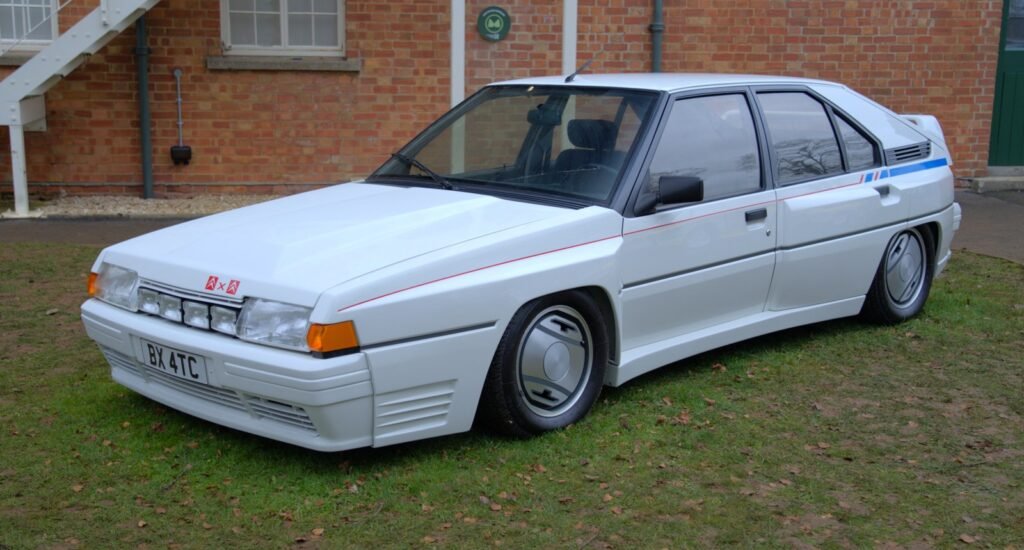
For context, the road-going Peugeot 205 T16 of 1984 also made around 200 hp, but with its engine in the middle where it belonged. And here’s the twist: Heuliez, the French coachbuilder that assembled the BX 4TC road cars, also built the 200 road-going 205 T16s. Same shop, same era, one car became a legend and the other became scrap.
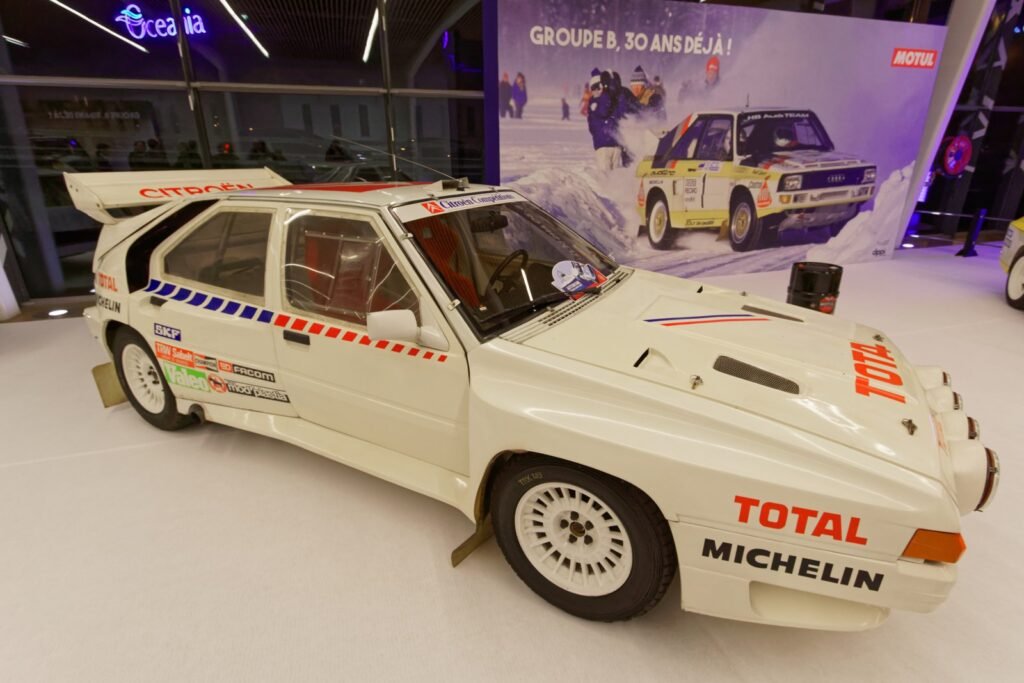
The 4TC Evolution rally car made 380 hp at 7,000 rpm and 252 lb-ft at 5,500. It weighed 1,150 kg, about 2,535 pounds, against a class minimum of 960 kg. That’s nearly 200 kg, more than 400 pounds, of dead weight. Meanwhile at least two Group B cars were past 500 hp by 1986, and the Delta S4 and 205 T16 ran in a class with an 890 kg minimum. Less power, more weight, the wrong layout. You don’t need a degree in engineering to see where this goes.
Three rallies, one finish
The Evolution debuted at the 1986 Monte Carlo Rally. Philippe Wambergue was out in the opening stages with a hydraulic suspension failure. Jean-Claude Andruet, who set a couple of top-eight stage times, went off the road a few stages later. Next up was Sweden, and the only good day the car ever had: Andruet finished sixth, the only championship points the BX 4TC ever scored. Wambergue retired with a frozen oil line. In Sweden. Of course.
Citroën pulled the cars to work on them, and the world around it fell apart. In March, at Rally Portugal, Joaquim Santos lost control of his Ford RS200 and plowed into the crowd, killing three spectators. On May 2, 1986, at the Tour de Corse, Henri Toivonen and co-driver Sergio Cresto died when their Lancia Delta S4 left the road and burned. The governing body, then called FISA, killed Group B for 1987. The cars could race out the season, but the category was dead.
The BX came back for one more try at the Acropolis Rally in Greece in early June, the roughest event on the calendar. Andruet crashed on stage three. Wambergue and Maurice Chomat both broke their suspension. Three cars started, none finished. Citroën shut the program down and never looked back. For a team with one sixth place to its name, the end of Group B was less a tragedy than a convenient exit.
Andruet himself never bought the “disaster” story. Years later he told Hagerty the car was much better than its reputation, calling it “fast, fantastic, and extraordinary.” He apparently meant it: according to the auction house, he bought one of the Evolutions new from Citroën.
Paying to destroy your own cars
Now the part that made the 4TC famous. Citroën needed 200 road cars for homologation. It couldn’t sell half of them. Depending on who you ask, it sold 86 (a figure several sources use) or 62 (the number RM Sotheby’s quotes). The rest sat unsold.
Most companies would have discounted them. Citroën destroyed them. The reason, according to the Artcurial auction catalogues, was money rather than pride: supporting a tiny batch of complex, hand-built cars with parts, warranty and service would cost more than it was worth. So the unsold cars went to the crusher, with a court bailiff, a huissier in French, certifying each one was gone. The same catalogues record, explicitly as a rumor, that Citroën offered owners of cars already sold up to double what they had paid to get them back. Car Throttle repeated it with a careful “allegedly.” Nobody has ever produced proof. Of the 20 Evolutions built by the competition department at Trappes, most were reportedly taken apart.
Citroën wasn’t done yet. A rallycross driver named Pivert kept racing one of the Evolutions until 1989. According to Motor Sport, Citroën leaned on him to park it. The company didn’t just want to forget the car. It wanted nobody else to see it either.
From crusher to Monterey
That’s the irony. By trying to make the BX 4TC disappear, Citroën made it rare, and rare is what collectors pay for. Estimates of surviving road cars run from about 30 (RM Sotheby’s) to about 40, with six or seven Evolutions left, some in museums such as Citroën’s own Conservatoire and the Hommel museum in France.
The auction results tell the story. In February 2019, Artcurial sold a road car at Rétromobile in Paris for €58,408. In October 2021, Artcurial sold Andruet’s own Evolution, chassis 18, for €417,200, about $485,000, well over its €250,000-350,000 estimate. In August 2023, RM Sotheby’s sold a 1987 road car at Monterey for $89,600. And in January 2022, a US dealer listed another 1987 car at $198,000. Since every 4TC is now well over 25 years old, they can come into the US legally, and a handful already have.
The strangest car of the lot may be the one Heuliez kept in its own museum. It had been assembled by hand by students at a vocational high school in Niort, painted black, and had barely over 1,000 km on the clock. Artcurial sold it for €32,167. A car built to fight Lancia ended up as a shop-class project.
Bertone saw something in it
There’s another side to the story. In May 1986, while the rally car was still officially active, Bertone showed a concept called the Zabrus at the Turin show, built on BX 4TC mechanicals. Designed by Marc Deschamps, it was a three-door 2+2 with scissor-style front doors and none of the 4TC’s awkwardness. Some people see the later Citroën XM in its lines. That’s our read, not an official link. But it’s a nice footnote: the same hardware that embarrassed Citroën on gravel looked very good on a show stand.
For a sense of how far Citroën has drifted since: the company that crushed its own homologation cars now sells the Ami, an electric cube that tops out at 28 mph.
Stubborn to the end
The BX 4TC was the wrong car at the wrong time: an old engine, too much weight, a layout that was obsolete before it raced, and a suspension Citroën brought along out of pride as much as logic. If you want the other side of the same era, the cars that actually worked, NEC has the Mazda 323 GT-R, turbocharged and four-wheel drive, which arrived after Group B and won in Group A, and the Peugeot 205 GTI, the road car that made Peugeot’s name in the 1980s.
What makes the 4TC unique isn’t anything that happened on a stage. It’s what happened at the crusher. Citroën tried to erase a car, and in doing so turned it into one of the most collectible failures of the 1980s. A few dozen survive, each one a car its own maker wanted gone.
Check you’re still alive.
Photos: Mr.choppers (CC BY-SA 3.0), MrWalkr (CC BY-SA 4.0), Thesupermat (CC BY-SA 4.0).