Fiat Uno Turbo i.e.: the Italian firecracker America never got
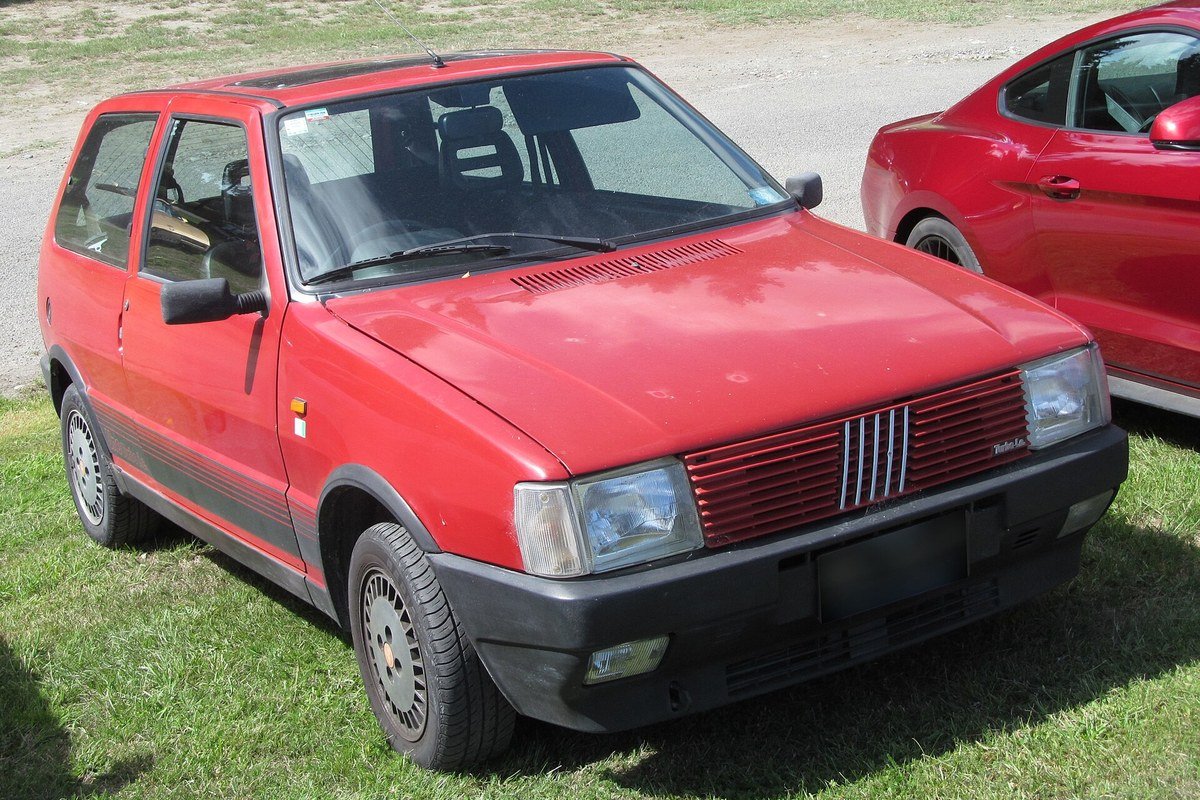
There’s a whole generation of European drivers who learned what turbo lag felt like in a Fiat Uno. Americans never had the chance. By the time the Uno Turbo i.e. arrived in the spring of 1985, Fiat had pulled out of the US market, leaving the X1/9 and the Spider to soldier on under Bertone and Pininfarina badges. So while kids in Turin and Madrid were scaring themselves silly in a boosted shopping car, the American picture of small Fiats stayed stuck on rusty Stradas. They missed the best one.
The Uno itself was no joke. It had been European Car of the Year in 1984, beating the Peugeot 205 and the Golf, and it had passed a million sales by the time the Turbo showed up. Fiat then did something Peugeot never would have done with its own hot hatch: instead of making the fast version polished and friendly, it made it a little bit dangerous.
105 horsepower and almost nothing to carry
Start with the numbers, because they still sound wrong. A 1,301 cc four-cylinder, an IHI turbo running around 0.6 bar, an air-to-air intercooler, 105 hp and 147 Nm at 3,200 rpm. All of that in a car weighing 845 kg, about 1,860 lb. That’s roughly 8 kg for every horsepower. Fiat quoted 200 km/h, or 124 mph, and 0 to 100 km/h in 8.3 seconds. In Italy it cost 14,450,000 lire.
Put it next to the cars it was built to embarrass. The 1984 Peugeot 205 GTI 1.6 had the same 105 hp and topped out around 190 km/h. The second-generation Golf GTI, also new in 1984, made 112 hp from its 1.8, weighed over 900 kg and ran out of breath at about the same speed. Only the 1985 Renault 5 GT Turbo beat the Fiat on paper, with 115 hp, a claimed 830 kg, 201 km/h and 0 to 100 in 8 seconds.
For an American yardstick, Honda’s CRX Si was the small fast car everybody wanted in 1988. It made 105 hp too, three years after the Uno, from a bigger 1.6 with no turbo. Volkswagen’s US-market GTI 16V that same year had 123 hp and a lot more car to haul around.
Today a hot hatch weighs well over 1,400 kg and we’re told it’s progress. We’ve written about the great weight lie before, and the Uno Turbo is the best argument for it you’ll find.
Two cubic centimeters and a faster lane
Here’s a detail that tells you a lot about Italy in the eighties. The engine was planned at 1,299 cc and went on sale at 1,301. Those two extra cubic centimeters weren’t about power. Since a decree in October 1977, Italian motorway speed limits depended on engine size: cars from 901 to 1,300 cc were allowed 130 km/h, anything over 1,300 cc got 140 km/h, or 87 mph. At 1,299 cc, a car that could do 124 mph would have been legally slower on the autostrada than a family sedan with a 1.4. Two cc fixed that.
Compare that with what was happening in America at the same time, where the double nickel, the 55 mph national limit, had been the law since 1974 and wasn’t relaxed to 65 on rural interstates until 1987. In 1985 an Uno Turbo owner in Italy could legally cruise more than 30 mph faster than a Corvette owner in Ohio.
The perk didn’t last. In July 1988 Italy’s transport minister cut every motorway limit to 110 km/h, supposedly just for the summer holiday rush. Accidents fell, so it stayed for more than a year. When displacement-based limits came back in the fall of 1989, the top figure was 130 km/h for anything over 1,100 cc, and the clever 1,301 cc trick stopped meaning anything.
The i.e. part mattered more than the turbo
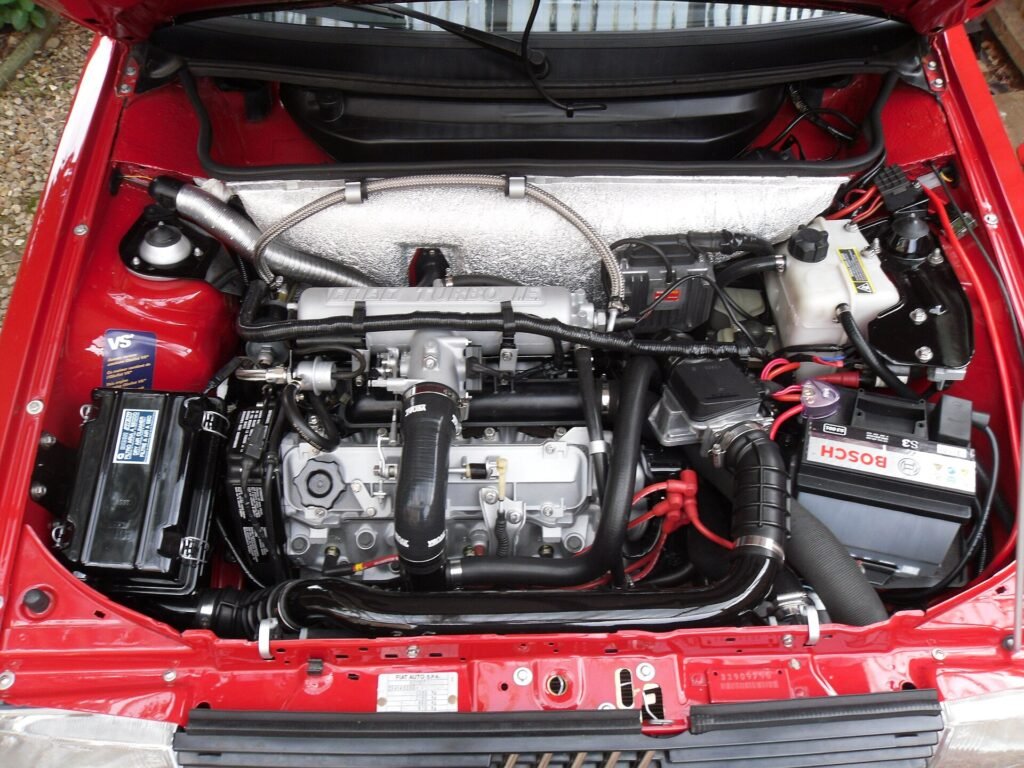
Those two letters stand for iniezione elettronica, and in 1985 that was rare in a small car. Most economy cars still breathed through carburettors. The Uno’s direct rival, the Renault 5 GT Turbo, blew through a Solex carburettor. The Peugeot 205 GTI did have Bosch injection, but it was a pricier, more grown-up car. Fiat gave the Uno a Bosch LE2-Jetronic and Magneti Marelli electronic ignition, electronics you’d normally find in a much more expensive sedan.
The rest was sensible engineering on a budget. The five-speed gearbox came from the Ritmo 105 TC, the same car Americans knew as the Strada. There were discs at all four corners, ventilated up front, plus an anti-roll bar. And the IHI turbo was cooled by water as well as oil, which tells you Fiat knew exactly how hot things were going to get.
Lag, then a kick
A turbo is an air pump spun by exhaust gas. The exhaust drives a turbine, the turbine drives a compressor on the same shaft, and the compressor forces extra air into the engine so it can burn more fuel. It’s how a small engine makes big-engine power, the trick Saab took to the street a few years earlier.
Eighties turbos had a catch. Below a certain speed the turbine simply isn’t spinning fast enough, so nothing happens. Then it wakes up and everything arrives at once. In the Uno that meant a soft, docile little car around town that turned into something else once the needle swung past the middle of the dial. In a straight line it was hilarious. In a bend, with the boost landing on the front wheels at the wrong moment, it could bite.
Fiat chose a small turbo on purpose, because a small one spins up sooner. The goal was a quick car an ordinary driver could handle. It nearly got there. Michele Alboreto, then driving for Ferrari in Formula 1, tested it at Jacarepaguá in Brazil and called it fun and responsive, with a turbo that gets your heart racing. He also said a bit more power would make it a proper track car, which is exactly what Fiat delivered four years later. Giancarlo Baghetti, René Arnoux and rally champion Markku Alén all took turns in it for Fiat’s tests and promotions too.
Velvet, red carpet and a warning light for everything
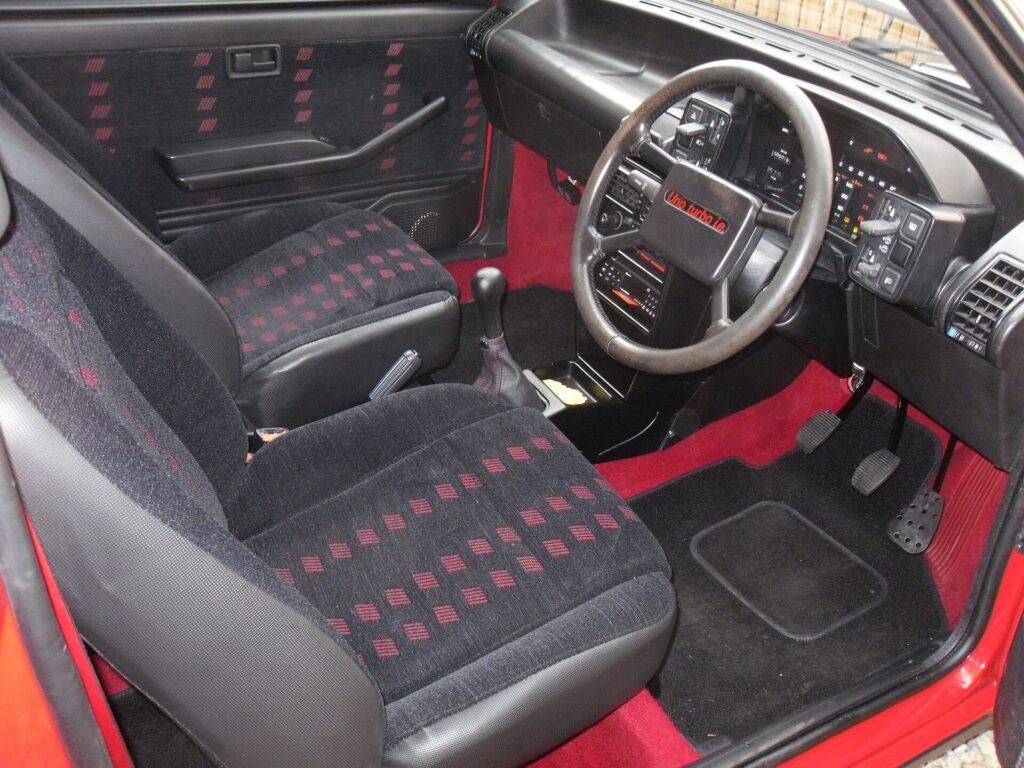
Fiat dressed the Turbo like it meant it. A fiberglass tailgate with a spoiler, a front bumper with built-in fog lights and openings for the intercooler and oil cooler, 13-inch alloys with an Abarth scorpion in the center, 175/60 tires that counted as low-profile at the time. Inside you got black velvet seats printed with the five red bars of the Fiat logo, red carpet and a red LCD clock.
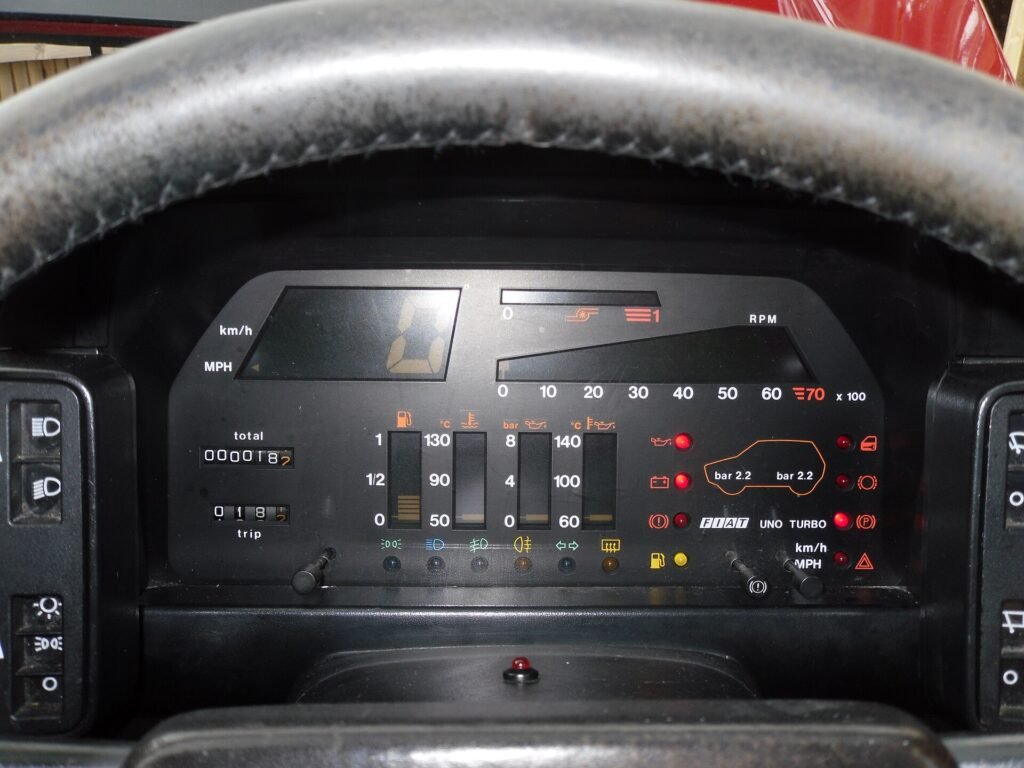
The gauges were analog from Veglia Borletti, or digital from Nippon Seiki if you paid extra, with boost pressure and oil temperature on display. There was also a “check panel” that warned you about open doors, lights, coolant and oil. Fiat’s own heritage department now admits, with a straight face, that it lit up more and more as the years went by.
Why so many died young
Turbos run on exhaust heat, and packing one into a tiny engine bay cooks everything around it. It’s the same enemy engineers fight today with EV battery thermal management, just with a lot less money behind it.
The rule with any turbo car of the era was to let the engine idle for a few seconds before switching off, so oil kept flowing through the hot bearings. Drive it hard, kill the ignition straight away, and the oil baked inside the turbo. Do that often enough and the turbo was finished. The Uno Turbo was quick and cheap, so a lot of them went to young drivers who never heard of that rule. That abuse, more than any factory flaw, gave the car its fragile reputation.
Fiat kept tinkering. A green digital dashboard arrived in 1986, very much of its time. With the 1987 update came Antiskid, an AP Lockheed anti-lock system that worked on the front wheels only. When the Italian press drove the prototypes in September 1987, the Antiskid car was expected to cost 17,974,000 lire, three and a half million more than the Uno Turbo had cost at launch. Fiat’s own heritage department now calls the system revolutionary and problematic in roughly equal measure.
The 1.4: more boost, fewer surprises
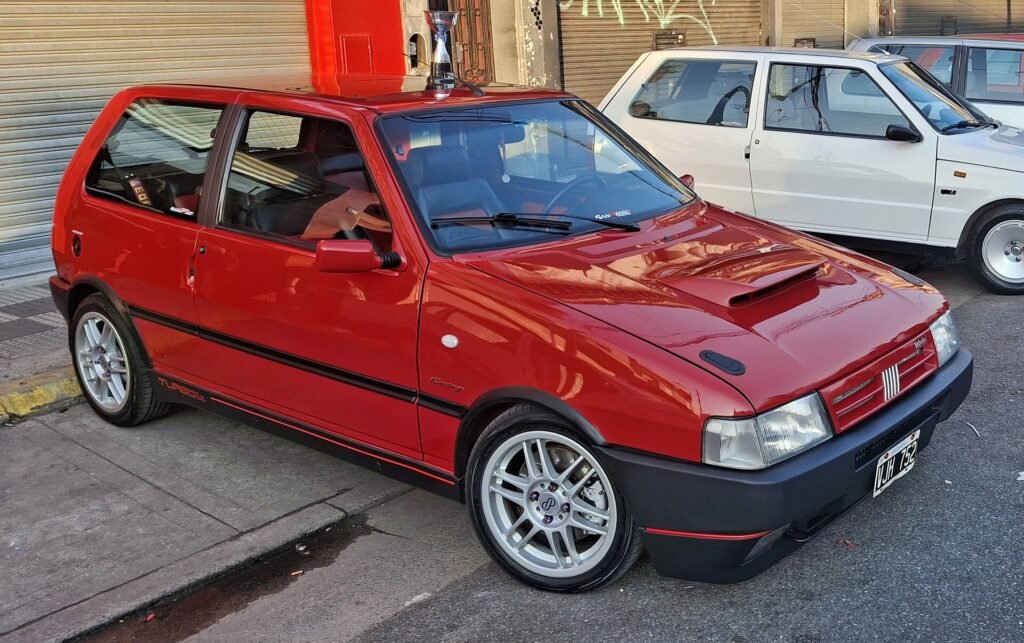
The second series arrived in 1989 with the facelifted Uno. The engine grew to 1,372 cc, borrowed from the Tipo, and the IHI was replaced by a Garrett T2 running around 0.8 bar. The 1990 update added an oil cooler. Fiat rated it at 116 hp, though many spec sheets say 118, and catalyzed cars made 112. The 0 to 100 km/h time fell to 7.7 seconds.
Weight crept up to around 910 kg, but the car felt more finished. It got a leather Momo wheel, a revised cabin, red-striped bumpers and four-spoke alloys. The Racing version added a sunroof, remote locking, electric windows and headlamp washers. Antiskid was dropped. For anyone who wants to actually drive one, the second series is usually the smarter buy.
Seen from Spain
Spain is where the Uno Turbo’s story gets interesting, because Spain should have built it. For three decades SEAT had essentially been Fiat with a Spanish badge, building Fiat designs in Barcelona. That partnership fell apart in the early eighties, just before the Uno was launched, and SEAT ended up with Volkswagen. So the Uno was never made in Spain. European Turbos came from Mirafiori in Turin, and Spanish buyers got them as imports, with all the parts and dealer headaches that implied, while the rival Renault 5 was being built in Valladolid.
At launch the Uno Turbo cost around 1.3 million pesetas in Spain, almost exactly what Renault asked for its GT Turbo, and the French car outsold it there. Hard to blame anyone: the Renault had a dealer in every town and parts from a factory down the road. By 1990 the Fiat cost 1,650,000 pesetas, which Spanish magazine km77 puts at around €23,500 in today’s money. Nothing else offered that much shove per peseta.
The Americas did get one, eventually
The headline needs a footnote. North America never saw an Uno Turbo, but South America did. In 1994, just as the car was being retired in Europe, Fiat launched an Uno Turbo i.e. in Brazil with the Italian-made 1.4 and a Garrett at 0.8 bar. It made 118 hp, topped 200 km/h and became the first factory turbo car sold in Brazil. It lasted until 1996 and was built in tiny numbers. Figures quoted range from just over a thousand to about 1,800, and none of them come from Fiat.
Back in Europe the job passed to the Punto GT in 1994, another 1.4 turbo with a reputation for being even harder to drive fast.
What one costs now
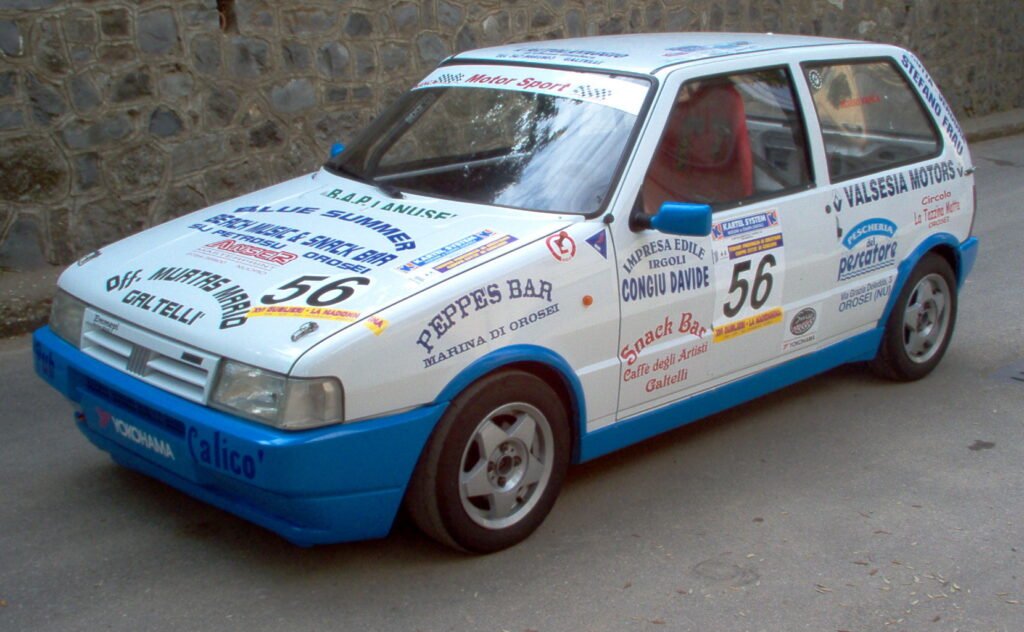
Fiat says about 50,000 Uno Turbo i.e. were built between 1985 and 1994. Crashes, blown turbos and backyard tuning took most of them. Moretti, Giannini and Scioneri all built their own versions, and plenty of private owners went further, so original cars are hard to find. The good ones now go for around €20,000 and sometimes more.
The 205 GTI handled better and the Golf GTI was more grown-up. Neither had the Uno’s mix of cheek, advanced tech and low price. It belongs on the list of cars with soul that no marketing department would sign off today, alongside oddballs like the Lancia Thema 8.32 from the same Fiat group.
The Uno Turbo made you feel like you were getting away with something. It looked like a car for picking up groceries and passed people who’d paid twice as much, and the guy in the expensive car spent the next few miles trying to work out what had just gone past him.
Check you’re still alive.
Photos: 1986 Uno Turbo i.e., Riley from Christchurch (CC BY 2.0); engine bay, interior and digital dash, Jas Racing (CC BY-SA 3.0); 1994 Uno Turbo i.e. Racing, Just a Man (CC BY 4.0); Uno Turbo rally car, Lou6977 (CC BY-SA 4.0). Via Wikimedia Commons.