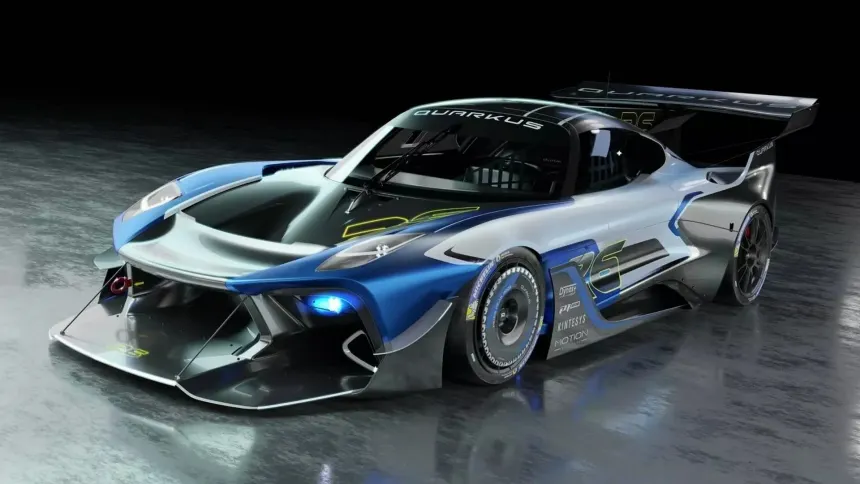
Quarkus P3: The 600kg French Supercar That DNF’d at Pikes Peak Before Selling a Single Car
They didn’t finish.
On June 23rd, 2024, a car that had never been sold to anyone, built by a company most people had never heard of, entered the most punishing hillclimb on the planet and did not cross the finish line. DNF. Three letters that would kill most startup car companies before they ever got started.
But Quarkus is not most startup car companies. And the DNF at Pikes Peak might be the most honest thing the modern supercar industry has seen in years.
Colin Chapman’s ghost walks into a French workshop
There’s a quote that floats around every car forum and every motoring show like a prayer: “Simplify, then add lightness.” Colin Chapman said it. Lotus built an empire on it. And the car industry spent the last twenty years ignoring it completely.
We live in an age where supercars weigh more than the family SUVs they’re supposed to outrun. A Ferrari 296 GTB tips the scales at 1,470 kg. A Lamborghini Huracán — even in its most stripped-out form — sits around 1,422 kg. The electric hypercars everyone keeps telling us represent the future weigh close to two tonnes. They’re fast, yes. But they’re fast in the same way a freight train is fast — momentum, not agility.
There have been holdouts. The Ariel Atom at around 550 kg. The Caterham Seven, still clinging to its 1957 bones. The BAC Mono at 580 kg. Gordon Murray’s T.50, which manages 986 kg while carrying a naturally aspirated V12 and a price tag of £2.8 million. These are the cars that Chapman’s philosophy never fully abandoned.
But all of them make compromises. The Atom and the Caterham have no bodywork worth mentioning. The Mono seats one. The T.50 costs more than a flat in central London. None of them offers what Quarkus claims its P3 will be: a fully-bodied, enclosed-cockpit, two-seat, mid-engine supercar that weighs 600 kg, runs on bioethanol, and is designed to be road-legal.
If they pull it off, there is genuinely nothing else like it.
A physicist in a world of MBAs
Damien Alfano did not come from a venture capital pitch deck. He came from an engineering school.
He graduated from ENSTA Bretagne in 2010, specialising in mechanics, vehicle architecture, and modelling. He spent three years at Valeo — one of the largest automotive component suppliers in the world — working as a project manager in their innovation department. Then he left to build his own thing. In 2012, he founded ADACCESS, an engineering consultancy generating strategic data for automotive innovation. He grew it, made it profitable, and sold it in 2019.
And then he did what every petrolhead engineer dreams of doing and almost nobody actually does: he founded a car company. Quarkus was established at the end of 2020, based initially in Poissy and later moving to Les Mureaux in the Yvelines, in the Vallée de la Seine — a patch of industrial France with Renault Flins down the road and Ariane Space history in the soil. It is not Silicon Valley. It is not Maranello. It is a proper working-class industrial town, and Alfano wanted it that way.
The first concept car — the P1 — appeared at the end of 2021. By November 2022, the P2 was turning laps at Paul Ricard. By May 2023, a running Quarkus prototype drove through the streets of Beaune on open roads, weaving past SUVs that weighed three times as much. These are not renders. These are real cars. And they rev past 10,000 rpm.
One litre, ten thousand revs
Now let’s talk engineering, because the P3’s spec sheet reads like something you’d find scrawled on the back of a napkin by someone who doesn’t believe in the rules.
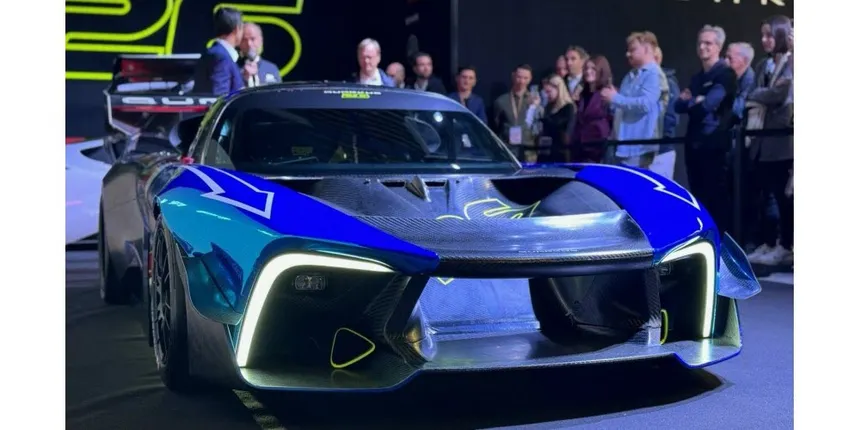
The heart of the car is a one-litre four-cylinder engine with forced induction, running on E85 bioethanol, producing between 296 and 300 bhp. One litre. Think about that. The engine runs a dry sump, carbon fibre intake, titanium exhaust, and spins beyond 10,000 rpm. It is a modified version of an existing engine block — whose, they will not say, which in an industry where everyone name-drops their suppliers is conspicuous — mated to a six-speed sequential gearbox with a limited-slip differential.
For anyone who has spent time around engines, the ethanol choice is revealing. E85 has an octane rating around 108, which lets you run more aggressive ignition timing and higher compression ratios without detonation. It also has a higher latent heat of vaporisation, meaning it cools the intake charge more effectively than petrol. You lose some range because ethanol carries less energy per litre, but in a 600 kg car built for track days and spirited road driving, that trade-off is entirely rational. It is a physics decision, not a marketing one.
The chassis is where the workshop logic gets interesting. Most ultra-lightweight supercars at this level use a carbon monocoque — a single structural shell, incredibly rigid, but brutally expensive to tool and essentially unrepairable after a serious impact. Quarkus went with a tubular chassis made from carbon fibre and Kevlar composite. A tube frame. The approach that racing cars used before monocoques took over in the 1960s. But made from modern materials.
Why? Because a startup that is still iterating its design needs a structure it can modify, repair, and learn from. A monocoque demands that you get everything right before you build it, because changing it afterwards costs you a new mould. A tube frame lets you break things, understand why they broke, and fix them. It is the choice of an engineer who works with his hands, not one who works with a procurement budget.
The target power-to-weight ratio is 493 bhp per tonne. For context, a current-generation Porsche 911 GT3 RS — 525 PS, approximately 1,450 kg — delivers around 362 bhp per tonne. The Quarkus exceeds it by more than 35 per cent. With a one-litre engine. Running ethanol.
Top Gear France meets the clouds
The decision to enter Pikes Peak in 2024 was, by any conventional measure, insane.
The company had not sold a single production car. The P3 was still a development prototype. The team was small. And Pikes Peak — nearly 20 kilometres of mountain road, 156 turns, an elevation gain of 1,440 metres, finishing at 4,302 metres above sea level where the air holds 40 per cent less oxygen — is not a venue that forgives unfinished homework.
Alfano did not come up with the idea. Ari Vatanen did — or rather, Vatanen lit the fuse. The 1988 Pikes Peak winner, one of rallying’s immortals, introduced Bruce Jouanny to Alfano, telling him he needed to see the car. Jouanny looked at the P3, thought about Vatanen, thought about the mountain, and at two o’clock in the morning left Alfano a voice message: we should take this car to Pikes Peak.
Alfano’s public response was characteristically clear-eyed. “To take on Pikes Peak while the first development prototype has just been presented is clearly not a reasonable idea. No constructor does that. But that’s our philosophy: to believe in our dreams, set no limits. When Bruce told me his idea to climb this monumental summit, I simply could not say no. It spoke to my heart. We have three months to complete what normally would take nine. Let’s go.”
Three months to do what was planned in nine. That single sentence tells you more about Quarkus than any spec sheet ever could.
Jouanny was the right man for it. A French racing driver with genuine credentials: Formula Palmer Audi Junior champion in 2000, fourth in the British Formula Three Championship in 2002, three starts at the Le Mans 24 Hours between 2005 and 2009 including an eighth-place overall finish with Pescarolo Sport. British audiences may know him as one of the presenters of Top Gear France; he is now also a test driver for the Automoto programme on TF1. Not a celebrity playing at racing, but a racer who became a presenter.
Technical support came from RD Limited, the outfit run by Romain Dumas, four-time Pikes Peak winner and holder of the outright record since his extraordinary run in the Volkswagen I.D. R in 2018. When Dumas puts his name to your project, it carries weight.
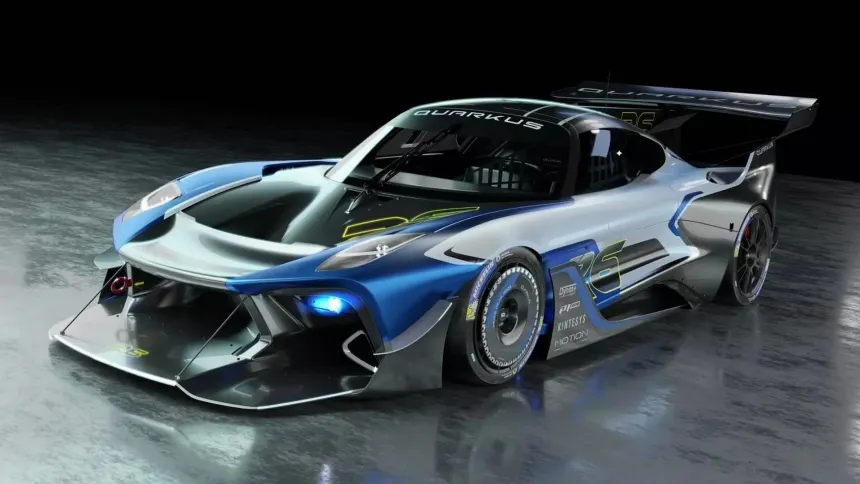
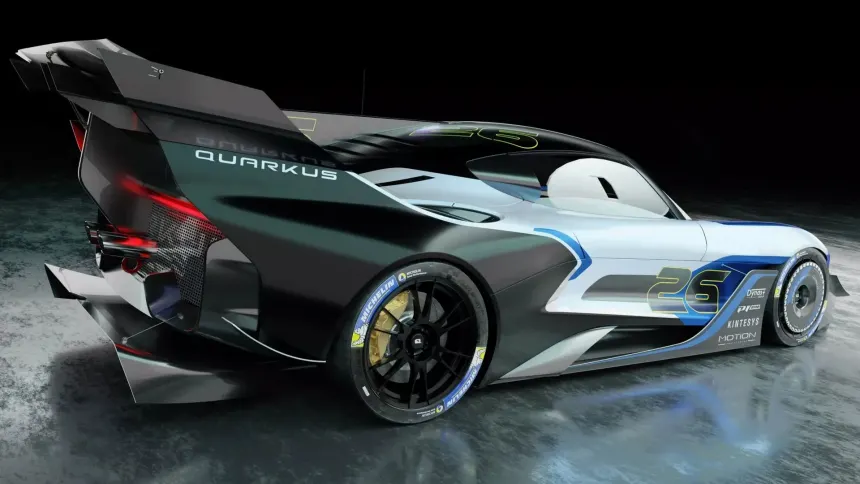
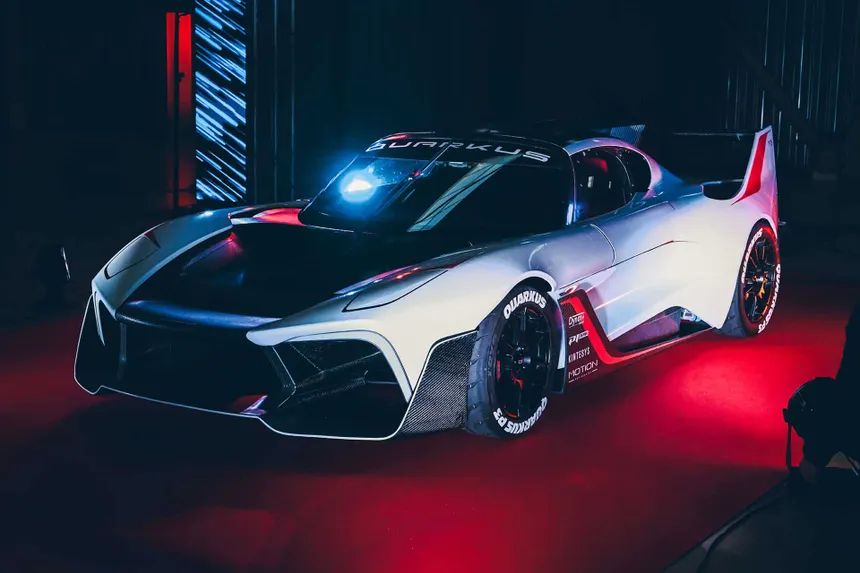
They built a Pikes Peak-specific aero kit for the P3: front splitter, active rear wing, extended diffuser, enlarged scoops for brake cooling and high-altitude air intake. All designed and built in three months instead of the nine that were originally planned.
And then they went to Colorado.
In qualifying, the P3 posted a time of 6:19.017.
In the race, it did not finish. DNF.
The official results from ppihc.org list it plainly: Jouanny, Quarkus P3 Pikes Peak, number 26, Unlimited class. DNF.
The render company question
Here is where we have to be direct, because the lightweight supercar startup space has a credibility problem. For every company that actually builds a car, there are fifty that produce renders, press releases, and Instagram posts before quietly disappearing. Publications like Carscoops have described Quarkus as “shrouded in mystery.” CarThrottle acknowledged that they had a real, running prototype — which already separates them from most — but maintained a cautious tone.
The original delivery date for production cars was 2025. It has been pushed to 2026. That is not unusual for a small manufacturer — even Lotus and McLaren have struggled with production timelines — but it is a fact that cannot be papered over with enthusiasm.
What works in Quarkus’s favour is concrete. There are real prototypes. They have turned laps at Paul Ricard, at Mas du Clos, on the streets of Beaune, and at Pikes Peak. The founder has genuine engineering credentials from Valeo and a track record of building and selling a company. The project has the backing of Romain Dumas and the association of Ari Vatanen. The car has actually been on a racetrack. It has actually started a race.
What is missing is a delivered car. One car, in the hands of one paying customer. Until that happens, Quarkus remains a promise.
Twenty-six and a point to prove
Following Pikes Peak, Quarkus announced the “Première Édition” of the P3: twenty-six numbered units — a tribute to the number 26 that Jouanny carried up the mountain. Price: between €150,000 and €200,000 including tax, with a 50 per cent deposit at the time of order. Production scheduled for 2026.
We are in 2026 now.
The automotive industry does not lack for companies that announced production dates and missed them. It does not lack for beautiful prototypes that never became production cars. What it lacks — what it has always lacked — is small manufacturers who are willing to be as transparent about their failures as they are about their ambitions. Quarkus went to Pikes Peak and didn’t finish. They said they would deliver in 2025 and they didn’t. Both of those facts are part of the story, not footnotes to be hidden.
The question that hangs over Quarkus is simple: can a small French outfit from Les Mureaux deliver a road-legal supercar that weighs 600 kg, produces 300 bhp from a one-litre engine, runs on bioethanol, and actually exists as a car you can buy?
The answer does not exist yet. And that, frankly, is what makes it worth watching.
In a world of two-tonne hypercars with touchscreens the size of dining tables, the idea that a physicist with grease under his fingernails could build something that weighs less than a Mazda MX-5 and outperforms a GT3 RS on paper is either brilliant or delusional. The line between those two things has always been thin. Chapman lived on it. Murray lives on it. Alfano appears to be building a house on it.
Whether Quarkus delivers twenty-six cars or zero, the philosophy behind the P3 is a question the entire industry needs to answer. Not because 600 kg is the magic number. But because somewhere between 600 kg and 1,600 kg, the car industry stopped asking whether there was a better way.
Check you’re still alive.