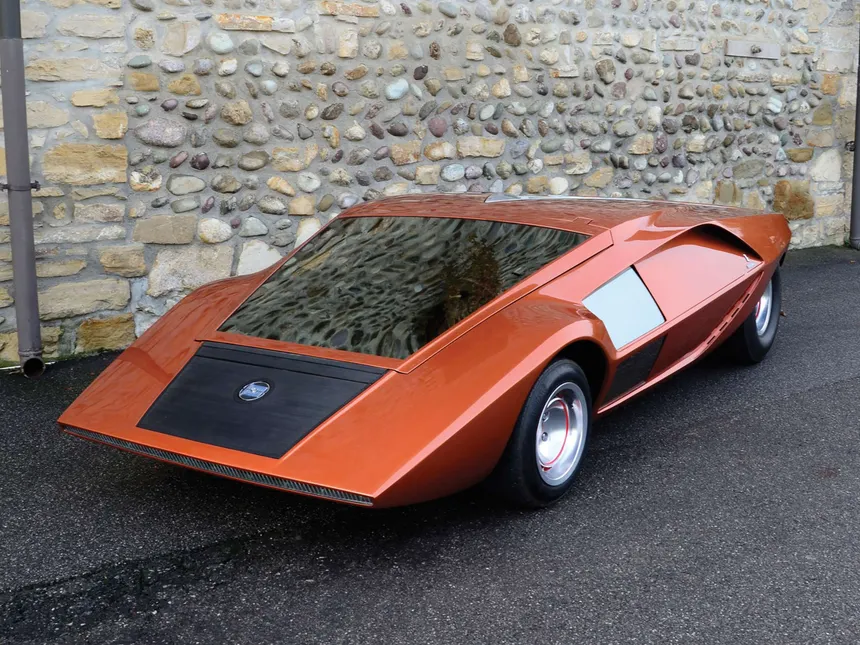
Lancia Stratos HF Zero: the wedge that was 33 inches tall and won three world titles
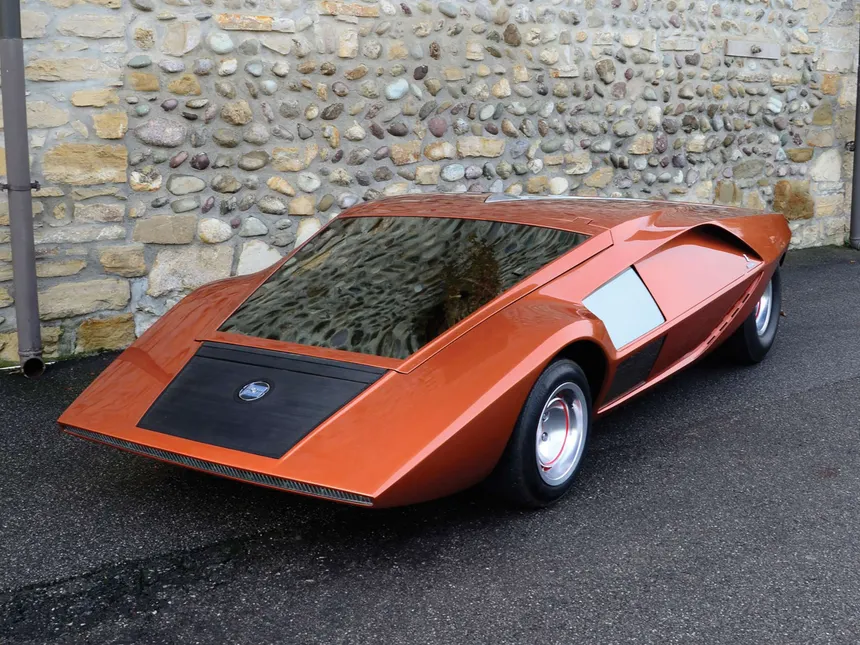
If you grew up watching Group B onboards, or if Sanremo and the Acropolis mean something to you because of Munari and the orange-and-white livery, you already know the Lancia Stratos. What you probably don’t know is that the Stratos started as a one-piece glass canopy concept that you had to climb into headfirst, sliding over the bonnet, because it was too low to have doors.
33 inches tall. That’s it. 84 centimetres. Lower than your kitchen counter. Lower than most chairs in your house. Bertone unveiled it at the Turin Motor Show in November 1970, and the people standing around it didn’t know whether they were looking at a sculpture or at a piece of industrial equipment that had wandered onto the wrong stand. The man who designed it was Marcello Gandini, the same Bertone designer who had already done the Miura and would do the Countach four years later. And he wasn’t trying to be clever. He was trying to win an argument.
Two design houses, one war
To understand why the HF Zero exists, you have to remember that 1970 was the year the two great Italian design houses went to war. Eight months earlier, in March, Pininfarina had shown the Ferrari 512S Modulo at Geneva. White wedge. Sliding canopy. 36 inches tall. The motoring press lost their minds. Critics declared it the most radical car ever conceived.
Bertone kept their heads down and went to work. By November, in Turin, they had their answer. Three inches lower than the Modulo. No sliding canopy gimmick — the entire windscreen lifted forward to let you in, like the cockpit of a fighter jet. And under the impossible wedge, hidden where nobody was looking too hard, sat a real engine. Not a fantasy V12 borrowed for the show. A working rally engine.
That was the difference. The Modulo was art. The HF Zero was a sales pitch.
The distinction matters and it’s worth explaining properly, because everything that follows depends on it. In 1970, the two studios divided up the great names of the Italian motor industry in a way that would be unthinkable today. Pininfarina had Ferrari almost on a permanent retainer since the late fifties and signed off on most of the relevant Alfas of the period. Bertone had Lamborghini — the Miura, the Espada, both Bertone — and fought tooth and nail with Pininfarina and Ghia for everything else: Lancia, Maserati, Alfa Romeo, Fiat. Every motor show was a business card. Every concept car was a way of telling the market who owned which patch.
Geneva 1970 had been a clean political win for Pininfarina. The Modulo wasn’t proposing anything. It wasn’t a preview of a future production car, it wasn’t an engineering proposition, it wasn’t a commission. It was a pure object, self-referential, designed to silence everyone for six months. And it worked. Every motoring magazine on the planet ran the Modulo on the cover for half a year.
Bertone had two options. One was to play the same game: another pure object, another piece of moving sculpture. But that game was already lost. Pininfarina had played it first and played it better. The other option was to change the rules entirely. And that’s what Nuccio Bertone, with Gandini running the studio floor, decided to do. If Pininfarina had said “look what we can draw,” Bertone was going to answer “look what we could build with you.” That turned the concept car into something different. Into a commercial tool, not a trophy.
That’s why, underneath the wedge, there was a real engine.
The bit you only understand if you’ve ever bolted a chassis together
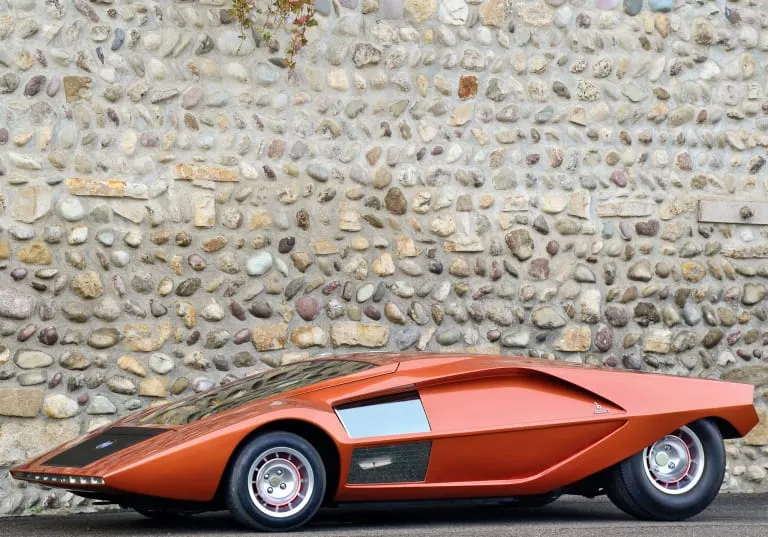
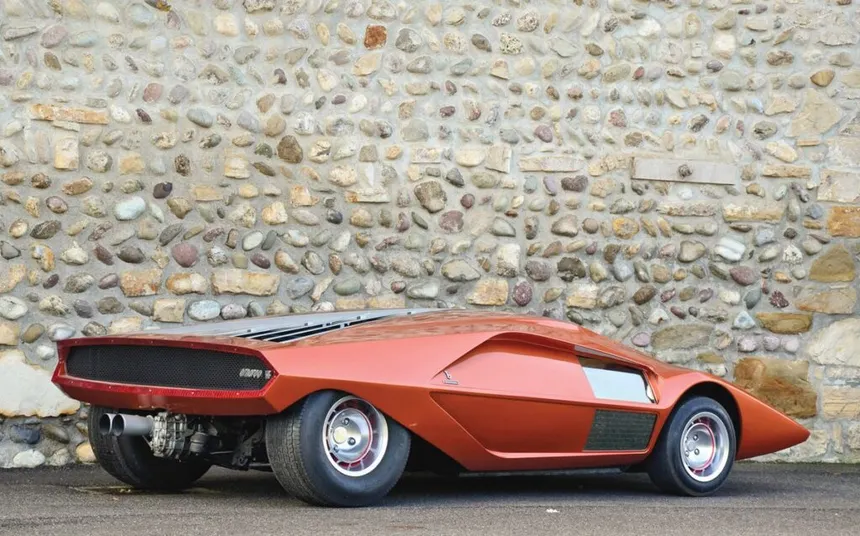
84 centimetres. It’s a number that needs to be repeated because the brain refuses to process it. For reference, the roof of a Lamborghini Countach LP400 sits at 105 cm. The HF Zero is 21 centimetres lower than that. The Countach was already famous for being almost impossible to get out of without looking ridiculous. The HF Zero made the Countach look like a family saloon.
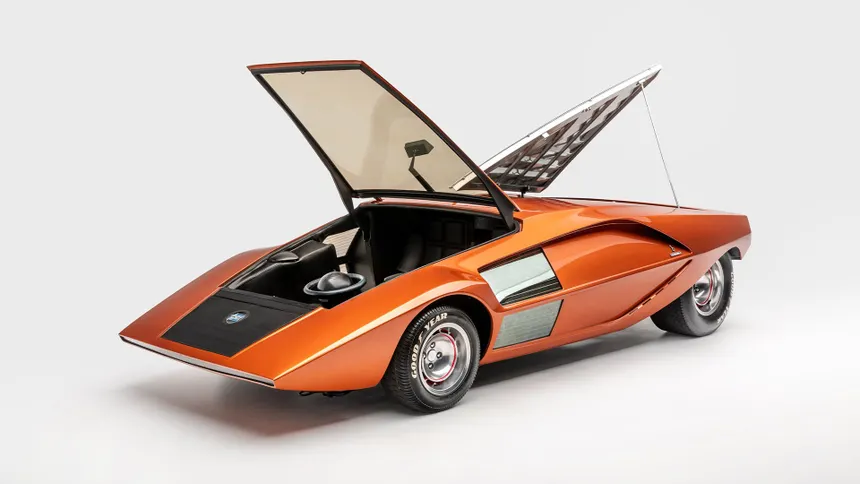
How did Gandini solve the entry problem? By deleting the doors. No side doors. The windscreen, the roof and the front glass form one single articulated piece that hinges up from the bonnet. You climb in over the nose, slide your legs forward, and end up lying down more than sitting. The pedals, the steering wheel, the gear lever — all positioned for someone driving in a posture closer to a Le Mans prototype than a road car.
The obvious question, the one anyone watching the car for the first time asks, is whether getting in is in any way dignified. It isn’t. The procedure — there’s video of it from MAUTO and from the 2011 Villa d’Este concours — goes like this. Two people lift the entire front canopy by hand: it isn’t a light piece, it carries the windscreen and the full roof structure. The driver puts both hands on the flanks, sits on the bonnet, swings the legs forward over the dashboard, and lets the upper body fall backwards into the seat until they’re effectively lying down. Getting out is the same in reverse. In a motor show stand, with time and an attendant beside you, it’s a piece of choreography. In any real-world scenario — a sloping car park, an emergency stop, a rainy Tuesday — it would be absurd. And that, frankly, is the point. A car like this isn’t designed to be comfortable. It’s designed to ask a question.
And here’s the part that anyone who has spent time under a car in oily overalls will recognise instantly: this isn’t a styling whim. When you drop the centre of gravity of a car to a stupidly low number, the chassis dynamics change in your favour. Weight transfer under braking and acceleration goes down. Mechanical grip goes up. Ergonomics and habitability go to hell, but you knew that going in. Gandini knew an 84 cm road car was never going to be a road car. Bertone knew. Lancia knew. The question wasn’t whether this was viable as a daily driver. The question was: what if a competition car could afford to do this?
The Fulvia engine: the giveaway nobody wanted to discuss
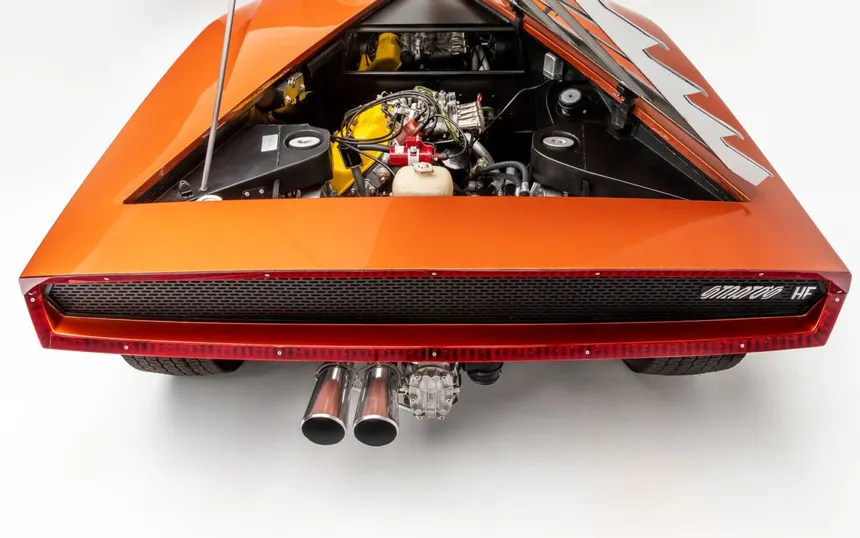
Here’s the technical detail that almost nobody talked about at the time but matters more than the height. The HF Zero wasn’t running a fictional engine. It had a working 1.6-litre Lancia Fulvia HF V4, narrow-angle, 115 horsepower. The same engine that was, that very season, winning rally stages around Europe in the hands of the Lancia works team.
It’s worth pausing here because that engine is one of the strangest production motors ever built, and anyone who hasn’t actually had one on a stand has no real idea how unusual it is. A 13-degree V4 means the two banks of cylinders sit just thirteen degrees apart. Not the 60 or 90 degrees you’d expect from any V engine in history. Thirteen. So narrow that the four cylinders share a single cylinder head, a single head gasket, a single camshaft feeding the whole thing. It’s an engine that occupies the same physical footprint as a small inline-four but mounts the cylinders almost in parallel rather than dead in line. Lancia developed it that way because it let them shoehorn a decently-sized engine into short engine bays — the Fulvia was a small saloon — without losing anything in height.
When you take an engine designed for that philosophy and drop it into a wedge that’s 84 centimetres tall, where the length of the engine bay matters more than its width, the choice starts to make sense in a way that isn’t immediately obvious. Gandini didn’t pick the Fulvia HF engine because it had won at Monte Carlo. He picked it because it fitted. And because it was already homologated, proven, reliable. And because it sent a very specific message.
That message is the whole point. A concept car running a current rally engine is sending coded information to the people who matter: this isn’t a styling exercise, this is a feasibility study. If you, Lancia, are wondering what your next rally car could look like, stop modifying saloons and start thinking about something like this.
At that point Lancia was winning rallies with the Fulvia HF. A development of a normal Lancia saloon that had been engineered to within an inch of its life. It worked, but the car had reached its ceiling. Cesare Fiorio, head of the racing department, had been turning over the same problem in his head for a while: the next step wasn’t a better Fulvia. It was a clean-sheet machine designed for one job only — winning the World Rally Championship. A purpose-built tool. Not a derivative.
The HF Zero didn’t invent that idea. But it gave that idea a body. It walked into the Turin Motor Show and turned a conversation in Fiorio’s office into a physical object the Lancia board could see, walk around, and approve. Bertone weren’t selling a dream. They were drawing a possibility on the table.
Why Bertone changed the rules of the concept car game
It’s worth coming back to the Bertone–Pininfarina rivalry because without it the HF Zero doesn’t exist. The two houses had spent the entire 1960s fighting for every major commission in Italy: Ferrari, Lamborghini, Alfa Romeo, Lancia, Maserati. The Modulo had been a brutal flex from Pininfarina — “we can design whatever we want and you’ll all clap.” A pure styling object, with no real intent of being driven anywhere meaningful. (The Modulo had a Ferrari V12 in it, but the car was conceived more for a turntable than for a road.)
Bertone responded by changing the question. The HF Zero didn’t say “look what we can draw.” It said “look what you could build if you have the nerve.” And in commercial terms, that was infinitely more dangerous for Pininfarina, because it turned the concept car from a styling object into an industrial prospecting tool.
That’s the difference between art and engineering. Gandini, who could do both, understood it from day one.
What happened next: three world titles
What came after is one of the cleanest paths that has ever existed between a concept car and a real, championship-winning machine. But before the Stratos there’s an intermediate step that almost nobody bothers to tell, and it’s the most interesting part of this whole story.
In November 1971, exactly a year after the HF Zero, Bertone showed a second car at the Turin Motor Show: the Lancia Stratos HF Prototype. Gandini again. But this time it wasn’t an impossible 84-centimetre sculpture. It was a car you could actually drive, with two real seats, with proper doors, with a roof height that let you sit down without performing gymnastics. It was the HF Zero translated into industrial language. Bertone had done exactly what the first concept had promised: turn the question into a viable proposition.
And here’s where the only plot twist of the whole story happens. The engine changed. Out went the narrow-angle Fulvia V4. In went, mid-mounted, the 2.4-litre Ferrari Dino V6. Why? Because Lancia, which had been absorbed by Fiat in 1969, now belonged to the same group as Ferrari. And because Fiorio and the racing engineers had run the numbers on the Fulvia engine pushed to its limit and seen the ceiling clearly: that motor was never going to compete against the Porsches and Alpines on fast stages. They needed more displacement, more cylinders, more torque. The Dino V6 gave all three at once, was compact, was already homologated for competition, was already in production. A pure engineering decision. The same logic that had made them pick the Fulvia engine for the HF Zero in 1970 — it fitted, it was real, it sent a message — now made them pick the Dino in 1971: it fitted, it was real, and it won races.
After that, things move quickly. By 1973, Lancia had homologated the road-going Stratos. And from 1974 through 1976, the Stratos won three consecutive World Rally Championships with Sandro Munari, Björn Waldegård and the rest of the works team.
The Stratos isn’t the HF Zero. It stands at 111 cm, has conventional doors, and runs Ferrari power instead of Lancia. But the design logic — extreme wedge, mid-engine, a car conceived from a blank sheet for one mission — comes directly from that November 1970 exercise. If the HF Zero had never been built, if Lancia hadn’t been able to walk around a three-dimensional sketch of how far the idea could go, the competition Stratos probably arrives years later, or in a very different shape.
The full story of the competition Stratos — the 1973 homologation, the three world titles with Munari, what it meant for Lancia and for modern rallying — is told in another NEC article: Lancia Stratos: the car built to win world championships. If you’ve followed the HF Zero this far, that’s the natural next stop. What you’re reading now is the prequel. The concept that almost nobody remembers is the spark that lit one of the most dominant rally cars in WRC history.
Where it lives now
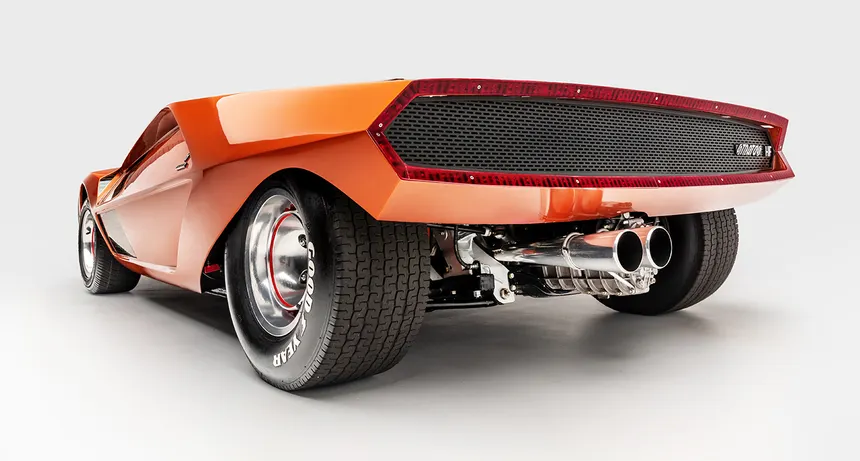
The original HF Zero survived. It’s at the MAUTO, the Museo Nazionale dell’Automobile in Turin, on public display. It still runs. In 2011 the car came up for auction at Villa d’Este and sold for €761,500, and at some point in its life it returned to the museum’s care. You can go and see it. It sits there, 84 centimetres off the floor, waiting for somebody to walk up and finally understand what Bertone were really saying back in 1970.
They weren’t designing a car. They were designing a question. And the answer, four years later, won three world championships in a row.
Check you’re still alive.