NO CURVES, NO DOORS, NO MERCY. THE FERRARI ANTI-FERRARI, THE 512S MODULO
The sketch in the corner of a Rolls-Royce blueprint
Spring of 1968. Paolo Martin is 25 years old. He has just been made chief of the styling department at Pininfarina. On his drafting table, a technical drawing of the Rolls-Royce Camargue. A large car. Bourgeois. Conservative. The exact opposite of what Martin is carrying inside.
In the lower right corner of that blueprint, almost without noticing, he scribbles something else. A wedge. A shape with no front and no back, symmetrical end to end, something that looks like it stepped out of 2001: A Space Odyssey. A car that, in his own words, was going to be “the most unique, violent, inimitable and conceptually different” car he could imagine.
That scribble, drawn while his hand was busy with a Rolls-Royce, will become the Ferrari 512S Modulo. The most radical concept car ever to come out of Pininfarina. And one of the hardest objects to classify in the entire history of the automobile.
But before it becomes a legend, it is going to go through everything. Through management’s contempt. Through 44 years hidden in a museum. Through an obsessive American who rescues it when nobody else wants it. Through a fire in Monaco. And through a New York state vehicle registry that has no idea what to do with it.
This is that story.
“It’s important that they speak of it”
When Sergio Pininfarina sees the first sketches, Martin has already gone further: during his summer holidays in 1968, he builds a full-size polystyrene model on his own. Nobody asked him to. He makes it because he cannot not make it.
Pininfarina looks at it and asks directly why he has drawn such a thing.
Martin’s answer became design-history folklore: “It’s important that they speak of it.”
Pininfarina shoots back: “Yes, but they’ll speak ill of it.”
That’s it. The model is set aside under a cover in Pininfarina’s photographic studio for months. Nobody looks at it. Nobody touches it. Martin keeps working on the Camargue by day and thinking about the Modulo at night. Until management changes its mind — it’s not entirely clear why, maybe because the climate in Italian design is shifting fast, maybe because someone higher up decides Martin is right — and he is told: go ahead, adapt it to a Ferrari chassis.
The chassis they give him is very special. It is also the only one they have left over.
A race chassis nobody wanted
The Ferrari 512S is a pure racing car. Ferrari built 25 units in 1969-1970 to homologate them for the World Sportscar Championship and fight the Porsche 917. The engine is a completely new 60-degree V12, almost exactly five liters (4,994 cc), designed by Mauro Forghieri’s team in just three months. 550 horsepower at 8,500 rpm. Tubular spaceframe reinforced with riveted aluminum panels. Five gears. Rear-wheel drive. The car shows up at Sebring and wins. Shows up at Kyalami and wins. But Porsche dominates the season and the 512S ends up as one of those machines lost in the memory of hardcore enthusiasts.
Chassis number 27 is among the last ones built. Ferrari converts it to 612 Can-Am specification — a 6.2-liter V12 making 620 horsepower — hoping to sell it to a privateer team. No buyer shows up. The car ends up as surplus material. Engine removed. Gearbox removed. Entire powertrain stripped. Off to Pininfarina. There, that bare chassis becomes the skeleton on which Martin will mount his polystyrene model turned into fiberglass.
Stop for a moment. What you are reading means that underneath the alien body you are about to see in Geneva there is a car that was nearly going to race at Le Mans and in Can-Am. This is not a show car with a toy engine. This is a racing chassis wearing a spaceship’s skin.
Geneva, March 1970
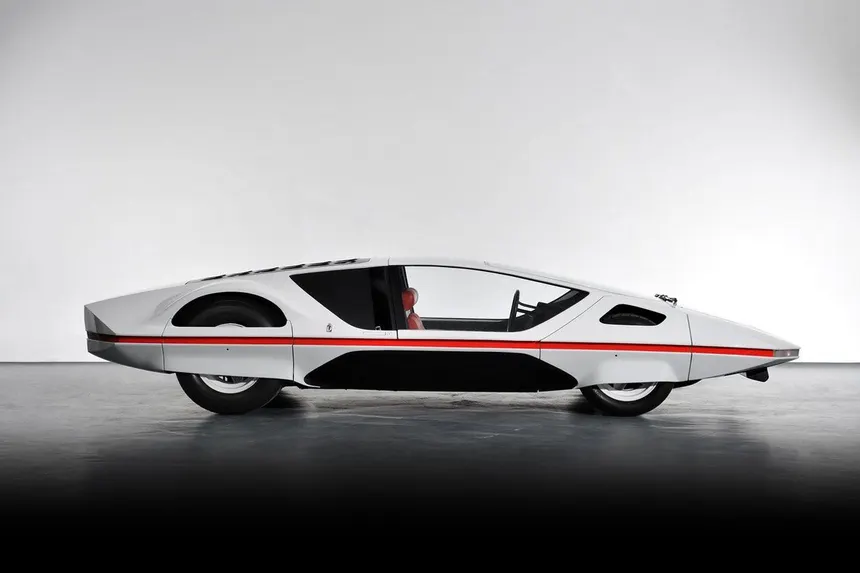
The car is 4,480 mm long, 2,048 mm wide, and only 935 mm high. Less than one meter. Put it in perspective: a Porsche 911 of the same era is 1.32 meters tall. The Modulo is 30% lower than a 911. You are talking about a car you would have to lie down to get into.
And to get in lying down, you first have to open it. Because the Modulo has no doors. It has no conventional doors and no unconventional doors. It has no doors, period. The glass canopy that forms the roof slides forward in one piece, like the cockpit of a fighter jet. You slide in underneath the glass. You slide it back to close. That is it.
The wheels are partially buried in four streamlined fairings that make the car look like a skate. The surface is almost totally clean. A red seam runs around the entire perimeter, front to back, joining the two halves of the car like the seam of a melon. And on the engine cover, 24 round holes reveal the V12 below, as if the car were breathing through gills.
Painted matte black. 550 horsepower hidden under the skin. Claimed top speed of 354 km/h (220 mph). Zero to 60 mph in around three seconds. A Le Mans monster dressed as a UFO.
The Geneva Motor Show stops. Photographers go crazy. Journalists don’t know how to describe it. One critic calls it “the most radical car ever built.” Pininfarina, the same man who told Martin that people would speak ill of it, collects 22 international design awards over the following years. Osaka, Montreal, New York, Los Angeles. The Modulo travels the world.
And then, silence.
A car that couldn’t steer
The Modulo returns to Italy and lives in Pininfarina’s museum. It doesn’t get sold. It doesn’t get driven. It doesn’t move. For 44 years.
The romantic version says it was too radical to be driven. The technical version, confirmed by Glickenhaus’s mechanics decades later, is more prosaic: someone, at some point after it was built, mounted the steering rack upside down. It wasn’t a conceptual design problem. It was an assembly error. A car that should steer couldn’t steer because it was incorrectly put together. And so it sat for four decades.
Paolo Martin, in the meantime, goes on to design the Rolls-Royce Camargue, the Fiat 130 Coupé, the Ferrari Dino Berlinetta Competizione, works for De Tomaso and Ghia, opens his own studio in Turin in 1976. He designs motorcycles, boats, cars for Stutz, Bugatti, Peugeot, Alfa Romeo. But he will never again draw anything like the Modulo. Nobody could.
The Modulo, during those four decades, influences everything around it without moving a single millimeter. Months after its Geneva debut, Bertone unveils the Lancia Stratos HF Zero in Turin, a conceptual twin. The Lamborghini Countach of 1971 carries Modulo DNA in every line. The Ferrari Testarossa of 1984, with its side strakes and wedge stance, too. An entire generation of 70s and 80s supercars owe part of their shape to a car nobody ever drove.
And there it remained. In a corner of the Cambiano museum. Waiting.
The obsessive American
Jim Glickenhaus is not your average collector. He is a New York film producer who directed cult classics like The Exterminator in the 80s, turned his fortune into a full-blown Ferrari obsession, and founded Scuderia Cameron Glickenhaus, a brand that builds its own racing cars and takes them to Le Mans. His collection includes a Ferrari P4, a P3/4, the P4/5 designed by Pininfarina on an Enzo Ferrari chassis, and a long, deep relationship with the Italian house.
Glickenhaus has been after the Modulo for years. Pininfarina won’t sell it. He has tried several times. Always no. He says so himself in an interview with Classic Cars: “Pininfarina wouldn’t sell it to me.”
Andrea Pininfarina, Sergio’s son and managing director of the company, dies in a motorcycle accident in August 2008. From that point, the museum’s direction begins to shift. Years later, Glickenhaus gets a call from Cambiano: “We think you are the guy to carry Modulo on.”
It is 2014. Pininfarina is in a delicate financial situation that will end with its acquisition by India’s Mahindra group in 2015. Glickenhaus goes to Cambiano with his mechanic Sal to collect the car. Once it’s loaded on the truck, Sal asks him what they are going to do with it. Glickenhaus answers in three words: “I want it to drive.”
Nobody has ever revealed what he paid. The number has never come out.
Four years to make the impossible work
The problem is not minor. The original engine and transmission had been removed by Ferrari decades earlier. The chassis is bare. The 612 Can-Am specification is long gone. The team at Podium Advanced Technologies, the same Italian partner Glickenhaus uses to build his own Le Mans cars, gets to work.
They rebuild the entire powertrain. Machined pistons. Original spare parts from Ferrari P3/4 and 512S cars that Glickenhaus had accumulated over the years, stored in boxes in case they ever came in handy. A completely new exhaust system, designed to handle a rich-running Can-Am-style engine without setting the car on fire. Everything calculated to the millimeter. And the steering rack, finally, mounted the right way around.
June 2018. The Modulo moves under its own power for the first time. Forty-eight years after Geneva.
The public debut in full running condition happens at the Concorso d’Eleganza Villa d’Este, on the shore of Lake Como, in 2018. A garden full of 1930s Bugattis and 1950s Ferraris. And among them, coming down a ramp with the V12 roaring, Paolo Martin’s white UFO. August of the same year: Glickenhaus drives it through the streets of Manhattan. A photo goes around the internet. A car that had never touched the pavement of a public street, stopped at a traffic light in New York.
The purists get angry. They say Glickenhaus has desecrated a museum piece. They say it shouldn’t be driven. They say he is going to break it. Glickenhaus has a simple answer: every car in his collection is registered, insured, and drivable. The Modulo was not going to be the exception.
The fire
Summer of 2019. After a return visit to Villa d’Este, Glickenhaus is driving the Modulo through Monaco. The Can-Am engine runs deliberately rich. The exhaust system, despite being redesigned, isn’t holding up. A backfire ignites the muffler. The fire starts climbing toward the bodywork.
The onboard fire-suppression system kicks in. The body takes significant damage in the rear: charred paint, a melted tail light, affected fiberglass sections. It could have been much worse. Glickenhaus comes out unhurt — and more importantly, he keeps driving it right after. The car goes back to the shop. Fully repaired. The purists, obviously, have fresh ammunition. Glickenhaus, obviously, keeps driving it.
In between, the Modulo shows up at Pebble Beach. It shows up at Cremona. It shows up at events nobody expected to see it running at again. Fifty years after Geneva, Paolo Martin sees it in full working order for the first time, moving, with a human being sitting inside it. That, on its own, is history.
Registered as “Ferrari sedan”
One last detail remains. Glickenhaus, who lives in New York State, wants it registered. Motor vehicle departments, like all motor vehicle departments everywhere, operate within closed categories. Coupe. Roadster. Sedan. Pickup. SUV.
What category do you put a car in when it has a single opening — a full canopy that slides like an F-16 cockpit?
There is no category. It doesn’t exist. New York, faced with administrative impossibility, registers it in its official records as “1970 Ferrari sedan.” The most radical concept car in all of Ferrari history, the one that influenced the Countach and the Testarossa, the one that won 22 international awards, the one that spent 44 years hidden in an Italian museum, is registered in the United States as if it were a Corolla.
There is something perfectly right about all of this. A car that broke every rule of automotive design has ended up breaking the rules of public administration too.
What Paolo Martin actually did
Let’s go back to the beginning. To the drafting table in 1968. To the Rolls-Royce blueprint with a scribble in the corner.
The version that has run for decades says Martin drew the Modulo at night, in secret, against his bosses’ judgment. It’s a good story but it isn’t quite true. Martin was head of Pininfarina’s styling department. He wasn’t a rebellious junior: he was 25 years old but already signing off on the most important projects. What he did was not draw it in secret. What he did was push a project his management looked at skeptically, build a full-size model on his own during his holiday, and sit through months of silence until they finally let him move on.
That is more admirable than the romantic version. Because it isn’t the story of a rebel who disobeys. It’s the story of a designer who believes so strongly in what he has in his hands that he is willing to build it himself, in August, while everyone else is at the beach, and wait months for the rest of the world to catch up.
And Jim Glickenhaus, 46 years later, does the same thing. Nobody asked him to buy the Modulo. Nobody asked him to spend four years and an unknown amount of money making it run. Nobody asked him to take it on the road. He did it because he believed a car like that had no business being dead behind glass. And when it caught fire in Monaco, when the purists told him they had warned him, he kept driving it.
Paolo Martin drew it at night because by day management frowned. Jim Glickenhaus bought it when nobody else wanted it and took it on the road when everyone said he shouldn’t. The Modulo caught fire in Monaco and came back. Now it is registered in New York as a sedan. There is something perfectly right about all of that.
Check you’re still alive.