Pegaso: The Winged Horse That Motorized a Nation and Couldn’t Survive Itself
A brand born from the ashes of another. A state-owned company created to build trucks in a country shattered by war that, by the vision of a genius with zero business sense, ended up producing the fastest production car on the planet. A name that for half a century meant heavy transport in Spain, that equipped foreign armies, that filled every road with buses, and that in the end couldn’t compete in an open Europe because it never learned to build cheap.
The story of Pegaso isn’t a tragedy. It’s something worse. It’s the story of a company that had all the talent in the world and never figured out how to turn it into a viable business. And when it was too late, nobody was willing to pick up the bill.
The Ashes: From Hispano-Suiza to ENASA
You can’t understand Pegaso without understanding what came before. Hispano-Suiza, the Spanish marque that in the early twentieth century rivaled Rolls-Royce, built luxury cars, legendary aviation engines, and since 1907, trucks and buses. Its factory in La Sagrera, Barcelona, was the beating heart of Spanish automotive engineering.
But the Civil War destroyed everything. When the fighting ends in 1939, industry lies in ruins, the vehicle fleet is a graveyard of scrap metal, and the country is desperate for transport. Hispano-Suiza tries to survive, but its only remaining client is the Air Force. The Franco government, through the newly created Instituto Nacional de Industria, pressures the company until in 1946 it forces the sale — an expropriation in all but name — of Hispano-Suiza’s automobile division.
From those remains, ENASA is born. Empresa Nacional de Autocamiones, S.A. October 1946. The mission is clear: build trucks, buses, and tractors to motorize a country still getting around on donkeys. And leading the technical project, an engineer who’s just returned from Alfa Romeo with half an Italian team in his luggage: Wifredo Ricart. If you don’t know who he is, you need to read his story. Because without him, nothing that follows would have existed.
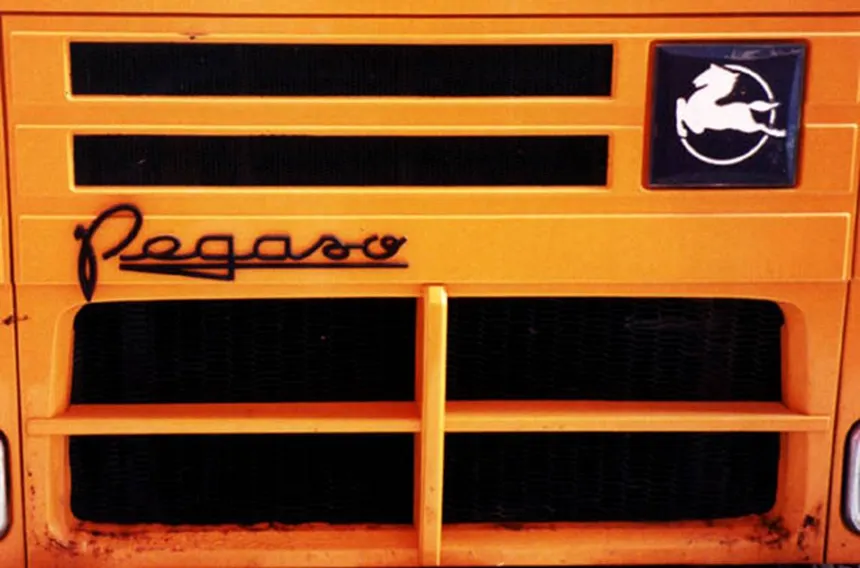
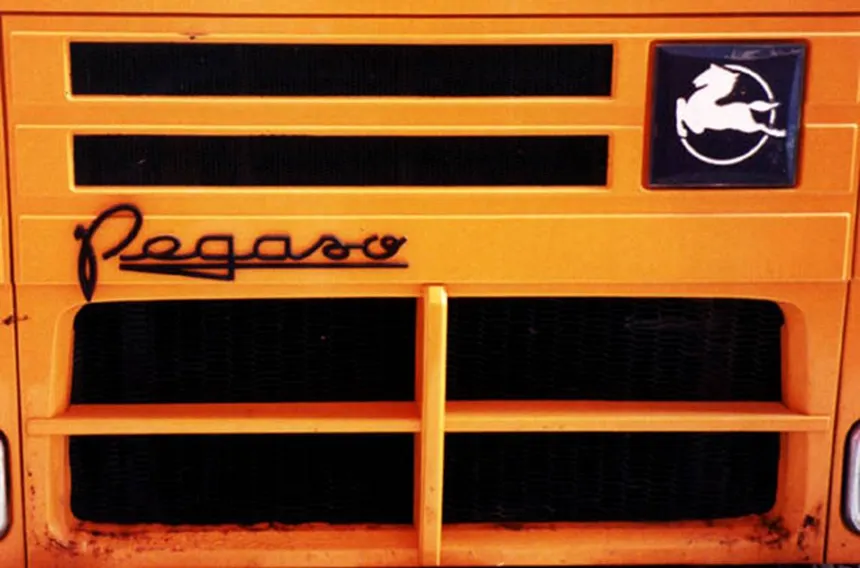
Ricart picks the name. Pegaso. The winged horse of Greek mythology. Strength, agility, elegance. It’s a pretentious name for a company making trucks in a country rationing food. But Ricart always thought big. He designs the logo himself — the horse silhouette in mid-leap. Curiously, without wings. American oil company Mobil already held the trademark for the winged Pegasus. Even in branding, Spain arrived late.
The Flat-Nose Era: The First Trucks
The first Pegaso rolls out in 1947. It’s little more than the old Hispano-Suiza 66G with tweaks. A chubby cab that drivers immediately nickname “Mofletes” — Chubby Cheeks. Gasoline engine, 8-ton payload, top speed of 60 km/h. No engineering marvel. But it’s what exists.
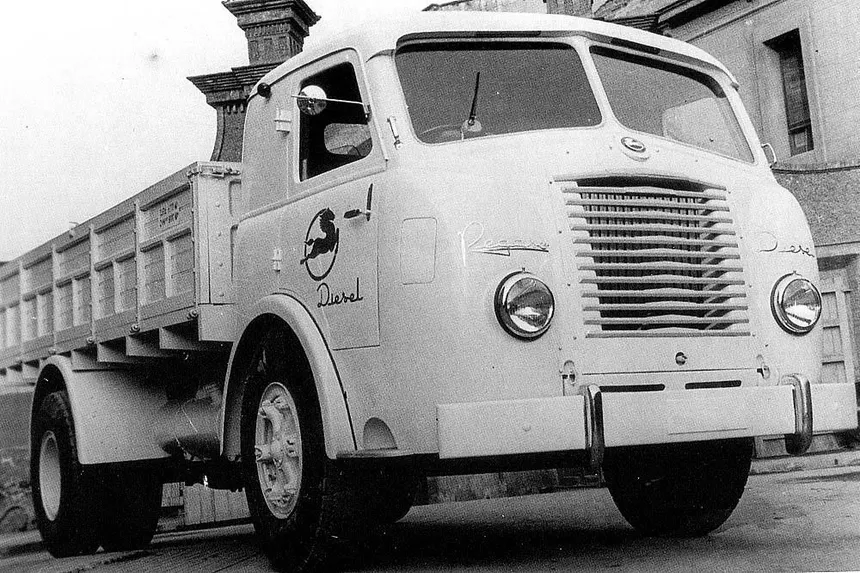
Soon comes the Pegaso Diesel, the first diesel heavy vehicle built in Spain after the war. It burns 29 liters per 100 km versus 45 for the gasoline version. In autarky-era Spain, that difference isn’t a spec sheet detail. It’s the difference between eating at the end of the month and not eating, if you’re a hauler.
By 1950, ENASA produces around 600 chassis per year. Not much. But it’s the foundation for an entire transport system the country simply didn’t have. Pegaso trucks with their corrugated steel cabs — so iconic that Spanish hardware stores still call that type of sheet metal “chapa Pegaso” — start filling Spanish roads. If you had to move freight in 1950s Spain, you moved it in a Pegaso or you didn’t move it at all.
The Barajas: A Good Truck for the Wrong Country
In 1954, ENASA opens a second factory in Barajas, Madrid, and launches the truck that bears its name. The Barajas is an important technical leap: diesel V6 with direct injection, light aluminum alloy block, independent front suspension. It hits 90 km/h, carries 5 to 6 tons, and offers a level of comfort unknown in Spanish haulage.
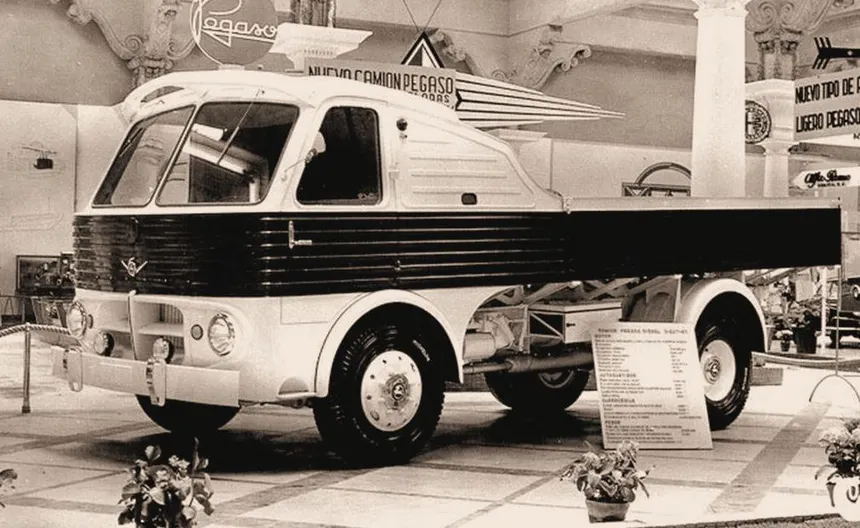
And here comes Pegaso’s first great fracture. The Barajas costs nearly twice as much as a Barreiros Diesel truck. And it’s not just about price. It was a bad product for its market. Not because of the quality of the engineering, but because of everything else.
Ricart designed without thinking about production costs or maintenance. The Barajas had technical solutions that mechanics of the era couldn’t repair. There was no workshop network prepared for it. If a Barajas broke down on a back road in Extremadura, the hauler had a problem that a Barreiros would never give him. Because a Barreiros could be fixed by any mechanic with a hammer and a wrench.
But the problem went beyond Ricart. ENASA wasn’t just a factory. It built an entire Ciudad Pegaso in Madrid — worker housing, services, a church. It maintained an Apprentice School under official Ministry regulations. It funded CETA as a pure research center. All of that was loaded onto the price of the truck. A Pegaso didn’t just carry Spain’s most advanced engineering. It carried an entire social structure on its back.
And on top of that, the lack of scale. ENASA produced hundreds of units per year. Barreiros produced thousands. When you build few, each part costs more. An excellent product that nobody can afford or repair is not a good product. It’s a prototype with license plates.
Eduardo Barreiros sold simpler trucks that did the same job for half the price. The market chose. And the market was right.
The Impossible Parenthesis: The Sports Cars
While the trucks barely keep the books in order, Ricart convinces the authorities to build competition sports cars at a state truck company. In a country where people go hungry. The result is the Pegaso Z-102. A V8 with four overhead camshafts, light alloy body, capable of exceeding 240 km/h. 86 units built between 1951 and 1958. At Jabbeke, Belgium, in 1953, a heavily prepared prototype sets a speed record averaging 243 km/h.
The full Z-102 story is already on NEC. But what matters here is the impact on the brand. The Z-102 was never profitable — it cost 500,000 pesetas when a SEAT 600 sold for 70,000 — and its buyers included Eva Perón, the Shah of Persia, and dictator Trujillo. It wasn’t a car for Spaniards. It was a showcase. And as a technical exercise and training ground for the workforce, it served its purpose. But when the Z-103 arrived in 1955 with engines up to 4.7 liters and 350 horsepower, the INI decided the showcase cost too much. By late 1956, the order was clear: no more sports cars. The remaining molds, parts, and blueprints were destroyed or sold as scrap. An irreparable loss.
The Engineer vs. The Manager
In 1960 comes the moment of truth. Claudio Boada replaces Ricart as managing director and president of ENASA. And what happens isn’t a simple management change. It’s a radical philosophical shift that defines the rest of Pegaso’s life.
Ricart was an engineer of exceptional talent and a disastrous manager. That’s not an opinion. That’s the verdict of his balance sheets. Every product that left his hands was a declaration of technical principles: the best possible, no compromises, cost be damned. Under his command, ENASA operated more like a research laboratory than an industrial enterprise. CETA designed engines, gas turbines, experimental military vehicles, bus prototypes, and competition cars. All with cutting-edge technology. All wildly expensive. And almost all of it running at a loss. Losses that the taxpayer covered.
Boada was the opposite. A manager who looked at the balance sheet before the engineering drawing. His mandate was explicit: produce more, cut costs, compete on price. His first move was to kill off the old Z nomenclature — which reeked of CETA and Ricart from every angle — and replace it with a rational number system. His second was to seek alliances with foreign manufacturers who could supply cheaper, proven components.
Let’s be clear: Boada was right. Technical excellence without profitability is a luxury a poor country can’t afford. But Ricart was right too, because without that technical excellence, Pegaso would have been nothing more than another forgettable truck brand. The brand you know exists because an engineering genius refused to do things halfway. And it died as a business because that same genius never understood that manufacturing is different from designing.
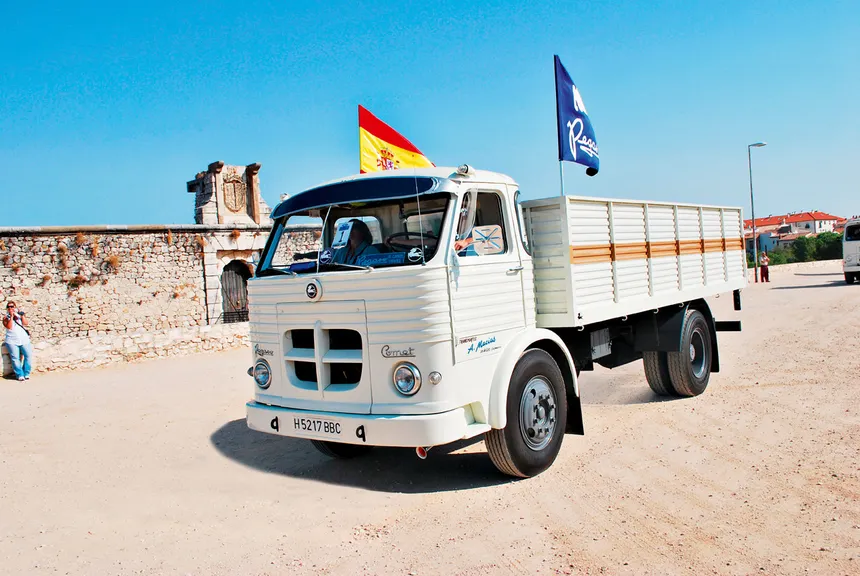
Boada’s immediate result was the Pegaso Comet of 1961, born from collaboration with Britain’s Leyland Motors. Eight-ton payload, simpler engine, competitive pricing. Compact cab, simple interior, reliable. Pegaso’s first bestseller. What the market had been demanding for a decade.
The Spain That Moved on Pegaso
From the 1960s through the 1980s, Pegaso is Spain in motion. The heavy trucks with square cabs and panoramic windshields — the iconic 1080, designed by Italian Aldo Sessano — become the standard for long-haul. If you saw a truck on a Spanish highway, it was a Pegaso. For a long time, there was no other option.
But the most important story of this era isn’t in the trucks. It’s in the buses. The 5020 model revolutionizes Spanish urban transport by mounting the engine horizontally under the chassis, freeing up passenger space and permanently ending the practice of bodying buses on truck frames. The city councils of Barcelona, Madrid, and every major Spanish city adopt Pegaso. Self-supporting coaches — designed with Italy’s Viberti — define intercity transport. If you rode an urban bus in Spain between the 60s and the 90s, a Pegaso moved you.
ENASA expands. In 1966 it absorbs SAVA of Valladolid and becomes Spain’s sole truck manufacturer. Military vehicles — off-road trucks, amphibious vehicles, and the legendary BMR-600 armored cars still serving in the Spanish Army today — open international markets. In the early 1980s comes the largest contract in Pegaso’s history: Egypt orders 10,500 units of the 3046 truck. Ten thousand five hundred trucks for a single client.
But not everything was glory. In the 70s and 80s, ENASA dragged serious problems that the nostalgic narrative tends to skip. Long, costly strikes that paralyzed production. Quality problems in many 1980s models — especially in electrical systems and fuel injection — that damaged the brand’s reputation among haulers. And chronic losses that the INI covered year after year with public money. Pegaso was a beloved brand. But it was a company that lost money on a structural basis.
The Agony: A Decade Looking for Someone to Pay the Bill
The oil crisis hits. Red ink soars. And ENASA begins a desperate decade-long search for a partner.
In 1981, American giant International Harvester buys a major stake and takes over management. The plan is to jointly develop heavy trucks. It lasts three years. The crisis hits IH too, and they abandon the deal, leaving ENASA with an orphaned engine project that ends up sold to an American marine engine company.
In 1984, ENASA buys British truck maker Seddon Atkinson from International Harvester for the symbolic price of one pound sterling. One pound. An entire truck manufacturer for the price of a coffee. Not because Seddon was garbage — it made well-respected construction trucks in the UK — but because its situation was so precarious that nobody else wanted it. ENASA buys it for a foothold in the British market and as an export platform for the coming Troner.
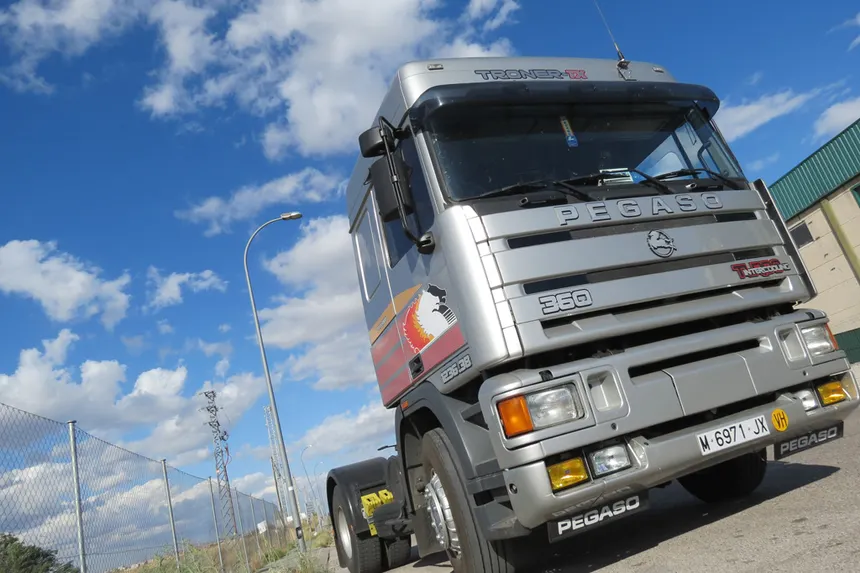
In 1983, development begins on the T-3 project — what will become the last great Pegaso. ENASA can’t finance it alone. Talks with MAN, conversations with Mercedes-Benz. The deal ultimately closes with Dutch manufacturer DAF. Together they found CABTEC to co-develop a shared cab. Giugiaro designs the exterior. The result is the Pegaso Troner, presented by King Juan Carlos I at the 1987 Barcelona Motor Show. 12-liter engine, 360 horsepower. ENASA creates the CS Pegaso Racing Team and competes in the European Truck Racing Championship in 1989 and 1990 with drivers Salvador Cañellas and Juan Escavias.
A Pegaso even runs in the Dakar. In 1984, a barely modified 3046 “Egyptian,” driven by Carlos del Val and Miguel Guerrero, finishes eighth overall. At the finish line, Del Val refuses to ship the truck home by sea. He drives it back to Spain himself.
Why Pegaso Couldn’t Survive Alone
This needs to be said plainly, because nostalgia makes for bad analysis. By the late 1980s, Pegaso was structurally unviable as an independent manufacturer. Not because of any single management mistake, but because of three problems that nobody could solve without infinite money.
First, scale. The European truck market demanded production volumes that Pegaso couldn’t reach. Volvo built more trucks in a month than Pegaso built in a year. Without volume there are no competitive costs. Without competitive costs there’s no margin. Without margin there’s no investment in new models. A closed loop.
Second, range. Pegaso was strong in heavies above 19 tons, but weak in mediums and lights — the very segments with the highest volume and growth. The J4 van, inherited from SAVA, was an umpteenth evolution of a 1960 British design. The 6420 urban bus derived from a 1972 MAN. The range was outdated where it mattered most.
Third, European integration. When Spain joins the EEC in 1986, the tariff barriers that shielded Pegaso fall away. Suddenly you’re competing against Volvo, Scania, Mercedes, MAN, Renault, DAF, and Iveco. All with more scale, wider range, and broader international dealer networks. And Pegaso alone, in a domestic market that’s no longer captive.
Keeping Pegaso alive as an independent brand would have required massive annual public subsidies with no guaranteed outcome. The Felipe González government had a clear policy of privatizing unviable state enterprises. It did it with SEAT, with ENOSA, with many others. Pegaso wasn’t an exception. It was a deliberate political decision, not “not knowing what to do.”
The End: Iveco and the Brand That Goes Dark
In September 1990, the INI and Fiat sign the deal. ENASA passes to the Iveco group. One thing needs to be clarified because it gets repeated a lot: Mercedes-Benz did express interest in ENASA, and according to press sources from the time, their offer was significantly higher than Iveco’s. But Mercedes withdrew of its own accord after the fall of the Berlin Wall, redirecting its resources toward East German industrial integration. The INI didn’t reject Mercedes. Mercedes walked away. And with Mercedes gone, the choice was Iveco or more public money.
And something else the nostalgic narrative usually omits: a sale to Mercedes would probably have ended the same way. Mercedes wouldn’t have kept the Pegaso brand any longer than Iveco did. When a large group buys a small one, the small brand disappears. That’s the logic of the industry. It happened to Pegaso with Iveco, it would have happened with Mercedes, and it would have happened with anyone.
The Troner survives three more years. It improves: 400 hp engine in 1992, ZF 16-speed gearbox, ABS, air suspension. The Troner 1240 is one of the most advanced trucks in Europe. But Iveco doesn’t need an internal competitor. Gradually, Pegaso’s lineup is replaced by Iveco’s own ranges. In July 1993, the last Troner rolls off the Barajas line. That same year, the last Pegaso engine is built.
But the factories didn’t disappear. The workers didn’t disappear. The technology didn’t disappear. Iveco still produces today at the Valladolid and Madrid plants it inherited from ENASA. What disappeared was the name. The horse was put in a drawer. But the industry that Pegaso built lives on, with a different logo on the door.
What Remains of Pegaso
It wasn’t just a truck brand. It was the backbone of transport in Spain for half a century. The “chatos Pegaso” — flat-nosed trucks — defined an era. Pegaso buses carried entire generations of Spaniards. The Apprentice School trained thousands of technicians who went on to work across Spain’s motor industry. Ciudad Pegaso in Madrid was an entire community built around a factory. Pegaso trucks hauled the materials that built modern Spain.
86 sports cars. Thousands of trucks. Tens of thousands of buses. Military vehicles on three continents. A speed record. Le Mans, the Carrera Panamericana, the Dakar, the European Truck Championship.
Wifredo Ricart created it from nothing with towering technical talent and a complete inability to balance a set of accounts. Claudio Boada made it viable and stripped its shine. Spain used it for half a century without ever giving it the scale it needed to compete beyond its borders. And Iveco bought its factories, absorbed its technology, and erased its name.
The horse is still there. In the few surviving Z-102s, in the Troners that a handful of diehards keep running, in the Iveco plants where trucks are still built by Spanish hands. And in the memory of those who grew up with the sound of a Pegaso engine at five in the morning, in a country that once, against all odds, built the world’s fastest car in a truck factory.
Check you’re still alive.
4 thoughts on “PEGASO – ENASA”