
Ford Mustang GTD Competition: Ford’s blow at the Nordschleife
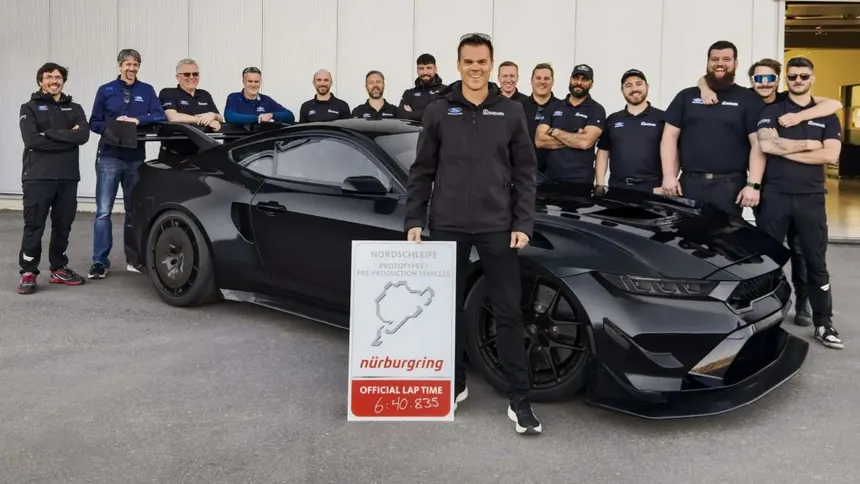
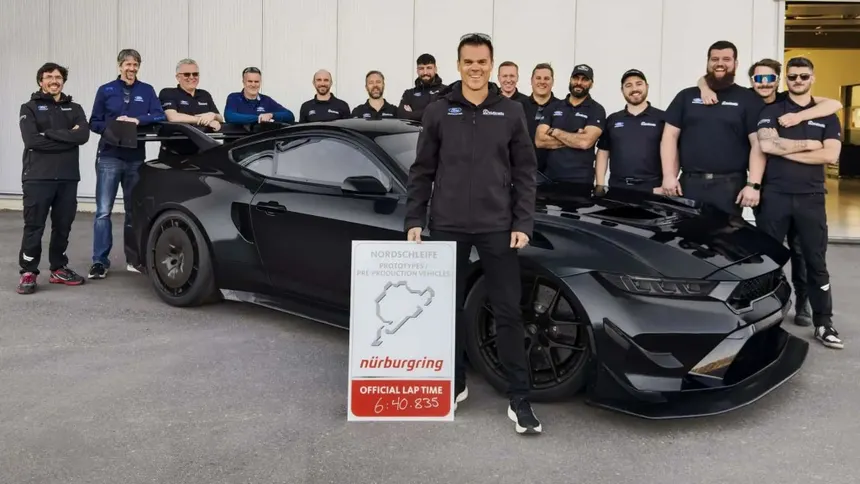
Six minutes. Forty seconds. Eight hundred and thirty-five thousandths.
6:40.835. Read it slow, because this isn’t going to live long in the papers before someone breaks it, but as I write this it’s the absolute fastest time an American street-legal car has ever registered at the Nürburgring Nordschleife. A Mustang. At the Green Hell. Ahead of the Corvette ZR1X. Ahead of the Porsche 911 GT2 RS with the Manthey kit. Ahead of the Mercedes-AMG GT Black Series. Ahead of the Porsche 911 GT3 RS, which was the car Jim Farley, Ford CEO, set as the target when all this started.
Only one street-legal car in the world is faster: the Mercedes-AMG One, which is literally a Formula 1 car with plates, running the Mercedes-AMG PU106 engine Lewis Hamilton used to win world championships. That doesn’t count. That’s a different league, a different sport, a different budget.
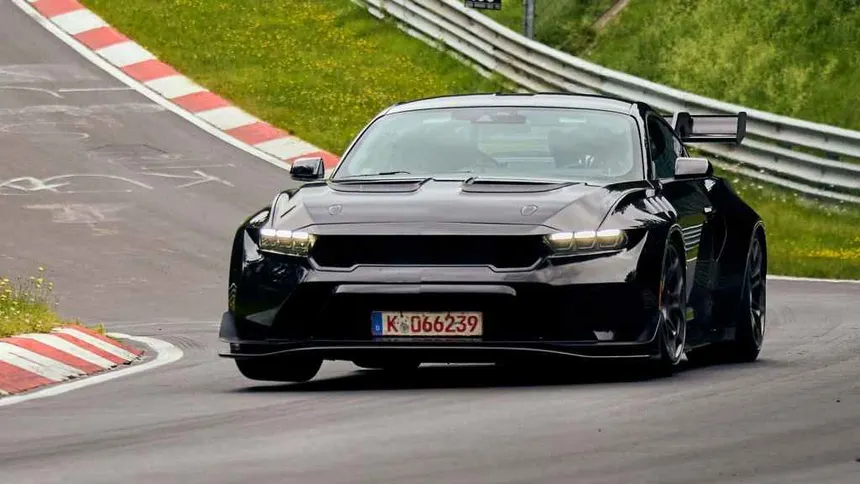
We’re not talking here about the street GTD that already broke the seven-minute barrier. We’re talking about the Mustang GTD Competition, the version Ford officially revealed on April 17, 2026, and that left the Corvette ZR1X looking stupid. By eight and a half seconds. At the ‘Ring.
What happened at the Dearborn garage
Quick context because you need it. Clean timeline:
August 2023, Ford unveils the Mustang GTD. Jim Farley promises it’ll be the first American street car under seven minutes at the Nordschleife. December 2024, Dirk Müller at the wheel, official time: 6:57.685. Promise kept. American street-legal absolute record at the ‘Ring. Spring 2025, second round of testing, improved to 6:52.072. Five seconds off.
Then Chevrolet showed up. Corvette ZR1 posted 6:50.763. Corvette ZR1X, all-wheel-drive hybrid with 1,250 hp, registered 6:49.275. Ford loses the American throne in a direct dogfight. Live corporate humiliation, with Detroit fans split between Blue Oval tifosi and Golden Bowtie tifosi.
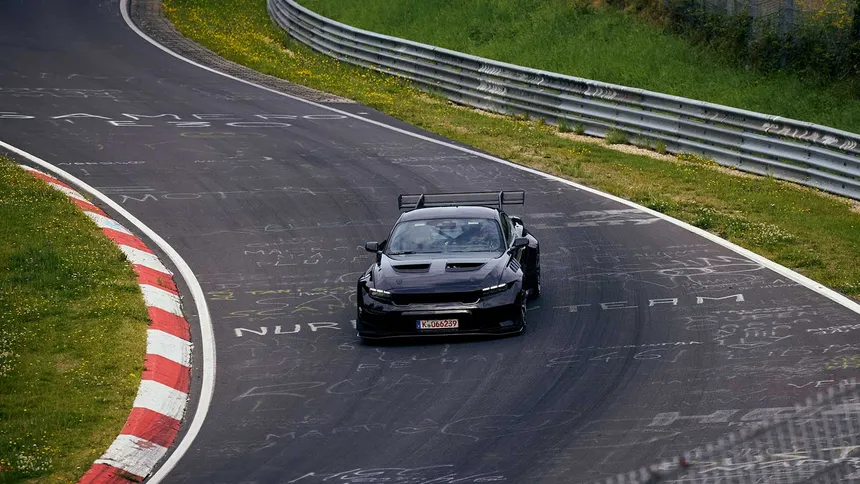
Ford could have stood still. Instead, on April 17, 2026, they sent Dirk Müller, the same Multimatic driver who held the previous two GTD records, to the Nürburgring with a car nobody had seen yet. They called it Mustang GTD Competition. Result: 6:40.835. Eleven seconds off the standard GTD. Eight and a half seconds off the hybrid ZR1X. American record recovered. And not just recovered. Demolished.
Jim Farley posted it on his own Twitter/X account that same afternoon, six words: “When we said ‘Game On,’ we meant it.”
The Mustang even the engineers didn’t fully expect
The GTD Competition is the GTD evolution that wasn’t in the original plan. Or rather, it was, but Ford didn’t want to show it yet.
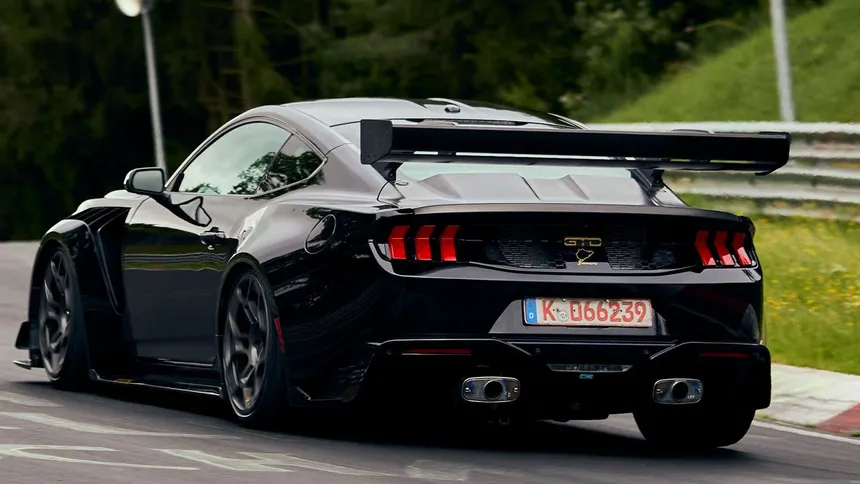
Over the standard GTD, the Competition adds a list of changes that are, basically, an obsession with cutting weight and sharpening aero. The wheels are now magnesium, not forged aluminum. Magnesium is lighter, more expensive, and harder to machine. You rarely see it on street cars because it requires specific processes. On the Competition, it’s standard.
The regular Recaro seats give way to carbon fiber competition bucket seats. Less weight, less cushioning, more lateral support, all at once. The damper setup gets revised with lighter springs and valves.
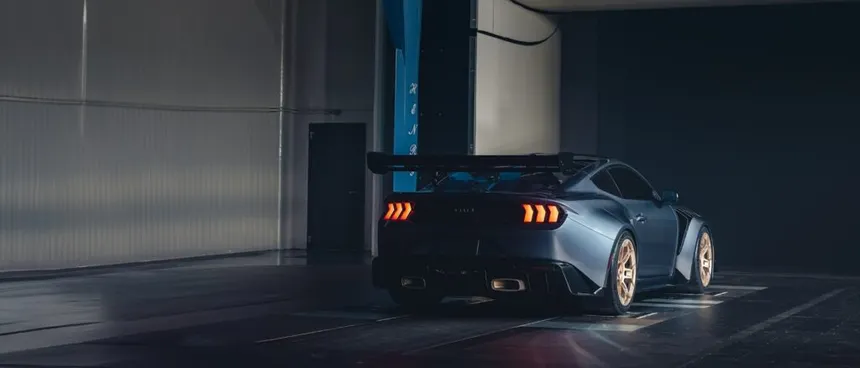
Aerodynamics get fine-tuning over the GTD’s base, not full redesign. On top of the existing DRS system, Ford has added specific rear wing modifications, secondary front dive planes, and carbon fiber aero discs on the rear wheels to manage airflow exiting the wheel arches. Details that on another car would be decorative poetry, but on a GTD already generating 885 kg of downforce at 180 mph translate to real stability in the Nordschleife’s high-speed sections.
And the 5.2 supercharged Predator V8, the one that in the standard GTD already pulled 815 horsepower and 664 lb-ft, grows in power. Ford hasn’t dropped the exact figure. They literally say it “surpasses the first GTD’s 815 hp output.” It surpasses it. By how much, Ford will say when it wants to. Exact numbers will come in the next few weeks, along with the official production figure and the price.
All of this lives inside a car that remains road-legal. It has to meet American federal homologations, it has to pass German ITV for Nürburgring track days, it has to be plate-able. It’s not a closed-circuit prototype. It’s a car you’ll be able to buy, in strictly limited and serialized quantities, according to Ford’s exact words.
Müller’s lap, and the engineer who isn’t a driver
Here’s the part that separates a technical note from an NEC piece: how the lap was set, and who else was at the wheel that day.
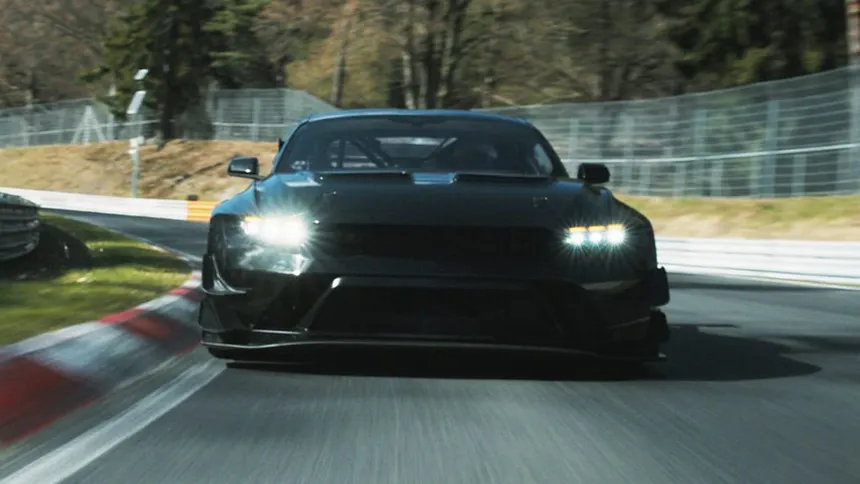
Müller posted 6:40.835 with the car calibrated by Multimatic, full telemetry, controlled conditions, and notarial supervision certified by TÜV Rheinland. The Nürburgring doesn’t accept times by waving a flag. For a record to count, timing runs on calibrated tech, a notary attends, the car passes homologation inspection, and TÜV documents that the vehicle meets the declared standards. Same applies to Porsche as to Ford. Müller put in the clean lap, no significant traffic, tires at optimal temperature. The onboard footage is published on the Nürburgring’s own official YouTube channel, not a Ford channel. That means technical transparency: if you want to verify the lap, the whole thing is visible, sector by sector.
But the truly brutal data point from that day isn’t Müller’s lap. It’s the engineer’s lap.
Steve Thompson, Ford Racing engineer, not a professional driver, with fewer than forty total laps on the Nordschleife in his entire career, climbed into the same GTD Competition that same day. Time: 6:49.337. Read it again: 6:49.337. That’s quicker than the standard GTD’s original record, set by Müller a year earlier. An engineer with forty laps in his life on one of the most complex circuits on the planet, in a supercar, sets a time the previous car couldn’t set with a professional driver behind the wheel.
That data point says more about the car than any official press release. It says the GTD Competition is so stable, so easy to read, and so generous to the driver that a serious engineer can extract record-level performance without having grown up in karting. Mark Rushbrook, global director of Ford Racing, summed it up: “You don’t run a 6:40 at the Nürburgring on hardware alone. The GTD Competition is the direct result of pouring our hardest-learned motorsport lessons into a street car, backed by a team of engineers who sacrificed their nights and holidays to squeeze out every possible millisecond.”
The engineers have names: Peter Kuechler, Sam Ashtiani, Steve Thompson. This isn’t an empty corporate statement. These are the people who signed off the lap before Müller drove it.
The question you’re asking
Okay. Six-forty. Cool. What’s the point?
Here comes the real editorial part. Because Nürburgring times are a marketing product as sophisticated as it is pure. The Nordschleife is, technically, a German secondary road converted into a circuit. It’s dangerous, it’s long, it has traffic when it’s not closed for testing, and it’s where every manufacturer with premium ambition sends its new car to set a time. Because ‘Ring times sell cars.
The GTD Competition isn’t a car you need. It’s not a car that works for daily use. It’s not a car you’re going to grocery shop with. It’s a collection object, ultra-exclusive, serialized, with a price that will sit, almost certainly, above $500,000. Ford hasn’t confirmed a figure but the standard GTD starts at $328,000 out the door, the Liquid Carbon lives around $450,000, and the Competition will sit above all of them.
And here’s a service note for the reader who might be considering one: Ford has reopened the application window for the standard GTD coinciding with the record announcement. It’s a transparent commercial play. They know demand is going to spike, the Competition won’t be within reach for most people, and the standard GTD at $328,000 looks almost reasonable next to what the Competition will cost. If you were already weighing a GTD, this is probably the moment. If the Competition interests you, applications are managed at themustanggtd.com, with global production of the original confirmed at under 2,000 units and the Competition being “an even more exclusive derivative,” per Ford’s literal text and authorized dealers.
A technical clarification the reader deserves: the Nürburgring’s “Pre-Production / Prototype Class” category where the GTD Competition was timed has no relation whatsoever to the Balance of Performance (BoP) the FIA applies to GT3 race cars. Different universes. BoP is an administrative equalization system between rivals in the same race class. Nordschleife categories are timing labels based on the car’s homologation status, not competitive equalization tools. The GTD Competition competes against itself and against the stopwatch, not against other cars with administrative ballast loaded on them. The Competition’s time is the Competition’s time. Period.
What the GTD Competition is is a statement. A positioning piece. A “we’re here” from Ford aimed at Porsche, Mercedes-AMG, Ferrari, McLaren, and the rest of the European club that has been deciding how much supercars are worth for decades.
For Ford, the GTD Competition sells regular Mustangs. Sells Ford GTs. Sells anything with a Ford Performance badge. Sells the idea that Ford isn’t just pickups and SUVs anymore. The car itself will move a very small handful of units to wealthy collectors, hedge fund managers who want a garage jewel, and entertainment executives. That’s not the real business. The real business is brand prestige built through this kind of car.
Where the GTD Competition sits among the gods
Let’s sort out the 2026 ‘Ring hierarchy so it’s clear where this car plays. List of the fastest street-legal cars at the Nordschleife, fastest to slowest:
First, the Mercedes-AMG One. 6:29.090. Hybrid powertrain derived from the Mercedes-AMG PU106 Formula 1 engine, with six additional electric MGU motors. 1.6-million-euro car. 300 units produced. This is literally a Formula 1 with plates, it’s not really comparable.
Second, the Mustang GTD Competition. 6:40.835. 5.2 supercharged V8. Rear-wheel drive. Bought at a Ford dealership, with manufacturer approval.
Third, the Porsche 911 GT2 RS with Manthey Performance kit. 6:43.300. 3.8 twin-turbo flat-six, 700 hp. Kit that converts the street GT2 RS into a ‘Ring-optimized version. 500,000-euro car with the kit on top.
Fourth, the Porsche 911 GT2 RS MR (original Manthey Racing setup). 6:44.749. Same car, earlier version of the Manthey treatment.
Fifth, the Mercedes-AMG GT Black Series. 6:48.047. Twin-turbo V8, 720 hp. 340,000-euro car.
Sixth, the Corvette ZR1X. 6:49.275. All-wheel-drive hybrid, 1,250 hp. Most advanced production tech, significantly higher weight than all the others.
Seventh, the Porsche 911 GT3 RS with Manthey kit. 6:49.328. The car Farley set as a target in 2023 and that the GTD Competition now beats by nine seconds.
Eighth, the Corvette ZR1. 6:50.763. The non-hybrid brother of the ZR1X.
Ninth, the standard Mustang GTD. 6:52.072. American record from just months ago.
Between the standard Mustang GTD and the Competition, eleven seconds. Eleven. On a closed track running 20.8 kilometers, eleven seconds is an abyss. It’s the equivalent of changing performance categories entirely. What was sitting near the bottom of the American top-10 jumps to second place absolute in the world’s street-car ‘Ring ranking.
Ford Racing and Multimatic pulled this off with sheet metal and paint, basically. Same chassis. Same base engine. Same foundations. Eleven seconds stripped out through magnesium, carbon, setup work, and fine aero.
The Ford GT Mk IV is still the king
There’s a nuance worth closing properly so no one sells a fake medal. The Mustang GTD Competition is the second fastest American car in Nürburgring history, not the first.
The first is the Ford GT Mk IV. 6:15.977. Twenty-five seconds quicker than the Competition. But the GT Mk IV has a significant catch: it isn’t road-legal. It’s a track-only exclusive, with specific chassis, dedicated engine, and optimized bodywork. Only 67 units were produced, at $1.7 million each, and they can only be used on circuit.
That’s why Jim Farley was so careful with his wording when he posted the record. He talked about “the two fastest American Nürburgring lap times,” not the absolute record. The GT Mk IV for track-only, the GTD Competition for street cars. Two different categories. Two different titles. The Competition is the fastest American among plate-able cars. That’s the fact.
Both American cars still sit below three references: the electric Volkswagen ID.R (5:19), the Porsche 919 Hybrid Evo (5:19), and the AMG One itself. These are pure circuit prototypes (the first two) or a disguised Formula 1 (the AMG One). In the combustion-plus-road-legal category, the GTD Competition has no rival on the Nordschleife list.
What comes next: 2027 and Le Mans
The GTD Competition doesn’t live in isolation. It’s the latest visible piece of a much larger industrial plan Ford has been executing since 2023, with a final goal that has a date and a postal address: June 2027, Circuit de la Sarthe, 95th edition of the 24 Hours of Le Mans, Hypercar class.
The 2027 Hypercar program data, now public, gives the dimension of what Ford is building. The chassis will be built by ORECA, the French outfit with nearly 240 LMP2 victories and ten consecutive Le Mans wins in prototype class. The engine will be a 5.4 naturally aspirated Coyote V8 developed entirely in-house in Dearborn, based on the Mustang Dark Horse R, GT4, and GT3 powerplants, mated to the standard LMDh hybrid system supplied by Bosch. Only the third naturally aspirated Hypercar on the 2027 grid, alongside the Cadillac V-Series.R and the Aston Martin Valkyrie.
Program director is Dan Sayers, ex-Prodrive (where he ran Aston Martin Racing and oversaw multiple Le Mans victories), ex-Red Bull Ford Powertrains (where he led the 2026 F1 engine development with Ford support). Confirmed drivers: Sebastian Priaulx (second generation of the Priaulx family at Ford), Mike Rockenfeller (2010 Le Mans winner with Audi LMP1), and Logan Sargeant (36 F1 starts, comes from Williams’s paddock, American from Florida).
The line that best sums up the program is from Sayers, speaking to press in January 2026: “When you hear a Ford coming down the Mulsanne Straight at three in the morning, you shouldn’t have to look at the badge to know who it is. That’s why we chose the Coyote.” Naturally aspirated American V8 against European turbo hybrids. The sonic and philosophical positioning is already set.
That’s the main course. The GTD Competition and all the GT3 work are the appetizer. The full industrial chain: GT3 gives engineers GT race experience, the street GTD trains Multimatic in serialized supercar production, the GTD Competition proves the team can step up when needed, and the 2027 Hypercar crowns the operation. Everything connects. Nothing is loose.
Until then, the record is six minutes, forty seconds, eight hundred and thirty-five thousandths. The car that set it is a Mustang. It carries plates. You can buy it at a dealership. And it left the Corvette ZR1X apologizing on every American forum.
This is what happens when Ford decides it’s had enough of being second.
Check you’re still alive.