
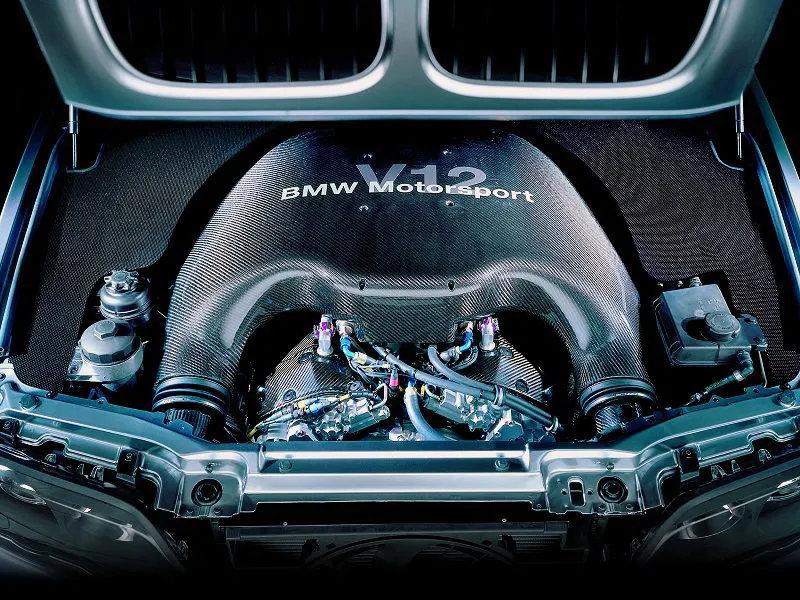
BMW X5 Le Mans: The SUV That Beat the Cayenne Two Years Before the Cayenne Existed
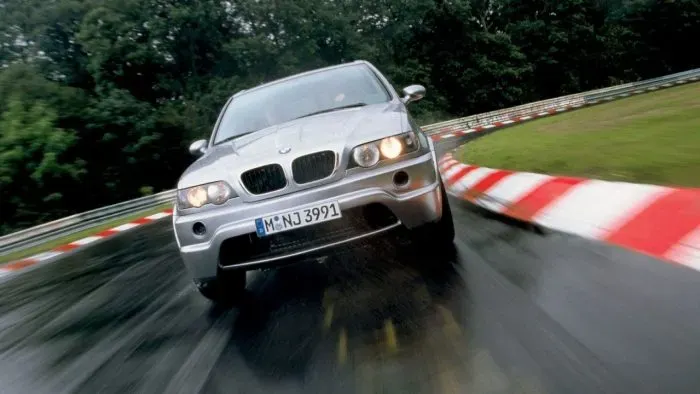
Hans-Joachim Stuck took a BMW X5 around the Nordschleife in June 2001. Seven minutes, forty-nine seconds, ninety-two hundredths. Three hundred and eleven kilometres per hour on the Kottenborn straight. The first SUV in history to break the eight-minute barrier at the Nürburgring, and the only one that would do it for the next nineteen years. Until 2020, when the Audi RS Q8 finally beat it. The Porsche Cayenne Turbo GT followed in 2021. Nineteen years it took the industry to catch up to a one-off concept BMW had built and quietly filed away.
To put that in perspective: when Stuck set the time, the BMW M3 CSL E46 — still considered one of the finest M cars ever made — was two years away from existing, and when it finally arrived it would lap the Ring slower than this X5, by eight hundredths of a second. A V8 sports coupé got beaten by an SUV concept car around the most famous circuit in the world. Top Gear has called the X5 Le Mans the wildest concept BMW ever made, and they’re not exaggerating.
The strange part isn’t that BMW built it. The strange part is that BMW didn’t sell it. Or anything like it. Not until 2009, when the X5 M E70 arrived with 555 horsepower — a hundred and fifty horsepower less than the concept that had been sitting in a BMW Classic warehouse for nine years. And even that production X5 M had all-wheel drive and an automatic gearbox. The Le Mans concept, by contrast, ran rear-wheel drive only and a six-speed manual gearbox. It took BMW twenty-three years from showing the X5 Le Mans at Geneva 2000 to actually building a production X5 M Competition that would approach what they’d already done with one off.
This is the story of the most extreme road SUV ever conceived. And of why the company that built it didn’t dare sell it.
When BMW had to enter the SUV game and didn’t want to
Set the scene. The late nineties. Mercedes-Benz had launched the ML in 1997 from its new Alabama factory. Lexus had the RX from 1998. Audi was preparing the Q7 for some unspecified future. And BMW — a brand whose entire identity for thirty years had been “the ultimate driving machine” — was arriving late and reluctant to a segment that was exploding in North America.
The internal decision was painful. BMW knew exactly what it was doing. Building a luxury SUV went against everything the brand had promised since the 1970s. But the money was in America, and Americans bought SUVs. So BMW did the one thing it could do: it called the new car a SAV — Sport Activity Vehicle — not an SUV. Pure marketing. The idea was to position the X5 semantically apart from the Range Rover, the Cherokee, the entire wagon-on-stilts category. To promise that whatever this was, it was sportier than that.
The X5 E53 launched at the 1999 Frankfurt Motor Show and entered production at BMW’s brand-new factory in Spartanburg, South Carolina. Not in Germany. A detail worth pausing on, because it explains the corporate vulnerability: BMW was launching its first SUV from an American factory the company had opened in 1994. Everything about the project was a stretch. Reputation, geography, segment. The brand was rolling the dice on something it didn’t fully believe in.
And then somebody in marketing had the kind of idea that only occurs when you’ve just watched your Formula 1 partnership wither and your endurance racing programme deliver an unexpected miracle. The idea: use BMW’s outright victory at the 1999 24 Hours of Le Mans — the only outright Le Mans win in BMW’s entire history — to legitimise the new SUV. The brief: take the X5 we just put into production, drop in the V12 from the Le Mans winning car, and let everyone in the world watch a Sport Activity Vehicle behave like a Le Mans Prototype.
The engine that came from a McLaren
This needs unpacking, because the engine in the X5 Le Mans has one of the most interesting genealogies of any production-era BMW unit.
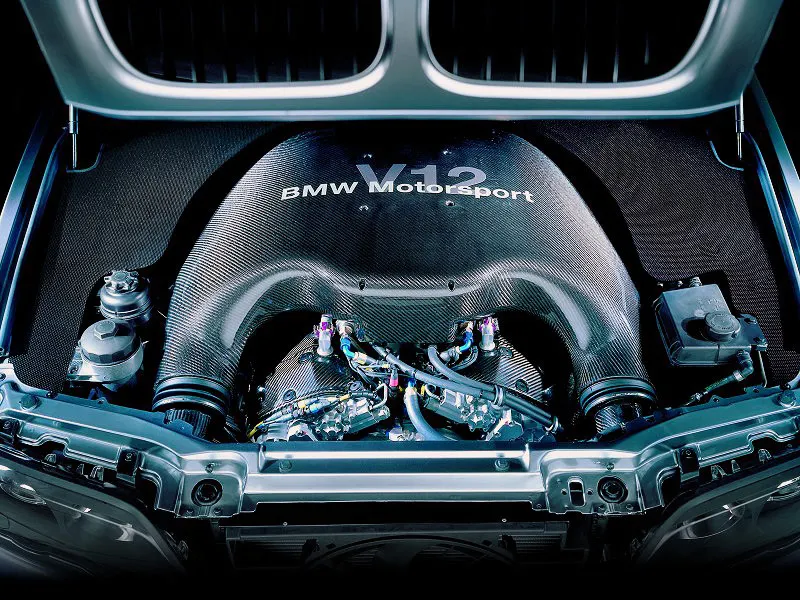
Internally called the S70/3: all-aluminium block and heads, 60-degree V12, 5,990 cubic centimetres, twin overhead camshafts per bank, four valves per cylinder, naturally aspirated. So far so spec sheet. But here’s the part most people don’t connect. The S70/3 is a direct evolution of the S70/2 — the V12 that Gordon Murray specified for the McLaren F1 between 1992 and 1998. Yes, that McLaren F1. The car that held the production-car top speed record for over a decade and is still, in many configurations, the fastest naturally aspirated production car ever built.
Paul Rosche’s BMW Motorsport team developed the S70/2 for Murray on the basis of existing BMW M architectures. When BMW returned to Le Mans in the late nineties after a disappointing 1998 effort with the V12 LM, the team took that engine, evolved it into the S70/3, and dropped it into the V12 LMR that won the 1999 24 Hours of Le Mans with JJ Lehto, Joachim Winkelhock and Pierluigi Martini behind the wheel. That win is, still today, the only outright Le Mans victory in BMW’s entire history. Twenty-five years on, it remains the only one. That isn’t decoration: it’s why the engine carried the symbolic weight it did when BMW dropped it into the X5. They weren’t fitting any old V12 to the SUV. They were fitting the engine of the only overall Le Mans win in a century of the brand.
In the LMR the engine was restricted to around 580 horsepower by mandatory air-intake restrictors imposed by the ACO regulations for Le Mans Roadster category cars — that’s where the R in LMR comes from. In the X5 Le Mans, BMW pulled the restrictors. Over seven hundred horsepower at 6,500 rpm. Seven hundred and twenty Newton metres at 5,000 rpm. Hypercar torque numbers in a vehicle weighing 2,130 kilograms.
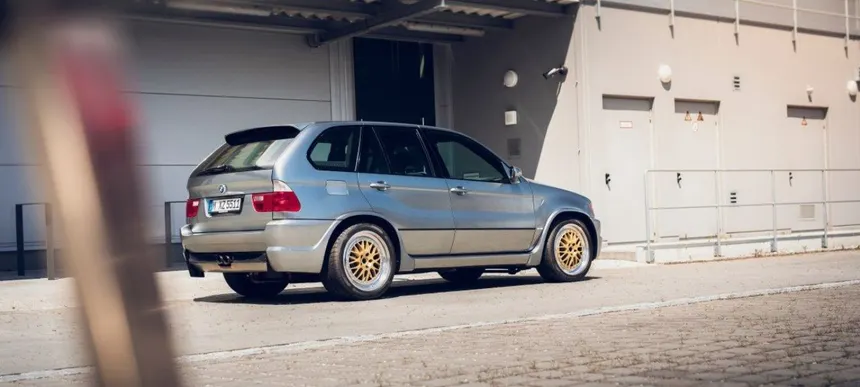
Here’s the workshop detail worth marking. The McLaren-derived V12 is narrower than the M62B44 V8 BMW was already fitting to the production X5 4.4i. Not shorter — a longitudinal V12 will always be longer than a V8 — but narrower. That’s what happens when you compare a 60-degree V12 to a 90-degree V8. The engine fitted across the X5’s bay without any structural modification. All they had to do was push the entire powertrain back inside the car to position it front-mid, then pull the heat out through that enormous carbon-fibre bonnet scoop you see in every photo. Geometrically, the car was ready to take the engine. The only obstacle was BMW’s internal culture.
What changes when you put a Le Mans V12 in an SUV
Stating the obvious: putting over 700 horsepower into a 2.1-tonne vehicle with rear-wheel drive and a manual gearbox is the textbook recipe for killing yourself quickly. BMW, however, didn’t build this car to kill anybody. They built it to demonstrate that it could be done, then decide what to do with the answer.
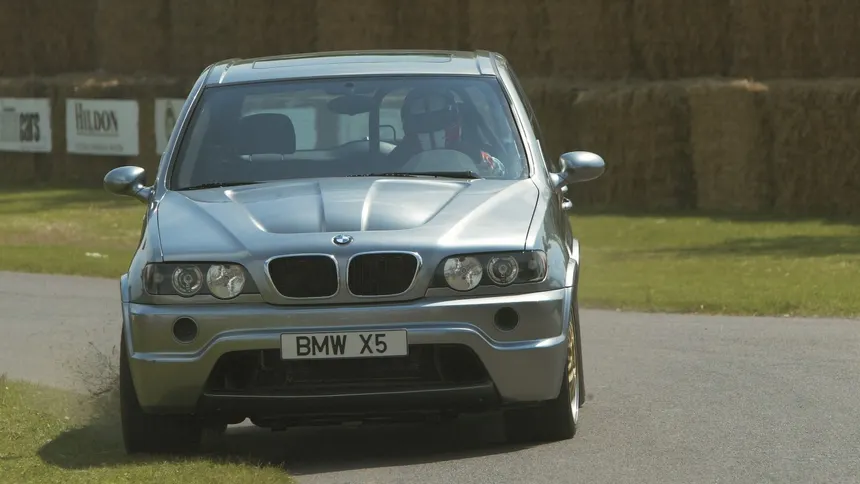
The modifications to the production X5 are surprisingly minimal, and that’s the most interesting part. Suspension dropped 30 mm. Twenty-inch gold BBS wheels in place of the standard 18s. Michelin 315/35 rear, 275/40 front in some configurations. Carbon-fibre racing buckets replacing the standard X5’s leather electric seats. And nothing else inside. Mechanically: the production X5 chassis took the engine with barely any reinforcement. That tells you a lot about the E53 itself. The car had enormous structural margin.
The most radical decision was the drivetrain. The production X5 came standard with all-wheel drive through a transfer case. The X5 Le Mans doesn’t have all-wheel drive. It runs pure rear-wheel drive to the back axle alone, via a six-speed manual gearbox lifted from the M5 E39 parts bin. A manual SUV. In the year 2000. The decision goes against everything BMW would later put in production.
Why? Two reasons. First, all-wheel drive adds weight and parasitic friction. In a car designed to break a circuit record, neither belongs. Second, and this is the more telling reason: BMW M Division — who signed off on this car, not BMW Standard — followed a philosophy through the entire 1990s the brand called “back to basics”. Rear-wheel drive, manual gearbox, naturally aspirated. The M3 E46. The M5 E39. And this X5 Le Mans, which conceptually is an M3 on stilts. The car isn’t a sports SUV. It’s an M car wearing an SUV body. That’s the distinction worth grasping.
The weight distribution that broke the SUV rulebook
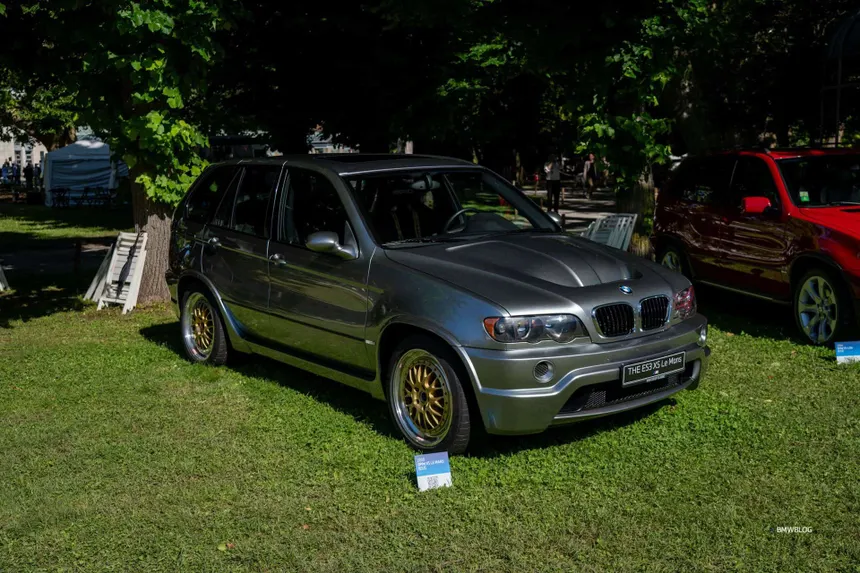
Here’s the technical detail that most coverage of this car undersells. The X5 Le Mans has 51:49 weight distribution between the front and rear axles. Two percentage points of asymmetry. In a 2.1-tonne car. With a longitudinal V12 sitting up front.
That isn’t an accident. It’s engineering. The V12 is mounted very far back in the X5’s engine bay, essentially behind the front-axle centre line. What BMW internally calls “front-mid engine”. The same principle they used in the Z8 contemporary, the M3 E46, and every M-division longitudinal engine of the period. The production X5 already used a similar layout for the V8, but stepping up to twelve cylinders longitudinally meant the engine block grew by nearly a metre toward the front. BMW solved that by shifting the entire powertrain rearward inside the car. The result, with a huge V12 up front, is almost identical mass on each axle.
This is what explains Stuck’s lap time. A normal SUV with 700 horsepower and 60:40 weight distribution understeers terminally through every high-speed corner, eats its front tyres within five laps, and the driver arrives at the pits wondering why he agreed to do this. The X5 Le Mans, with 51:49, behaves like a large car with sports-car dynamics. Stuck himself, in his post-record interviews, said he never had to fight the car at any point during the lap — which from a two-time Le Mans winner and DTM champion is the highest compliment a chassis can receive.
The Nürburgring lap that broke the rulebook for two decades
In June 2001, BMW brought the X5 Le Mans to the Nordschleife with Hans-Joachim Stuck behind the wheel. Stuck — from Garmisch-Partenkirchen, born into motorsport, the Ring’s grandson in every sense — has known that circuit since he was a teenager. They pulled the rear seats out to save weight. Fitted competition tyres. And asked him to do what no SUV had done before: lap the place in under eight minutes.
Stuck went around in 7 minutes, 49 seconds and 92 hundredths. Top speed recorded on the Kottenborn straight: 311 km/h, 193 mph. Some context. The M3 CSL E46, launched two years later in 2003 and still considered among the most magnificent M cars ever built, lapped the same circuit in 7:50.00 flat. Eight hundredths of a second slower than the SUV. Read that again. A pure homologated competition coupé, two years newer, hundreds of kilos lighter, lost by eight hundredths to the X5 Le Mans. The contemporary Z8 never had an official published Nordschleife time. And no SUV anywhere in the world would beat the X5 Le Mans’ mark for nineteen years, until the Audi RS Q8 finally did it in 2020 and the Cayenne Turbo GT followed in 2021. Nineteen years of unchallenged dominance in a segment that didn’t even properly exist when the lap was set.
Top Gear, in their retrospective on the car, put it bluntly: BMW built the answer to a question nobody else would think to ask until two decades later.
Why the Cayenne had to exist anyway
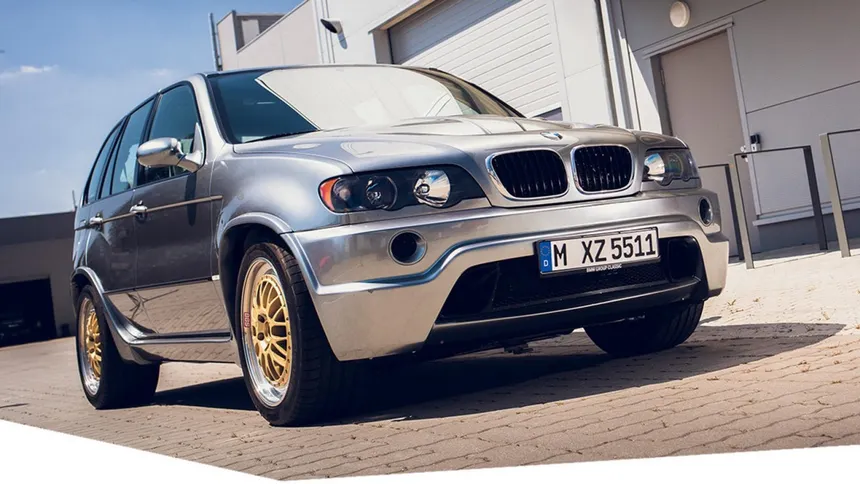
Now the interesting part. Porsche Cayenne launched in 2002, two years after BMW showed the X5 Le Mans at Geneva. And Porsche, who knew exactly what they were entering, had to justify internally that they were going to charge into a segment where BMW had already filed the proof of what the ceiling looked like.
But something strange happened next. BMW didn’t continue. The X5 Le Mans was wheeled into BMW Classic storage. No production X5 M appeared until 2009. And when the X5 M E70 finally arrived, it made 555 horsepower. A hundred and fifty less than the 2000 concept. With all-wheel drive and an automatic. The car BMW sold as an X5 M in 2009 was technically less extreme than the concept they’d already finished in 2000.
Three reasons, ordered by importance.
First, BMW M’s internal discipline. In the early 2000s M Division was singularly focused on M3, M5 and M6. Building an X5 M with rear-wheel drive, manual gearbox and a V12 would contradict the positioning of the M5 itself. Any M5 customer who saw an X5 M lapping faster than his saloon would start asking awkward questions. The brand refused to cannibalise itself from inside.
Second, the market wasn’t ready. In 2000, luxury SUV customers wanted ride height, space and prestige. Not extreme performance. The performance SUV market didn’t fully open until the Cayenne Turbo and the ML 63 AMG of the mid-2000s. BMW could build the car. But there weren’t enough customers willing to pay what a Le Mans V12 X5 would cost. It would have been the most expensive vehicle in the entire BMW lineup, sold in token numbers.
Third, the reason BMW will never confirm: industrial cost. Producing an X5 with a naturally aspirated V12 racing engine would have required a parallel assembly line, near-impossible emissions homologation, fuel consumption figures that would tank the brand’s fleet average, and dealer-network technical training nobody had budget for. For 200 or 300 units a year. Any CFO worth the title kills that car on the first review.
So the X5 Le Mans stayed what it was. A demonstration. A statement. A record that would hold for two decades. And an internal BMW M legend of “what we could have done if they’d let us.”
The one detail almost everyone misses
When the original X5 Le Mans concept was being discussed inside BMW Motorsport in 1999, the initial proposal wasn’t for the V12 LMR engine. The first plan was to use the V10 from BMW’s Formula 1 engine that Williams was about to receive for the FW22 chassis. The same engine that would debut in 2000 with Jenson Button on the grid. Imagine it. An X5 with a Formula 1 V10 revving to 19,000 rpm. The fuel consumption and cooling problems made it physically impossible, but the idea was tabled in BMW Motorsport meetings. Somebody, mercifully, remembered that the Le Mans V12 was lighter, more compact and had usable torque from below 3,000 rpm. That’s how the car we know was born.
Sometimes the ceiling of a segment gets built before the segment exists. Sometimes the company that built it decides not to open the door, because they know that the moment they do, they’ve got nothing left to surprise the market with. The X5 Le Mans is that case. Twenty-three years later, the ceiling is still there, in a BMW Classic warehouse, waiting for somebody brave enough to beat it. Probably nobody ever will.
Check you’re still alive.