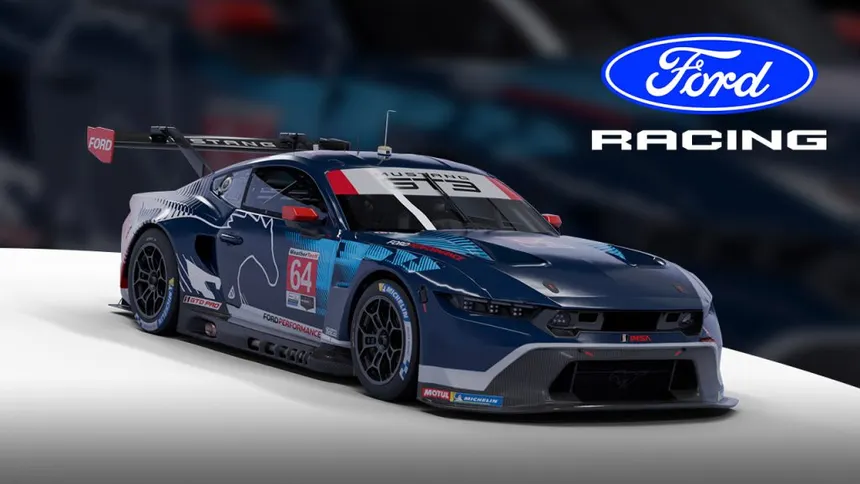
Ford Mustang GT3: the wild horse at Le Mans
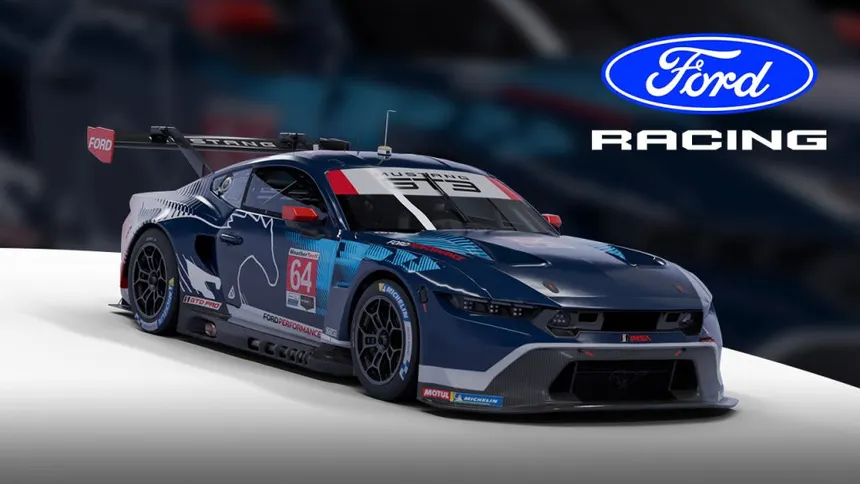
June 2024. Circuit de la Sarthe. Centennial of the 24 Hours of Le Mans. Twenty-four cars line up on the LMGT3 grid. Porsche 911s. Ferrari 296s. Aston Martin Vantages. BMW M4s. McLaren Arturas. Corvette Z06s. Mercedes-AMG GTs. Lexus RC Fs. Mid-engine cars. Rear-engine cars. Mid-rear-engine cars. All purpose-built for this.
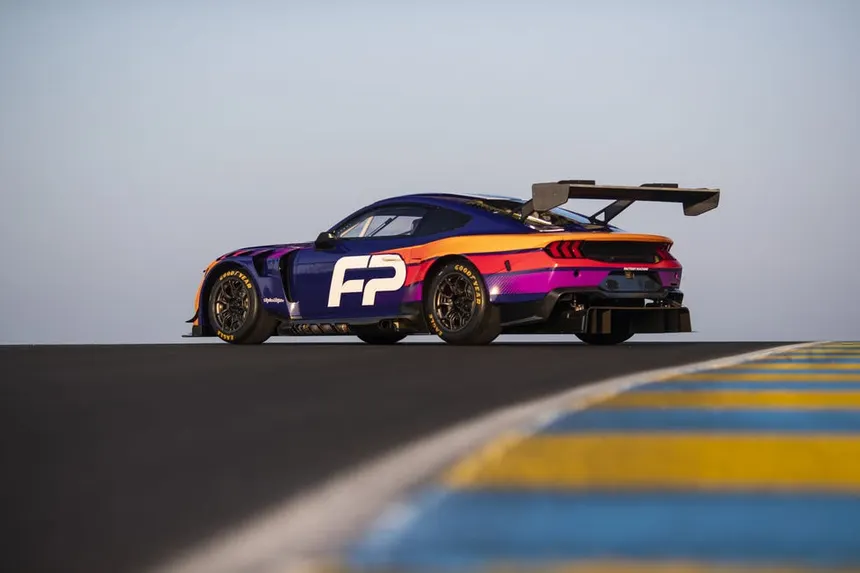
And in the middle of that grid, three Ford Mustangs. Front engine. Long hood. Six meters of American muscle car in a European championship.
Two of those Mustangs crossed the line third and fourth in class. All three finished the 24 hours. And Bill Ford, the company’s executive chairman, stood on the Le Mans podium for the first time since the GT40s beat Ferrari in the sixties.
This is the story of a car that wasn’t supposed to be there. And that, even so, showed up and did well.
The Jim Farley line
“It is not Ford versus Ferrari anymore. It is Ford versus everyone.”
Jim Farley, Ford CEO, said that on June 9, 2023, at Le Mans, at the Mustang GT3’s reveal, right at the heart of the 24 Hours centennial. Picking that date wasn’t an accident. Staging the reveal in France, on the same circuit where the Ford GT40 marked American motorsport history in 1966 with the 1-2-3 that humiliated Ferrari, wasn’t an accident either.
Sixty years later, on the Mustang’s sixtieth anniversary, Ford was coming back to Le Mans. Not with a nostalgic replica. Not with a limited-edition GT. Coming back with a Mustang. With the brand’s most recognizable symbol turned into a professional race car.
A clarification for the reader who lands here without having read the other two pieces in the series. The Mustang GT3 we’re talking about is the pure race car: it doesn’t sell to private customers, it has no plates, you can’t drive it on the street. It exists in parallel with the Mustang GTD, its road-legal cousin running a supercharged V8, which we cover in another article in this same batch. Two cars, two missions, two universes. Here we’re in the universe of the stopwatch and the homologated roll cage.
Farley’s 2023 message was clear. It’s no longer about avenging an old defeat against Ferrari. It’s about Ford, in 2024, standing in global motorsport and fighting everyone. Germans, Italians, British, Japanese, French. Everyone.
And the car Ford brought to the fight is, on paper, the weirdest one on the grid.
Front engine in a mid-engine world
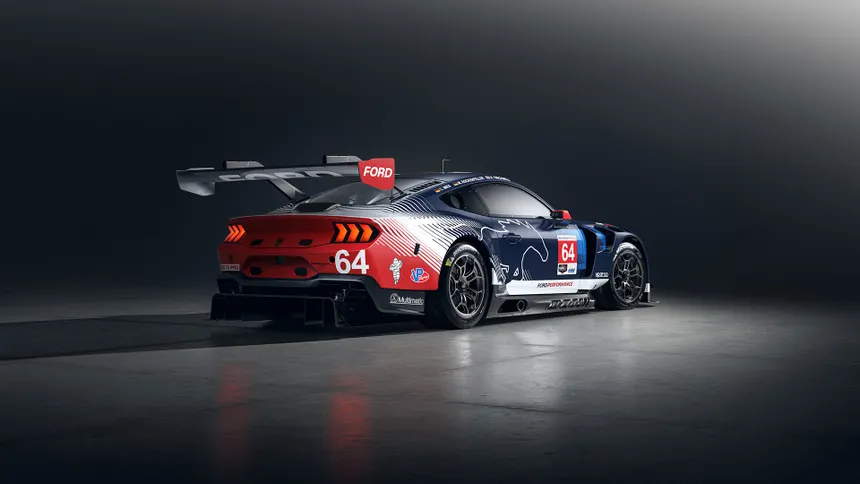
Here’s the technically tricky part that’s essential to understand the car. FIA GT3 regulations allow radically different configurations. Porsche races a rear-engine 911. Ferrari a mid-rear 296. McLaren an Artura, also mid. BMW an M4 with a front engine. Mercedes an AMG GT, front engine. Ford a Mustang, front engine.
But “front engine” in a Mustang means something very specific: big V8, long hood, weight concentrated ahead of the cabin. It’s the hardest configuration to optimize for modern competition. Single-seaters run mid engines for a reason. Purpose-built GT3s, when the manufacturer can pick freely, run mid engines for the same reason. Porsche sticks with rear because that’s the 911’s identity and they manage to make it work.
Ford had two options when it decided to come back to Le Mans: design a specific mid-engine car, the way it did with the 2016 Ford GT, or take the production Mustang and derive the GT3 from it. It picked the second. And that’s the editorial bet of the program: the GT3 isn’t a race car dressed as a Mustang. It’s a Mustang turned into a race car.
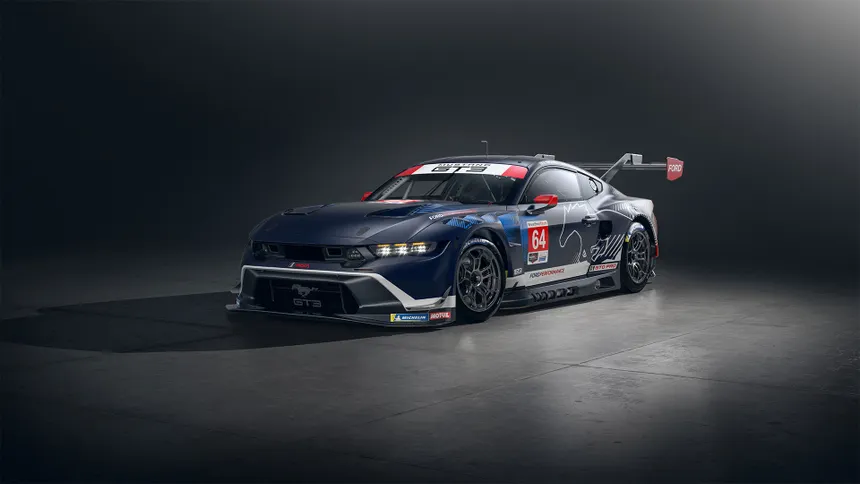
That’s why the technical base is the seventh-generation Mustang Dark Horse (S650). Same chassis. Same architectural layout. Same concept. What Multimatic Motorsports and M-Sport did was transform it from the inside without changing its structural identity.
5.4-liter naturally aspirated Coyote
The GT3’s engine is a 5.4-liter naturally aspirated V8 developed by M-Sport, the same outfit that has been building Ford’s World Rally engines for decades. It’s derived from the Mustang road car’s 5.0 Coyote, but grows in displacement and loses forced induction, because GT3 regulations forbid turbos and superchargers in this class.
The engine connects to a six-speed Xtrac sequential transaxle, mounted at the rear axle to improve weight distribution, through a four-plate AP Racing multi-disc clutch. Suspension is double wishbone front and rear with Multimatic DSSV five-way adjustable dampers. Brakes are Alcon with a dedicated cooling system. The chassis carries an FIA-homologated integrated roll cage. Carbon fiber bodywork with quickly interchangeable panels: at Le Mans, if you break a panel chasing another car in its slipstream, repair takes minutes, not hours.
That last part, the panels, isn’t a small detail. It’s the difference between finishing the race and dropping out.
Multimatic and M-Sport: the people who know how
Ford didn’t build the car alone. It built it with two partners that have been operating at motorsport’s highest level for decades. Multimatic Motorsports, the Canadians who built the 2016 Le Mans Ford GT and have been in Ford’s racing program ever since. And M-Sport, Malcolm Wilson’s British outfit that has been making Ford’s WRC engines for over twenty years.
Multimatic handled the chassis, suspension, aerodynamics, and integration. M-Sport handled the engine. Ford Performance coordinated everything and set the strategic direction. This isn’t a car Ford designed and assembles in Detroit. It’s a car built in Mooresville, North Carolina, in a 20,000-square-foot dedicated facility that Multimatic set up specifically for this program, with engines shipped from Cumbria, England.
The Mooresville facility detail matters. When a brand builds a new dedicated plant just for a specific program, it isn’t playing. It’s putting serious money on the table. For scale: Multimatic can produce two chassis per month, and the list of serious orders by end of 2024 was over 45 units.
Le Mans 2024: the podium on debut
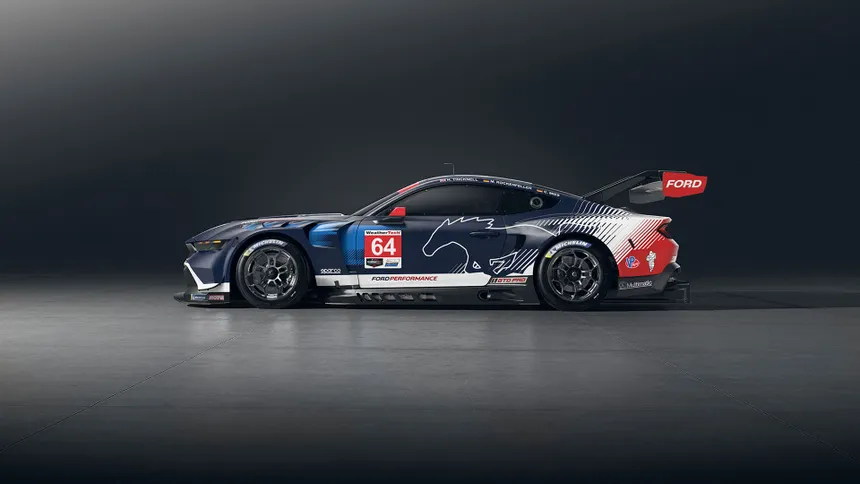
The debut story belongs to Proton Competition, the German team Ford picked as its European operational arm. Three Mustang GT3s on the grid. The #77 with Ryan Hardwick, Ben Barker, and Zacharie Robichon. The #88 with Dennis Olsen, Giorgio Roda, and Mikkel Pedersen. The #44 with Christopher Mies, John Hartshorne, and Ben Tuck.
In qualifying, Barker’s #77 claimed LMGT3 Hyperpole, the first pole for a Mustang GT3 in any race. A Mustang, on pole, at Le Mans. The headline wrote itself before the lights went out.
The race was tough. Changing conditions, intermittent rain, safety cars. A problem showed up in the early stages: when one Mustang GT3 closely followed another car, the air flow behind the leading car would lift the rear diffuser and rear panel of the chasing car. Ford had to ask the FIA for an “erratum fix” to reinforce the area, and the FIA granted it because it was a safety issue.
The #88 crossed the line third in LMGT3 class. The #44 fourth. The #77, despite its opening pole, hit technical problems and finished 17th in class. But all three Mustangs completed the 24 hours. And Bill Ford, grandson of Henry Ford II, stood on the Circuit de la Sarthe podium for the first time since that 1-2-3 in 1966.
Larry Holt, Multimatic Special Vehicle Operations Executive Vice President, summed up the moment: he was “over the moon.” Floating. A Le Mans podium on the absolute debut. Anyone who knows what Le Mans really is knows that doesn’t happen easily.
Daytona 2025: the night that changed the program
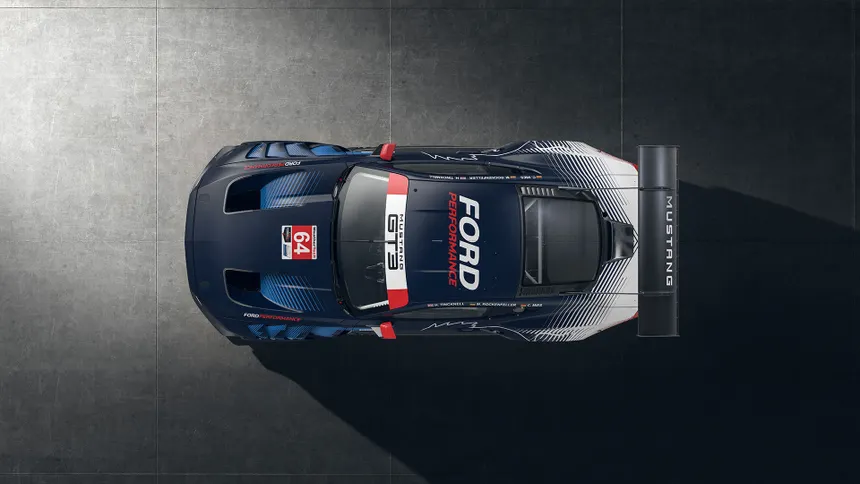
January 26, 2025, exactly two years after Ford announced the Mustang’s return to global racing, Ford Multimatic Motorsports’ #65 crossed the Daytona International Speedway finish line first in GTD Pro class. First global victory for the Mustang GT3. And how it was won deserves telling, because it wasn’t a stroll.
The race stayed open until the end. Ten different cars led the GTD Pro class through the 24 hours. No clear favorite. The #65 Mustang, driven by Dennis Olsen, Christopher Mies, and Frédéric Vervisch, took the definitive lead with 42 minutes to go, on a safety-car restart that caught the Pratt Miller Corvettes off-guard. Olsen held the front while Alexander Sims, in the #3 Corvette, sat on his bumper within tenths of a second through the final twenty minutes. Final margin: just under two seconds.
Mies put it like this afterwards, helmet still in hand: a year earlier they had arrived at Daytona with the car fresh out of the oven, finished without issues but lacked pace. They came back exactly twelve months later and won the race. The difference, according to him, was Bruno Couprie, the team strategist, who gambled big in the final hour. And the car, which on Daytona’s long oval straights ate its rivals thanks to the power Ford had been refining over the winter.
Context for the win: the #64 Mustang, sister car to the winner, had started from pole position. So this wasn’t an isolated lucky break. Both factory Mustangs were on pace. The #64 finished third. Double podium for the car’s first global triumph.
From there, the 2025 season was consolidation. Haupt Racing Team took its class at the 24 Hours of the Nürburgring (SP9 Pro-Am) in May, finishing fourth overall. In July the same team won for the first time in ADAC GT Masters, on the Nürburgring itself, with Salman Owega and Finn Wiebelhaus from pole. Multimatic won again in Detroit. The year-end count, per Ford’s own channels and the 24 Hours of Le Mans official portal, sits at fourteen global victories for the Mustang GT3 across its programs in 2025.
And on November 13, 2025, Ford began testing the Evo package, a technical evolution of the car including dive planes, a revised front splitter, a new rear diffuser, updated Brembo brakes, and improved suspension. It debuts in 2026 in IMSA with Multimatic, and in WEC with Proton. As the 24 Hours of Le Mans portal summed up with a very French phrase: “Ford a fait le choix d’une évolution plutôt que d’une révolution.” Evolution, not revolution.
The uncomfortable BoP question
The Mustang GT3 is a fast car. But its actual performance depends on something Ford doesn’t manufacture and no driver pilots: the Balance of Performance the FIA applies. And we don’t need to speculate here. The quote belongs to Larry Holt, Multimatic boss, in an interview with Professional Motorsport World magazine during the car’s development:
“With BoP being the prime limitation on aero performance in GT3, Multimatic’s job was to ensure the Mustang fitted in the required window across as broad a range of conditions as possible while also remaining driveable. That’s what we have to do these days. We have to make these cars fit into the limits that we’re allowed to fit in.”
Read it again. The chief engineer of a GT3 program publicly admitting his job isn’t to build the fastest car possible, but to build the fastest car the FIA will let him build. That sentence sums up exactly what BoP is: an administrative box that caps development. Brands don’t compete in open aerodynamics, they compete inside the margins the FIA defines.
Is this bad? Here’s the NEC take, no fence-sitting: BoP is necessary for the GT3 business model, but it’s bad for the sport. And it’s worth separating those two things to understand the mess.
Necessary, because without BoP, GT3 wouldn’t exist as it exists. If the FIA demanded technical homogeneity, brands like Porsche, with its rear-engine 911, or Ford with its front-engine Mustang, couldn’t compete. They’d have to design specific mid-engine cars the way Ferrari, McLaren or Lamborghini did. The grid would lose visual diversity, brand identity, and many manufacturers simply wouldn’t enter the championship because the math wouldn’t work. Without BoP, GT3 would be purer but also poorer.
Bad, because it turns motorsport into administrative management. When a Ferrari wins, Porsche teams complain. When a Porsche wins, McLaren complains. When a Mustang wins, everybody else complains. Race-changing decisions get made in offices before the cars leave the pits. Fans see a victory and never quite know whether the best car won, the best team won, or just the car the FIA loaded least that week. That, in a sport, is a problem. And nobody discusses it openly because every brand benefits from BoP at some point.
NEC says it straight: BoP is a necessary evil. It allows GT3 to exist as a commercially viable category, but it contaminates any conversation about who’s really fastest on track. And as long as the conversation about real performance gets decided on a Geneva spreadsheet rather than on a Le Mans stopwatch, GT3 will be a very entertaining championship but technically soft.
Real stopwatch: how fast the Mustang GT3 actually goes
Since we’re talking about race cars, lap-time data deserves its place in the article. Ben Barker’s pole at Le Mans 2024 in LMGT3 class during the Hyperpole session sets the reference: a competitive lap in a class that, that year, ran starting paces around 3:53-3:55 per lap of the Circuit de la Sarthe (13.6 km). In race trim, the Mustang’s average pace on long stints sat at 3:57-4:00, per the team’s own statements.
The top-class Hypercars, modern LMP1s and LMDhs, lap twenty seconds quicker. GT3s are slower by design and by regulation: less powerful engines, higher weight, less aggressive tires, restricted aero. Comparing absolute times of a GT3 with a Hypercar makes no sense. The Mustang GT3’s fight lives within its class, against the rest of the GT3s, and there the numbers were good in 2024 and improved in 2025.
At Daytona 2025, in very cold conditions, the #65 Mustang’s race pace was good enough to stay near the front through the entire night. The fastest lap in GTD Pro class came from the #4 Corvette around 1:46 on the 5.73 km oval-road combination. The winning Mustang ran consistently in the 1:46-1:48 band on long stints, which in a 24-hour race is what counts: not the isolated fastest lap, but sustained pace when tires are halfway gone and the lights have been on for ten hours already.
The GT40’s heir?
No. The Mustang GT3 is not the Ford GT40‘s heir.
The GT40 was a car built from scratch to beat Ferrari in a personal war between Henry Ford II and Enzo Ferrari. Mid engine. Specific bodywork. A project born exclusively to win Le Mans and humiliate a rival.
The Mustang GT3 is something else. It’s the street Mustang turned into a race car. It’s a modern brand’s strategy of using motorsport to sell production cars. It’s the car that drives showroom traffic and headlines in the automotive press. It’s a commercial icon wearing a fighting suit.
The GT40 was war. The Mustang GT3 is marketing with very serious engineering behind it. Both are legitimate. Both deliver wins. But they’re not the same thing.
And yet, when Proton’s #88 crossed the line third at Le Mans 2024, and when Multimatic’s #65 won Daytona in 2025 with 42 minutes to go, and when Haupt Racing Team started collecting podiums at the Nürburgring, something of that 1966 spirit was back in the air. Not because it was the same war. But because there was, once again, an American car with a V8 fighting toe-to-toe against Europe’s best.
The Mustang GT3 isn’t going to win the 2026 LMGT3 title against Porsche and Ferrari. Probably not, because BoP is what it is and the GT3 ecosystem is built to spread titles. But it doesn’t need to. The car already proved what it had to prove: that a Mustang can sit on the Circuit de la Sarthe grid and finish on the podium. That a front engine doesn’t disqualify a car from global motorsport. That Ford Performance, with Multimatic and M-Sport, knows how to build cars that compete where competing really happens.
For a brand that had been absent from European endurance’s main stage for decades, that’s already a win.
Check you’re still alive.