
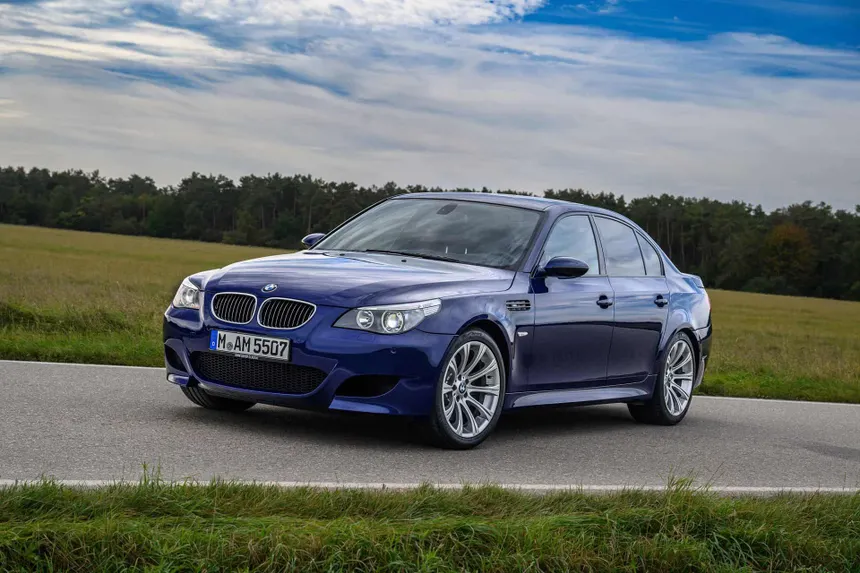
BMW M5 E60: The Most Ambitious Engine BMW Ever Built, Bolted Into the Most Hated Chassis They Ever Sold
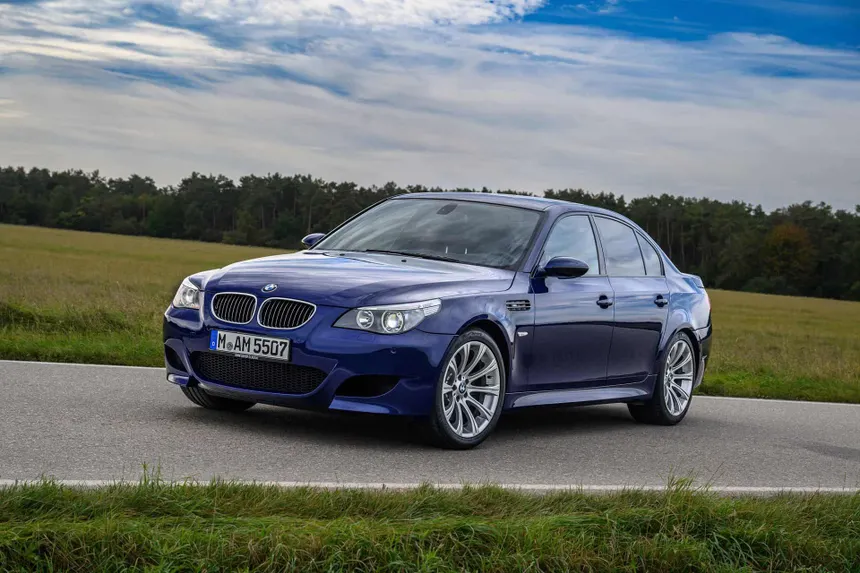
Sixty-one thousand seven hundred and fifty pounds in 2005. Twenty-two thousand pounds today. That’s what Top Gear quoted in their best-ever V10s retrospective for a clean E60 M5. Sixty-five percent depreciation in twenty years. By way of comparison, an E39 M5 from 2002 — the car this one replaced — has held its value or appreciated. The E60, despite carrying the most extraordinary engine BMW has ever fitted to a road car, has fallen off a cliff and is still falling.
The reason isn’t the engine. The engine is the reason anyone still wants one. The reason is what BMW bolted around it.
You’re looking at a car that was simultaneously the most technically ambitious M5 ever made and the most universally loathed during its launch period. Chris Bangle’s E60 chassis split the BMW faithful in two camps: those who thought it was futuristic, and those who thought it looked like a dragon wearing cat-eye glasses, to quote Top Gear directly. Inside, an early iDrive that Top Gear called “the single most mental health damaging invention to inhabit a screen until the creation of Twitter.” And in place of the perfect six-speed manual of the E39, a seven-speed automated manual called SMG III that’s the reason 80 percent of these cars now sell at scrap-adjacent prices.
But the engine. The engine is something else entirely.
The F1 promise that arrived after the party ended
In the early 2000s BMW was supplying Williams Formula 1 with a V10. This was the gilded era of F1: ten cylinders, naturally aspirated, 19,000 rpm, a sound that hit you in the chest from the next paddock over. BMW M decided the next M5 should align with that identity. The flagship 5 Series would carry an engine that shared philosophy with the one battling Schumacher every other Sunday.
The project, code S85, was greenlit around 2001. And here is the first irony of this whole story, which almost nobody puts in writing. By the time the M5 E60 reached showrooms in September 2004 with its V10, the FIA had already announced the change. From 2006, Formula 1 was abandoning V10s and reverting to V8s. BMW also fell out with Williams in 2005, bought the Sauber team, won exactly one race in four years, and left the sport in 2009 with very little to show for it. The M5 E60 was conceived to align with Formula 1 and arrived at the moment Formula 1 was walking away. The car was already an anachronism the day it launched.
But the engine was Formula 1 to its bones. And we need to be precise about what that means, because the F1 connection has been both inflated and dismissed in different places.
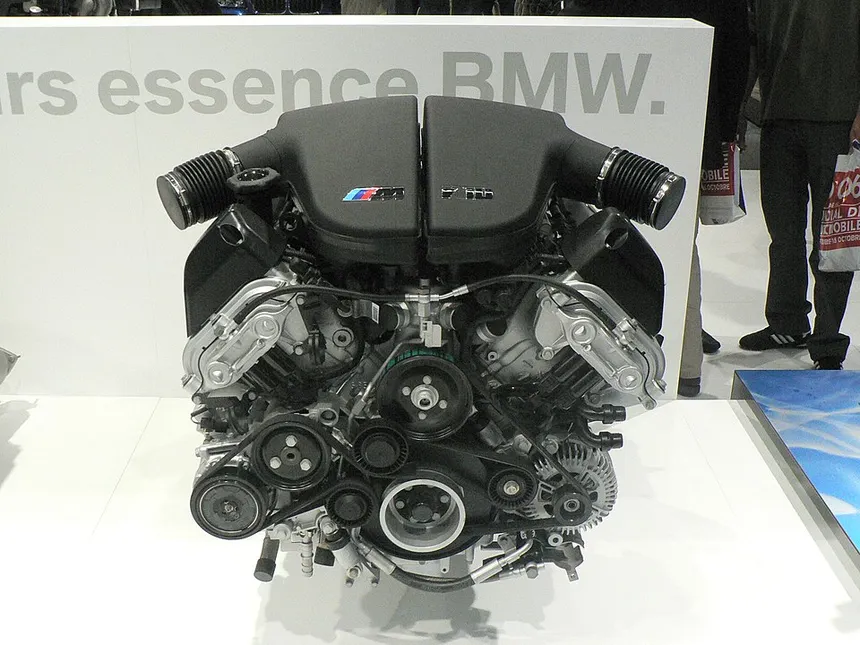
What’s actually F1 about the S85
The genuine F1 connection breaks into three concrete points. First, the S85 block and the V10 F1 engine blocks were cast at the same BMW foundry in Landshut, Bavaria. Same plant, same alloy, same crews. Different engine, same birthplace. Second, the F1 programme forced BMW to develop in-house ion current measurement for knock detection — a system that applies 400 volts to the spark plugs between firing events to detect detonation before it can wreck a piston. That technology migrated to the S85 and is the reason BMW could safely run a 12:1 compression ratio on a road car in 2005. Third, the S85 uses a semi-dry sump with two electrically driven, continuously variable scavenge pumps that suck oil down from the cylinder heads back into the pan when lateral acceleration exceeds 0.6 g. The cornering forces are roughly four times higher in F1, but the engineering principle came from the race programme. Racing lubrication, scaled to road use.
Then the architecture. Ten individual throttle bodies — one butterfly per cylinder, no shared plenum, the same configuration BMW M had pioneered in the M3 CSL inline-six and the S62 V8 of the Z8 and E39 M5, but here applied to ten cylinders for the first and last time in a series production car. Forged steel crankshaft. Forged connecting rods. Forged pistons. All-aluminium block and heads. Double-VANOS on all four camshafts. Cut-out at 8,250 rpm, peak power at 7,750 rpm. And the number that mattered most when this car launched and still matters now: 100.4 horsepower per litre of displacement. That, in 2005, was naturally aspirated competition territory. No road saloon was making that kind of specific output.
What isn’t F1 about the S85: the engine was not designed by the Formula 1 team. BMW M GmbH has its own technical division at Garching, and they designed it. Nor does it share architecture with the F1 V10s, which used a 72-degree bank angle — the ideal geometry for a naturally balanced V10. The S85 uses 90 degrees, a decision forced entirely by packaging. The V10 had to fit under the standard 5 Series bonnet without major structural surgery, and 72 degrees would have been too wide.
And that 90-degree decision is what defines the sound.
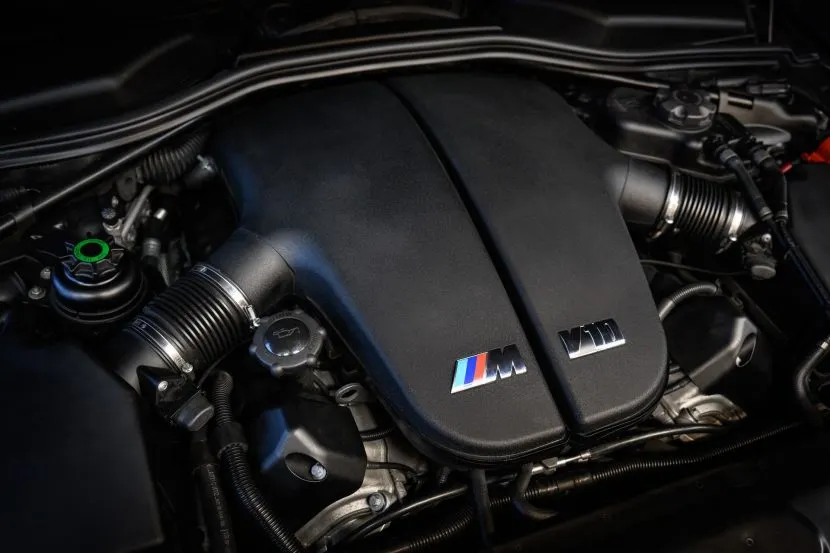
The sound of the only road-going German V10
A V10 with 90-degree bank angle has an inherently uneven firing order. The exhaust pulses don’t exit at regular intervals like a 72-degree V10; some cylinders fire close together, others spaced further apart. Mechanically, that produces secondary vibration and an irregular pulse train in the exhaust manifolds.
Sonically, it means the S85 doesn’t wail like a perfect F1 V10. It wails like something else. Halfway between the high, sharp bark of a true 72-degree V10 and the deeper, lumpier note of a cross-plane V8. That uneven scream — metallic and serrated as you climb past 6,000 rpm, transforming into a pure high-pitched howl beyond 7,500 — exists in no other production car. BMW had to choose between making the engine geometrically perfect and making it unique, and they chose unique. The packaging brief mandated the 90-degree bank, and the result was the only soundtrack of its kind ever to leave a German assembly line.
Add to that the ten individual throttle bodies. When you stand on it and all ten butterflies open simultaneously, air rushes through ten separate trumpets, and that’s what reaches the cabin. Top Gear, in their retrospective of the greatest V10s ever made, described it as one of the most out-of-place engines ever to power a leather-lined family four-door. They got it right. The S85 didn’t belong in a 5 Series. It belonged in a museum exhibit. But there it was, in a four-door saloon, with a school-run seat and a boot full of golf clubs.
The SMG III, the original sin
This is where the story turns sad. BMW made a decision that looked logical at the time and that history has proven catastrophic.
The SMG III is a seven-speed manual gearbox with hydraulically automated clutch actuation and gear selection. It’s not an automatic. It’s not a dual-clutch. It’s not a true racing sequential. It’s a regular manual with the clutch pedal removed, a hydraulic pump fitted, and electronic actuators that engage gears according to which paddle you pull. The promise was 65-millisecond shifts at full attack and an F1-style two-pedal experience. The reality was a transmission that lurched in traffic, hesitated in reverse, and never quite mastered low-speed parking. If you came from the E39 M5’s perfect Getrag six-speed manual, you wanted to throw the keys back at the dealer.
And then the real problem. The SMG hydraulic pump is a consumable component. It dies somewhere between 50,000 and 80,000 miles. The clutch wears at a similar rate. The wiring harness running over the gearbox cooks itself slowly from the V10’s heat. Replacing a failed SMG runs anywhere from £3,500 to £7,000 in the UK depending on shop and parts choice. And it never quite returns to factory-new feel afterwards. It also fails again.
BMW offered a Getrag six-speed manual in the United States from the 2007 model year, after American buyers refused the SMG-only proposition. In Europe, for the early years, you took SMG or you didn’t take the car. And here it’s worth describing what actually happens when you drive the same car with the two different boxes — because the press never quite tells this story properly.
The dry numbers first. The SMG has seven gears, the manual six. Internal ratios differ — the SMG is shorter in first and second, the manual takes longer strides between gears. Same 3.62:1 final drive on both. The translation to the road: the SMG accelerates marginally harder in pure straight-line bursts because the short low gears keep the V10 in its narrow torque window, but the manual is more relaxed on motorways because the longer ratios let the engine rest at cruising speed. When M5Board.com regulars have run two stock cars side by side with stopwatches, the quarter-mile difference is tenths, not seconds. At intermediate speeds — the 30-to-170 mph range — the manual can actually be quicker because it doesn’t have to shift as often.
The feel. The SMG changes gears mechanically faster than any human can — that part isn’t debatable — but the ECU takes time to decide when to shift, and that cognitive delay makes the real-world experience of upshifts lumpier than a well-operated manual. Car Throttle put it pointedly: each upshift carries a pause that feels eternal, after which the whole car lurches as the next ratio drops in. The actual time difference against a competent manual shift is negligible, they argued, and certainly not worth the rest of the inconvenience. Especially around town, in reverse, on parking ramps. The manual hands the driver full authority. When you want a brutal launch — feathering the clutch to extract every Nm available — the SMG won’t allow it. There’s a limited launch mode, but it falls a long way short of what a human foot can do with a clutch pedal.
The reliability. The SMG slips its clutch constantly in urban use, every time the ECU calculates a smooth take-off. The duty cycle on the release bearing is far higher than a competent driver puts on a manual clutch they actually only press to shift. The result is that SMG clutches wear faster, and when they die they drag the wiring loom and hydraulic pump down with them — the failure cluster the previous section already covered. The Getrag manual operated by a thinking human is robust. It’s essentially the same gearbox lineage as the E39 M5’s, and people have taken those past 300,000 miles without major work. The standard advice on the buyer-question threads at M5Board.com is straightforward: if you find an E60 M5 manual, take it; if you only find SMG, make sure the pump and clutch are recent or have the repair budget sitting on the table.
Today a European E60 M5 with SMG sells for £22,000. An American E60 M5 with the manual conversion or factory six-speed sells for three to four times that figure. That delta is exactly the discount the market applies to BMW’s original sin.
The rod bearings that kill engines
If the SMG is the design error, the rod bearings are the manufacturing one. And it’s worth explaining what physically happens here because the issue is misunderstood.
A modern engine’s connecting rods ride on the crankshaft via plain bearings: two half-moons of soft alloy that sit between the rod’s big end and the crank journal. Between the bearing surface and the journal there’s a film of pressurised oil. That film prevents metal-to-metal contact. If the film breaks, even for a fraction of a second, the bearing surface scores. Score it enough times and it wears. Wear it far enough and the rod has slack, knocks against the journal, and eventually a piece of bearing material finds its way into the oil pan, another into the filter, and the engine commits suicide from the inside.
The S85 has a well-documented rod bearing problem. Two theories exist for the cause. BMW’s official line is that it’s a maintenance issue: late oil changes, wrong oil grade, drivers taking the engine to redline before it reached operating temperature. The specialist independents say there’s a tolerance problem between the original bearings and the crankshaft: the clearance is too tight, the oil film never establishes properly, and the bearings wear out even on engines maintained perfectly. The truth probably sits between the two. What is certain is this: any S85 past 100,000 miles without preventive bearing replacement is a grenade with the pin pulled. The job costs £2,500 to £4,500 done properly. If the engine grenades, you’re rebuilding or sourcing a used unit at five times that figure.
To which you add the S85’s minor list of horrors: two throttle actuators, one per bank, with effectively a 100% failure rate over the engine’s life. VANOS pump issues on the early version. Stuck injectors. Leaking oil coolers. Passenger airbag faults. It’s a long, expensive list. The figure that recurs most often on M5Board.com — the forum where actual owners argue about actual bills — is around $5,000 per year set aside for routine maintenance, before any of the big jobs like rod bearings or transmission rebuilds. One owner with two E60 M5s in the garage and eight years of documented invoices put the total at $10,000-$12,000 over that full period including the bearings on both cars. The rule of thumb the regulars quote new buyers is brutal but accurate: if you can’t set aside $5,000 a year, rain or shine, don’t buy the car.
The hidden lineage: the M3 E90’s V8 is an S85 with two cylinders removed
Here’s a detail almost nobody mentions when talking about the E60. The S65 V8 in the E90 M3 — the last naturally aspirated M3, the one that closes that chapter forever — is not a descendant of the S62 V8 from the E39 M5. It’s an S85 with two cylinders removed.
Same architecture. Same bank angles. Same firing-order philosophy. When BMW M’s engineers finished the S85 and started planning the next M3’s powerplant, they didn’t go back to the older V8 — they took the V10 and chopped two cylinders off the back. That’s why the S65 carries its code rather than continuing the S62 family: because its parent is not the E39 V8, it’s the E60 V10. It also explains why the E90 M3 vibrates the way it does, sounds the way it does, and suffers the same rod-bearing problem as its larger sibling. Those issues weren’t inherited from the M3 lineage. They were inherited from the S85.
If you own or are looking at an E90 M3 with the S65, check the rod bearing history before you check anything else. Same story, same fix.
What happens when a unique engine ends up in the wrong body
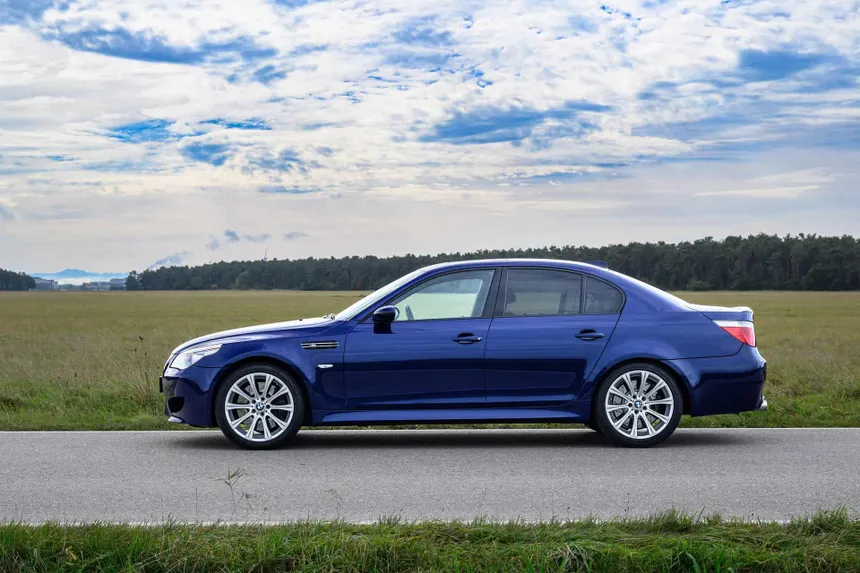
Twenty years on, the E60 M5 has settled into the asterisk paragraph of automotive history. The engine is a monument. The chassis is a regular 5 Series, heavy at 1,830 kg, with hydraulic steering whose feedback is muted, and suspension calibrated more for comfort than for attack. The interior is an electronic minefield. The styling, controversial from day one. And the gearbox, as already discussed.
But the engine. Every time an E60 M5 starts, the ten cylinders fire one after another in that dry, irregular, almost angry tickover. The idle isn’t flat: it oscillates and vibrates, reminding you there are ten independent connecting rods inside trying not to fly apart. Press the M button and the rev limit climbs from 7,750 to 8,250. Take third to fourth at 8,000 rpm with the exhaust open and you realise no other production car has ever sounded like this. Not before, not since. Formula 1 dropped V10s the following year. Audi put a V10 in the RS6, but it was the twin-turbocharged Lamborghini Gallardo V8, not comparable. Lexus built the LFA with a V10 of its own, an extraordinary instrument, but the LFA was a low-volume coupé made by Yamaha’s audio engineers, not a road saloon you could buy at a normal dealer.
The E60 M5 is the only saloon in history with a naturally aspirated V10 that howls. It almost certainly always will be. Which is why, fifteen or twenty years from now, when the surviving E60 M5s are the ones with replaced bearings and serious maintenance trails behind them, the price curve will invert. The market always gets there eventually. The trick is keeping the crankshaft alive long enough to see it.
Check you’re still alive.