The V16 Goldfisch: BMW’s Secret Engine That Forced Mercedes to Build 85 Prototypes in Response
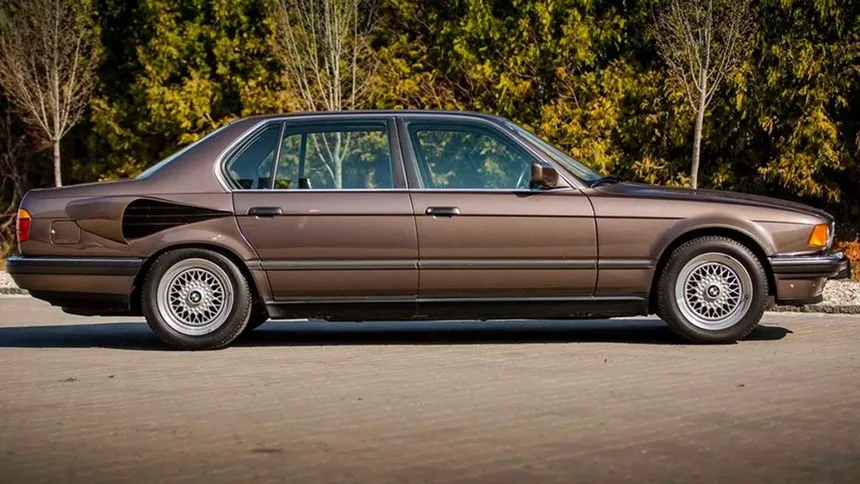
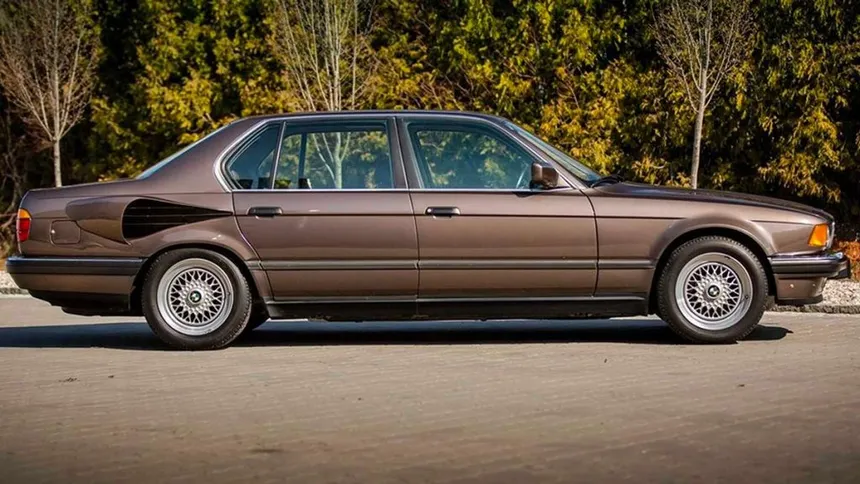
Most automotive readers know the headlines on this one. A brown BMW 750iL with science-fiction air scoops behind the rear wheels and the radiators stuffed into the boot, hidden in BMW Classic’s warehouse for decades, finally rolled out at Techno-Classica Essen. The 7 Series with a V16. A curiosity. A footnote. A bit of late-eighties Bavarian excess that never made it past the prototype stage.
That’s the version the gloss pages run. The real story is much larger, and the punchline lives in Stuttgart.
When Mercedes-Benz heard the rumour that BMW was developing a V16, the response from across the Swabian border was not measured. It was completely disproportionate and economically suicidal. Mercedes built between 85 and 100 running prototypes of a W140 S-Class fitted with their own V16 engine, plus a parallel programme for an even more extreme W18 motor. They spent enormous money on a project that died entirely. And none of it was for the customer. All of it was for BMW’s benefit, because Mercedes refused to be outflanked.
The Goldfisch is interesting as an engineering exercise. As an act of industrial cold war, it’s one of the most efficient strategic moves any carmaker has made in the last fifty years. BMW spent three engineers and two prototypes. Mercedes burned a small fortune. And the public never saw a single one of these cars on sale.
Here’s how it actually went down.
The cylinder war of 1987
Set the scene. September 1986, BMW launches the E32, the second-generation 7 Series. Already an extraordinary car in its six-cylinder form, but the move that changed the segment came twelve months later, in 1987, when BMW unveiled the 750i with the M70 V12 engine: a 5.0-litre, twelve-cylinder unit that became the first post-war German V12 ever fitted to a road-going passenger car. Mercedes-Benz, until that moment the unchallenged reference of the luxury saloon segment, found itself flat-footed.
The Stuttgart response was disastrous in cost terms. The W140 S-Class, originally scheduled to launch in late 1989 with V8 power from the M119 family, was delayed by eighteen months to redesign the engine bay around a new M120 6.0-litre V12 that Mercedes had to scramble into existence. The delay cost the careers of several Daimler executives and ballooned the W140 budget into territory that, according to widely cited industry chatter, ran around a billion dollars over its original estimate. BMW’s V12 didn’t just hurt Mercedes commercially. It nearly broke the development team.
Meanwhile, in Munich, BMW M GmbH was not resting on the V12 laurel. In July 1987 — exactly when Mercedes started reeling from the V12 announcement — Munich quietly opened a new internal project. If the V12 had pushed Mercedes against the ropes, what would a V16 do?
The engine: how to build a sixteen without losing sleep
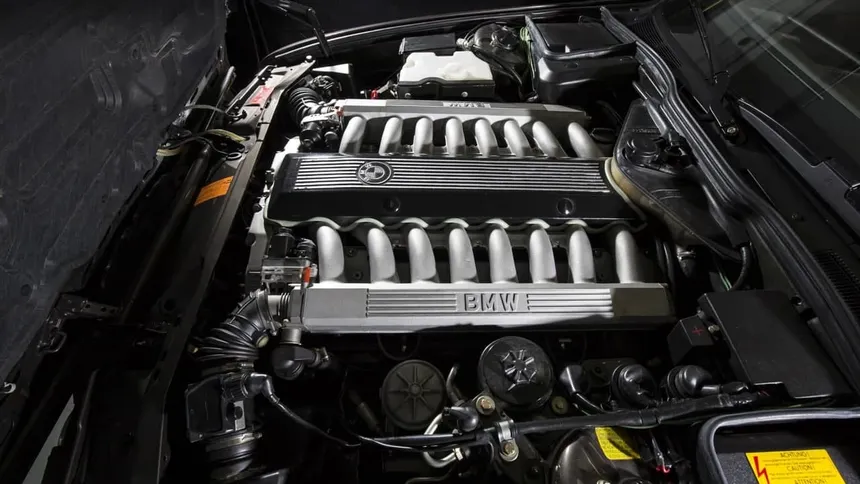
The brief landed with three men: Karlheinz Lange, Adolf Fischer, and Hanns-Peter Weisbarth. Three engineers, not a team of a hundred. Their solution was elegant precisely because it was obvious. If we already have a V12 that works, don’t reinvent anything. Take the V12 and add two cylinders per bank.
This sounds trivially simple when said out loud. It isn’t. When you take a production V12 — already homologated, already in series production, already with its engine management mapped and proven — and you extend it by two cylinders per bank while keeping the original 60-degree bank angle, what you’re doing is making the engine longer along its centreline. You don’t change the bore. You don’t change the stroke. You don’t change the connecting rods, the pistons, or the cylinder spacing. Same bore at 84 mm, same stroke at 75 mm, same 91 mm bore spacing as the M70. The only thing that changes is that you now have eight cylinders per bank instead of six, and your crankshaft is correspondingly longer. The cost of development collapses by an order of magnitude compared to a clean-sheet engine.
The result: 6,651 cubic centimetres, all-aluminium block and heads, single overhead camshafts with two valves per cylinder. Yes, SOHC, not DOHC. The Goldfisch was an exercise in pragmatism, not technological showcase. The valvetrain inherited the M70 V12’s straightforward two-valve design because it was proven and cheap. Compression ratio 8.8:1, kept deliberately moderate to preserve durability margin. Twin Bosch DME 3.3 management units — one per bank — because a single ECU of that era couldn’t handle sixteen cylinders. Redline at 6,000 rpm. Peak power at 5,200 rpm. Peak torque at 3,900 rpm.
The numbers: 408 horsepower and 613 Newton metres of torque. Dry weight, 310 kilograms. That’s 52 kilos heavier than the M70 V12 — almost nothing for a third more cylinders.
This is the genius of the Goldfisch as engineering. It wasn’t a revolutionary engine. It was an extension of an existing one. What made the Goldfisch unique wasn’t the architecture; it was the strategic decision to build and test it before Mercedes could do the same.
Why a German V16 sounds the way it does
Worth a paragraph on the sound, because hardly anyone explains it from a workshop perspective and it’s one of the most interesting aspects of the motor. BMW Group Classic has published a walkaround video of the Goldfisch starting and idling. What you hear isn’t what most people expect from a V16. The reason is pure geometry.
A V16 with 60-degree bank angle and a properly phased crankshaft has an ignition order that distributes its sixteen combustion events exactly every 45 degrees of crankshaft rotation. Seven hundred and twenty degrees — the two full crank revolutions of a four-stroke cycle — divided by sixteen cylinders gives 45 degrees flat between firing events. Compared to a V12 that fires every 60 degrees, or a cross-plane V8 firing irregularly, you get a pulse train so closely spaced it becomes almost continuous. So continuous that the human ear stops resolving individual pulses and starts perceiving a texture closer to a turbine than to a piston engine.
That’s what you hear in the Goldfisch. Not the pulsed bark of an American V8, nor the operatic howl of a Ferrari V12. Something denser, more homogeneous, more continuous. A deep underlying hum in which the individual cylinders barely separate, with higher harmonics layered on top as the engine climbs the rev range. The M70 V12 already had the quality of an engine that purrs rather than roars. The V16 simply pushes that one step further. At 5,000 rpm with 16 cylinders firing every 45 degrees, the exhaust fundamental frequency lands around 666 Hz. A V12 at the same revs is at 500 Hz. Those 166 extra hertz are what the ear registers as added density, almost mechanical white noise, instead of individual pulses.
And there’s the irony. A BMW M70 V12 is already an almost inaudible engine at idle: you feel it through vibration more than you hear it. The Goldfisch, by adding more cylinders, doesn’t add noise. It removes texture. It removes the gaps between pulses. It turns into a mechanical whisper. For a car aimed at presidents and chairmen who wanted to cross Europe at 250 km/h without noticing, the soundtrack was perfect. For selling the car as an emotional flagship sports saloon, it was a problem. A V12 stirs the listener. A V16 fades into background.
The packaging problem that defined the look
The engine was complete by January 1988. Bench testing through January and February. In May 1988, the first running prototype hit the road. And this is where things got entertaining.
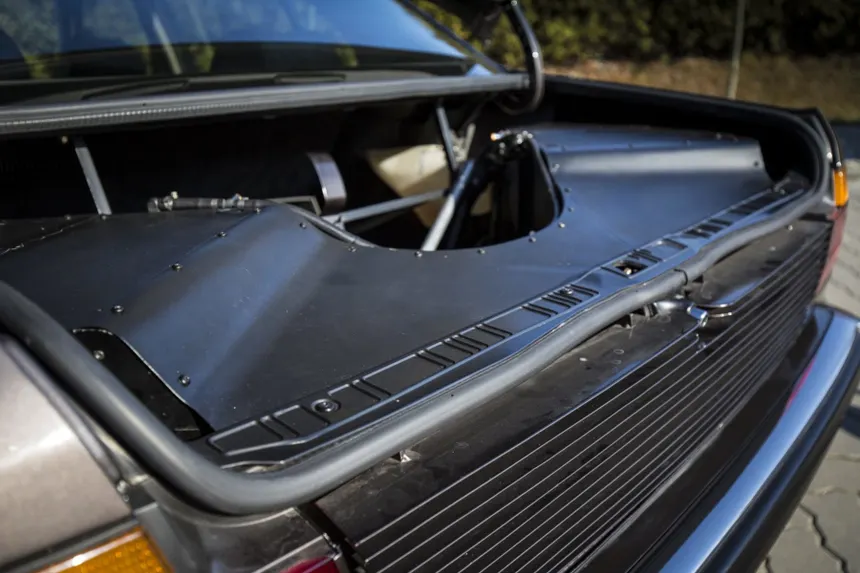
Fit a longitudinal V16 measuring roughly 1.2 metres into the engine bay of an E32 7 Series and the engine itself goes in. The cooling system doesn’t. The M70 V12 already filled the front of the car with radiators, oil coolers, fans and ducting. Adding 33 percent more cylinders increases heat rejection proportionally, but the space available in front of the engine doesn’t expand to match. And in an engine pushing 1,800 kilograms of luxury saloon to 280 km/h, cooling isn’t optional. It’s the whole question.
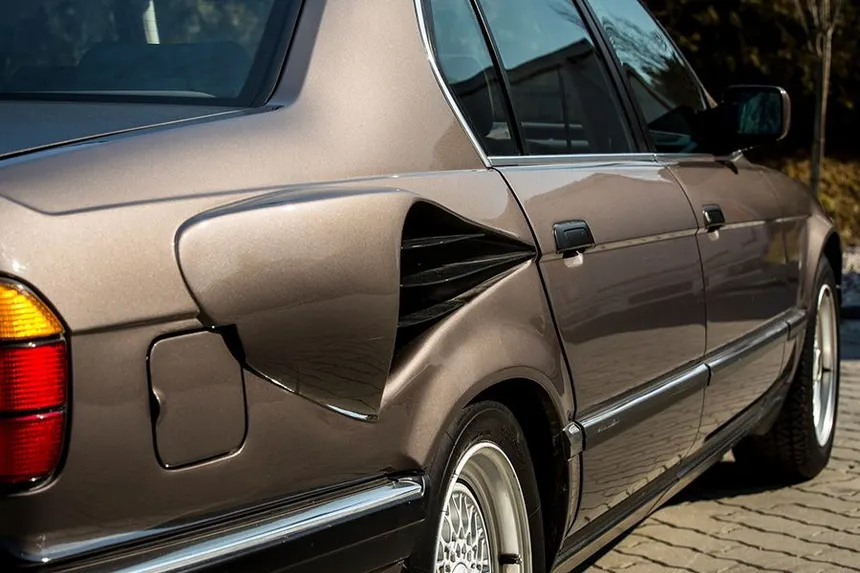
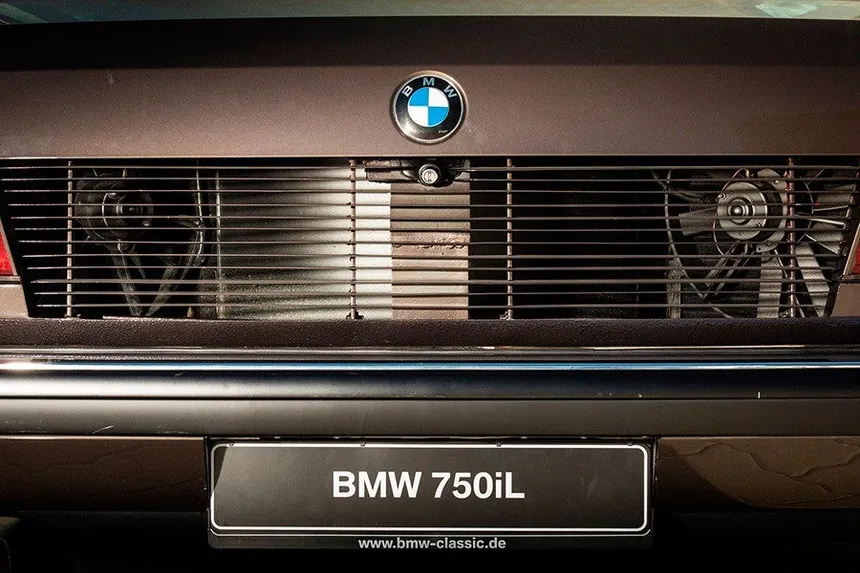
The BMW engineers’ solution was radical and visually unmistakable. They removed the radiators from the nose of the car and relocated them into the boot. That’s why the 767iL Goldfisch has those enormous side scoops behind the rear wheels: air enters through the flanks, passes through vertically mounted radiators occupying what should have been luggage space, and exits through an open rear fascia panel that looks like something off a Group C prototype.
This tells you three things mechanically. First, the engine was unviable in production exactly as configured, because no 7 Series customer accepts a car without a boot. Second, BMW knew that perfectly well and built it anyway, because the goal was never production — it was internal demonstration. Third, packaging a sixteen-cylinder longitudinal engine in a chassis designed for twelve is a geometry problem without an elegant solution. The engine fits in the volume; nothing else does.
The car was internally codenamed “Secret Seven” or 767iL. The colour was a deliberately quiet metallic brown. The point wasn’t to draw attention. The point was to hide it. One unit built in 1988. The gearbox: a six-speed manual borrowed from the 8 Series E31 development programme, because the automatic transmissions available at that time couldn’t handle 613 Newton metres without complaining.
When Mercedes found out
This is where the story becomes properly large, and the part most Goldfisch articles barely touch.
The V16 rumours reached Stuttgart in 1988-89. Mercedes-Benz, already eighteen months behind schedule on the W140 because of BMW’s V12, took a decision that only makes sense in the framework of corporate pride: if BMW launches a V16, Mercedes launches a V16. And it won’t be a small one.
The Mercedes plan was the inverse of BMW’s. Where BMW had taken the M70 V12 and made it longer, Mercedes took the brand-new M120 6.0-litre V12 and applied exactly the same logic — two more cylinders per bank. Resulting displacement: 8.0 litres. Projected power: 540 horsepower. Target vehicle: a hypothetical 800 SEL / S 800 that would have been the most expensive series-produced saloon in the world when launched in the early 1990s.
And here’s the eye-watering part. Mercedes didn’t build one prototype. Or two. Or five. Mercedes-Benz built somewhere between 85 and 100 running W140 V16 test mules. The exact figure varies by source — Wikipedia documents 85, other accounts say 100 — but the order of magnitude is consistent. Compare with BMW: one Goldfisch in 1988, one more in 1990. Mercedes built nearly a hundred. The corporate panic answered BMW’s single move by two orders of magnitude.
There’s more. In parallel with the V16, Mercedes developed an even more radical engine: the W18, internally classified as M216 according to Daimler’s project records. Three banks of six inline cylinders, 75-degree angles between the banks, 18 cylinders forming a “W” configuration. The idea was to triple the M103 2.6-litre straight-six. If the V16 of 8.0 litres was a message, the W18 was a shout into a stadium.
The W18 blueprints contemplated two distinct versions according to sources from Stuttgart that AutoBild reported at the time and Carscoops cited later. The standard variant, with two valves per cylinder — one intake, one exhaust, following the M103 family architecture — was projected to deliver around 490 horsepower and 750 Nm of torque. The radical variant, with five valves per cylinder, scaled up to roughly 680 horsepower and 800 Nm. Numbers nobody else was writing onto a saloon specification sheet in 1990. For context: the contemporary Ferrari F40 made 478 horsepower. We’re talking about putting Italian hypercar output inside an S-Class.
And here’s the crucial distinction between the V16 Mercedes and the W18 Mercedes, important not to inflate the data. The V16 was actually built: 85 W140 prototypes carried it and ran. The W18, according to documented sources — Wikipedia records the internal M216 classification with that explicit note — never progressed beyond the blueprint and mock-up stage. Designed, calculated, dimensioned. But never fabricated as a running engine. It was the next escalation step Stuttgart was prepared to plan if BMW responded with something larger again. When BMW filed the Goldfisch, the W18 was filed alongside it.
And all of this — all of it — was hidden from the public of the time. Mercedes-Benz built 85 running W140 V16s, tested them, validated them, kept them concealed, and ultimately filed the entire programme. Only at Techno-Classica Essen in 2024 did Mercedes confirm imagery of any of those cars. BMW kept the second Goldfisch (more on that in a moment) hidden from 1990 until that same 2024 Techno-Classica, where the public saw it for the first time. Thirty-four years in a shed.
Why nobody put a V16 into production
If both companies had functional engines, why did neither launch? Three reasons, in priority order of how they actually weighed inside the boardrooms.
First, and the most decisive argument inside BMW, internal cannibalisation. BMW was developing, in parallel with the Goldfisch, the S70B56 V12 destined for the 850CSi 8 Series. That engine made 376 horsepower. Putting it next to the Goldfisch’s 408, you have a 32-hp difference. But the Goldfisch weighs more, drinks far more, has an impossible packaging solution, and needs the manual gearbox borrowed from the 8 Series anyway. The question that landed on the BMW board’s table was as simple as it was brutal: why build an impossible car if your own V12 already gives supercar power in a saloon and a coupé? Every Deutschmark spent on the V16 was a Deutschmark not invested in optimising the V12 that would actually be sold. The marketing argument for the V16 was seductive. The board-level argument wasn’t.
Second, fuel consumption. The BMW Goldfisch was calculated to return roughly 9 miles per gallon, which in metric terms is 26 litres per 100 kilometres. Petrol was still cheap in 1988, but it wasn’t 1973 cheap. European regulators were tightening fuel economy and emissions legislation. A car drinking that much was, by 1990 standards, commercially impossible. The fuel-consumption delta between the M70 V12 (around 18 l/100 km in real-world use) and the V16 ran close to ten extra litres per 100 km. That doesn’t justify itself with 32 additional horsepower.
Third, the wind changed. The 1990 Gulf War left the entire industry reconsidering efficiency. Environmental awareness in Germany — always more developed than in other markets — became a homologation pressure. Mercedes said this openly when it cancelled the W140 V16: they feared sending the “wrong message” to the public in the middle of a growing climate conversation. That phrase, spoken in early-nineties Stuttgart, fixes the era exactly. BMW reached the same conclusion through the same door.
BMW presented the project to its inner circle. It was filed. Mercedes did the same. The 85 W140 V16s ended up, according to widely circulated industry chatter, either scrapped or converted back to standard V12 configuration. None survive. Only the BMW Goldfisch of 1987 and its 1990 sibling remain as physical witnesses to that prestige war.
The second Goldfisch nobody saw until 2024
Here’s the detail that even most Goldfisch retrospectives barely mention. There was a second Goldfisch. And it’s probably more interesting than the first.
In 1990, BMW reopened the V16 project with a different brief. Where the first Goldfisch had been a technical demonstration — stretch the V12 and see what happens — the second was a product study. The engine was detuned to 348 horsepower, a more sensible figure for a luxury car, and mated to a ZF five-speed automatic instead of the first prototype’s six-speed manual. The body was rebuilt entirely in aluminium to offset the engine weight. And here’s the give-away detail: the body was designed by Boyke Boyer, the same designer who would shortly draw the production E38 7 Series that arrived in 1994.
Look at photos of the second Goldfisch and you see a car that’s a crossbreed between the outgoing E32 and the incoming E38. The grille and headlights clearly preview the E38 production car. Top speed was set at 175 mph (282 km/h), electronically limited. And most importantly, the engine fitted in the engine bay without radiators in the boot. BMW had learned from the first exercise.
But it was already too late. By 1990 the W18 Mercedes was dead. The V16 Mercedes was dead. And BMW also concluded that the party was over. The second Goldfisch went into the BMW Classic warehouse and stayed there for thirty-four years, until April 2024 brought it out for the public at Techno-Classica Essen.
What both Goldfisch cars teach you today
The Goldfisch is a case study in how the luxury car industry actually operates. The public narrative says large engines are developed because customers want power. The documentary record says something else: large engines are developed to force the competition’s hand. The M70 V12 wasn’t necessary to sell 7 Series cars. It was necessary to outflank the previous S-Class. The Goldfisch wasn’t necessary to outdraw the customer. It was necessary to push Mercedes into a spending spiral. And it worked: Mercedes spent fortunes on 85 prototype V16s and a complete W18 programme, all of which ended up archived without a single customer ever seeing them.
BMW, in the other corner, spent relatively little — two prototypes, three engineers, a couple of years — and achieved a disproportionate effect on its rival. It’s one of the most efficient acts of industrial cold war in the modern automotive record. For BMW, the Goldfisch was a message. For Mercedes, it was a haemorrhage.
And in the end, neither car existed. The Gulf crisis, the rising environmental conscience, and internal cannibalisation killed both initiatives almost simultaneously. The public of the period never knew how close they came to being able to buy a German V16 road car. Even the few who heard the rumours didn’t know how far the thing had gone: that Mercedes had built eighty-five prototypes, that the W18 existed, that the second Goldfisch was a nearly finished car hidden in a Bavarian warehouse for thirty years.
Today, when you see the brown 767iL Goldfisch in a BMW Classic image, with its sci-fi air scoops and its open rear fascia, you’re not looking at a car that didn’t make production. You’re looking at the trigger of a battle that almost forced Mercedes-Benz to build the first German V16 in thirty years. The bullet that never fired but moved the target anyway. The threat that never materialised but cost Stuttgart more money than the company will probably ever admit.
Sometimes the most influential engine of a decade is the one that was never built.
Check you’re still alive.