Heriberto Pronello: The Argentine Who Built Ground Effect Before Lotus Did
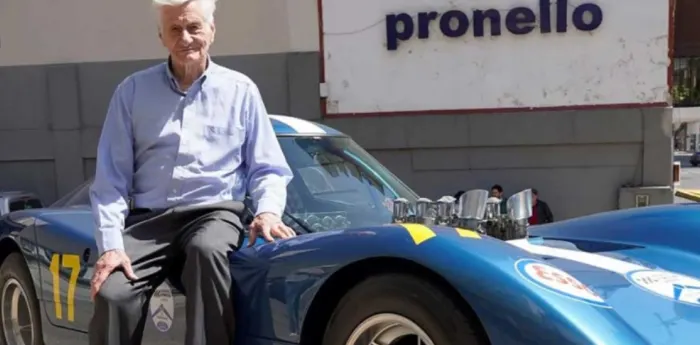
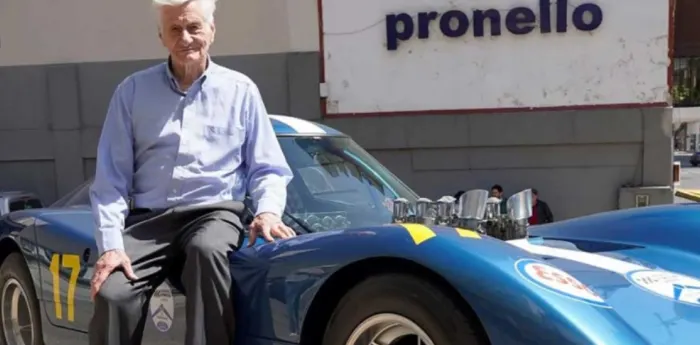
In July 2023, the Brooklands Paddock at the Goodwood Festival of Speed put a 1969 Argentine sports prototype on display alongside two Ferrari 250 GTOs, Jackie Stewart’s Tyrrell, Carlos Reutemann’s Brabham, and the six-wheeled Williams that never raced. The crowd voted it “new favourite car” of the festival. The British classic-car press could not get over it. Internet searches for the car spiked in the United Kingdom that week. The man who designed it watched the whole thing live on Instagram from a house in Córdoba, Argentina, because at eighty-seven he was no longer fit to fly. His name was Heriberto Pronello, and the car was a coupe he had drawn on a napkin in 1965 and tested in a wind tunnel four years before Colin Chapman would receive global credit for inventing ground effect in Formula 1.
That is not a typo. Four years before the Lotus 78.
If you have read our piece on Oreste Berta, you already know half of the story. Berta was the engine man. Berta built the powerplants that took the IKA Torino to the front of the 1969 Marathon de la Route at the Nürburgring for fifty-six straight hours. Pronello was the other half. Pronello drew the air. Pronello was the aerodynamic eye that closed the partnership and that, on his own afterwards, produced the car this piece is built around: the Huayra Pronello Ford. The most aerodynamically advanced racing car nobody outside South America had ever heard of, until a wind tunnel in the English Midlands and a few Oxford students finally explained to the world what an obscure Argentine constructor had done while everyone was looking at Jim Clark.
This is the story of being right too early, in the wrong country, and living long enough to see the proof.
An aeronautical engineer who fell in love with cars
Heriberto Pronello was born on 2 February 1936 in Morteros, a small farming town in the Argentine province of Córdoba. The detail that changes everything in his story is this: he studied aeronautical engineering at the Escuela de Aviación Militar in Córdoba, the same institution that fed pilots and engineers to the Argentine Air Force. He did not learn to shape cars by hammering panels in a workshop. He learned boundary layer theory, Bernoulli equations, subsonic flow behaviour and lift coefficients. To Pronello, a car body was never a metal box with a driver inside. It was an aerodynamic surface that had to manage airflow around the vehicle.
That framing, in mid-1960s Argentina, was science fiction. The Turismo Carretera, the country’s most popular touring car championship, was still running prewar coupes with bodies that looked like garden sheds on wheels. Cars like “La Galera” of Dante Emiliozzi or “La Coloradita” of Juan Manuel Bordeu rarely exceeded 180 km/h, for the simple reason that their bodywork stopped the air like a wall. Pronello argued constantly with his friends in the paddock about how outdated those lines were. The answer he kept getting was a laugh: “easy for you to say, you drive a Porsche.” That part was true. In the middle of the TC boom, Pronello had bought one of the first Porsche 911s imported into Argentina. For him, a racing car was a different species altogether. And he was about to prove it.
IKA, the Liebres and the partnership with Berta
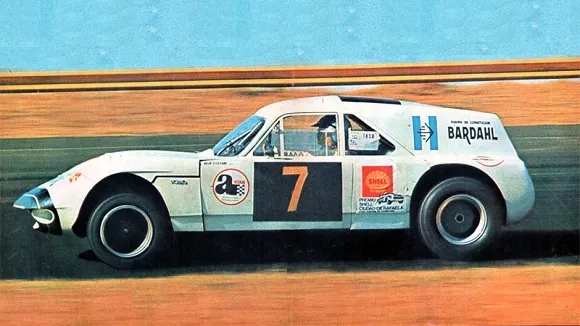
By 1967, IKA had just won its first Turismo Carretera title with Oreste Berta running the technical side and Eduardo Copello driving. It was the first time in the history of the series that a marque other than Ford or Chevrolet had taken the championship. The plant in Santa Isabel wanted more. IKA president James McCloud called Pronello and asked him to develop the next evolution of the Torino race car. Pronello accepted, but he was already working on something far bolder of his own: a scale model that he had been refining for five hundred hours, tested repeatedly in the wind tunnel of the Escuela de Aeronáutica de Córdoba. That model was the embryo of the car he would later name Huayra. McCloud, however, wanted the new Torino to use as many production parts as possible, and the timeline was tight. So Pronello shelved his dream and built the Liebre Mk II.
The Liebres are the visible signature of the Berta-Pronello partnership. Berta built and tuned the engines. Pronello shaped the bodies, stretched the rooflines, lowered the silhouettes, opened the wheel arches. Together they produced the cars that dominated the Argentine Turismo Carretera from 1967 through 1971: four championships in five years. The British, French and Italian engineering presses of the period barely registered any of this, partly because Argentina was a closed market, partly because Cold War priorities were elsewhere. But on the ground, two men in different Córdoba workshops were doing something unusual: combining the discipline of a thoroughbred motor builder with the discipline of an aircraft engineer, applied to closed sedan racing.
The Liebres won. The IKA team flew to Germany in August 1969 with three Torino 380Ws. The number 3 led the Nürburgring 84 Hours race for fifty-six straight hours before exhaust regulations and brake wear knocked it down to fourth on the official sheet. We have covered the engine side of that story elsewhere. The chassis and body side, the part nobody writes about, belongs to Pronello. The car’s silhouette had to survive eighty-four hours of pounding on the Nordschleife without deforming, without lifting at over 200 km/h, without the weight of repeated heavy braking eating its suspension geometry. That is not bodywork. That is structural and aerodynamic engineering disguised as “preparation”.
But Pronello already had his eyes on something else. Something the Torino, no matter how much he reshaped it, would never be allowed to become.
The car that arrived a decade early
In 1968, IKA officially withdrew from the Turismo Carretera. The company was struggling. Ford Argentina, sensing opportunity, called Pronello and offered him what he had been waiting for: build a clean-sheet car for the new Sport Prototipo Argentino series. A category for purpose-built prototypes only, no production constraints, no regulatory corset. The dream Pronello had been carrying since 1965 became green-lit.
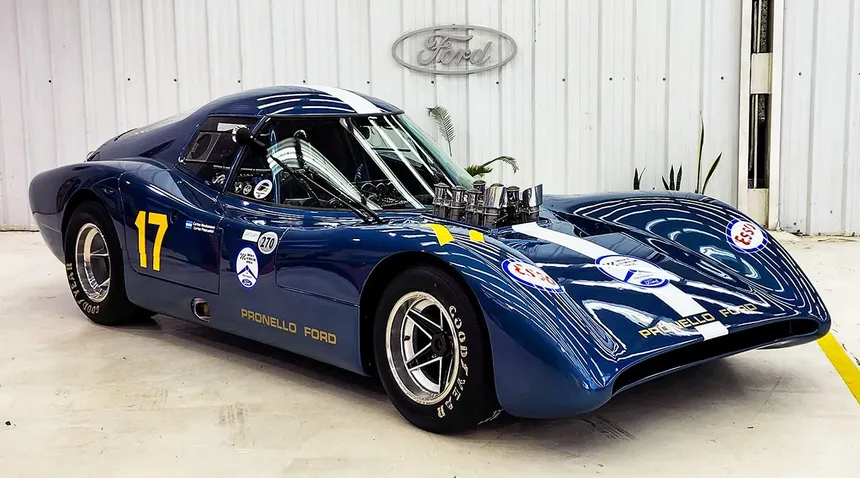
He went back to the drawing board with his students from the Instituto Rivadavia, where he taught a course called Técnica de Automovilismo Deportivo. The result was a car called Huayra, the Quechua word for “wind”. The name had been suggested by the Argentine visual artist Rogelio Polesello, who saw the wind tunnel model and said the shape itself demanded that name. The car debuted on 18 May 1969 at the Oscar Cabalén circuit in Córdoba. The drivers were Carlos Pascualini and a then-twenty-seven-year-old former kart racer who would, five years later, become an F1 podium regular: Carlos Alberto Reutemann.
Now let us look at the numbers, because in Pronello’s case the numbers are the entire argument.
The Huayra had a tubular space-frame chassis and a fibreglass body. The engine was a Ford 292 “Fase 1” V8, bored out to 5.0 litres, fed by four Weber 48-48 IDF carburettors with a flat-plane crankshaft. Output: 430 horsepower. Top speed: 320 km/h. Aerodynamic coefficient measured on the scale model at Córdoba in 1965-1968: Cx 0.22. Aerodynamic coefficient measured on the actual finished car in 2023 at the Catesby Tunnel in England, with sensors and modern instrumentation: Cx 0.25 in short-tail configuration, Cx 0.23 with the long-tail bodywork used at high-speed circuits.
To understand what those figures mean, compare them with peers from the same era. A 1969 Porsche 911 was around Cx 0.41. A Ford GT40 sat at roughly 0.37. A Ferrari 312P, somewhere around 0.40. The cleanest sports prototypes designed throughout the entire 1960s, outside outright land-speed record cars, rarely went below 0.30. The Huayra, a sports prototype meant for mixed circuits, sat at 0.23 with the long tail. It is not a small difference. It is a category-shift difference. In modern terms, that is the gap between a base hatchback and a current Formula 1 car.
How did Pronello get there? By doing something nobody else in 1969 was doing systematically. The Huayra had no big rear wing of the kind Jim Hall’s Chaparral cars were using contemporaneously. It had no aero fins glued to the deck like the Porsche 917 long-tails. Instead, as Sergio Rinland (a Formula 1 aerodynamicist who later joined Sauber and Brabham) would explain decades later: “Pronello used the whole car as a single aerodynamic piece, a wing travelling close to the ground.” Minimal frontal area. Flat floor. Lateral channelling. Underbody diffusers. Everything we now call ground effect, fully integrated into the body design of a 1969 sports prototype made in a workshop in Villa Nueva, Córdoba.
Two Huayra Sport Prototipo cars were built. Four Halcón TC cars followed, the Turismo Carretera version, technically related but visually distinct, mounted on a chassis derived from the Jeep Bronco’s tubular structure. The Halcón made its TC debut at the very last round of 1969, with Jorge Ternengo finishing second at Comodoro Rivadavia. The following season, the car came into its own: in 1970, Dante Emiliozzi took a Pronello Halcón to runner-up in the Argentine Turismo Carretera championship, beaten only by Gastón Perkins driving — of all things — a Liebre Mk III, the previous-generation race car also designed by Pronello. The top two cars in the 1970 TC championship had both come off Pronello’s drawing board. Pascualini took an absolute record at the Rafaela oval in the Huayra. The Sport Prototipo category itself, however, would last only four seasons before economic pressure killed it: 1969 to 1973.
Then Colin Chapman released the Lotus 78 in 1977. Then Mario Andretti and Ronnie Peterson started winning Grands Prix with it. Then Formula 1 collectively realised that the car as a whole could be turned into an inverted wing, and the global motorsport press wrote thousands of articles celebrating Chapman’s “invention” of ground effect.
Pronello had built it, run it, and won races with it in 1969. He never sued. He never wrote an angry letter to Autocar. He simply moved on to other projects.
Goodwood, Oxford, and a kind of vindication
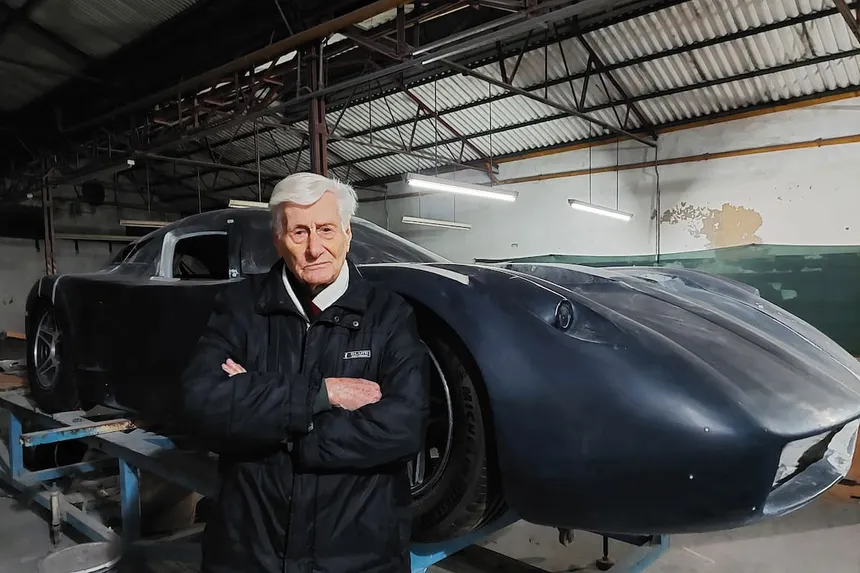
For five decades, the Huayra Pronello Ford was a curiosity known only inside Argentine motorsport circles. Two surviving cars passed through collectors. The Argentine vintage car fair Autoclásica gave one of them the prize for Best Argentine Competition Car in 2011. That was as far as international recognition went, until Ricardo Zeziola, the Argentine collector and owner of the most complete Huayra, decided in 2023 to fly his car to England.
The trip had three stops. First, an exhibition at the Argentine Embassy in London, hosted by ambassador Javier Figueroa, with Argentine F1 aerodynamicist Sergio Rinland and Tucumán-born McLaren designer Esteban Palazzo in attendance. Second, the Goodwood Festival of Speed, where the Huayra was placed in the Brooklands Paddock alongside Ferrari 250 GTOs, Jackie Stewart’s Tyrrell, Reutemann’s Brabham and other icons. Third, the most important stop of all: the Catesby Tunnel near Daventry, a converted 2.7-kilometre former railway tunnel that Rinland and partners had turned into a wind tunnel where cars are tested in motion rather than statically.
The test ran on Tuesday 4 July 2023. Watching the runs was Willem Toet, a Formula 1 aerodynamicist who has worked for BAR, Sauber, BMW and Ferrari at various points in his career. Toet kept saying the same thing throughout the day, in different words: he could not understand how something this advanced had been conceived in Argentina in 1969. The Oxford University students managing the sensor data agreed. The figures (Cx 0.23 with long tail, flat floor with functioning diffusers, integrated bodywork acting as one continuous aero surface) were not just impressive for 1969. They were unusual for 2023.
At Goodwood, festival visitors voted the Huayra “new favourite car” of that year’s edition. Internet searches for the Pronello-Huayra spiked across the UK that week. The British classic-car press did a lap of vindication for a car that, until weeks before, most of them had never heard of.
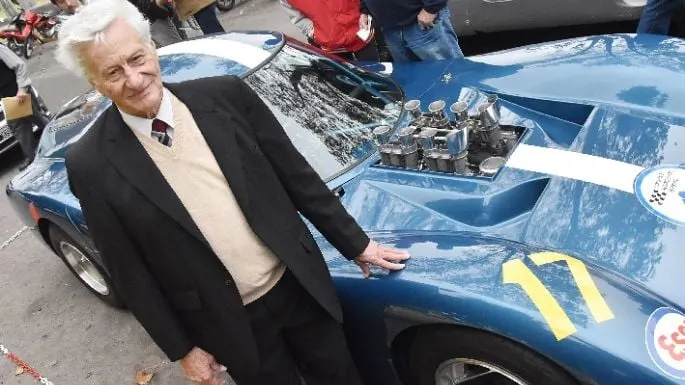
Pronello, eighty-seven years old at the time and unfit for the journey, watched the entire week unfold on the live streams of Argentine motoring historian Gabriel de Meurville. When asked by the Argentine newspaper Infobae what it felt like, his answer was disarmingly simple: he had followed it all “with enormous joy and emotion”. He said the car “looked beautiful in such a large tunnel”. That is the voice of a man who designed something fifty years ahead of its time and who, half a century later, watches the world’s most experienced aerodynamicists confirm what he had always known. No “I told you so”. No bitterness. Just a quiet sentence from a grandfather watching his grandchild perform on stage.
In December 2023, Ford Argentina formally honoured Pronello at its General Pacheco plant. CEO Martín Galdeano handed him a diploma. There were photos and a small ceremony. After fifty-four years, the manufacturer that had funded the original two Huayra and four Halcón cars got around to publicly thanking the man who had designed them.
What Argentina could have had
Imagine, for a moment, an alternative 1970. Imagine that instead of letting the Sport Prototipo Argentino category die in 1973, the Argentine state, the major manufacturers, the Automóvil Club and a handful of private financiers had decided that motorsport engineering was a strategic industry. Imagine that Villa Nueva had become the South American equivalent of Huntingdon, where Cosworth grew, or Maranello, where Ferrari kept compounding its expertise. Imagine that Pronello had been given a team of five aerodynamicists, his own dedicated wind tunnel, an updated dyno, and a regular production run of six chassis per year.
That Argentina existed in embryo. The Huayra scale model was spinning in a Córdoba wind tunnel in 1965. Berta had the powertrains. Reutemann had the driving talent. Fangio had the political weight to open doors anywhere in the world. The basic raw material was there. What was missing was a sustained collective decision to invest. England made that decision in the 1970s and never stopped making it. Italy made it with Ferrari decade after decade. Germany made it with Porsche. Argentina did not. The Sport Prototipo died, the Liebres faded out of the Turismo Carretera, and Pronello went on to build industrial robotics, motorboat hulls and military components because there was no longer a national racing industry to absorb the talent he was producing.
The cruelest part of this is that Pronello has never been bitter about it. He has carried himself through five decades with the calm of a man who knew he had been right and did not need an external authority to confirm it. Even when Lotus 78 stories filled the press, even when Chapman became the global poster child for ground effect, even when motoring journalists wrote books about it without mentioning Argentina, Pronello kept working. Quietly. Patents. Inventions. Small wins. The world’s attention was somewhere else.
Then Catesby happened. Then Goodwood happened. Then Oxford happened. And what should feel like a triumph instead reads as something stranger and more uncomfortable: an octogenarian engineer in Córdoba being told by the best aerodynamicists alive that yes, he was right in 1969, here are the sensor readings, please accept this diploma.
In England, this kind of belated acknowledgement at least lifts a career into the record books. In Argentina, it does something else. It exposes how completely the country lost the chance to industrialise what one of its most gifted minds had already prototyped. The Huayra was not a one-off curiosity. It was a working blueprint for what Argentine motorsport engineering could have become. Nobody picked it up.
Two minds, one workshop
If you have read the piece on Oreste Berta, you know that he was the engine. Here you know that Pronello was the air. Between them, in those years between 1966 and 1972, they covered the entire intellectual stack of what a racing car needs to be: combustion, aerodynamics, chassis, suspension, body construction. Every time you look at an old photograph of a Torino Liebre, you are looking at two brains thinking the same car from two different sides of the same workshop. The engine came from Alta Gracia. The silhouette came from Villa Nueva. And the sum of those two villages, on a single August week in 1969, led the longest motor race in the world for fifty-six straight hours.
But there is a difference between them that deserves a final line. Berta tried Formula 1 in 1975 and got crushed by it. His F1 chassis ended up dismantled in an Argentine customs warehouse. Pronello, by contrast, did something rarer: he turned out to be right ahead of his time and lived long enough to watch the proof appear on an English wind tunnel printout. In human terms, that is a victory. In industrial terms, it is a verdict on a country. Because what Argentina lost with Pronello is not a career that started promisingly and ended badly. It is a career that ended exactly as well as it began: with a brilliant engineer doing the work he understood, and with a national industry that never built the structure around him to capitalise on any of it.
The Huayra now lives in Goodwood retrospectives, in Oxford aerodynamics papers, in Classic & Sports Car magazine. It lives, most importantly, in the ninety-year-old head of Heriberto Pronello in Córdoba, who watches the photographs with the quiet of someone who always knew.
That quiet, after Berta, after Reutemann without a title, after so many others, no longer surprises anyone in Argentina. It just keeps hurting.
Check you’re still alive.