
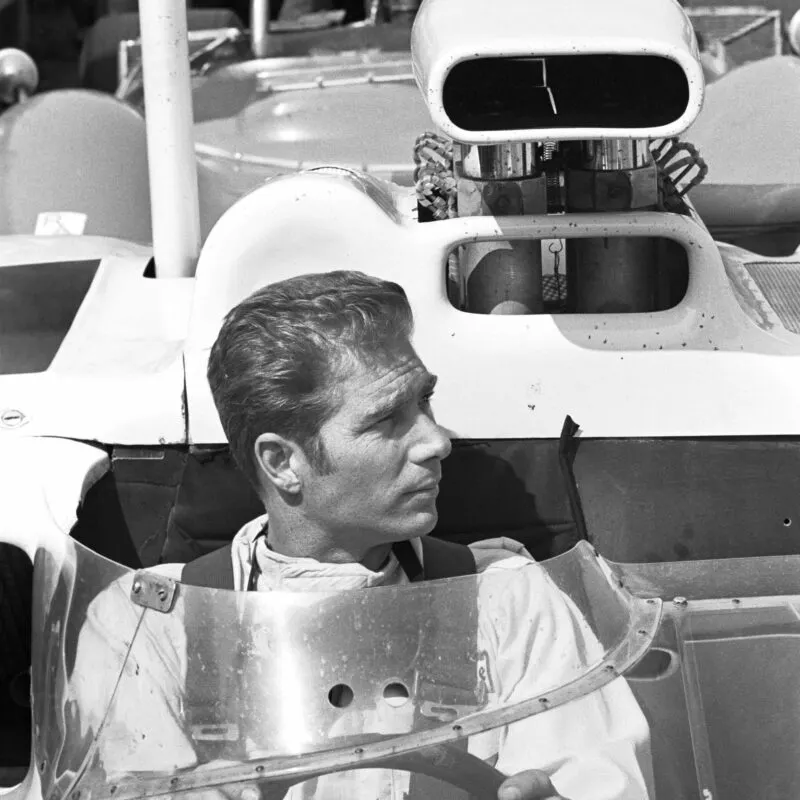
Jim Hall: the Texan who understood the air while everyone else stared at the engine
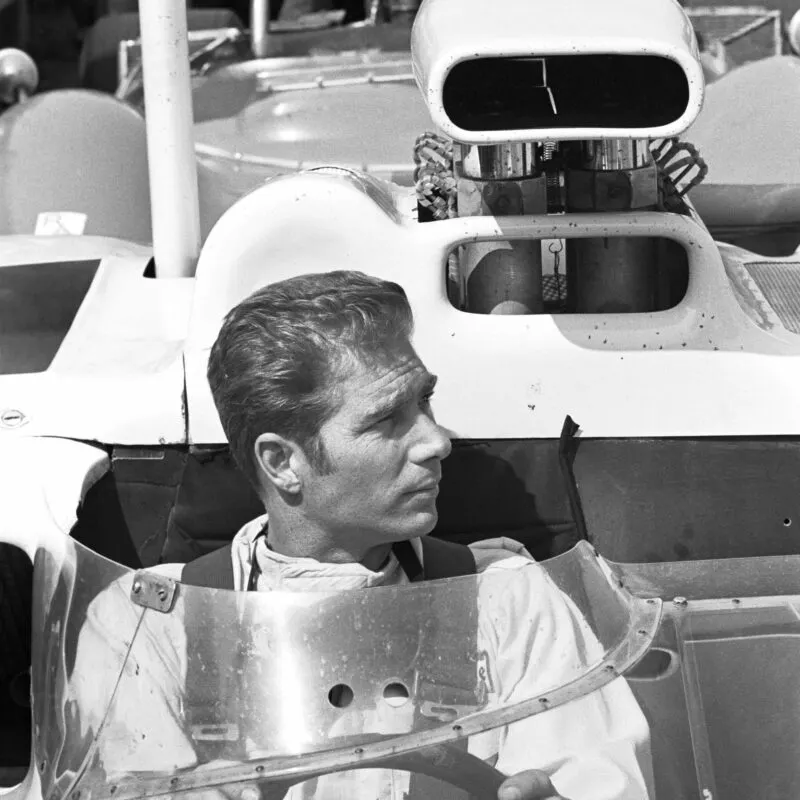
If you walk into the Permian Basin Petroleum Museum in Midland, Texas, you’ll find oil derricks, rock samples and a hall full of dinosaurs. You’ll also find, almost by accident, the most important collection of racing cars built in America. The Chaparral 2E with its movable wing. The Chaparral 2J with its two ground-effect fans. The Chaparral 2K that won Indianapolis. They sit there next to fossils and pumpjacks because the man who built them, Jim Hall, never thought of himself as a museum piece. He was a Texan engineer with money in oil, an engineering degree from Caltech and a workshop in the desert. The fact that he changed how every racing car in the world cuts through the air was, to him, just what happened when you applied your head properly to the problem in front of you.
To understand Hall, you have to forget the European racing tradition for a minute. Forget Maranello, forget Hethel, forget Woking. Forget Colin Chapman trimming weight obsessively and Enzo Ferrari treating his drivers like gladiators. Hall came from a different planet entirely: the American speed shop. The kind of place where a guy with grease under his nails and a slide rule in his back pocket builds his own bracket racer because the factory ones don’t go fast enough. Hall took that mentality, added a Caltech engineering degree, added a chequebook funded by Texas oil, and added a partner inside General Motors’ R&D department. What came out of that combination is what Bruce McLaren and Colin Chapman were quietly studying in 1967, even if they would never admit it publicly.
The kid who lost his family the month he started Caltech
James Ellis Hall was born in Abilene, Texas, in 1935. Oil family with a private plane. His father Ellis was a geologist who flew himself around for business. The four Hall children learned to fly before they learned to drive.
In the summer of 1957, the month before Jim was due to start his engineering degree at Caltech, a private aircraft crashed in British Columbia. His father, his mother and his older sister were all killed. Three gone in a single accident. Jim was left with two brothers, a multimillion-dollar inheritance and a decision to make. He had been planning to study geology and join the family oil business. He switched to mechanical engineering instead.
That switch tells you everything about the man. Hall didn’t study engineering as an abstract calling. He studied it because life had just taught him, brutally, that aeroplanes fall, that mechanical things fail and that the only way to feel any control over the world is to understand exactly why they fail. That obsession with understanding the failure mode of every component is the through-line of his entire career. Every Chaparral innovation, from the semi-automatic gearbox to the suction fans, was driven by the same engineer’s question: what happens when this breaks, and how do I fix it in thirty seconds in the pit lane?
While at Caltech he raced an Austin-Healey his brother Dick had bought. He met Carroll Shelby, who at that point wasn’t yet Shelby. Just another Texan racer running a sports car dealership in Dallas, with a head full of ideas he hadn’t yet been able to build. The Hall family sponsored Shelby. Dick Hall and Shelby opened Carroll Shelby Sports Cars together in Dallas, and when Jim graduated from Caltech without a job — General Motors had offered him one and pulled it back during the 1958 recession — he ended up selling Italian cars in Dallas alongside the future creator of the Cobra. Two Texans nobody outside the SCCA paddocks had heard of, working a showroom floor in a city better known for cattle deals than racing programmes, neither of them yet knowing that one would change Le Mans and the other would change the entire concept of how a racing car interacts with the air.
Hap Sharp, another Texan with money and a need to race, joined them shortly after. From those three names — Hall, Shelby, Sharp, with the GM engineering brain trust feeding them in the background — comes Chaparral.
Midland, Texas: the most illogical place on earth to build a racing car
Stop and think about where racing cars were built in the 1960s. Maranello. Modena. Coventry. Brackley before it was Brackley. Indianapolis. Los Angeles, if you stretched the definition. Hall and Sharp set up Chaparral Cars in Midland, Texas. An oil town in the middle of the desert, hundreds of miles from any city that took motorsport seriously. They built their own private test track next to the workshop and called it Rattlesnake Raceway. The name is exactly what the name suggests: a tarmac strip in the desert with rattlesnakes in the brush.
The geographical decision matters because of what it allowed. Far from the gossip of pit lanes, far from European specialised press, far from the spies that haunted any serious racing facility in 1965, Chaparral could experiment behind closed doors with a freedom no European team had. And here enters the silent partner: Chevrolet R&D.
General Motors had officially banned itself from motorsport in 1957 with the AMA Ban, an industry-wide agreement that the Detroit Three would stop factory racing programmes. Officially. In practice, GM’s engineering department had been desperate for a real-world testbed to try the things they’d been theorising for a decade. Hall offered them exactly that: a private team, a private track, a Caltech-trained engineer running it, and a code name for everything they shipped him. They sent him aluminium small-block V8s machined to specifications nobody could buy. They sent him a torque-converter automatic transmission rebuilt as a near-direct-drive racing component. They sent him fibreglass moulding expertise from the Corvette programme. In return Chaparral validated GM’s experiments at speed and gave them deniability.
This is the context for everything that follows. When Hall debuts a semi-automatic gearbox in the 2A, he isn’t pulling a stunt. He’s running a GM laboratory project under a Texan flag, with a Caltech-trained driver-engineer who knows exactly what he’s looking at.
And now is the moment to talk about that gearbox the way it deserves. Because if you look at it from the outside you might think: automatic transmission, big deal, my mother’s Buick has one. The point is what’s inside. A standard road-car torque converter from the 1960s loses a brutal percentage of horsepower through hydraulic slip and heat. If you drop one straight into a racing car you’ll cook the fluid in five laps and lose the engine in ten. What GM and Hall did was redesign the converter so it acted essentially as a clutch with a lock-up point at racing rpm, plus they re-engineered every cooling and sealing component down the driveline to handle sustained heat that no production transmission was designed for. That’s not an idea. That’s months of bench work, temperature mapping and component-by-component redesign. Which is why nobody copied it for twenty years. Not because the concept was unknown — everyone in racing knew torque converters existed — but because the workshop hours required to make one survive a 12-hour endurance race were not something a small European team could afford to commit to.
The wing that moved with the pedal
Most people know Chaparral invented the wing. That’s half-true. Before Hall, a Swiss engineer called Michael May had bolted a movable wing above the driver’s head on a Porsche 550 at Nürburgring in 1956. He was banned from starting the race. Good ideas always arrive ten years too early and they always get banned twice.
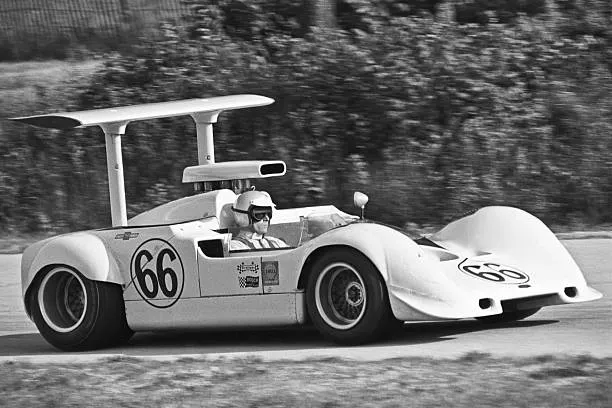
What Hall did with the Chaparral 2E in 1966 is different. It wasn’t just a high-mounted wing. It was a wing connected to the pedal. Hall had figured out something nobody had put on the table yet: aerodynamic downforce also creates drag. On the straights, that drag is killing your top speed. In the corners, you need every kilo of downforce you can get. So if you could flatten the wing on the straights and tilt it on the corners, you’d have the best of both worlds. That’s what he built. The 2E had a third pedal on the left: wing pedal. Press it, the wing flattens. Release it, the wing tilts. Three pedals on a two-pedal automatic car. One of them controlling the air.
The technical detail almost nobody talks about: the system was mechanical. Cables and levers, no hydraulic servo, no electronic actuator. When the wing failed — and it failed more often than the official record suggests — it failed violently. Mounts cracked, cables jumped, and the wing froze in some intermediate position the driver couldn’t control. That’s why Hall moved from the 2E to the 2G specifically reinforcing the wing assembly and the actuation linkage. It wasn’t a styling exercise. It was a field repair to a component that had revealed itself fragile under real load.
That detail separates Hall from a pure theorist. A theorist designs a wing that’s not supposed to fail. A driver-engineer who’s spent ten years racing knows everything fails, and designs a wing knowing what fails, how it fails and how to swap it in the pit box in thirty seconds.
Sebring 1965: the day a Texan workshop beat Ferrari, Ford and Shelby in the rain
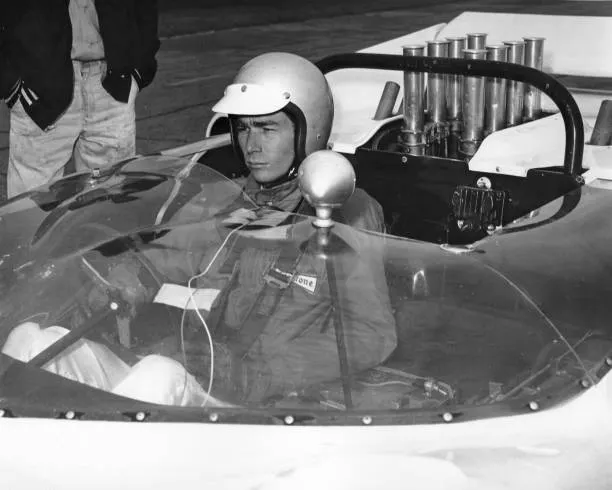
Before the movable wing, before the suction car, you have to talk about Sebring 1965. 12 hours. Heavy rain from the opening laps. Hall and Hap Sharp running a Chaparral 2A weighing 924 kilograms against the works Ferrari team, the Shelby Daytona Coupes and the factory-supported Ford GT40s. On paper this was a hierarchy race: the small American outfit from the provinces against the entire establishment.
Hall did two things that day that decided the race. First, a tyre call his rivals didn’t dare make. With the track running rivers of water, he stayed on softer compound longer than logic dictated, betting that the standing water would give him enough grip to make the softer rubber pay off. Second, he stayed out when everyone else pitted for fresh tyres. While Ferrari and Ford were losing time in the pit lane, the Chaparral was still circulating with a tyre set already up to operating temperature.
The car held. Sebring’s surface, with its concrete patches and broken kerbs, is murder for any suspension. For a fibreglass monocoque eight years ahead of its time, it was a structural endurance test on top of being a race. The semi-automatic gearbox, the heat from the Chevrolet small-block, the rain getting in through every joint, and a car designed in a shed in Texas. They won. Hall and Sharp first, the works Ford GT40 second, the rest of the field strung out behind. It’s the proof that the Chaparral model worked: light fibreglass chassis, GM-built Chevrolet motor, semi-automatic transmission and a driver who was also the engineer. Against the entire global motorsport establishment. On home soil. In the rain.
That win is what bought Hall the freedom to keep experimenting. When you’ve beaten Enzo Ferrari and Carroll Shelby in the same afternoon, the sponsors and the GM allies stop asking stupid questions. They let you work.
The 2J: the car that sucked the floor
In 1970 came the Chaparral 2J. If the 2E moved the wing, the 2J directly sucked the air out from under the car. Two rear-mounted fans driven by an auxiliary 247cc JLO snowmobile engine, plastic skirts sealing the underbody against the tarmac, and constant suction that did not depend on the car’s forward speed. The 2J generated downforce sitting still in the pit lane.
At Riverside in 1970, the 2J qualified more than two seconds per lap faster than the McLaren M8D that would go on to win the championship. Two seconds. In that era, two seconds was a geological era. The other Can-Am teams gathered, complained, lobbied. The SCCA, initially permissive, eventually folded. By the end of 1970 “movable aerodynamic devices” were banned. The 2J ran one season and the story ended.
Except the idea didn’t end. Eight years later, Gordon Murray revived it on the Brabham BT46B in Formula 1 with the polite excuse that the fan was for “engine cooling”. Niki Lauda won with it at the Swedish Grand Prix in 1978 and Bernie Ecclestone withdrew the car before it could be banned outright. One victory, tactical retreat, the rule book closing the same door Hall had opened in Texas. And fifty-two years on, at Goodwood in 2022, a British electric car called the McMurtry Spéirling drove up the Festival hill in 39.08 seconds and broke the all-time record using exactly the same physics: two electric fans on the underside, flexible skirts sealing the floor. Call it by its name — a Chaparral 2J with an electric motor, half a century later. The FIA, the SCCA and the rule books can ban whatever they want, but you can’t ban physics. Active suction generates more downforce than anything else, and that’s what Hall figured out in 1969 on a track between the rattlesnakes in West Texas.
What was brutal about the 2J wasn’t the fan. It was the skirt system. Flexible plastic strips that ran along the tarmac and sealed the low-pressure chamber underneath. If a skirt broke, suction collapsed and the car stopped working. In a racing car full of vibration, glowing exhaust pipes and brutal underbody temperatures, keeping a plastic skirt intact is a serious mechanical problem. They solved it with aerospace materials and a quick-release fixing system that allowed pit crew to swap skirts in seconds. Once again: the idea is laboratory; the solution is workshop.
Indianapolis 1980: the experiment wins the most conservative race in the world
Hall had already been out of Can-Am for years when he came back through the front door. In 1980, with Johnny Rutherford driving, the Chaparral 2K won the Indianapolis 500. The 2K was a passive ground-effect car. No fans, no movable parts, no rule-breaking tricks. Underbody Venturi tunnels, side skirts, exactly the same physics Lotus was applying in Formula 1 with the 78 and the 79, but adapted to American oval racing and the specific demands of Indianapolis.
Here’s the detail nobody talks about. Hall, the Texan who had designed every Chaparral with his own team in Midland for fifteen years, did something for the 2K that he had never done before: he hired a foreigner to lead the design. Specifically, John Barnard, a young British engineer with direct hands-on experience of what Lotus had been doing with ground effect in Formula 1. The decision says something about Hall the engineer that’s easy to miss. Lotus had cracked passive ground effect in Europe and Hall recognised, without ego, that the European Formula 1 paddock was further down that specific road than he was. So instead of trying to catch up alone, he brought in the man who had been inside that knowledge. The 2K is the only major Chaparral whose design DNA isn’t purely American. It’s a Texan project with British technical leadership, and that mix is exactly why it worked.
Barnard would leave Chaparral the following year and build the first carbon-fibre monocoque in Formula 1 history with the McLaren MP4/1. The 2K was his calling card.
That Indianapolis win closed the Hall circle. From the banned experiment of 1970 to the legitimate trophy of 1980, with the same physics under the floor. The 2J had been thrown out of the rulebook ten years earlier. The 2K, doing essentially the same thing through passive geometry rather than active fans, won the most conservative race on the planet.
What he left behind
Let’s do the inventory cold, because the list is long and each item carries weight on its own.
In aerodynamics, Hall introduced or popularised the high-mounted wing bolted directly to the chassis — not to the bodywork, which was the European trick of the era — the driver-controlled movable wing, the underbody skirts, the active suction fan, and ground effect applied to oval racing. Every single one of those concepts is still in every Formula 1 and IndyCar car running today. Anyone who tells you that competition aerodynamics was invented in Maranello or Hethel is selling you a partial truth. A huge part of it was invented on a track between rattlesnakes in the Texas desert.
In chassis design, he was among the first to run a full fibreglass monocoque in a competitive racing car, and one of the first to relocate the radiators to side pontoons rather than mounting them in the nose. That second point looks minor but changed the aerodynamic geometry of the entire car: low nose, clean air over the top, radiator weight centralised and low. The torsional stiffness of the Chaparral 2 was around four times higher than European rivals of the era, and that’s not a decorative number. It means that when Hall adjusted the suspension, the adjustment did exactly what he expected. His rivals running flexible chassis were adjusting blind, because the chassis itself was twisting under load and falsifying the suspension’s response. That’s why Hall could go to a corner, change a setting and be a second faster two laps later. His rivals were spinning around the same lap times guessing.
In transmission, Hall put a serious semi-automatic torque-converter gearbox into competitive racing two decades before electronic semi-autos arrived in Formula 1 in the late 1980s. And above all of that, he was the first to think of the entire racing car as an aerodynamic system, with the engine, the suspension and the chassis all subordinate to the air. Today every engineer in every category applies that principle. When Hall applied it for the first time, in 1966, it was heresy that took his rivals a decade to understand.
And all of this was done by a Texan engineer who nearly died racing and who decided that, since he was going to survive, he was going to be the one who controlled how cars move through the air.
The FIA, the SCCA, the rivals and the rulebooks all eventually banned what he was doing. But banning is the only way the establishment has of saying: you’re right, you’ve done it better than us, and since we don’t know how to match you, we’ll stop you. Every time something gets banned, somebody invented it first.
Hall sold Chaparral in 1996 after a brief return in CART and IndyCar with Carl Haas. He turned 90 in 2025. He’s still alive, still in Midland, on the same Texas ground where he set up the workshop sixty years ago. His museum sits inside the Permian Basin Petroleum Museum, where the original Chaparrals — the 2E, the 2J fan car, the Indianapolis-winning 2K — are displayed as if they were artefacts of a dream that actually happened.
Which is what they are.
Check you’re still alive.