Carroll Shelby: the bankrupt chicken farmer with a bad heart who beat Ferrari
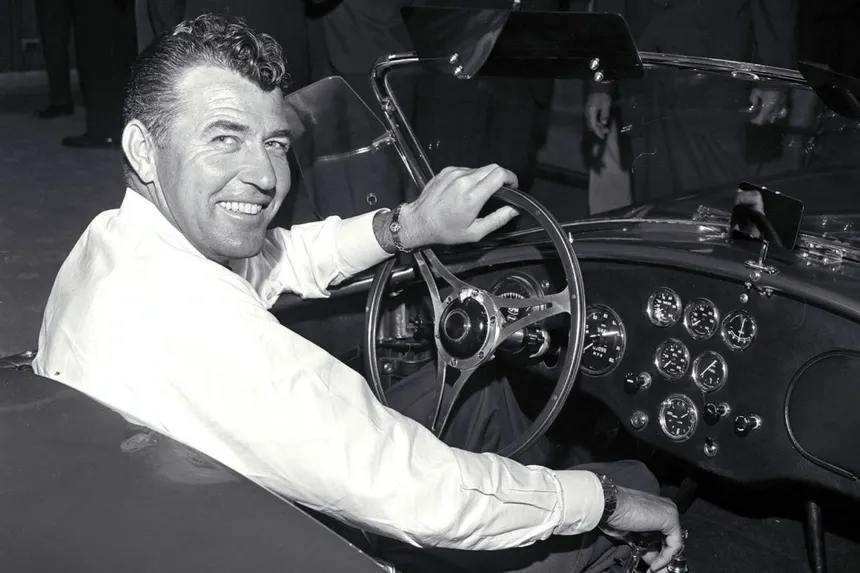
Most people under 40 met Carroll Shelby through Matt Damon. In Ford v Ferrari, the 2019 movie, Damon plays him as the cool Texan who stands between Henry Ford II’s executives and Ken Miles. It’s a good performance, and it leaves out most of the man. The real Carroll Shelby was a broke chicken farmer, a Le Mans winner who raced with nitroglycerin pills under his tongue, the father of the Cobra, the man who put up the money for the first Chili’s, a heart transplant patient who outlived his doctors’ predictions by half a century, and a husband seven times over. Hollywood picked one chapter. Here’s the rest.
In short: Carroll Shelby, born in Leesburg, Texas, on 11 January 1923, was a broke chicken farmer who became a Le Mans winner, raced Formula 1 in 1958 and 1959 and created the Cobra by putting a Ford V8 in an English roadster. He led Ford’s victory over Ferrari, built the Shelby Mustangs, co-founded Chili’s, lived decades after a heart transplant and married seven times.
Born with a leaking heart
Carroll Hall Shelby was born on January 11, 1923, in Leesburg, a tiny town in East Texas. His father, Warren Hall Shelby, was a rural mail carrier who loved cars. His mother was Eloise Lawrence Shelby. When Carroll was seven, doctors found leaking heart valves, and he spent much of his childhood in bed, told to avoid exertion.
The family moved to Dallas, and his father took him along to dirt-track races. That’s where the sick kid in the stands got hooked. After Woodrow Wilson High School in Dallas, he enrolled at Georgia Tech to study aeronautical engineering, then joined the Army Air Corps in 1941. During World War II he served as a flight instructor and test pilot at bases in Texas, flying Beechcraft AT-11s and Curtiss AT-9s. Legend has it he courted his girlfriend, Jeanne Fields, by dropping love letters tucked inside his flight boots over her family’s farm. They married in December 1943 and had three children: Sharon, Michael and Patrick.
Broke at 26
After the war Shelby tried running dump trucks, working the Texas oil fields and finally raising chickens. His first batch of broilers made him about $5,000, real money in the late 1940s. The second batch got sick and died. Sources disagree on the disease, with Newcastle disease and avian botulism both cited, but the result was the same: the farm went under, and Shelby was broke.
Racing was what he had left. His first known race came in January 1952, a quarter-mile drag in a hot rod powered by a Ford flathead V8. Soon he was driving a friend’s MG TC and then Cadillac-powered Allards in SCCA events, and winning. Around this time he turned up at a race straight from the farm, still wearing his striped bib overalls. The press loved the image of a chicken farmer beating the gentlemen racers, and Shelby, who understood publicity better than most, kept wearing them. He wore them at Le Mans.
From Texas to Le Mans
Aston Martin team manager John Wyer noticed the lanky Texan and brought him to Europe. Through the 1950s Shelby drove for Aston Martin, Maserati and others, and Sports Illustrated named him its Driver of the Year in 1956 and 1957. He even raced in Formula 1, starting eight Grands Prix in 1958 and 1959, from his debut at the French Grand Prix in Reims. His best finish was fourth.

His biggest win came in 1959, when he and Englishman Roy Salvadori won the 24 Hours of Le Mans in an Aston Martin DBR1. Shelby was only the second American to win the race, a year after Phil Hill.
His heart was running out of patience. In 1960 he was diagnosed with angina and told to quit racing or die, with doctors giving him only a few years. In one of his last big races, a 200-mile event at Riverside, California, he drove with nitroglycerin tablets under his tongue to ward off a heart attack and finished third. He later joked that he might have won if he hadn’t had to slow down every time he took a pill. He was 37. He would live another 52 years.
The Cobra: an English roadster with a Ford V8
If he couldn’t drive, he’d build. Shelby’s idea was simple: take a light European sports car and put an American V8 in it. He found the right car in the AC Ace, a nimble British roadster from Thames Ditton, outside London, which had just lost its engine when Bristol stopped making the six-cylinder that powered it.

Shelby asked Chevrolet for engines first. Chevy said no, since it had no reason to arm a rival to its own Corvette. Ford said yes. It had a new lightweight 260-cubic-inch V8 and every reason to want a Corvette beater. In September 1961 Shelby wrote to AC with his proposal, and AC agreed if he could supply the engine. In February 1962 the first chassis arrived by air in Los Angeles. Shelby and hot-rodder Dean Moon took it to Moon’s shop in Santa Fe Springs, and within about eight hours the Ford V8 was in and the car was running. That car was CSX2000, the first Cobra. Shelby said the name came to him in a dream.
One car, many colors
Shelby had exactly one Cobra and a press corps to convince. So every time a magazine wanted to test it, the car got a fresh coat of paint. Yellow for one, another color for the next. Editors thought they were seeing a production line. They were seeing the same car again and again.
CSX2000 stayed with Shelby’s family until 2016, when RM Sotheby’s sold it in Monterey for $13.75 million, at the time the most ever paid for an American car at auction.
Racing needed a similar sleight of hand. To compete as a production GT car, the Cobra had to meet the FIA’s homologation rules, which required a minimum production run. Shelby is widely credited with using chassis numbering to make his output look bigger than it was. Decades later he stirred up another controversy by selling "continuation" Cobras built with McCluskey Ltd. in the 1990s, presented as cars using leftover period chassis numbers. Purists were furious. Shelby didn’t care.
A world title before Le Mans

Before the GT40 glory, Shelby beat Ferrari with his own car. The open Cobra was brutally fast but its shape fought the air at Le Mans speeds, so Shelby’s team built a closed coupe body for it, designed by Peter Brock. The Cobra Daytona Coupe ran in the 1965 international GT championship, and Shelby American took the GT title, the first time an American manufacturer had won an FIA world championship. Only six Daytona Coupes were built. Shelby American had started in a small shop in Venice, California, and by then had moved into hangars beside Los Angeles International Airport, where the Cobras, Mustangs and race cars took shape a few hundred yards from the runways.
Ford v Ferrari, the real version
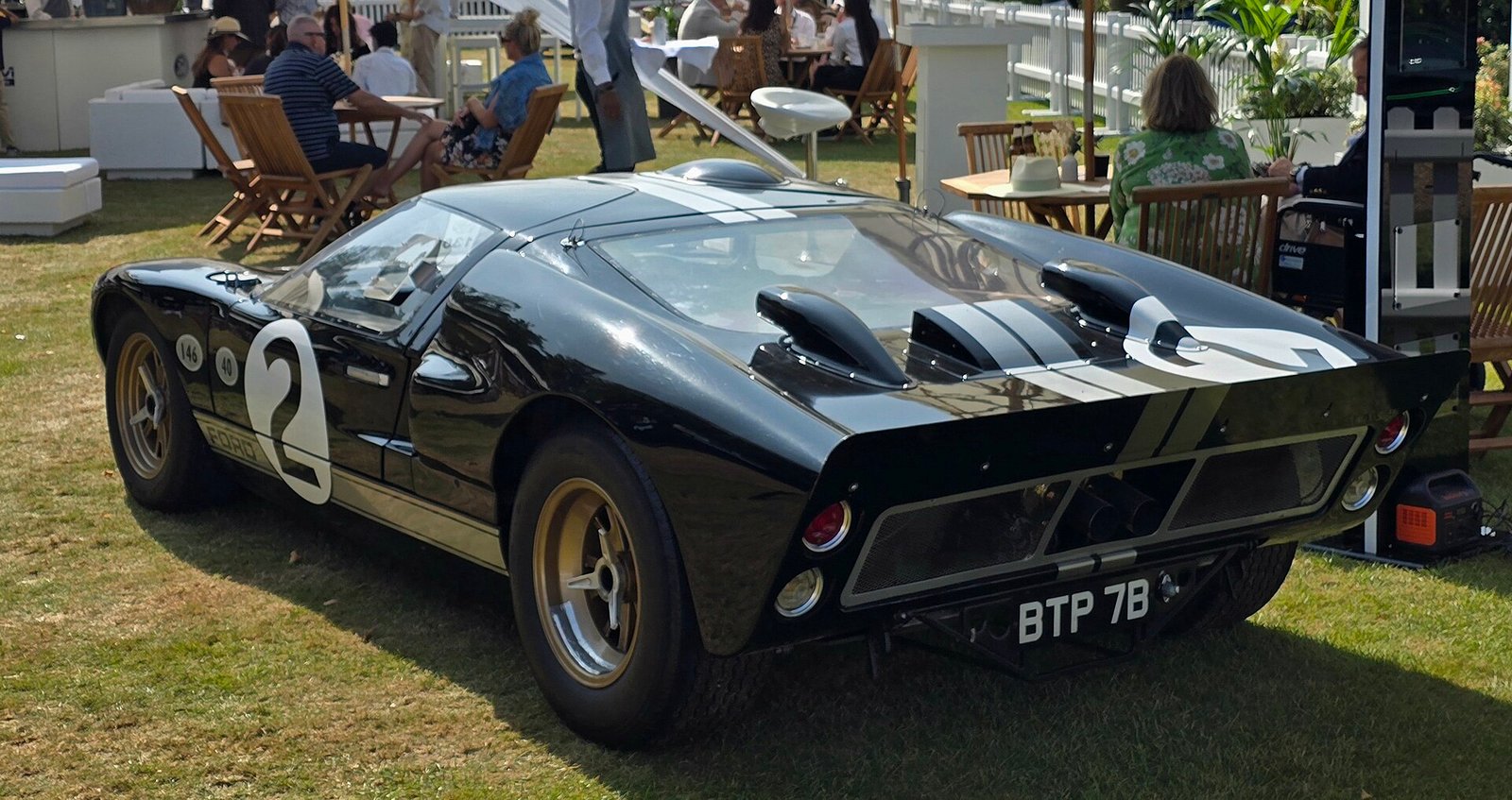
The movie gets the broad story right. Henry Ford II tried to buy Ferrari, Enzo Ferrari walked away, and Ford set out to beat him at Le Mans. When the GT40 program struggled, Ford handed the race effort to Shelby American. In 1966 three Ford GT40 Mk IIs crossed the finish line together for a 1-2-3. In 1967 Shelby’s team won again, this time with the GT40 Mk IV of two Americans, Dan Gurney and A.J. Foyt, an all-American car and crew winning in France.
The Shelby Mustangs
Ford also wanted the Mustang taken seriously on the track, and Shelby delivered the 1965 GT350. He took a Mustang fastback, deleted the rear seat, reworked the suspension and pushed the 289 V8 to 306 hp. For racing there was the GT350R, of which 34 were built according to most historians, with 36 or 37 counted when prototypes and late cars are included.

The big-block GT500 arrived for 1967 with the 428 Police Interceptor V8 rated at 355 hp. In 1968 it became the GT500KR, for King of the Road, with the 428 Cobra Jet, officially rated at 335 hp, a number everyone knew was conservative. Shelby’s Mustang program ended with the 1970 cars, and his relationship with Ford cooled for decades, until the company brought him back in the 2000s around the Ford GT and new Shelby Mustangs.
Chili, Chili’s and Terlingua
Shelby’s other legacy is food. He owned a huge ranch near Terlingua, a ghost town in the West Texas desert, and in 1967 the first famous Terlingua chili cook-off, a publicity stunt dreamed up by newspaper writers, was held on his land. Chili became part of his brand. He sat on the board of the International Chili Society, formed around 1970, and sold Carroll Shelby’s Original Texas Chili kits for decades.
His son-in-law, Larry Lavine, who was married to Shelby’s daughter Sharon, loved the cook-off atmosphere. In 1975 he pitched his father-in-law on a casual restaurant with that same spirit, and Shelby put up the seed money. The first Chili’s opened on March 13, 1975, on Greenville Avenue in Dallas, in a former post office. Lavine founded it with partners, and Shelby’s money got it started. Today it’s one of America’s biggest casual-dining chains.
Back with Iacocca and the Viper
When Lee Iacocca, the man behind the original Mustang, moved to Chrysler, he called his old friend. Shelby developed performance versions of Dodge’s small front-drive cars in the 1980s and then served as a consultant on something much bigger, the Dodge Viper. A huge 8.0-liter V10 in a light roadster with no traction control and no ABS was the Cobra formula again, three decades later.
A gambler’s heart and a son’s kidney
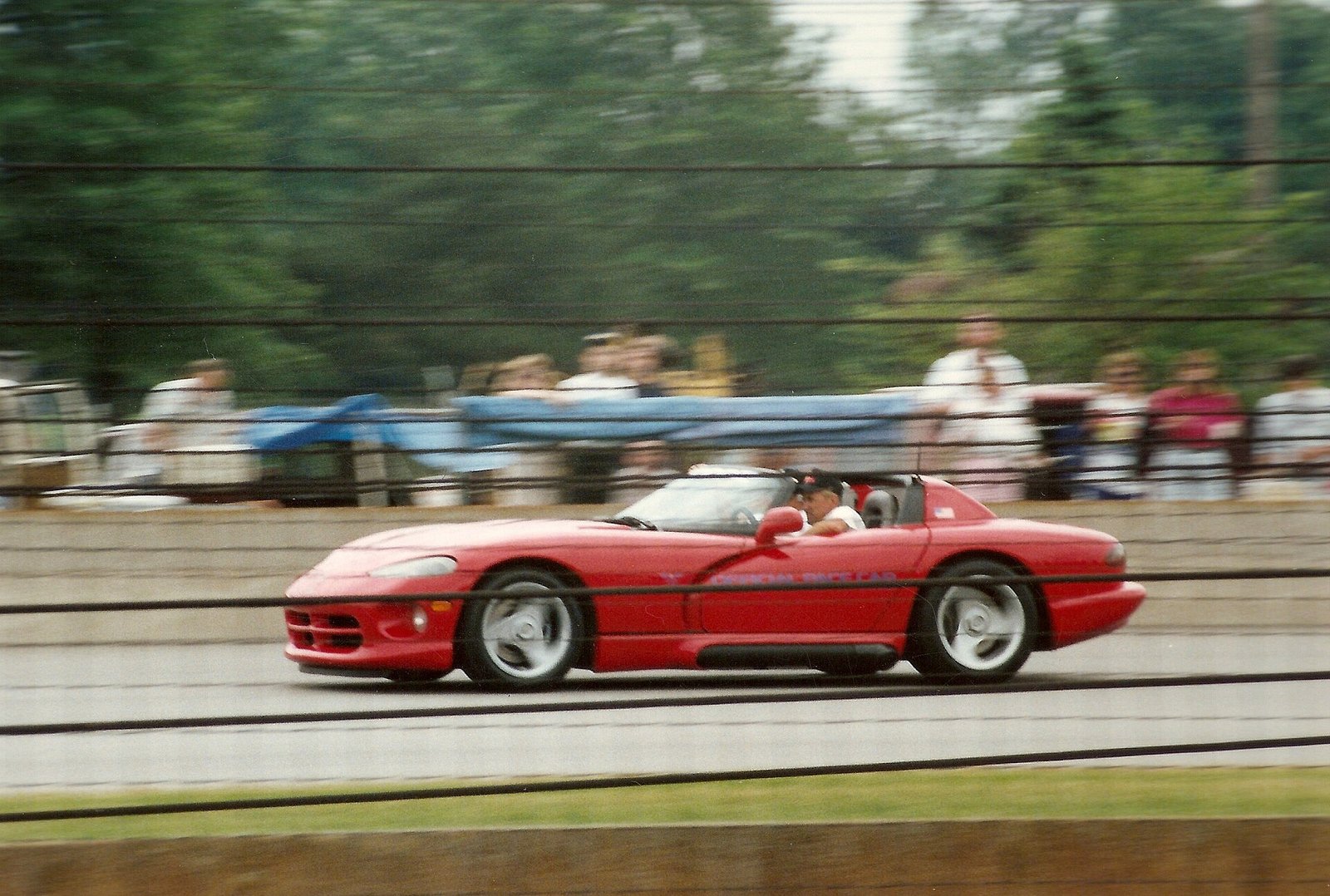
On June 7, 1990, at 67, Shelby finally got a new heart. The donor was a 34-year-old Las Vegas man who had died of an aneurysm, widely described as a gambler. Less than a year later, in May 1991, Shelby drove the Dodge Viper pace car at the Indianapolis 500.
In 1996, at 73, his kidneys failed, and his son Michael donated one. Asked how he felt, Shelby said he’d be fine as long as he didn’t run out of spare parts. After his transplants he set up the Carroll Shelby Children’s Foundation to help children who needed heart and kidney transplants.
Seven marriages
Shelby married seven times, though he only admitted to six, saying a quick wedding in Mexico didn’t count. His first marriage, to Jeanne Fields, lasted about 16 years. Among the later wives were Jan Harrison, Sandra Brandstetter and Cynthia Psaros. His Swedish wife, Helena Dahl, died in a car crash in 1997, and that same year he married Cleo, who was with him until the end. In his last years he split his time between Bel Air, Las Vegas and a ranch in Pittsburg, Texas, where he raised miniature horses and exotic cattle.
Carroll Shelby’s last lap
Carroll Shelby died on May 10, 2012, at Baylor Hospital in Dallas, at 89. Doctors had given him a few years in 1960. He’d lived 52 more, built the Cobra and the Shelby Mustangs, won Le Mans as a driver and as a team boss, bankrolled the first Chili’s, helped create the Viper and survived two organ transplants. He was still working on new Shelby Mustangs near the end.
Matt Damon’s version is fun to watch. The real one is better, and you can follow more of the story in our pieces on the AC Cobra, the Ford GT40, the Ford Mustang, the Dodge Viper and the history of Le Mans.
Carroll Shelby FAQ
Who was Carroll Shelby?
An American racing driver and car builder, born on 11 January 1923 in Leesburg, Texas. After failing as a chicken farmer, he raced for Aston Martin and Maserati, won Le Mans and later created the Shelby Cobra and the Shelby Mustangs.
How did Carroll Shelby beat Ferrari?
He ran Ford’s racing effort that ended Ferrari’s dominance at Le Mans, the story the 2019 film Ford v Ferrari tells with Matt Damon as Shelby. Before that, his Cobras had already won a world GT title.
What was the Shelby Cobra?
An English AC roadster fitted with a Ford V8, the idea that made Shelby a car builder in the early 1960s.
Check you’re still alive.
Photos via Wikimedia Commons: Aston Martin DBR1 at Sebring, C5813 (CC BY-SA 4.0); Cobra CSX2000, LotPro Cars (CC BY-SA 2.0); 1965 Shelby GT350, Sicnag (CC BY 2.0); Ford GT40 Mk II, Calreyn88 (CC BY-SA 4.0); 1991 Dodge Viper pace car, Doctorindy (CC BY-SA 3.0); Shelby Daytona Coupe, Bernard Spragg (CC0). Opening photo: press archive image.