
AC Cobra History Starts in Surrey, Not California
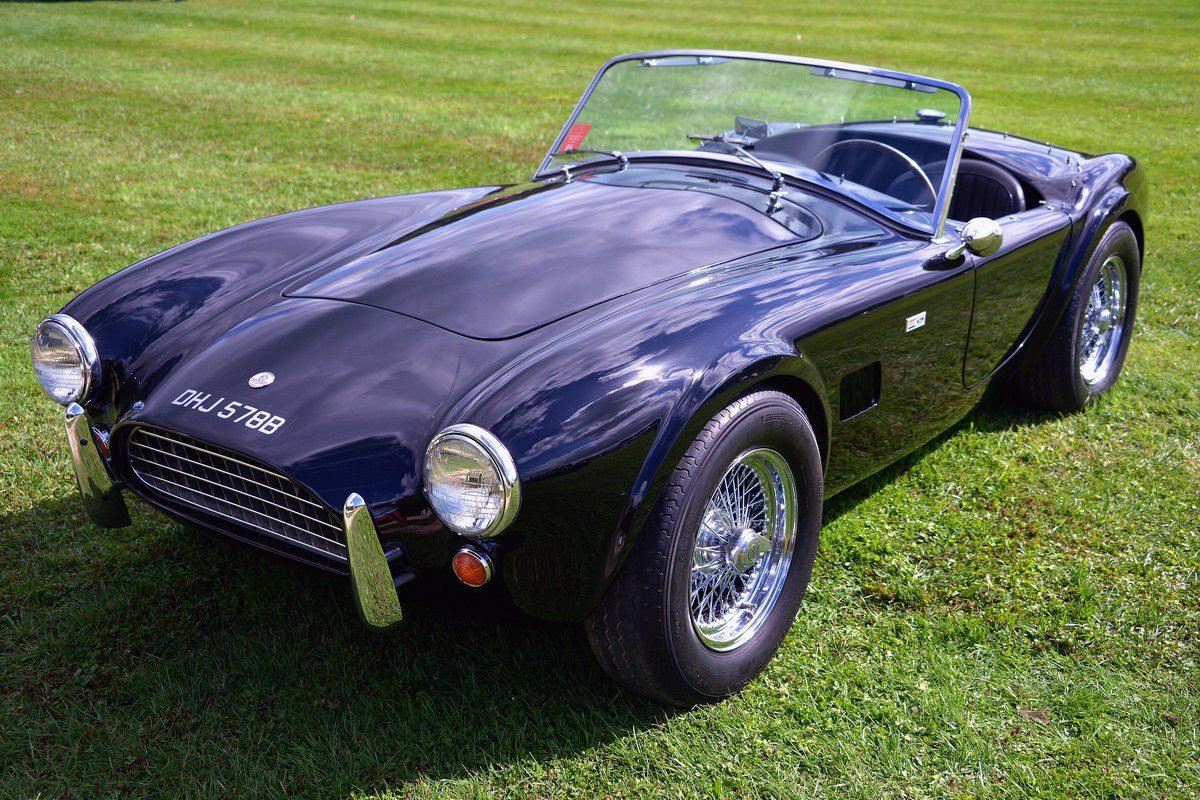
Every original Cobra that Carroll Shelby sold in America arrived from England without an engine. The frame was welded, the aluminum body was shaped by hand and the suspension was bolted on in a riverside works in Surrey, and then the car crossed the Atlantic as a rolling chassis waiting for a Ford V8. Ford and Shelby were decisive partners. The car itself came out of Thames Ditton. Six decades later, the question of who owns the Cobra is still being argued in court, and the American side of the story has done most of the talking.
The Company That Built Everything
AC began life as Auto Carriers, a London firm that moved into a works by the Thames at Thames Ditton in 1911. By the 1950s it was an odd little outfit. It built sports cars in tiny numbers and, at the same time, held government contracts for single-seat motorized carriages for disabled drivers, with fiberglass bodies and small Villiers two-stroke engines. The AC owners’ club puts that output at around 80,000 units, a figure not confirmed by any other source, and the company liked to say it built both the fastest and the slowest cars in Britain.
It also built trains. In 1949 AC supplied the cars for the Southend Pier Railway, and in 1958 it delivered five lightweight railbuses to British Railways: 36-foot vehicles with a 150 hp AEC diesel and 46 seats, meant to keep money-losing rural branch lines alive. They were built in the same works that would later turn out the Cobra, and getting them out was a real problem. The factory had no rail connection and its doors were too small for a finished vehicle, so each railbus left by road in two parts, underframe in one load and body in another, and the two were joined somewhere else. The five ended up costing £70,113, more than £20,000 over budget. They lasted about a decade, until the lines they served were closed.
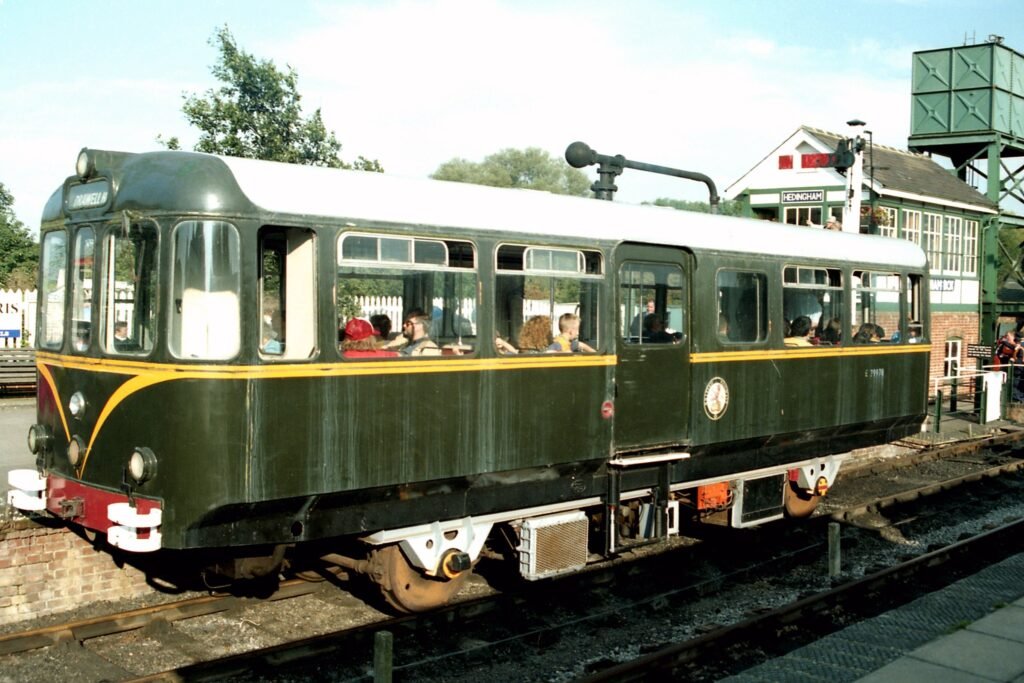
A company that can build trains in pieces and ship them out through the wrong doors is a company used to solving problems with very little money. What AC lacked in the early 1950s was a modern sports car.
John Tojeiro’s Frame
In 1953 a British constructor named John Tojeiro was building small runs of competition sports cars. One of them was ordered by racer and car dealer Cliff Davis, who ran it with a Bristol six. The car had a ladder frame made of two long, parallel steel tubes joined by crossmembers, and independent suspension at all four corners.
That last point mattered. Most British sports cars of the day still used a live rear axle, a solid beam that ties both rear wheels together, so a bump under one wheel unsettles the other. With independent suspension, each wheel moves on its own and the car keeps its grip on broken pavement.
AC needed something new for the Earls Court Motor Show in October 1953. Tojeiro brought one of his cars to Thames Ditton, AC bought the rights, fitted its own engine and steering, and showed it as the AC Ace next to a bare chassis. The prototype, registered TPL 792, still exists.

The engine AC used was already a museum piece. It was a 2.0-liter inline six designed by John Weller and in production since 1919. The Motor clocked an Ace at 103 mph in 1954, well clear of the 80 an MG TD could manage and just short of the 106 of a 1953 Austin-Healey 100, and the old six had nothing left to give. In 1956 AC added the Bristol six as an option, an engine derived from the one BMW used in its prewar 328, and the racing results followed. An Ace Bristol finished tenth overall at Le Mans in 1957, and the following year two more finished eighth and ninth.
The American results are the part Shelby fans tend to skip. Ace Bristols won three straight SCCA E-Production championships from 1957 to 1959, then two D-Production titles in 1960 and 1961. The Ace was already a winner on American tracks before Shelby showed up.
Bristol Pulls the Plug
In 1961 Bristol stopped building its six for its own cars and only agreed to keep making the 2.0-liter version for AC until 1963. AC turned to Ken Rudd, whose Ruddspeed business tuned the 2.6-liter six from the British Ford Zephyr, and the Ace 2.6 was born. Thirty-seven were built. There was no time for more.
In September 1961 AC heard from Carroll Shelby, a Texan who had won Le Mans in 1959 in an Aston Martin DBR1 with Roy Salvadori and who had stopped racing because of a heart condition. Shelby wanted a light European roadster with an American V8 to take on the Chevrolet Corvette in US racing. He had already tried other routes. Chevrolet wouldn’t sell him engines, and BMC showed no interest in selling Austin-Healey chassis. AC’s owner, Charles Hurlock, said yes.
The engine came from Ford, through Dave Evans, who ran the company’s stock car program. Ford had just developed a small thin-wall V8 of 221 cubic inches for the Fairlane. Thin-wall meant the block was cast with thinner walls than the cast-iron V8s of the day, so it weighed little more than the Bristol six it was replacing. That made the whole idea possible. A traditional iron V8 would have loaded the Ace’s nose so heavily that the car would have been undriveable.
CSX2000
In January 1962 AC’s mechanics fitted one of those 221s to a modified Ace at Thames Ditton and tested it. It worked. They pulled the engine and gearbox, and the car was flown to Los Angeles in early February. Shelby and hot rod builder Dean Moon picked it up at the airport, took it to Moon’s shop in Santa Fe Springs and installed one of the first 260-cubic-inch Ford V8s, which had just become available, along with a four-speed gearbox. The job took about eight hours. Ford signed a letter of agreement to supply engines and gearboxes on February 5, 1962.
That car became chassis CSX2000, the first Cobra. It made its public debut at the New York Auto Show in April 1962, painted pearlescent yellow because Shelby was told that color looked best under fluorescent lights. The name, Shelby always said, came to him in a dream.

Shelby kept CSX2000 until his death in 2012. In August 2016 his trust sold it at RM Sotheby’s in Monterey for $13.75 million, at the time a record for an American car at auction. American, the catalog said. It had been built in Surrey.
How the Work Was Split
The division of labor held for the whole production run. AC built the complete car, including its aluminum body, minus engine and gearbox, and shipped it to the United States. Shelby American installed the drivetrain, fixed any body damage from the sea crossing and sold the car. For Europe, AC finished cars in Thames Ditton and sold them as AC Cobras, with an AC badge on the tail and no Powered by Ford emblems.
The first 75 cars got the 260. Then came the 289, the 4.7-liter small-block Cobra most people picture: about 271 hp in a car that weighed around 2,315 lb. Next to everything else on the road, that was outrageous. A 1961 Jaguar E-Type 3.8 roadster weighed about 2,770 lb with roughly 265 hp. A 1963 Corvette Sting Ray, the car Shelby was obsessed with beating, came in around 3,050 lb. The Cobra had a Jaguar’s power and weighed like a 1950s car, because underneath it was one. And that was the street engine. The competition 289s swapped the stock carburetor for four twin-choke Weber 48 IDAs, each breathing through its own intake trumpets, and went past 350 hp.
Alan Turner’s Steering Rack
The first Cobras kept the Ace’s steering and its transverse leaf spring suspension, which needs some explaining because it defined how these cars drove. A leaf spring is a stack of curved steel strips, the kind you’d find under an old truck. On the Ace, instead of a coil spring at each wheel, a single leaf spring ran across the car from side to side, with each end attached to a wheel. That spring did two jobs at once. It absorbed bumps, and it also served as the upper arm that holds the wheel in place. It was cheap and light, but adjusting the angle of the wheels meant swapping springs, and with a V8 up front it was being pushed to its limit.
In late 1962, AC’s chief engineer, Alan Turner, redesigned the front end to take rack-and-pinion steering while keeping the leaf springs. A steering rack is a toothed bar that slides left or right when a small gear on the end of the steering column turns with the wheel. It gives more direct, more precise steering than the worm-type steering boxes many cars used then. The first production Cobra with rack-and-pinion, CSX2127, was finished in March 1963, and from then on every car was a Mark II. By March 1965, 655 leaf-spring Cobras had been built.
185 MPH on the M1
Shelby usually gets credit for the Cobra’s entire racing career, but AC ran its own program. At Le Mans in 1963, the factory Cobra driven by Ninian Sanderson and Peter Bolton finished seventh overall and won its class.
For 1964, while Shelby had Peter Brock designing the Daytona Coupe, Alan Turner drew AC’s own racing coupe at Thames Ditton, the A98. It sat lower than the Daytona, and Shelby didn’t know it existed until it appeared at the Le Mans test days in April. Both coupes existed for the same reason: a closed roof and a chopped tail slash the roadster’s aerodynamic drag, and on a straight that long, less drag was worth more than another fistful of horsepower. AC had registered it as BPH 4B so it could be tested on public roads.
The problem was where. No British circuit had anything like the Mulsanne Straight, close to four miles long. So in the early hours of June 11, 1964, a little after 4 a.m., Jack Sears took the A98 out of the Blue Boar services onto the M1 motorway and ran it up to 185 mph. Britain had no motorway speed limit at the time, so the run was legal. The story made the front pages of the national papers, and the press and the driving public came to link it with the 70 mph limit. Sears and Bolton carried that reputation for decades, but the M1 run was not the cause. The 70 mph limit came in as a four-month trial at noon on December 22, 1965, ordered by Transport Minister Tom Fraser on road safety grounds, and Barbara Castle made it permanent in 1967.
At Le Mans, the A98 was timed at 180.2 mph, matching Shelby’s Daytonas. Its race ended after dark on Saturday. With Bolton driving, a rear tire blew at Maison Blanche, the car spun and Giancarlo Baghetti’s Ferrari 275 P collected it. The Ferrari left the track and killed three young spectators standing in a prohibited area. The A98 flew over the guardrail. It sat under a tarp until it was restored in 1972, and it remains the only Cobra racing coupe built start to finish by AC.
The 427
The 289 had a ceiling. To keep winning, Shelby wanted Ford’s big V8, the 7.0-liter 427 used in NASCAR, a naturally aspirated big-block that made its power the old way, with displacement. A chassis made of three-inch tubes and leaf springs couldn’t handle it. The first 427 test car, CSX2196, produced disastrous results.
So the Mark III was born, designed by Ford in Detroit together with AC. The main frame tubes grew to four inches. A thicker tube resists torsion far better, that is, the frame’s tendency to twist like a wrung-out towel when one front wheel and the opposite rear wheel load up together in a corner. The leaf springs were gone, replaced by coil springs at each wheel. The body grew the flared fenders everyone now associates with the Cobra. Mark III production began on January 1, 1965, and AC was still shipping the cars as unpainted rolling chassis.

The 427 was built with one goal: homologation for the FIA GT championship. Homologation means proving to the sanctioning body that you’ve built a minimum number of production cars, so nobody can race a prototype in disguise. The number was 100. On April 29, 1965, when FIA inspectors visited Shelby, they found 51 finished cars, according to RM Sotheby’s (other sources say 56, and neither number is anywhere near 100), and refused homologation. Shelby canceled the remaining competition cars, and AC switched to building street versions.
And here is what defined the street 427: not all of them had a 427. A Shelby American press release from August 1966 describes the street car’s engine as a 428 Police Interceptor, the V8 Ford used in its police cars, with Shelby modifications. The 428 was cheaper and milder, with 340 to 360 hp against the 427’s 390 to 425. The car was still called the 427.
A Cobra in Barcelona
One of those competition 427s raced in Spain, driven by Paco Godia, the Barcelona driver who was the first Spaniard to race in Formula 1, with Maserati between 1951 and 1958.
Godia debuted it at the 13th RACE Rally of Spain, April 1 to 4, 1965, wearing number 47. He didn’t finish. A blown tire, a string of small failures and a broken suspension patched up on the spot ended with his retirement on the second lap of the speed test at the Montjuïc street circuit. A month later he was back on the same circuit for the third Trofeo Juan Jover on May 9, 1965, and won it: 20 laps in 40 minutes 23 seconds, ahead of Juan Fernández’s Porsche 904 GTS.
AC on Its Own
While Shelby moved on to Ford’s GT40 program, AC built two cars of its own on Cobra underpinnings. The AC 428 Frua, introduced in 1965, used the Mark III chassis stretched six inches under a body by Pietro Frua of Turin, as a coupe and a convertible. And the AC 289 Sports was the last Cobra-based car to leave Thames Ditton: the wide 427 body, the 289 engine and no Cobra name anywhere on it. Twenty-seven were made, 17 of them right-hand drive. The last one, COB6124, left the factory for a dealer in Godalming on March 29, 1968. Roughly a thousand Cobras had been built between 1962 and 1967.

Autokraft and the Original Tooling
The story could have ended there. It didn’t. In 1982 a British Cobra restorer named Brian Angliss bought AC’s original body jigs, tooling and drawings from Thames Ditton, and hired some of the people who had used them. A jig is the template the aluminum panels are formed on and the chassis tubes are positioned in, so every car comes out the same. With that, his company Autokraft began building the Mark IV at Brooklands, and that same year AC licensed him its name.
In 1986 the Hurlock family sold AC after 56 years in charge. The company ended up with Autokraft and Ford, which came in as a partner in 1987, and in 1992 Angliss bought out Ford’s share. Ford had already licensed him the Cobra name in 1986. The Mark IV used a fuel-injected 5.0-liter Ford V8 and was sold in the United States wearing only the AC badge.
Shelby was furious. His line was that nobody wanted a Cobra built by Brian Angliss, and that if anybody was going to build the Cobra again, it should be him.
1965 Cobras Built in the 1990s
So he did. In the early 1990s, with original 427 prices through the roof, Shelby announced he would complete 1965 Cobra 427s from original chassis that, by his account, he’d kept in storage since then and whose titles had been lost. He asked the California DMV for 43 duplicate titles for chassis numbers from the 1965 series.
In April 1993, an investigation by reporter Paul Dean in the Los Angeles Times showed those frames weren’t from 1965. McCluskey Ltd., an engineering shop in Torrance, California, had built them in 1991 and 1992, copying the AC frame. Shelby eventually admitted they were reproductions, denied misleading anyone, blamed a campaign by Angliss and argued it was perfectly legal to build a new car today, register it and sell it as a ’65.
The fight between Angliss and Shelby played out in public. In June 1993 Angliss argued that every Cobra had been built by AC in Britain, logged in AC’s records and shipped to Shelby without engine or gearbox. Shelby answered that AC was a subcontractor, that some cars had been built in Italy and the US, and that the 427 development work was his. A settlement in December 1993, as reported at the time, favored Angliss, but the feud went on. AC went into receivership in 1996, and Shelby used the moment to claim he had proved in court that his company, not AC, built the Cobra.
Then came the strangest turn. Alan Lubinsky bought what was left of AC at the end of 1996, and on December 4, 2003, AC and Shelby, sworn enemies for a decade, announced they would build “authentic” Cobras together, the CSX1000 and CSX7500 series. By 2007 they had finished 14 and 2. And in 2014, two years after Shelby’s death, his trust decided to complete the 1965 competition chassis numbers that were never built. It called them Sanction II: new cars with half-century-old chassis numbers, sold for track use only to sidestep the safety and emissions rules for new vehicles.
The Shape Nobody Owns
In the United States, Shelby never managed to own the car’s shape. In 2002 a federal court in Massachusetts threw out his trade dress claims against Superformance over the Cobra’s silhouette. Trade dress is the legal protection for a product’s look when buyers identify that look with a single maker. The court held that even if Shelby was the original designer, he hadn’t shown the public associated that shape with him alone. Superformance, incidentally, said it built its replicas with AC’s permission. Shelby’s earlier suit against Factory Five ended in a settlement that kept the Massachusetts kit builder from using the names Cobra, 427 S/C and Shelby, but its roadster stayed in production. And in 2010 the US Trademark Trial and Appeal Board refused to let him register the car’s shape as a trademark after Factory Five opposed it.
In Britain, Ford has held the word COBRA as a trademark for vehicles since 1966, with a second registration from 2001. That came up in 2023 at London’s Intellectual Property Enterprise Court, in a case that sums up the whole mess. Since 2016 AC has built cars in Britain under the AC Cobra name, and its parent company, Acedes Holdings, owns the UK trademark AC COBRA. In 2022 it sued Clive Sutton, a London dealer importing American replicas under the Shelby Cobra name, which said it did so under license from Ford and Carroll Shelby Licensing. Shortly before trial, Acedes dropped the claim.
The dealer counterclaimed to have the AC COBRA mark declared invalid or revoked for non-use, arguing that Ford’s marks came first. Judge Richard Hacon dismissed both requests, for two reasons. First, when Sutton filed, it was not a licensee of Ford’s UK marks. The 1997 license it relied on covered only Ford’s US federal marks, and only an owner or licensee of an earlier mark can ask to invalidate a later one on that basis. Second, Ford had known about AC’s use of the name and let it stand, which trademark law calls acquiescence. The ruling does not say AC owns the word Cobra outright. It only decides that the AC COBRA registration survives those challenges, and it even notes that, on the dealer’s own evidence, “Cobra” works in the market as a generic description of a type of car. In parallel proceedings, the registered designs covering the Cobra’s shape were revoked.
The result is that in Britain today Ford still has its COBRA marks, AC keeps its AC COBRA registration and replicas carrying Shelby’s name are still on sale, and none of them can claim the shape of the car.
The Chassis Has the Last Word
Shelby was a brilliant salesman with a nose for putting other people’s parts together. He saw a winner in the Ace and talked Ford into giving him engines when nobody was backing him. That deserves enormous credit. But the Cobra was designed by Tojeiro, adapted by Alan Turner, built by the hands in Thames Ditton and powered by a Ford V8. Shelby brought the idea, the name and the phone calls.
He spent the rest of his life trying to make the world forget the first two letters of the car, and along the way he sold frames welded in 1991 as 1965 cars. There’s no defending that. The original Cobra deserves its full name, and that name starts with AC.
Keep reading: Renault Caravelle: Renamed to Not Insult 49 States
Check you’re still alive.
Photos: Eric Manesse (CC BY-SA 4.0), kitmasterbloke (CC BY 2.0), Mr.choppers (CC BY-SA 4.0), Sicnag (CC BY 2.0), TaurusEmerald (CC BY-SA 4.0), Mr.choppers (CC BY-SA 3.0).