
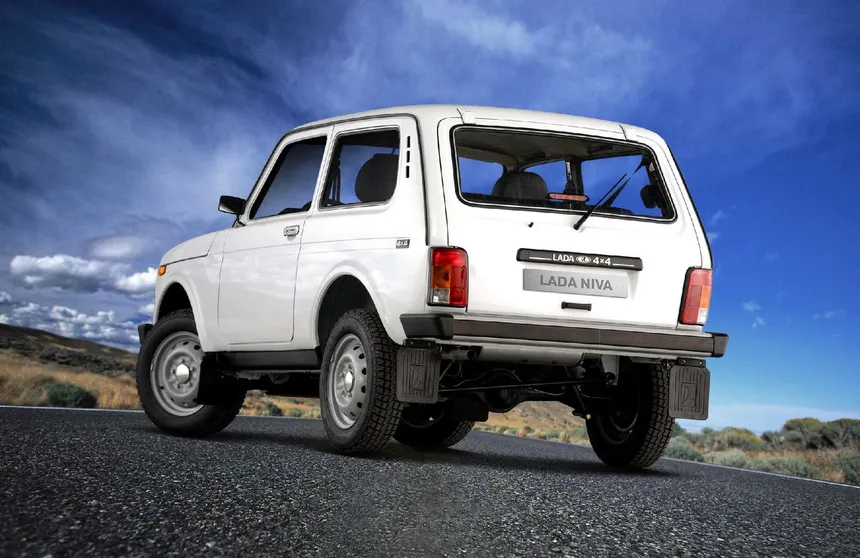
The Soviet 4×4 That Embarrassed Land Rover, Mercedes, and Toyota — In 1977
Chris Harris once said that the best cars are the ones engineered by people who have to use them. Not engineered for marketing. Not engineered to win awards. Engineered because the engineer knows that if it breaks, he’s the one walking back through the snow.
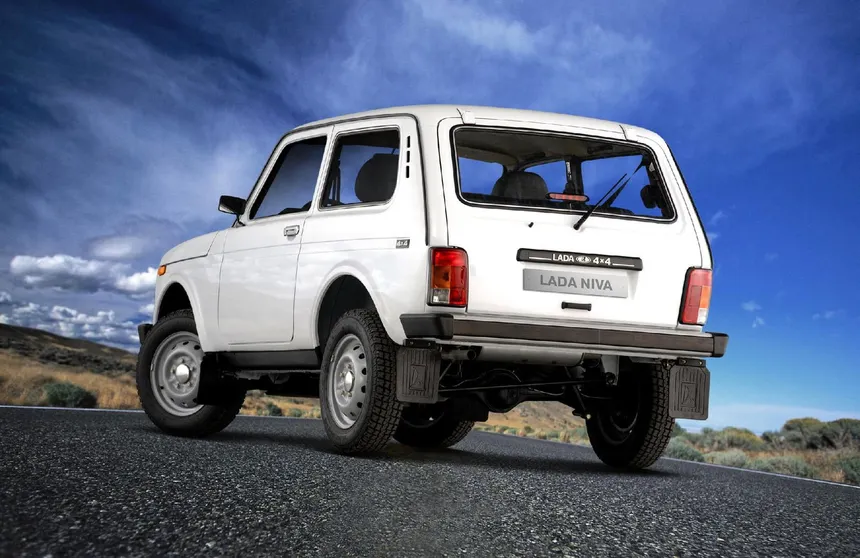
That’s the Lada Niva.
The British press laughed at it when it landed at the 1980 Motor Show. They called it “agricultural.” They wrote about its primitive interior. They focused on the cheap plastics and the Soviet badge. And they completely missed what they were looking at.
Because the Lada Niva of 1977 was the most technically advanced production off-roader in the world. More advanced than the Land Rover Series III, which still had a ladder chassis and live axles front and rear. More advanced than the Toyota Land Cruiser FJ40, which was essentially a wartime jeep stretched and refined. More advanced than anything Mercedes had on the road — the G-Wagen wouldn’t even appear until 1979.
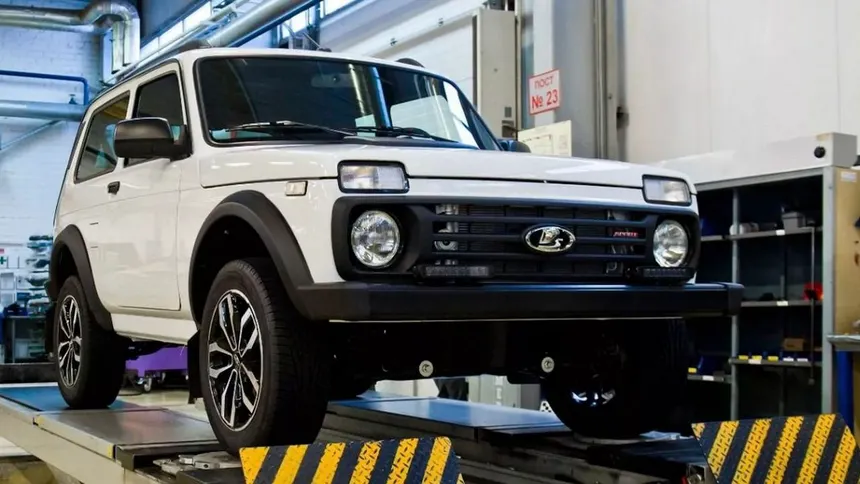
And here’s the part Top Gear never told you: the Niva is the longest-running off-road vehicle still in continuous production. Land Rover killed the original Defender in 2016. The Niva has been rolling off the same Togliatti line since April 5th, 1977. Same concept. Same basic mechanical layout. Forty-nine years and counting.
So let me tell you how four engineers, working under Soviet central planning with no access to Western components or trade fairs, built something that took the rest of the world fifteen years to catch up to.
The names you’ve never heard
Vladimir Solovyev. Pyotr Prusov. Valery Semushkin. Vadim Kotlyarov.
Those four names don’t appear in any English-language automotive history book worth mentioning. They should. Solovyev was the original chief engineer who set the philosophy. Prusov took over when Solovyev died in 1975 and got the credit for the rest of his life. Semushkin designed the body. Kotlyarov ran the testing program — the one that took prototypes into the Pamir Mountains at 4,000 meters to see what they could survive.
The name Niva is a folk myth that AvtoVAZ still maintains. The official story is that it means “cornfield” in Russian. The real story is that it’s an acronym: Natalia, Irina, Vadim, Andrei. The first letters of the four children belonging to Solovyev and Prusov. They named the car after their kids. That’s not in the AvtoVAZ corporate brochure.

The brief that nobody else would have given
The whole thing started in 1970 with Alexei Kosygin, the Soviet Prime Minister. Kosygin looked at the map of the USSR and saw a problem. Millions of square kilometers without paved roads. Collective farms — kolkhozes — that needed something between a Moskvitch saloon and a UAZ military jeep. Something tough enough for the conditions but civilized enough that you didn’t break your back driving it.
He gave the brief to two factories. VAZ in Togliatti and AZLK in Moscow. They had to compete. Whichever produced the better prototype would get the production contract.
VAZ assigned Solovyev. He started building prototypes in 1971. The first one — the E-2121 — was a canvas-topped jeep with a small engine. Too crude. Rejected. The second — the 2E-2121 in 1973 — already looked like a modern hatchback. The roof was steel. The doors were proper doors. The shape borrowed from the VAZ-1101 prototype, which had been derived from the Fiat 127. That’s why the Niva’s bonnet has that “clamshell” curve. Pure Italian influence, filtered through Soviet engineering.
The team tried four different engines across four years of prototypes. The 1.452 cc from the VAZ-2103. The Moskvich UZAM-412 at 1.478 cc, which they abandoned because it couldn’t handle the off-road stress. Finally, in 1975, the VAZ-2106 appeared with a 1.568 cc engine producing 75 hp. The most powerful engine VAZ had ever built up to that point. It went into the Niva.
The AZLK competitor — the Moskvitch 416 — lost. Production was approved in March 1976. Series production started on April 5th, 1977. And the British press wouldn’t see it for another three years.
Four things that didn’t exist together before
Here’s the technical claim. The 1977 Niva was the first production off-road vehicle in the world to combine four things simultaneously: monocoque construction, full-time permanent four-wheel drive with a lockable centre differential, independent front suspension with coil springs, and front disc brakes.
Each of those things existed separately by 1977. The combination didn’t exist on any other production vehicle.
Let me put it in context.
The Land Rover Series III, the contemporary benchmark in Britain, had a ladder-frame chassis, live axles at both ends, and selectable four-wheel drive. You had to climb out and lock the hubs manually when you wanted four-wheel drive. That’s 1948 engineering still being sold in 1977.
The Toyota Land Cruiser FJ40 had been in production since 1960. Same approach: ladder chassis, live axles, big lazy engine. Reliable, yes. Sophisticated, no.
The Range Rover, launched in 1970, was the only contemporary that had independent front suspension with coil springs and an off-road bias. But the Range Rover cost more than three times what a Niva cost. And it still had selectable four-wheel drive, not permanent.
The Niva had all of it. Monocoque body. Permanent 4WD. Independent front. Coil springs at all four corners. For the price of a Ford Cortina.
Stop on the front discs for a moment. In 1977, no affordable off-road vehicle ran disc brakes anywhere. The Land Rover Series III used drums all round. The FJ40 used drums all round. Discs on a budget 4×4 was Martian technology. The Niva had them from day one.
Why the rear axle matters
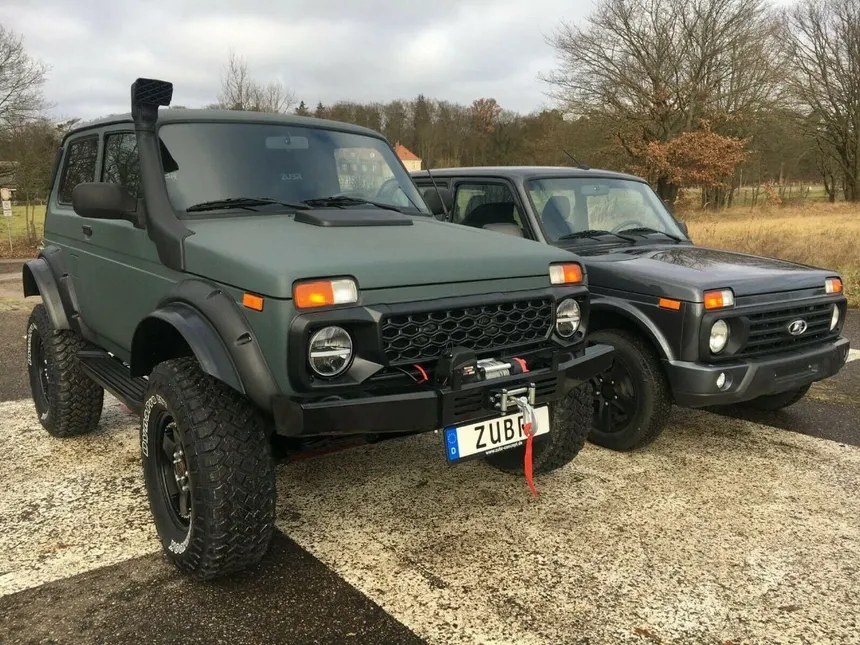
Let’s get one thing straight because every careless article about the Niva gets it wrong. The rear suspension is NOT independent. The Niva has independent front suspension with control arms and coil springs, but the rear is a five-link live axle. Live axle means solid beam connecting both wheels. Same setup the Defender used. Same setup the Wrangler still uses.
This is deliberate engineering, not a cost-saving. A live rear axle gives you articulation that an independent setup can’t match. When you’re crossing diagonals — left front wheel up, right rear wheel up — a live axle keeps the opposite wheels in firm contact with the ground because they’re physically connected. An independent rear lifts wheels into the air and you spin them uselessly.
What Solovyev and Prusov did was take the best of both worlds. Independent front for road manners and steering precision. Live rear for off-road capability. Coil springs everywhere for ride comfort that traditional leaf-spring 4x4s couldn’t match.
The result is a car that handles a 58% gradient — that’s steeper than most ski slopes — and still cruises at 130 km/h on the motorway without your fillings rattling out. In 1977 that combination didn’t exist anywhere else.
The Pamir test
VAZ didn’t trust their own engineers. Before approving production, they sent the prototypes into the worst terrain the Soviet Union could provide.
The Ural Mountains in winter. The deserts of Kazakhstan in summer. The Pamir Mountains in Tajikistan, where altitudes exceed 4,000 meters and oxygen-starved engines lose 40% of their power.
They tested against the UAZ-469 military jeep. They tested against a Land Rover Series III. They tested against a first-generation Range Rover — which the Soviet Union had quietly purchased from the UK specifically to study and beat.
The Niva crossed 60 cm of water without preparation. It pushed through 100 cm of mud and snow. It outperformed the Land Rover in some conditions and matched the Range Rover in others — while costing a fraction of either.
Six years of testing. That’s longer than most modern automakers spend on a complete new model from scratch. The Niva went into production already battle-hardened.
Then it went to the Dakar
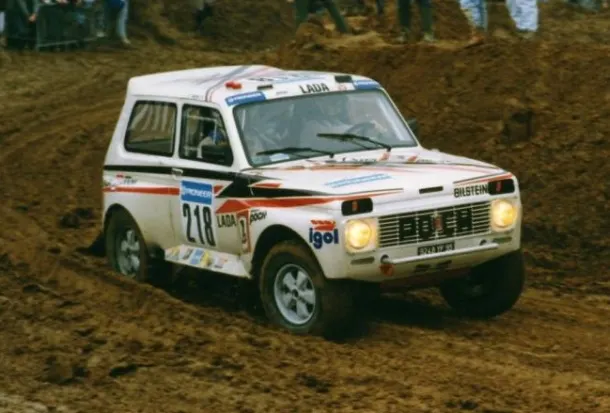
In late December 1978, the very first Paris-Dakar Rally departed. Among the entries: five Lada Nivas, all driven by French privateers who had bought the cars cheap and wanted to see if they’d survive. The organisers barely noticed them. Two of the five finished — already an unexpected result for a Soviet farm vehicle.
One of those finishers went back to France and contacted Jean-Jacques Poch, the official Lada importer. Poch saw the opportunity. By 1980 he had entered an official Lada Niva — Jean-Claude Briavoine driving, race number 128. It didn’t finish. But three private Nivas did.
In 1981, Poch came back with serious preparation. Engines bored out to 1.8 litres by Starkit, delivering 140 hp — nearly double the standard output. Briavoine led the overall classification for most of the race. He lost it to a punctured radiator in the closing stages. Final result: third overall.
Third overall in the Paris-Dakar. With a Soviet farm vehicle. Against works-prepared Range Rovers and Mercedes G-Wagens.
1982: second overall. Briavoine again, with André Deliaire. 1983: second overall. Same team. The Niva never won the Dakar outright — but it dominated the Rallye des Pharaons in Egypt, taking a complete podium sweep in 1983, and won the Paris-Tunis and Algeria rallies repeatedly.
By 1986, the “Niva” running at the Dakar wasn’t really a Niva anymore. The Pastis team had built a prototype with a ROC turbocharged 2.4-litre engine producing close to 300 hp, fibreglass bodywork, and a tubular space-frame. Only the silhouette remained. But the project was born from the Niva. The base concept came from those four engineers in Togliatti.
The market the Soviets didn’t see coming
While the Dakar campaign played out, something unexpected happened in Western Europe. France went mad for the Niva.
Skiers bought them to drive up to Alpine resorts. Farmers in the Massif Central bought them. Hunters bought them. Mountain villagers in regions where snow lasted four months a year bought them. The Niva became the affordable 4×4 of choice for people who couldn’t justify a Range Rover.
At peak, the Lada Niva captured 40% of the European market for 4×4 vehicles. AvtoVAZ exported more than 530,000 units. Up to 70% of total Niva production went abroad.
It went to Japan with right-hand drive — making it the only Soviet car ever to crack the Japanese domestic market. It went to the UK as the “Lada Niva 4×4.” It went to Australia, Canada, South America. The Soviet Antarctic Expedition used Nivas at Bellingshausen Station because they started in conditions that defeated Western diesels.
Andy Thompson, the British researcher of Soviet automotive industry, considers the Niva the direct conceptual ancestor of the compact crossover class — explicitly citing the original Suzuki Vitara of 1988 as a vehicle whose creators were guided by the Niva concept. If Thompson is right, the best-selling vehicle segment on the planet today — the small crossover SUV that fills every supermarket car park from Birmingham to Brisbane — traces its lineage back to four Soviet engineers whose names never appear in Western automotive history books. Monocoque body, permanent four-wheel drive, compact dimensions, road manners that don’t punish you for daily use. That’s the Niva formula. That’s also the RAV4 formula, the CR-V formula, the Qashqai formula. You can argue the family tree branches multiple ways. You can’t argue that Niva wasn’t the first to put all of it together.
And it’s still being built
This is the part that hurts Western engineering pride. The Niva entered production on April 5th, 1977 and has never stopped being made. Not during the collapse of the USSR. Not during the rouble crisis. Not during the pandemic. Not during the post-2022 sanctions.
When Land Rover killed the original Defender in 2016, the Niva became the longest-running off-road vehicle still in continuous production anywhere in the world. It’s been called VAZ-2121, Lada Niva, Lada 4×4 (2006-2021), and now Lada Niva Legend. The badges change. The basic mechanical concept that Solovyev and Prusov designed in 1975 has not.
More than 2.5 million units. Without interruption. With the same fundamental architecture.
What it feels like behind the wheel
Let’s come down from the engineering pulpit for a moment. Driving a serious Niva — an original 1980s carburettor model, not the modernised Legend — is not what you’d call a refined experience. Ask anyone who’s actually owned one and they’ll tell you the same thing.
The steering is vague. There’s a dead spot in the centre that runs through about a quarter-turn of the wheel, which means motorway driving becomes an endless series of small corrections. It’s not precision European steering. It’s tractor steering with a recirculating ball box that does its job without showing off.
The gearbox is loud. Straight-cut gears whine like a cement mixer. The synchros are weak, you notice it dropping into second. The shift throw is long and imprecise, with a clunky feel that on any modern car would be flagged as a manufacturing defect. On the Niva, it’s part of the character.
The 1.6 carburetted engine needs working. You have to rev it to get anything out of it. Zero to sixty takes around 23 seconds. That tells you everything. It’s not slow — it’s from another era.
The cabin is noisy. Engine, wind, road roar — it all gets in. At 90 km/h you have to raise your voice to talk to the passenger. At 120 km/h you’re shouting.
And here’s the strange contrast. The suspension is surprisingly soft. The long-travel coils and the geometry designed to absorb broken tracks make the Niva float over tarmac potholes. It rolls like a boat in corners — severe body roll, you feel it in any direction change — but it also isolates you from the road better than you’d expect from such a basic vehicle.
Then you leave the tarmac. You drop the transfer box into low. You lock the centre diff. And the Niva transforms. What was vague on the road becomes precise. What was loud becomes mechanical in the good sense — you hear the diffs working, you hear the tyres searching for grip, you hear the drivetrain doing exactly what it was designed to do.
Driving a Niva on the motorway is penance. Driving a Niva off it is when you understand why the French fell in love with it. It wasn’t built for the asphalt. It was built for everything else.
What the Niva teaches you about engineering
Pull from the workbench. The lesson of the Niva isn’t that the Soviets were geniuses. The lesson is that constraint produces innovation.
When you have access to every supplier in the world, every advanced material, every CAD package and wind tunnel and test track — you tend to design for marketing. You add features because you can. You complicate things because complication is what justifies the markup.
When you have none of that — when you’re working with limited tooling, no Western components, gasoline of variable quality, mechanics in rural villages who’ll repair the car with whatever they find — you design differently. You strip everything to what works. You keep the mechanical layout simple enough that anyone can fix it with hand tools. You build for the worst-case scenario from day one.
That’s why the Niva still runs after 49 years. That’s why French rally privateers chose it for the Dakar in 1979. That’s why farmers bought it instead of Land Rovers. Not because it was the best off-roader money could buy — but because it was the off-roader that kept working when the expensive ones broke.
Solovyev died in 1975 and never saw the car succeed. Prusov died in 2017, three weeks after retiring from AvtoVAZ at age 75. He was still going to work right until the end. The factory he helped build still rolls Nivas out the gate. And nobody outside Russia really remembers his name.
Check you’re still alive.