Chaparral 2C and 2E: the car that drove the air with its left foot
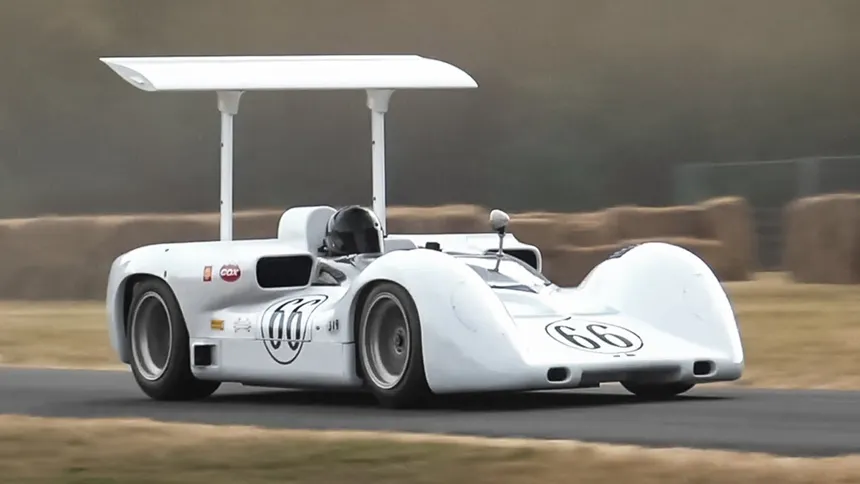
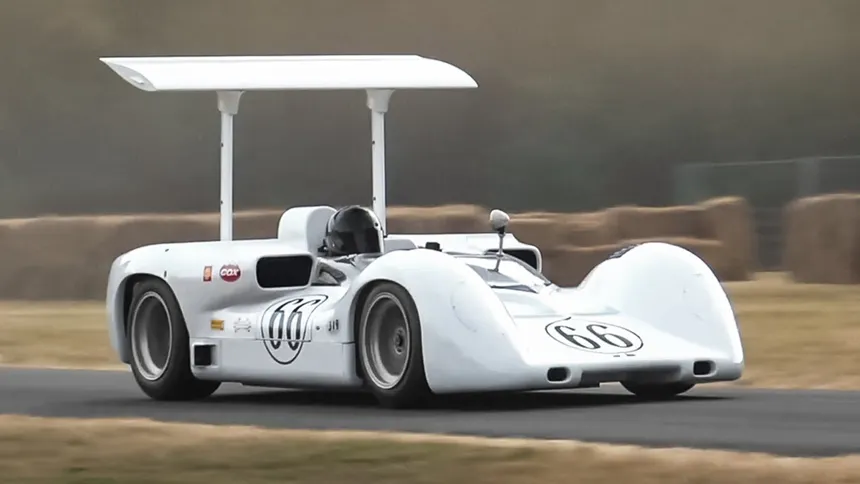
Bridgehampton, Long Island. September 1966. Practice for the second-ever round of the brand-new Can-Am championship. Bruce McLaren walks across the paddock and stops in front of the Chaparral pit. He stares at the white car parked in front of the truck. The car has a wing the size of a small fence mounted a metre and a half above its rear deck on two thin struts. The radiators are not in the nose. The nose has a duct cut into it. There is no clutch pedal in the cockpit but there is a third pedal where the clutch should be.
The legend among the team is that McLaren stood there for a long minute and then said, under his breath, “Bugger me. Hall’s done it to me again.”
If that quote is real, and the people who were there say it is, it captures the entire Can-Am paradigm shift in one sentence. McLaren had spent the off-season building what he thought was the most advanced racing car in the world. Then the Texans rolled in with this. A car that didn’t just have a wing — every serious team had been thinking about wings since Michael May’s banned Porsche in 1956 — but a car where the driver moved the wing with his foot in real time. A car where the rear deck wing wasn’t bolted to the chassis but bolted directly to the rear hubs. A car with side-mounted radiators ten years before Formula 1 figured that out. A car running an aluminium 5.3-litre Chevrolet against rivals already pushing 6 and 7 litres of iron, and beating them on lap time anyway.
This is the story of the two cars that broke the paradigm. The 2C, which set up the trick, and the 2E, which weaponised it. Two cars that together rewrote the rule book of how a racing car interacts with the air.
Before the wing: the 2C and the pedal that nobody understood
You can’t tell the 2E story without telling the 2C story first. Most accounts skip it. Don’t.
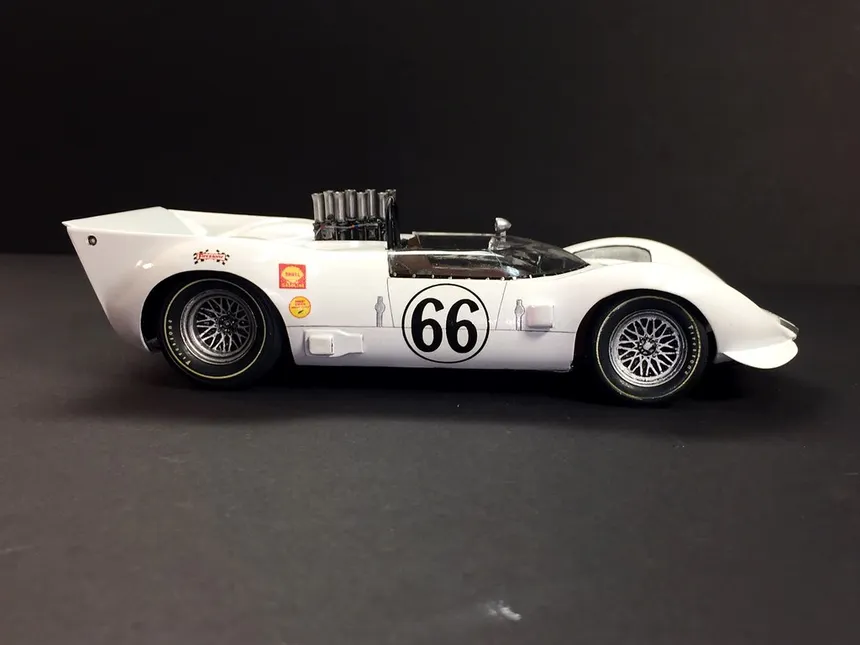
The 2C arrived in 1965 as the next evolution of the original Chaparral 2. The big change was the chassis: out went the fibreglass monocoque, in came an aluminium chassis designed by GM’s R&D department in Warren, Michigan. The vibration through the new aluminium tub was so bad that Hall christened it the EBJ — the “Eye Ball Jiggler”. That name tells you something about the workshop culture in Midland. They didn’t invent marketing nicknames. They named the car after how it felt to drive it. If your eyes shake in their sockets at 6,500 rpm, you call it the eye ball jiggler. End of discussion.
The technical innovation that mattered on the 2C was the movable rear spoiler. Not a wing yet. A flat panel about 30cm tall on the rear deck that could be tilted up to 90 degrees by an extra pedal in the cockpit. The original purpose was as an air brake. Approach a corner, push the extra pedal with your left foot, the spoiler stands up like a wall, and the car decelerates aerodynamically before the mechanical brakes even bite. Hold it up through the corner for added rear downforce. Drop it flat on the straight to minimise drag.
The trick that made all of this possible — and this is the bit that separates the 2C from any other 1960s race car — was the clutchless three-speed semi-automatic gearbox, designed by Chevrolet R&D from a heavily modified torque converter base. As covered in the Jim Hall piece, this transmission wasn’t a Buick automatic dropped into a race car: it was a torque converter completely redesigned to behave as a near-mechanical clutch with lock-up at racing rpm, with a cooling system rebuilt from scratch for endurance use. Months of bench work, not a clever idea. What matters here for the 2C — and what will matter even more for the 2E — is what that gearbox enables: with no clutch pedal needed, the driver’s left foot is free. Hall used that freedom to install the spoiler control pedal where the clutch had been. That single decision, more than the wing itself, is what unlocked Chaparral’s aerodynamic adventure. Free up the left foot, and suddenly you have a third axis of control to play with.
The 2C raced through 1965 with the moveable spoiler doing its work. It won races. It set up the lesson Hall was about to learn for himself. The spoiler was defensive — you used it to brake and to add corner load. The rest of the time it sat flat, doing nothing. Hall spent the off-season turning that idea inside out.
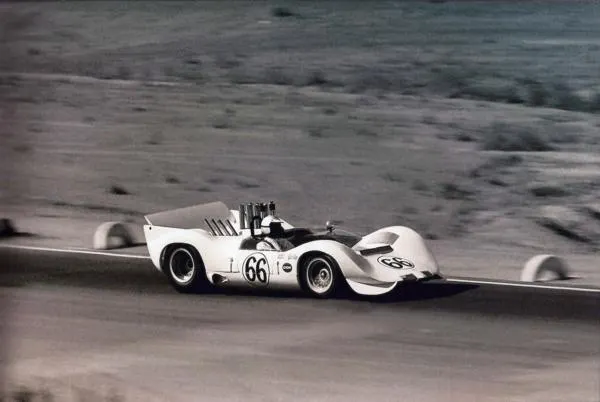
The 2E: invert everything
Here’s the conceptual leap that defines the 2E. What if, instead of a flat spoiler that you raised when you needed it, you ran a permanent, full-blown wing tilted into a downforce position by default, and the driver pedal flattened it for the straights?
That single inversion — load by default, flatten on demand — is the line between racing before 1966 and racing after 1966. With permanent rear loading, the suspension can be tuned for that load. Cornering speeds go through the roof. And on the straight, where a permanently loaded wing should cost you top-end through drag, the driver hits the pedal, the wing flattens, and the drag penalty disappears.
The 2E built that idea into a complete aerodynamic system. Here’s the full breakdown, piece by piece, because the 2E isn’t a car with a wing — the 2E is a car where every panel and every duct was designed to manage airflow as a system.
What you actually see when you climb into one
Before the aerodynamics, sit in the cockpit for a minute. The 2E’s cabin is narrow, the harness is fastened by a mechanic from outside the car. The shifter sits to your right, low, almost beside your thigh. Three positions only: park, neutral, drive. No first, no second, no third. The semi-automatic does it all.
Look down at the floor. Three pedals in an automatic-gearbox racing car. The right pedal is the throttle, you recognise that immediately. The middle one is the brake, fine. The left one is where every racing driver of the 1960s expects to find a clutch pedal. You put your foot on it. It’s stiff. Nothing about its travel feels like a clutch. It’s a rigid pedal with a strong return spring, hinged into a heavy mechanical mount on the bulkhead. Press it. You can hear the clack of cables and a linkage rod working under the transmission tunnel. Release it. The spring slams the pedal back to the up position.
Behind you, running rearward over the transmission tunnel, a bundle of cables and rods snakes through the chassis to the wing struts and from there up to the wing itself, more than a metre above your head. That bundle is what you have under your left foot. When you press the pedal, you are physically moving a wing the size of a small fence at 250km/h, through five metres of intervening linkage. There is no servo assistance. It’s pure human muscle, your left thigh against an aerodynamic component weighing several kilos and loaded with hundreds of kilos of air pressure. That’s why the pedal is heavy. The wing doesn’t move by itself.
Now, with that picture in your head, here’s what the wing was actually doing.
The wing
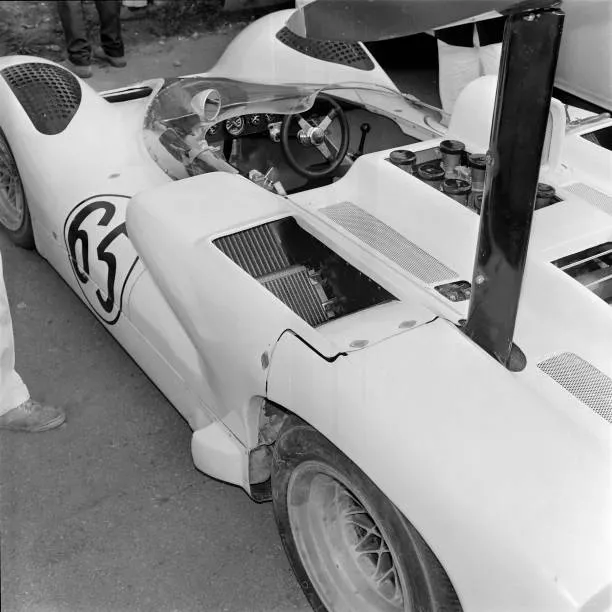
Start with the obvious. The 2E’s wing was nearly a metre and a half wide, mounted on twin struts that put it more than a metre above the bodywork. That height matters. Wings work on clean air. Mount one low and you’re feeding it the dirty turbulent wake from the cockpit, the headrest and the rear bodywork — your numbers are unpredictable and your downforce is a fraction of theoretical. Mount it high enough to clear all that disturbance, and the wing operates almost in wind-tunnel conditions, generating clean predictable load.
Now the workshop detail that almost no Sunday morning telling of the 2E story includes. The 2E’s wing was not bolted to the chassis. It was bolted directly to the rear suspension uprights. Read that twice. The aerodynamic load from the wing fed straight into the rear hubs, not through the springs and dampers, not through the chassis tub.
Why? Because if you bolt the wing to the chassis, the load it generates has to travel through the springs and dampers before it reaches the contact patch. Two problems with that. First, you lose force to chassis flex and to spring compression — your downforce is doing work it doesn’t need to do. Second, your suspension was set up to handle dynamic mechanical load transfer, and now you’re piling variable aerodynamic load on top of it, and your damper map becomes impossible to optimise. Bolting the wing directly to the upright is a driver-engineer’s solution. The wing’s load goes straight to the contact patch with no detour. The springs and dampers carry on doing their old job, untroubled by the new aerodynamic load. And the corner setup doesn’t go haywire every time you enter a fast bend.
That solution, in 1966, hadn’t occurred to anyone else. Half a century later it’s the foundational thinking behind active suspension on modern hypercars. Hall was thinking about the separation of mechanical and aerodynamic load paths in West Texas in 1965 and 1966.
The actuation system
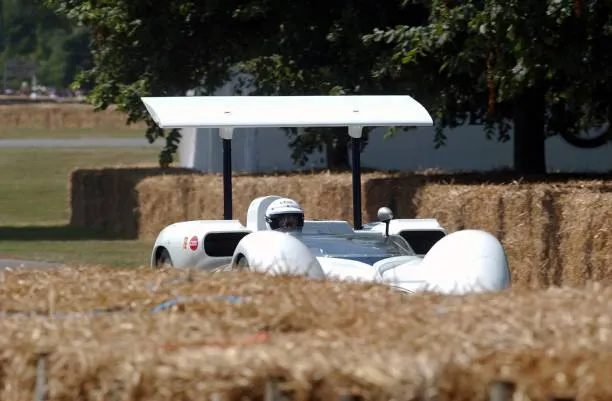
The 2E’s wing moved mechanically. Cables, levers, rods. No hydraulic servo. Press the left pedal, a rod pulls a lever, the lever rotates the wing axle, the wing flattens. Release the pedal, a return spring tilts it back into the downforce position.
Beautiful in theory. In practice, it broke. A lot.
Bridgehampton 1966, the 2E’s debut: trouble with the hydraulic wing-trimming control during practice, and a Watt linkage bolt that walked itself loose and put Phil Hill off the road. Hill took over Hall’s car for the race, gifting away Hall’s pole. Mosport: Hill suffered low oil pressure but inherited a second place after Hall’s engine let go. Stardust 1966 — and this is the 1966 season finale, not to be confused with the 1968 Stardust race that ended Hall’s driving career two years later in a different car altogether, the 2G — both 2Es suffered actuation rod failures. Hall’s wing started flapping, he retired. Hill’s wing failed the same way. The pit crew removed the wing entirely and bolted a spacer bar between the struts to hold them in place, leaving Hill to limp the car home seventh in what he later called “the most diabolical handling car” he had ever driven.
That’s the cost of being twenty years ahead. Things work on paper. In the workshop they fail. And in the workshop you fix them, again and again, until they stop failing. The difference between Hall and a pure theoretician is that Hall expected the failures before they happened. The 2G of 1967 reinforced the entire wing assembly and actuation linkage as a direct field response to what the 2E had taught them.
The nose: the other wing nobody looks at
Now the part most accounts miss. Everyone stares at the rear wing of the 2E. The 2E also had a front aerodynamic system mechanically linked to the rear, and it was nearly as important.
The 2E’s nose carried a venturi tunnel: air entered the nose intake, accelerated through a narrow throat under the front section, and generated low pressure — and therefore downforce — across the front axle. So far, basic fluid dynamics. The clever bit is that the nose duct had a flap at its inlet, mechanically linked to the same left pedal that controlled the rear wing. Press the pedal: rear wing flattens, nose flap closes, both axles unload simultaneously. Release the pedal: rear wing tilts up into downforce, nose flap opens, both axles load simultaneously.
Why? Aerodynamic balance. If you only modulate rear load and leave the front constant, the car becomes nervous when you change phases. Driver hits the pedal in the middle of a long straight, the rear unloads 200kg of downforce, the front stays loaded, and the car suddenly understeers and feels twitchy. By coupling front and rear, Hall kept the balance consistent across both states. High-load corner setting and low-drag straight setting, with no balance shift between them. This is the kind of solution only a driver-engineer comes up with. A pure theoretician designs the rear wing pedal and stops there. A man who has felt aerodynamic balance shift under his own seat at 200mph designs the nose flap to compensate.
The side radiators
The other quiet revolution of the 2E. Until then, every serious race car carried its radiator in the nose. Reason: that’s where the cool air lived. But the consequences were two: first, a nose-mounted radiator cooked the driver’s feet with 250-degree water sitting 20cm from his ankles for a four-hour Can-Am race. Second, it occupied the part of the car you needed clean to channel airflow under or over.
Hall pulled the radiators out of the nose and put them in two ducted pods next to the cockpit. The nose was freed up to host the venturi tunnel we just described. The cockpit stopped being an oven. The radiator and coolant mass became centralised, lowering the polar moment of inertia and improving the car’s reaction to direction changes.
Sixty years later, every Formula 1 and IndyCar carries its radiators in side pontoons. Hall did it on the 2E in 1966.
The 1966 Can-Am season: one win, total impact
The 2E debuted at Bridgehampton on 16 September 1966. Hall qualified on pole, Hill had practice issues, Hall handed his car to Hill for the race — which erased Hall’s pole from the official record because the car ran with another driver. Hill finished fourth after the wing actuation system jammed.
At Mosport Hall set fastest practice lap, broke the engine in the race. Hill came home second on attrition. At Laguna Seca, the 2Es finally fulfilled their promise: Phil Hill won, Jim Hall finished second, a Chaparral one-two. The 2E’s only victory of the season. At Riverside, fuel vapourisation under the desert sun ended both cars. At Stardust the wing actuators broke on both cars, the wings were physically removed in the pit lane, and John Surtees took the inaugural Can-Am title in the Lola T70.
Six races, one win. If you only read the final standings, the 2E was a failure. If you watched the paddock between rounds, the 2E was the moment Can-Am pivoted. McLaren, Lola and everyone else spent the off-season retooling for serious aerodynamics. The era of “stick a Chevy V8 in a Lotus chassis and bolt some bodywork on top” ended in 1966. The era of the racing car as an aerodynamic system began.
Phil Hill said the 2E was his favourite Chaparral until the day he died. Jim Hall says the same thing in interviews to this day. When a Formula 1 World Champion and a constructor with 60 years of career tell you their favourite car is one that won a single race, they are telling you the result is irrelevant. The car taught the entire racing world a lesson, and the lesson was bigger than the trophy.
The Chaparral philosophy in one sentence
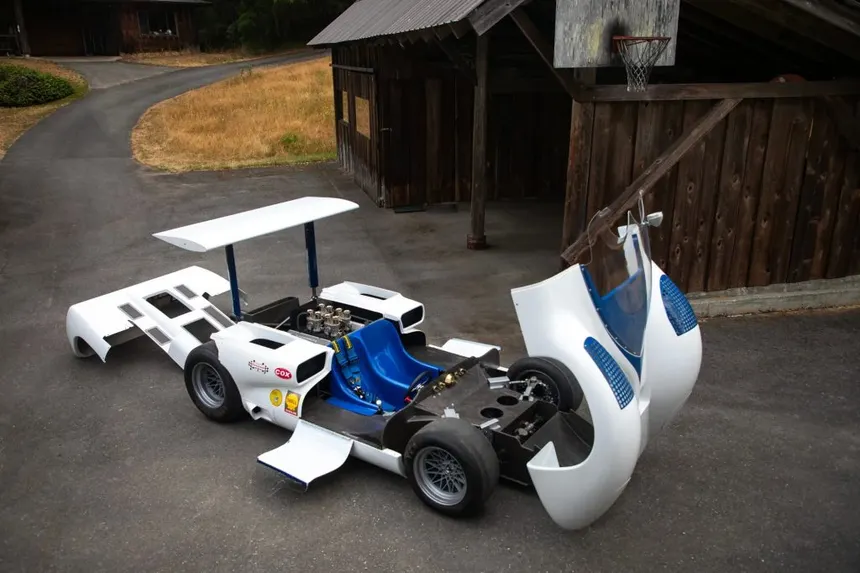
While McLaren, Lola and everyone else stuffed in 6 and 7 litres of cast-iron Chevy big-block to chase 600 horsepower at the cost of an extra 100 kilos, Hall stayed with a 5.3-litre aluminium small-block making 420 to 450 horsepower. Less power, dramatically less weight, and aerodynamics five years ahead of anyone else.
That’s the Chaparral philosophy. And in the context of mid-sixties American motorsport, it was a heresy. Hall was a Texan, in the heart of the no-replacement-for-displacement culture, and he built a car that beat the iron V8s with smaller capacity and a brain. That’s why the rule books eventually came for him: when you apply your brain instead of your wallet, the regulations cannot keep up, and regulators always close down faster than they open up.
By the end of 1969 the SCCA had banned “movable aerodynamic devices” outright. Goodbye 2E wing. Goodbye 2C spoiler pedal. Goodbye to the entire moveable aerodynamics experiment. The FIA had done the same in Formula 1 after the high-wing chaos of 1968 and the catastrophic failures at the 1969 Spanish Grand Prix at Barcelona, when both Lotus 49s broke their wing struts and crashed identically. The whole world banned the same thing at almost the same time.
And here’s the punchline that should make you laugh and then make you angry. Formula 1 has been running DRS since 2011. A driver-controlled rear wing flap that opens to reduce drag on the straight. Same physical principle as the 2E pedal. Driver controls the wing. What was a heresy banned for safety in 1969 became mandatory for entertainment in 2011. The unanswered question: what changed? The physics didn’t. Only the political convenience of the rule book did.
That’s what the 2E left behind. Not just a 1966 season with one trophy and a pile of mechanical failures. An uncomfortable question that has been hanging over the sport for sixty years. When the rules and the physics disagree, which one wins?
Hall already answered that one in Midland in 1966. Physics wins. The rules just slow down what physics has already decided.
Check whether your left foot is good for anything besides a clutch pedal.
2 thoughts on “Chaparral 2C and 2E”