Siegfried Marcus: erased by the Nazis, buried by a fake date
On 23 September 1998 the American Society of Mechanical Engineers held a ceremony with the Austrian Engineers and Architects Association and declared the Siegfried Marcus car a Historic Mechanical Engineering Landmark. The ASME landmark page for the car is still online today, and it still dates the machine to “circa 1875”, adding that historians are working on a more specific date.
They finished that work in Austria in 1968. The car is from 1888 or 1889. Which means the most prestigious engineering society in the United States honored the right man with the wrong year, and it did so during the centenary of his death, after the research that killed the year had been sitting in print for three decades.
That is the story of Siegfried Marcus in one scene. A Jewish engineer in Vienna who did serious, documented work on gasoline engines, got wiped out of German reference books on orders from Goebbels’ ministry, and was then rescued by people who stapled a fake date to his name and made him easy to dismiss all over again. Two separate jobs were done on him. Most of what you will read online covers one and repeats the other.
A tinkerer with the Emperor’s ear
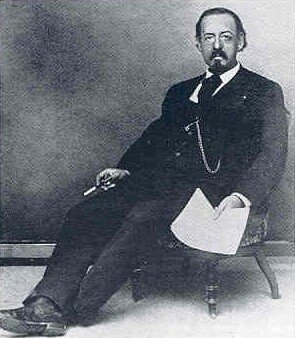
Marcus was born on 18 September in Malchin, in the Grand Duchy of Mecklenburg-Schwerin, on the Baltic side of what is now Germany. The year depends on who you ask. Most German and English references say 1831. The ASME’s landmark brochure says 1833. Nobody has settled it with a birth register that we could find, so it stays open here.
He was working as an apprentice mechanic at twelve. At seventeen he joined Siemens & Halske, the Berlin firm that was stringing telegraph lines across the German states. In 1852 he moved to Vienna, then capital of the Austrian Empire, and took a technician’s job at the Physical Institute of the medical school, where he ended up assisting Carl Ludwig, one of the founding names of modern physiology. In 1860 he opened his own shop for mechanical and electrical equipment, first on Mariahilferstrasse and later on Mondscheingasse, and he never worked for anyone else again.
What came out of that shop is where the numbers get messy. The figure everybody repeats is 131 patents in 16 countries. The ASME brochure itself says about 76 patents in about a dozen countries. Germany’s national biography, the Neue Deutsche Biographie, counts 38 Austrian patents filed between 1857 and 1896, plus German, French and British ones. Take your pick, but every version describes a prolific inventor. Among the confirmed ones: a blasting machine sold as the “Wiener Zünder” (the Vienna igniter), an electric lamp patented in Germany in 1877 and 1878, a telegraph relay, and, in 1883, a low-voltage magneto ignition for gasoline engines.
That magneto matters. A magneto is a small generator driven by the engine itself that produces the spark, so the engine doesn’t depend on a battery that runs flat. In the 1880s, getting a reliable spark into a cylinder full of fuel vapor was one of the hardest problems in the whole business. Marcus also worked with a captain of the Imperial German Navy on electrical firing for ship cannons, so the gunnery officer could fire a broadside from the bridge. By 1886, according to The Times of London, German torpedo boats were running Marcus engines.
He moved in high company. Franz Joseph awarded him the Golden Cross of Merit for his scientific work. Popular accounts add that he wired a bell into Empress Elisabeth’s bedroom and taught physics to Crown Prince Rudolf. Those two details come from secondary sources and we haven’t found them in a primary record, so treat them as color, not as fact.
Four wheels on a handcart
Here is what can actually be documented about Marcus and the automobile.
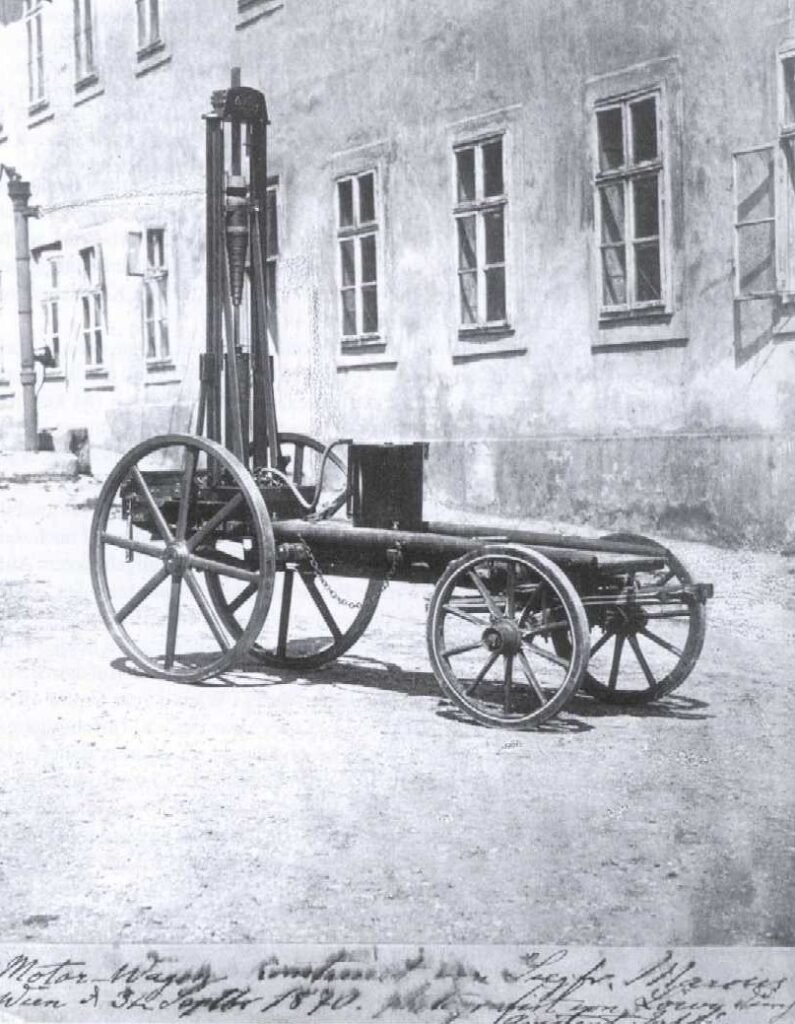
Around 1870 he bolted a gasoline engine to a four-wheeled handcart. There’s a photo of it, with Marcus’ own handwritten notes on the back. It had no steering, no brakes, no seats and no transmission worth the name. To start it, you lifted the drive wheels off the ground and spun them. Marcus didn’t think much of it and took it apart. Still, nobody had moved a vehicle with liquid gasoline before, and on that narrow claim he has a solid case.
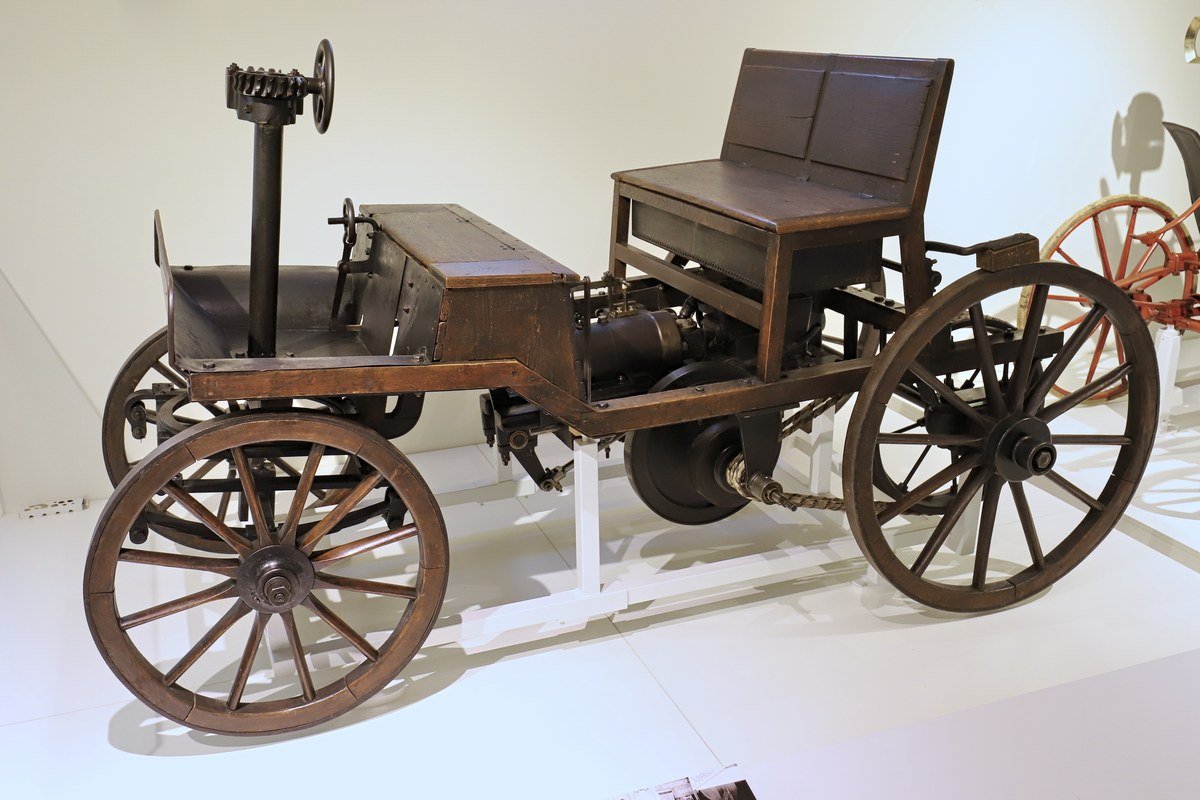
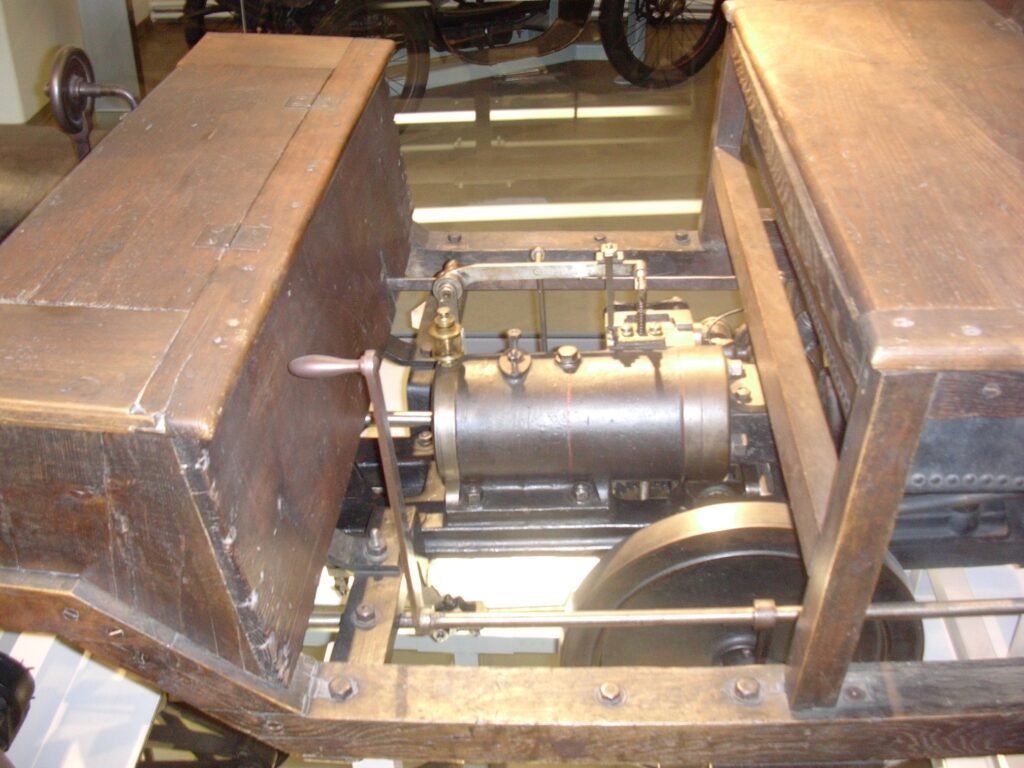
In 1887 he started working with Märky, Bromovsky & Schulz, an engineering firm in Adamsthal, Moravia, today Adamov in the Czech Republic. The firm sold Marcus-type two-stroke engines and, after Nikolaus Otto’s four-stroke patent was knocked down in Germany in 1886, four-strokes too. At that Adamsthal works, between 1888 and 1889, the firm built the vehicle we now call the Second Marcus Car: the engine in 1888, the chassis in 1889 or later. It used his magneto and a rotating brush carburetor, a spinning brush that flicked fuel into the incoming air. It’s the only one that survived. Most experts call it the oldest surviving gasoline car on the planet.
For American scale: Charles and Frank Duryea first drove their gasoline buggy on a street in Springfield, Massachusetts, in September 1893. Henry Ford rolled his Quadricycle out of a shed behind his house on Bagley Avenue in Detroit at around four in the morning on 4 June 1896, a 500-pound contraption with a two-cylinder engine of about 4 horsepower and no brakes. Karl Benz had been driving his three-wheeled Patent-Motorwagen around Mannheim since 1886. So the surviving Marcus car is a few years younger than Benz’s and a few years older than Ford’s. That’s a perfectly respectable place to sit in history. It just isn’t first.
The Vienna Technical Museum has held the Second Marcus Car since 1915 and put it on display in 1918. The museum’s own catalogue entry is titled “Marcus Wagen, 1888/1889”. Restorer Alfred Buberl got it running again in 1950. The original no longer goes on the road for heritage reasons, and an exact replica was built for public outings, with its first run announced in 2005. During that 1950 restoration the igniter was missing. It turned up inside the museum’s own holdings, in the estate of a Viennese patent attorney named Tischler, who had handled Marcus’ patent affairs from 1892. The man had a patent lawyer, and his lawyer’s drawer held the part that makes the car run.
How 1875 got into print
So where does 1875 come from? Not from Marcus.
Marcus died in Vienna on 1 July 1898. That August, the Austrian Automobile Club bought the old car from the Adamsthal firm for a hundred gulden. A board member, Professor Czischek, handled the deal. The firm’s own delivery note says the car could not be driven.
Two years later Austria needed exhibits for the Paris World’s Fair of 1900, and the car went into the Austrian story with a date attached. According to the Austrian regional encyclopedia Austria-Forum, the dating came from Czischek himself: a photo caption first said 1877, and later he spoke only of 1875. The name that went into the literature is Ludwig Czischek-Christen. Later, patent lawyers asked him to back up the 1875 date with evidence. Digging through his own material, he turned up proof that pointed to 1888 instead. An article titled “The End of the Marcus Legend” lays out how the man who launched the date ended up finding the evidence against it. In Austria, Hans Seper published the evidence in 1968, and further work in 1971 closed the matter. Later Ursula Bürbaumer and Horst Hardenberg went through it all again and reached the same conclusion.
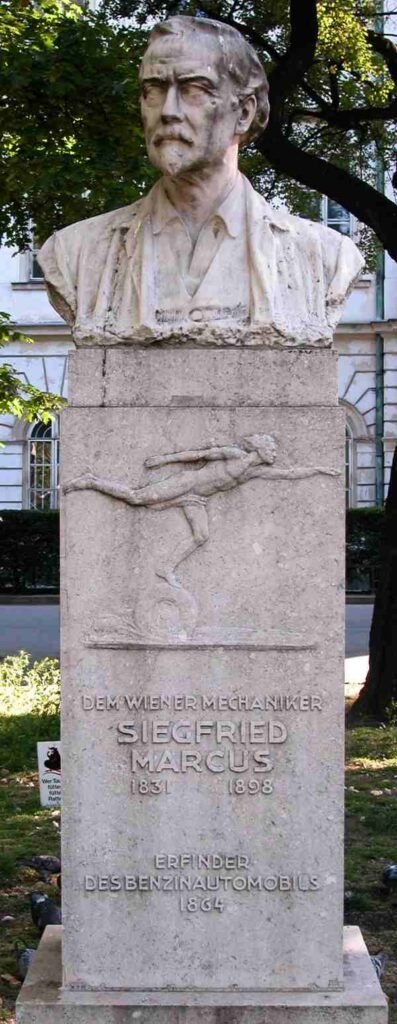
The other early dates are worse. The year 1864, carved on the Marcus monument in Vienna’s Resselpark, goes back to a 1901 magazine article by Ladislaus Jonasz, the first Fiat director in Vienna and later an executive at Austro-Daimler, who relied on a workshop hand named Blum. Blum had joined Marcus in 1864 and claimed the car was already standing there. The year 1866 comes from a ride described by Albert Curjel, who wrote it down in 1904, about thirty-five years after the fact, in an account with demonstrable mistakes elsewhere.
None of this stopped the myth from going international. In 1950 The Times of London ran a story calling the car an 1875 machine and the first gasoline road vehicle. The Encyclopaedia Britannica still gives 1864 for his first car. And the ASME still prints circa 1875.
Here is the part that matters most. Marcus never applied for a patent on an automobile, never held one, and never claimed to have invented the car. The guy with dozens of patents left that one alone. The claim was made for him, after he was dead, by people who had a museum piece to promote.
The American mirror: Selden
If that sounds strange, Americans have the reverse case on file.
On 8 May 1879, a Rochester patent lawyer named George Selden filed for a patent on a “road engine” driven by a liquid hydrocarbon engine. He had no working car. He spent sixteen years stalling the application with legal maneuvers until the market was ready, and on 5 November 1895 he got US Patent 549,160. He sold the rights in 1899, and a cartel of manufacturers, the Association of Licensed Automobile Manufacturers, paid royalties on every car they built. Henry Ford refused. The fight ran eight years and produced a 14,000-page court record. Selden won the first round. Ford won on appeal on 10 January 1911, when the court ruled that real cars ran on Otto’s four-stroke design, not on the Brayton engine Selden had drawn.
So the US had a man who patented the automobile and never built one. Vienna had a man who built automobiles and never patented one. One got rich off royalties, the other ended up as a stamp and a monument that got torn down.
The letter of 4 July 1940
The stamp came in 1937. The Austrian Harand Movement Against Racial Hatred, an anti-Nazi group led by Irene Harand, printed a series of stamps honoring Jews who had contributed to humanity. They did it in response to “The Eternal Jew”, Julius Streicher’s antisemitic exhibition in Munich. Marcus was in the series, credited with inventing the gasoline car.
In March 1938 Germany annexed Austria. The Marcus memorial in front of Vienna’s Technical University came down. In June 1938 the Nazi liquidator of the Austrian Automobile Club handed the car to the Technical Museum as a so-called donation. In 1958 the ÖAMTC, the club’s legal successor, established that this “donation” amounted to seizure by a Nazi institution, and in 1962 a settlement returned ownership to the club, which agreed to leave the car at the museum on permanent loan. You’ll also read that museum staff bricked it up behind a fake wall to save it. That version isn’t in the restitution record, which describes a confiscation dressed up as a gift. English Wikipedia says only that the car “had been hidden”. Nobody has produced a document for the wall.
Then there’s the paper that settles the German side. It’s dated Berlin, 4 July 1940, from the Reich Ministry of Public Enlightenment and Propaganda, reference S 8100/4.7.4.0/7 1, addressed to the board of Daimler-Benz AG in Stuttgart-Untertürkheim. The subject line reads “Eigentlichen Erfinder des Automobils”: the actual inventor of the automobile. It answers a letter from Daimler-Benz dated 30 May 1940. It says the Bibliographisches Institut and the publisher F. A. Brockhaus had been told that from now on Meyers Konversations-Lexikon and the Große Brockhaus, the two big German encyclopedias, would name Gottlieb Daimler and Carl Benz as the creators of the modern motorcar, and not Siegfried Marcus.
Read it carefully, because people get it wrong in both directions. We have the ministry’s reply. We don’t have the company’s letter of 30 May, so we don’t know exactly what Daimler-Benz asked for. What we know is that the company wrote to Goebbels’ ministry on the subject of who invented the car, and got back a promise that the Jewish candidate would be removed from the encyclopedias. Carl Benz had died in April 1929. Gottlieb Daimler had died in March 1900. Neither of them took part. The company carrying their names did.
And it worked. Marcus disappeared from German reference books, textbooks and classrooms. After the war the monument went back up and historians put his name back in. Then, in 2000, the book that buried the 1875 myth for good, Horst Hardenberg’s Siegfried Marcus, Mythos und Wirklichkeit (“Myth and Reality”), came out in the scientific series of the DaimlerChrysler corporate archive. The Austrian Academy of Sciences named it book of the month in June 2001. The same corporation that asked the Nazis about the inventor of the car in 1940 paid sixty years later for the research that showed Marcus wasn’t first. The research is solid. You can decide for yourself how you feel about who paid for it.
Spain’s own first-car mess
Spain has its own version of this mess. In 1889 a Barcelona textile industrialist named Francesc Bonet saw Daimler engines at the Paris World’s Fair, bought one, shipped it home and filed a Spanish patent on 12 December 1889 for vehicles driven by explosion engines. The three-wheeler he built around it, dated 1889 or 1890 depending on the source, is shown in replica today at the Catalan national science and technology museum as the first internal combustion vehicle built on the Iberian peninsula. A few years later another Barcelona man, Emilio de la Cuadra, tried to build cars in series and set up what is considered Spain’s first car factory. Spain’s first license plate, PM-1, went to a Clément quadricycle with a 2 hp De Dion-Bouton engine in Palma de Mallorca in October 1900. Some sources say the 31st, others the 11th. Madrid and Barcelona didn’t register their first cars until 1907. Look closely in any country and “the first car” stops meaning anything.
NEC verdict
John Nixon of The Times wrote in 1938 that Marcus’ cars were experimental and impractical and that Benz was the one who took the idea into production. That’s still the fairest line on the case, and it costs Marcus nothing. He built an engine-driven cart in 1870, a working magneto ignition in 1883 and a car that still exists from 1888. He did good, careful engineering, and that’s a strong record without any invented date.
The Reich took his name out of the books because he was Jewish, and a German car company was involved. His defenders put it back with a date that was made up, which made him look like a fraud the moment anyone checked. Then the corporate heir of the company that wrote to Goebbels’ ministry published the book that corrected his record. Marcus himself never claimed any of it, and he’s the one who keeps getting judged for it.
Check you’re still alive.
Photos: Second Marcus Car at the Technisches Museum Wien, Herbert Ortner (CC BY 4.0); Karlsplatz monument, GuentherZ (CC BY-SA 3.0); 1870 handcart, portrait of Marcus and engine of the second car, public domain. Via Wikimedia Commons.