Ferrari F12: The Car That Killed the Gear Lever
Several articles in this series have been following a countdown. Here it reaches zero.
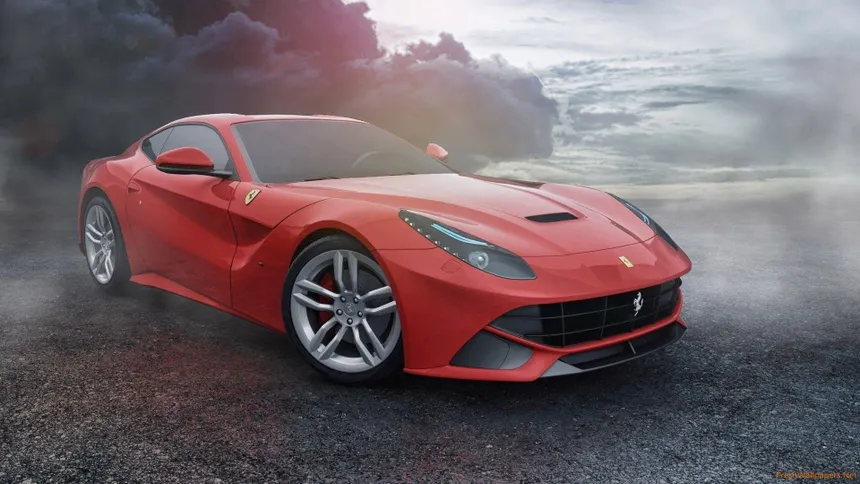
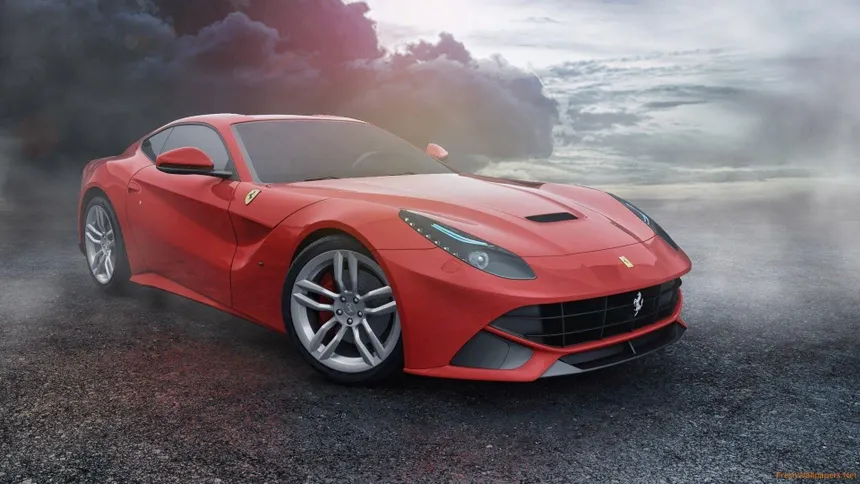
The F12berlinetta is the first Ferrari twelve-cylinder that did not offer a manual gearbox even as an option. Not one car. The 599 we covered in its own piece stands permanently as the last V12 Ferrari with three pedals, and this is the car that shut the door on it.
Fourteen years later, Ferrari has opened it again. That comes at the end.
The full countdown
It is worth seeing the whole curve, because it is one of the steepest in recent automotive history.
The F355 introduced Formula 1-derived paddles behind the wheel in 1997, and we covered it in that article as the cutting-edge option it was. The 550 Maranello was built entirely with the gated manual, 3,083 cars without a single exception. The 575M dropped to roughly 246 manuals. The 599 got down to 30, with chassis 187007 leaving the factory in 2012 with no announcement and no press release.
And the F12, launched that same year, did not offer it at all.
Fifteen years from the lever being the only thing available in the twelve-cylinder flagship to the lever disappearing from the order form. And the decision was never announced as a decision. It simply stopped being on the options list.
It debuted on the internet, on a day that does not exist
The F12 was shown for the first time on February 29, 2012, in an online unveiling, ahead of its public debut at the Geneva Motor Show.
A February 29. Ferrari chose the one day on the calendar that turns up once every four years to show its new twelve-cylinder, and did it over the internet instead of at a show. In 1992, as we covered in the 456 article, the company was launching models at a Belgian dealer’s birthday party. Twenty years later it did not need the show either.
The name needs little explanation: F12 for Ferrari and the twelve cylinders, with berlinetta stuck on the end in lower case, no space. It is the tenth entry in this series on naming, and the first to abandon displacement entirely.
The most powerful naturally aspirated engine Ferrari had built
The engine is the F140 FC, a 65-degree V12 of 6,262 cc with 200-bar indirect injection inherited from the Enzo.
It makes 740 hp at 8,250 rpm, with 690 Nm at 6,000 of which 80 percent is already there from 2,500, and it cuts out at 8,700. The figure that matters is specific output: 118 hp per liter, an absolute record for a naturally aspirated engine of this class at the time.
Compression went up to 13.5:1 and the crankshaft was completely redesigned to sit lower. The result is a V12 mounted 30 mm lower and further back in the chassis than in the 599 GTB Fiorano.
The complete package runs 0 to 62 mph in 3.1 seconds, 0 to 124 in 8.5, and beyond 211 mph.
Twelve different alloys
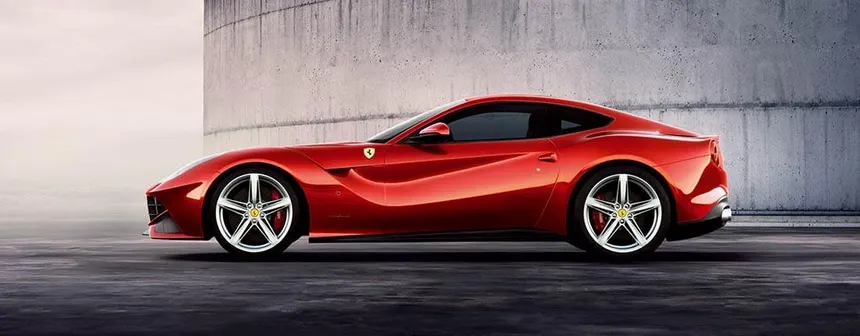
Scaglietti built the chassis and body using twelve different light alloys, some of them used in a car for the first time according to Ferrari, with new joining processes.
The result is 20 percent more torsional rigidity and 70 kg less than the 599, coming in at 1,525 kg dry with 54 percent of the weight over the rear axle.
This connects to what we covered in the 360 Modena article. That aluminum body developed with Alcoa opened the road, the 599 continued it, and the F12 takes it to the point of using a dozen different alloys depending on what each part has to do.
The Aero Bridge: using the hood to push the car down
This is the solution worth explaining, because it changes how you think about road car aerodynamics.
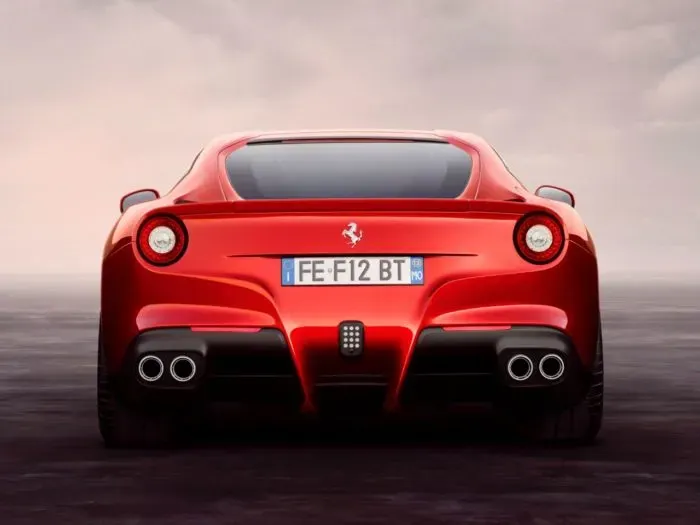
The Aero Bridge is a channel that begins at the hood and routes air over and through it, exiting through the front fenders toward the flanks. It is the first time a car’s hood has been used to generate downforce rather than simply cover things up.
The numbers back the invention. Overall aerodynamic efficiency reaches 1.12, double the 599 GTB Fiorano’s. Downforce rises 76 percent to 123 kg at 200 km/h. And drag drops to a coefficient of 0.299.
In the F355 article we covered how the flat floor with a diffuser came over from Formula 1 and generated downforce without wings. The F12 is the logical continuation of that idea, applied this time to the part of the car that had gone unexamined.
Fiorano, and the rival it carried inside
The F12 posted 1 minute 23 seconds at Fiorano, and at launch it was the fastest road-going Ferrari in history around that circuit.
The time it beat has a name and it is in this very series: the 1:24.0 set by the 599 GTO in 2010. Which means the car that killed the manual made its debut by beating the best of the generation that still offered one.
For context on what else you could buy, a McLaren MP4-12C made 600 hp at 1,509 kg, a Mercedes-Benz SLS AMG GT made 591 hp at 1,695 kg, and an Aston Martin DBS made 517 hp.
None of the three came close to the F12’s 740. That was exactly the message.
The engine debuted in another car
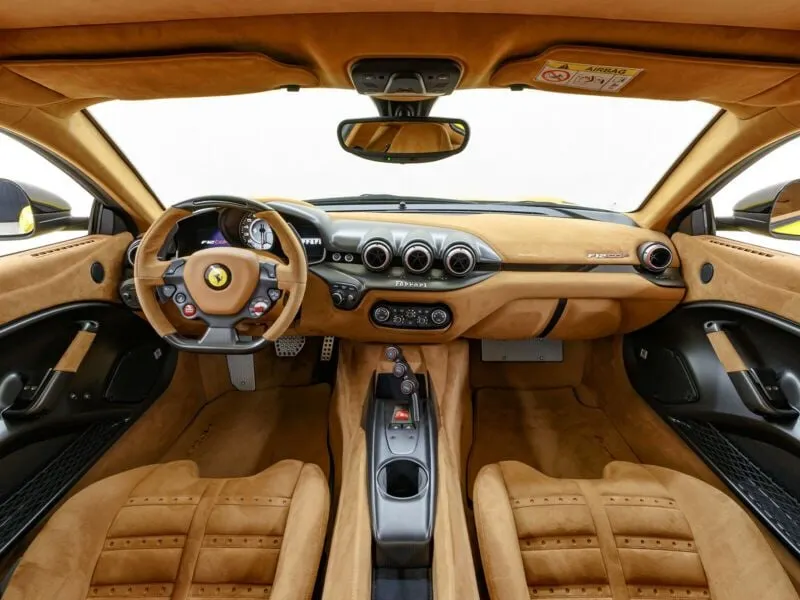
One piece of context that changes how you read the spec sheet: the F12’s V12 is not exclusive to it. It is the same 6,262 cc 65-degree block used in the Ferrari FF shown at the 2011 Geneva Motor Show, with 82 more horsepower.
The FF is the first production Ferrari with four-wheel drive, and a good share of the F12’s elements come from it. Which means the most powerful twelve-cylinder Ferrari had built to that point made its debut leaning on the engineering of a four-seat all-wheel-drive car, which is exactly the kind of Ferrari the company has spent decades pretending it does not build, as we covered in the 456 article.
The engine did not go unnoticed. In 2013 it took the International Engine of the Year award in the Best Performance category and Best Engine above 4.0 liters, and Top Gear magazine named the F12 Supercar of the Year 2012.
The brakes, which rarely get a mention
With 740 hp it is easy for the whole conversation to go to acceleration, and the F12’s most impressive number sits on the other pedal.
The car runs 398 by 38 mm carbon-ceramic discs at the front with six-piston calipers, and 360 by 32 mm at the rear with four-piston units. With those it stops from 62 mph in 30.5 meters and from 124 mph in 131 meters.
Stopping from 124 mph in under 131 meters in 2012, in a car weighing over 1,500 kg, is a figure that still holds up against almost anything today.
Production closed in 2017 and the 812 Superfast took over, on an identical 2,720 mm wheelbase.
The F12tdf, or how to manufacture a problem and sell the solution
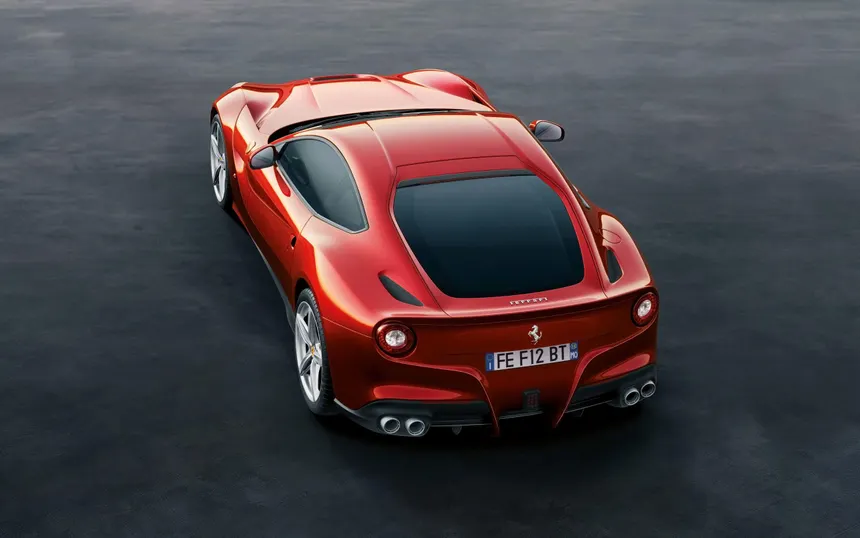
The extreme version arrived in 2015, the F12tdf, limited to 799 cars. The initials stand for Tour de France, the road endurance race Ferrari dominated in the 1950s with the 250 GT Berlinetta.
The numbers are brutal: 780 hp, 1,415 kg dry after shedding 110 from the standard F12, 230 kg of downforce at 200 km/h which is 87 percent more, aerodynamic efficiency of 1.6 and a Fiorano lap of 1 minute 21 seconds. Zero to 62 drops to 2.9 seconds.
But the interesting part is in the chassis, and it is a sequence worth reading slowly.
Ferrari wanted sharper turn-in, so it widened the front tire from 255 to 275 mm, the rim from 9.5 to 10 inches and the whole front track. More grip at the front means, inevitably, that the rear axle loses relative authority and the car steps out more easily.
Ferrari manufactured that problem deliberately. Then it fitted Passo Corto Virtuale, a rear-axle steering system, the first on a Ferrari twelve-cylinder, so the car would remain drivable by somebody who is not a professional. The rear wheels turn in the same direction as the fronts at high speed, virtually lengthening the wheelbase for stability, or in the opposite direction at low speed to shorten it and gain agility.
Now set that alongside what we covered in the 348 article.
In 1989 Ferrari released a car with a tendency toward abrupt oversteer and the press crucified it until it became the worst Ferrari ever built. In 2015 Ferrari engineered the oversteer on purpose, compensated for it with electronics, and sold all 799 cars at special-edition money.
The same behavior. Twenty-six years apart. And the real difference between the two stories is not the car. It is who controls the narrative.
The F12 TRS, which looks at the real Testarossa
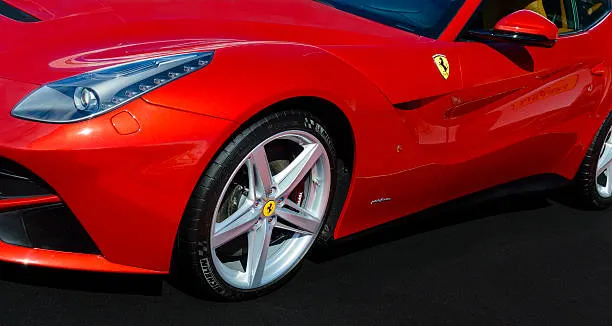
Special Projects produced the F12 TRS in 2014, a one-off roadster on the F12 platform explicitly inspired by the 1957 250 Testa Rossa, with a wraparound windscreen and a completely redesigned tail, keeping the standard V12.
Worth noting because this site has already dealt with the Testarossa of 1984, the one that borrowed that name without sharing a single bolt with the racing car, as we covered in its article. The F12 TRS is the other way of doing it: not taking the name, taking the shape.
What to check before buying one
The F12 is still an expensive car, but it is no longer at novelty money, and there are two things worth being clear about before sitting down to negotiate.
The first is that this is not a soft grand tourer for crossing states in comfort, however much the bodywork suggests it. It is a demanding car that asks you to select the softest suspension setting before setting off on any real road.
The second is the usual one for this brand and this series: a 740 hp Maranello twelve-cylinder does not have cheap maintenance just because the purchase price has come down.
And one market note that recurs across this family: on the 599 the value gap was set by the gearbox. On the F12 that does not exist, because every car is the same. What sets values apart here is the tdf against the standard berlinetta, and that gap is of a different order.
The verdict
This is the car where Ferrari decided the driver was surplus to the business of changing gear, and it had the technical argument to do it. A dual-clutch gearbox is faster, smoother and more efficient than any human with a lever. There is no argument available on the stopwatch.
Except that in July 2026, at the British Grand Prix, Ferrari presented the 12Cilindri Manuale. A limited series of 1,499 cars with an open-gate lever and a clutch pedal.
Only it is not a manual gearbox. It is the Manuale by-wire system: the lever and the clutch have no physical connection to the transmission. They are electronic inputs sending commands to the same eight-speed dual-clutch unit as the rest of the range. Underneath it all sits a mechanical module weighing under 3.5 kg, full of sensors and kinematic mechanisms, whose only job is to replicate the clicks, resistances and load variations a real manual would have. Get the synchronization wrong and the car jerks. Get it very wrong and it stalls.
Ferrari has built a machine whose job is to fake the imperfections of an earlier machine that Ferrari itself removed for being imperfect.
And there is what grates about all of this. Not that they fitted a fake lever, which as a piece of engineering strikes me as brilliant and will work better than the original. It is that they spent fourteen years selling the idea that the lever was an obsolete nuisance and now sell it as a 1,499-unit limited series.
The F12 killed the lever because it was slow. The 12Cilindri Manuale revives it because it sells. Both decisions are commercial, and only one of them was presented that way.
How many things Ferrari has told you were obsolete will come back the moment there is a queue to buy them?
Check you’re still alive.